In the crime writing world, the increasing number of conventions and events mean that there are many more opportunities for socialising between crime writers than was the case even when I started out as a published writer. As a result, one bumps into people from time to time who may not become close friends but who nevertheless prove to be pleasant acquaintances.
I'm sorry to say that a couple of people who fall into that category as far as I'm concerned have recently died. One is the novelist Raymond Flynn. Ray was taken on by Hodder & Stoughton two or three years before I joined their list and we met at a Dead on Deansgate conference in Manchester at the end of the Nineties. Ray also joined us, as far as I remember, for a very enjoyable Hodder author dinner at which those attending included those very interesting writers Andrew Taylor and Nick Blincoe. Andrew has of course gone on to great things in the crime world, while Nick Blincoe has not (as far as I know) stayed with the crime genre, but has moved on to other literary projects (and I gather he was also once an adviser to Nick Clegg...)
Ray inscribed for me a couple of his books, Busy Body and A Public Body, both of which featured DCI Robert Graham. He had been a career police officer in Nottinghamshire, and his experience strengthened the books. Like me and many others, however, he departed from the Hodder list, and I lost track of him in recent years, though I gather he continued to attend CWA regional chapter meetings in the West Midlands. He is, perhaps, a good example of an enjoyable mid-list writer who faded from sight all too soon because of the vagaries of the publishing world, rather than because of any lack of ability.
Another recent loss is that of Dorothy Lumley, often known just as Dot. I was quite shocked to hear of her passing. A former publisher, she was a literary agent whom I met at a few CWA events and also at the memorable Las Vegas Bouchercon. We once had a meal together and she told me she wanted to submit a short story for a future CWA anthology.I asked her about this a few times afterwards, but she never got round to doing it - too busy representing her clients, I think. She had a loyal set of writers on her books, including that very entertaining crime writer Amy Myers, and they will miss her greatly as agent and friend .
Thursday, 17 October 2013

Wednesday, 16 October 2013
The Tunnel - Sky Atlantic - TV review
The Tunnel, which made a very good start on Sky Atlantic this evening in the first of ten episodes, is an Anglo-French thriiller starring Stephen Dillane as Karl, an amiable British cop, and Clemence Poesy as Elise, his gifted and driven but difficult French counterpart. The case that brings them together starts with the discovery in the Channel Tunnel of a woman's body, exactly at the midpoint of the tunnel. Soon it emerges that the body has been cut in two, and then it turns out that the two halves belong to different women -one a controversial French politician, one a British prostitute.
This story is a re-make, it seems, of The Bridge, the highly acclaimed Scandinavian drama, but as I never saw The Bridge, I'm coming to it fresh. I suspect this is an advantage, given that comparisons are apt to be unflattering to re-makes. I started out by being unsure whether this was a series I'd want to watch beyond the first programme. Suffice to say that by the end, I was very much looking forward to the next instalment.
Dillane is very good, while Poesy is quite compelling, in a totally different role from her part in Birdsong. The script has quite a few witty moments, and some of the filming is quite beautiful. The storyline at this stage is suitably mysterious, with a rather nasty-seeming young British journalist receiving messages from the apparent killer, and enduring a rather memorable near-death experience while trapped in his car.
So, yes, I''ll be tuning in next week. And if The Tunnel maintains the high standard of the first episode, I feel strongly tempted to check out The Bridge as well..
Yvonne Eve Walus - guest blog
Tomorrow, I am planning a post about a couple of members of the crime fiction community who have died recently, but today there's something happier. I've never met Yvonne Eve Walus, which isn't too surprising, since she lives in New Zealand (a country that's quite high on my must-visit list, I might add), but she has contributed more than once to CWA anthologies that I've edited, and I've enjoyed her rather quirky and original approach to the short story form. As a result, I was more than happy to oblige when she offered to write a guest blog post in connection with her brand new novel. Here it is:
'It’s the eve of the release date for Operation Genocide and the first hate review is already in. As its author, I can’t help but feel a twinge of pride: the book is being slammed for being too liberal, too anti-apartheid, too anti-white. That’s a perfect breeding ground for controversy, if you take into account my very pale skin and my very pro-apartheid surname, and controversy is good. Controversy makes readers think. Controversial books are usually the ones that make a difference.
'It’s the eve of the release date for Operation Genocide and the first hate review is already in. As its author, I can’t help but feel a twinge of pride: the book is being slammed for being too liberal, too anti-apartheid, too anti-white. That’s a perfect breeding ground for controversy, if you take into account my very pale skin and my very pro-apartheid surname, and controversy is good. Controversy makes readers think. Controversial books are usually the ones that make a difference.
So, what is
Operation Genocide about? It’s about loving your country so much, you’re
willing to sacrifice your life, your sons, your principles and your basic
humanity. It’s about making difficult choices in impossible situations. It’s
about circumstances making either monsters or heroes out of ordinary people.
Too vague? Picture
this: South Africa 1982. The country is run by a white government voted in by
the white population. Other races are second-class citizens. White women do
have the right to vote, but they do not enjoy the same privileges as their male
counterparts: they need their husband or father’s permission to open a bank
account or buy a house. If they earn a wage, they are taxed in a higher tax
bracket than their husbands. Just like there are white-only bars, there are
men-only bars where women aren’t allowed to enter.
Imagine being a
wife in that setting. Imagine staying at home every day, chilling your
husband’s beer mug, looking after the children and keeping yourself pretty for
him. Imagine your shock when your husband’s murdered and you discover he was an
evil scientist plotting to solve the country’s racial problems with one dose of
a deadly virus. Imagine your shock when an anonymous note demands you burn the
secret files you don’t have. Oh, and meanwhile, you don’t have access to the
family bank account because you’re a woman.
Sound like your
type of book? Then try the excerpt on my website'.
Monday, 14 October 2013
Dinner with the Sherlockians - and the Gladstones
If, twenty years ago, you'd have told me that one day I'd not only be asked to deliver an after-dinner speech, but would accept the invitation and enjoy the experience. I wouldn't have believed you. For many years, I was a very reluctant public speaker, and although I did a lot of advocacy and gave quite a few legal lectures, public speaking was something I went to some lengths to avoid. I have always felt more comfortable away from the public eye, writing rather than talking. But times change, and life as an author has made me - gradually - increasingly confident about my public speaking. I'm still not a natural, but I cherish some of the kind speaker testimonials that I've put on my website, because this is a skill I've learned slowly and with some trepidation over a long period.
Quite out of the blue, the Sherlock Holmes Society of London approached me earlier this year. They were holding their annual conference in the North West, based at Gladstone's Library, and asked me to give the main speech. After a bit of hesitation, I said yes and started thinking about how to tackle the task. I decided to include in the speech a jokey pastiche of a Sherlock Holmes story, set at the Library and featuring William Ewart Gladstone himself. I ran it by a Sherlockian expert once I'd written it, but when I learned, a few days before the event, that the guests of honour were Sir William and Lady Gladstone, members of the great man's family who are still based at Hawarden Castle, I was a bit daunted!
I did feel a bit nervous, but the evening proved very enjoyable and I met some delightful people, including the Gladstones. And it's abundantly clear that Sherlock is as popular as ever. This Society alone (and there are others) has 1400 members, and the success of the recent films and Benedict Cumberbatch show has boosted numbers. Sherlockians are apparently very active on Twitter and I learned a great deal in pleasant company.
I've always been a Sherlock fan, but this experience has strengthened my enthusiasm especially since by coincidence, I've recently been commissioned to write an essay about Conan Doyle for a literary book to be published in the near future. I may well write another Sherlockian pastiche before long, time permitting, using an idea that came to me when I visitied a museum in Prague lsat year. And on the subject of speaking, the after dinner speech has led to another speaking invitation, this time to one of the Oxford University Societies. Again, something I never would have imagined, twenty or so years ago.
Friday, 11 October 2013
Forgotten Book - Fatality in Fleet Street
A recurrent theme of my blog posts about books of the past has been the great work done by a variety of small presses in resurrecting hidden gems from long ago. One of the newer kids on the block in this respect is Oleander, which recently set up a fresh imprint, London Bound. I'm hoping to cover another of their titles in this series before long, but today I want to focus on a particularly fascinating author and novel.
The writer is Christopher St John Sprigg, and the book is Fatality in Fleet Street, first published in 1933. When I spoke about the Golden Age at St Hilda's recently, a lady came to speak to me afterwards and said that her husband was a great admirer of Sprigg, and had been presented by Sprigg's family with copies of all of his detective novels. Lucky chap. They are rarities, and of genuine interest for their period feel. An added bonus is that Sprigg was himself was such a remarkable man.
He was only in his mid-20s when he wrote this book. He became better known as Christopher Caudwell, a poet and Marxist who was killed at the achingly young age of 29 fighting in the Spanish Civil War. I do not claim that his detective novels are masterpieces, but those I have read are definitely enjoyable. This one opens with an argument between a politician and a newspaper owner. Very topical, as I'm sure my British readers will agree!
The newspaper magnate, Lord Carpenter, is using his influence to stoke up anti-Russian feeling, despite knowing that war is bound to ensue. The Premier, Claude Sanger,is desperate to stop him. There's an echo here of Stanley Baldwin's battles with the Press, although Sprigg carefully sets his story in the near-future: Needless to say, Carpenter is murdered within hours. Could the Prime Minister be guilty? Or was it one of the many people at the newspaper who had good cause to hate Carpenter? Or even his betrayed wife?
It must be said that the story has too many characters, but even so I found it fairly easy to figure out the culprit early on (though the precise means was not clear to me). This didn't matter, because Sprigg compensates for a certain amount of clutter in his narrative with some very engaging scenes and several good lines. When you think of his youth, this book is a notable achievement and absolutely fascinating as a period piece. I'm delighted that this London Bound issue has enabled me to read it at last. Recommended.
Thursday, 10 October 2013
Italy and Crime Fiction

Like so many lovely places, Italy is a popular setting for crime stories, and I suppose the leading exponent of Italian detective fiction currently known to British readers is Andrea Camilleri, creator of Inspector Montalbano. As the years pass, I draw some comfort from the fact that he did not create his most successful character until he was nearly 70! Like Ellis Peters, he achieved international fame late in life,but it is well deserved. Camilleri comes from Sicily, a gorgeous island I've enjoyed visiting twice, but during my recent holiday I concentrated on exploring the north of the country, and spent a day with Italian friends in Florence.


Florence is the setting for the books by the late Magdalen Nabb, possibly my favourite British author of crime novels set in Italy.The fabulous Duomo also earns a thought-provoking mention in Harlan Coben's Stay Close, which I'm reading in the moment, though that book is firmly set in the US. Flroentine daggers were popular murder weapons during the Golden Age in particular, but I resisted any temptation to invest in one of my own whilst I was in the city.
My visit reminded me that it's a long time since I read any of the Zen novels by the late Michael Dibdin. One I never read was Back to Bologna, but that's now zoomed up the to-read list. I can't recall if he set any of his stories in any of the smaller, but quite breathfaking, places within easy reach of Bologna. Modena, for instance, is famous for its cathedral, and I was also struck by the nearby 'haranguing stone', an elevated slab in the piazza on which wrongdoers were placed to face public opprobrium.


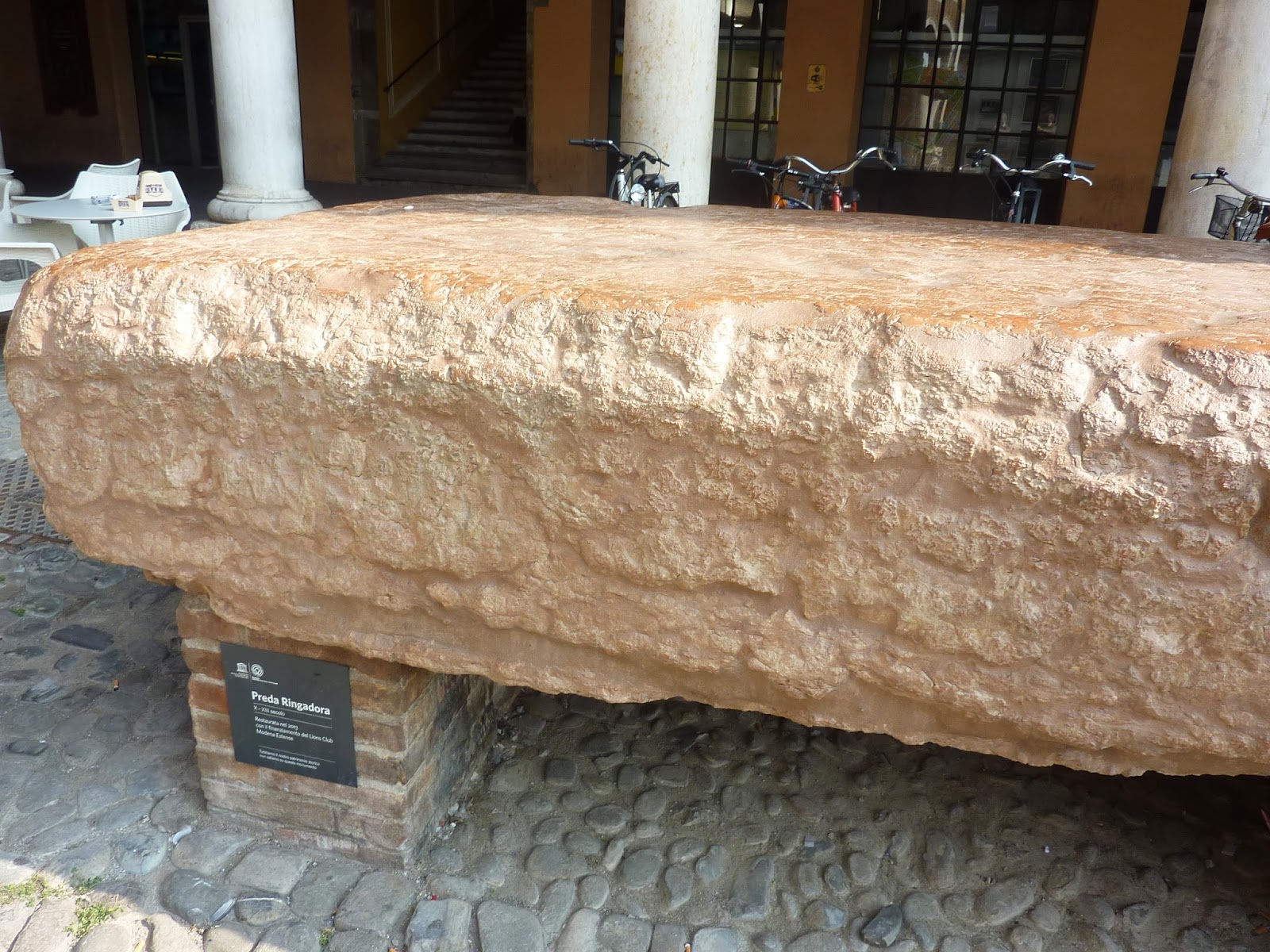
Ferrara is, to my mind, even more impressive, with its terrific moated castle,grassed ramparts and a host of wonderful sights. As I was walking round, the idea for one of the two short stories I mentioned in my blog post yesterday came to mind.


Finally, Ravenna. It's famous for its mosaics, and these really are dazzling. The old mausoleum and the archaeological museum, with its ivory throne, are among countless sights packed in to a small area, easily walkable. You can also find Dante;'s grave and an interesting exhibition, which gave me a much better understanding of his work (perhaps I should read Dan Brown's Inferno too?) Dorothy L. Sayers translated and admired Dante, but I don't know if she ever visited Ravenna. If so, I'm sure she was impressed. Like Ferrara, it would make a terrific setting for a detective novel, and I'm sure that some writers have already made good use of it. I look forward to tracking down one or two examples.


Wednesday, 9 October 2013
Back from Bologna


You could spend a lot longer than a few days there, just marvelling at the history and architecture as well as the culture, the often hidden canals, and of course the food.In terms of sightseeing, first stop was the impressive library in the Piazza Maggiore. It's unique in that you can also visit the ancient Roman ruins and the old town that lie beneath the building, some of which can be seen through panels in the floor at ground level. And then it was on to the Whispering Gallery, Eataly (a combination of bookshop and restaurant that stocked loads of Golden Age classics and served very good food) and the amazing Teatro Anatomica, where public dissections used to take place. Spot the dissecting table in the photo!

The Basilica of San Luca stands just outside the old city walls, at the top of a hill that can be reached via a walkway with 666 arches - a very stiff climb in searing heat, and I confess I opted for the little train that wove through the city streets before tackling the hill. The result was spectacular views, enjoyed without being exhausted. Just as well, since there was lot of walking to be done, both in Bologna and in the other towns within easy reach by train.


Despite Italy's economic problems, Bologna seems a pretty affluent place and I was pleasantly surprised by the number of bookshops, even by the standards of university cities (incidentally, there were also loads of bookshops in Budapest, but my Hungarian is even worse than my Italian!). Reading does seem to be enormously popular in Italy and tomorrow I'll say a bit more about Italian crime fiction. I did manage to get some reading done, mainly on the plane and train trips, but the real focus was on discovering a part of the world that seems to me to have enormous appeal. I'm also pleased to say that Bologna gave me two brand new ideas for short stories, though with my current schedule, I'm not quite sure when I'll get round to writing them.


Finally, a special word of thanks to the Bologna tour guide, namely Catherine Edwards, a linguist who is dividing her year abroad between Bologna, Rome and Berlin, lucky thing. An aspiring journalist who has already worked on a number of publications, including The Big Issue, for which she reviewed Harlan Coben's latest, she has just started her own blog, Bologna to Berlin. Biased as perhaps I am, I think makes very interesting reading and it will be featuring on the blogroll shortly.

Monday, 7 October 2013
Ellis Peters and Wellington Literary Festival
This year sees the centenary of the birth of Edith Pargeter, better known to crime lovers as Ellis Peters, the creator of Brother Cadfael. Although she often travelled abroad, set many books overseas, and was a noted translator of works written in Czech, she was first and foremost a woman of Shropshire, the county where she was born and spent nearly all her life, and which featured in many of her best books. Pleasingly, Wellington Town Council in Shropshire decided to celebrate her at its Literary Festival this year and I was honoured to be asked to be the guest speaker, discussing her life and work.
I imagine the invitation stemmed in part from the fact that I edited a collection of obscure Peters stories for a book published by Crippen and Landru some years ago, The Trinity Cat, and in part from the fact that I've written about her work on a few occasions, for instance in Following the Detectives, edited by Maxim Jakubowski. So I was glad to accept, although as I journeyed down the M6 to Wellington through ghastly traffic, I reflected that travel hasn't improved as much as it should since Cadfael journeyed around in the twelfth century.
One thing that impressed me enormously was the venue for the Festival. This is a large and recently built leisure centre which includes a public library, and much else besides. The very pleasant town councillor who introduced my talk was clearly proud of the centre, and quite right too. This is exactly the sort of project that provides tremendous benefits to a community, and my impression was that the facilities are well used and much appreciated.
Putting a library together with other leisure resources may sometimes be complicated and far from cheap, but the social dividends can be hugely rewarding if it is done well (in a more modest way, it's been done in my home village,Lymm, and again the results have been admirable.) In the 21st century, when maintaining social cohesion is, in many ways, as important as ever it has been, a high calibre venue such as this brings people together and ensures that events like the Literary Festival are not only possible but likely to be successful and greatly valued.
The festival committee had certainly done a good job in getting an eclectic list of speakers: it's not often that Germaine Greer and I are metaphorically rubbing shoulders in the same programme. Although I've visited nearby Ironbridge before, I 'd never stopped in Wellington previously, but I was really struck by what the local people, and their authority, have created. And I'm sure Edith Pargeter would have been impressed as well.
Friday, 4 October 2013
Forgotten Book - Cicely Disappears


Today's Forgotten Book is one that I'm fairly confident few readers of this blog will have encountered. What's more, it was written by one of the finest novelists of the Golden Age. It's a fabulous rarity,conceivably the most sought-after of all Golden Age mysteries, and I was lucky enough to be loaned a dust jacketed copy in superb condition. I've no idea how much it was worth, but quite a bit, and you can be sure I took good care of it before returning it to its owner.And for good measure, it is a novel with a curious history. What's not to like? Well.....
The book is Cicely Disappears, and the author is A.Monmouth Platts. Now, if that name is unfamiliar to you, I should add that it's a pseudonym, composed of the names of two houses owned by Anthony Berkeley Cox, whose much better known pen-names were Anthony Berkeley and Francis Iles. Regular readers of this blog will be well aware that I'm a fan of Berkeley-Iles. He really was an interesting writer.
This particular story began life as a serialisation published by The Daily Mirror, of all newspapers,under the by-line of A.B. Cox. The Mirror ran a competition with prizes for those who guessed the solution correctly.The story was at that stage called The Wintringham Mystery, and Tony Medawar, a great researcher into the Golden Age, published a piece in CADS some time ago explaining that Agatha Christie's husband Archie was one of the runners-up. Did Agatha enter the competition under Archie's name, I wonder?
Berkeley made some changes to the story, and published it as a novel under his new pen-name a year later. So, what of the story? It's a book of legendary rarity, but I am afraid I think this is a case where obscurity is deserved. Really, the changes to the story are largely padding, and the mystery of Cicely's fate is dragged out in a way that tempts one to skip to the end. I'm so glad I have had the chance to satisfy my curiosity by reading this particular forgotten novel, but I'm afraid the final verdict is that those who are less fortunate are not really missing out. The books that appeared under the Berkeley and Iles names are infiinitely better.
Wednesday, 2 October 2013
The Running Heroine - guest blog by Jessica Mann
The competing merits of stand-alone and series crime novels is a topic of perennial interest, and I'm delighted to say that Jessica Mann is today contributing a guest blog on this very topic.
"Off the top of your head how many crime writers can you think
of whose books are all stand alone? In fact, can you think of any? Because even
those who started with one-offs usually move on to re-using the same
characters, as HRF Keating, did when the first Inspector Ghote followed five
stand-alones. Authors can be bored by their running heroes, as Christie seemed
to become with Poirot. Lindsey Davis and
Val McDermid both gave themselves breaks
recently , each writing a one-off novels, but then returned to their series
characters, in, almost by definition, “series places”.
Other writers feature not so much series as recurring places
and people. One is Michael Gilbert, of whom Martin Edwards wrote , “It is a
feature of this author’s work that he regularly created fresh and engaging
characters who would pop up in various novels and short stories, without any
one achieving dominance.” Characters, and places: having adopted Thomas Hardy’s
cathedral city of Melchester in his first book, Close Quarters, he revived
that scene of crime thirty years later
in The Black Seraphim.
I enjoy these surprise encounters even more than meeting reliable old favorites. It
was fun when Margery Allingham’s Amanda
Fitton, introduced in one
of the early, more light-hearted crime
novels, reappeared half a dozen books
later in The Fashion In Shrouds, after which she’s a fixture. Agatha Christie’s
return to Hercule Poirot in her last book, Curtain,
is in a different category, as she wrote
the book many years earlier and put it aside for later publication.
Minor characters reappear in my own books; and some are connected by series heroines. Professor Thea Crawford, reluctant detective in The Only Security and
Captive Audience, plays a small part in subsequent novels featuring her former pupil,
the archaeologist Tamara Hoyland. Both of them know Dr
Fidelis Berlin, introduced in A Private
Inquiry, and taking a minor role in Under
A Dark Sun and a major one in The Voice From The Grave.
The heroes and
heroines of crime fiction often grow up
(as Margery Allingham’s Albert Campion did)
even reach retirement age, like Ian Rankin’s Rebus, but they usually remain
vigorous and influential, as did Ngaio Marsh’s Alleyn. Very few detective heroes grow realistically old, though Ruth Rendell’s
Wexford, Peter Dickinson’s Pibble and
Hercule Poirot do.
And I hope the septuagenarian Fidelis is credible in my new book, Dead Woman Walking. One of its minor characters, a young Isabel Drummond, is revived forty years after her first
appearance in A Charitable End. It was
my first novel – so perhaps it no longer counts as a stand-alone."
Subscribe to:
Posts (Atom)