Showing posts with label Carol Reed. Show all posts

Friday, 9 June 2023

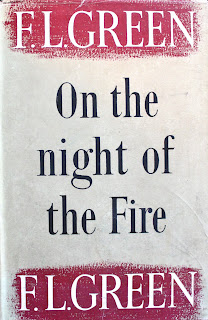
Forgotten Book - On the Night of the Fire


If you're looking for 'cosy' escapism, you'd probably better give F.L. Green's On the Night of the Fire a miss. This book, published in 1939, reads almost as if it was written to demonstrate that crime fiction of the 30s was not all about nostalgic make-believe. It's a doom-laden tale and was the basis of a film released in 1940 and also known as The Fugitive, which has been claimed as the first British film noir. The movie starred Ralph Richardson.

Frederick Laurence Green (1902-53) was born in Portsmouth and died in Bristol, but after marrying an Irish woman spent much of his life in Belfast - and he was himself of Irish descent. He is perhaps best known as the author of Odd Man Out, filmed by Carol Reed and starring James Mason, but it was his second novel, On the Night of the Fire, that made his name. It's the only crime novel I can think of in which the protagonist is a barber.

The book is a sort of  'inverted mystery' in that we follow Wal Kobling's journey from petty thief to burglar to murderer, but there is no puzzle element in the story. And it must be said that the events of the book are as bleak as the drab back streets of the unnamed port town (scenes for the film were shot in Newcastle) in which it is set. This isn't a mystery that will cheer you up. But it's well-written and compelling and Francis Iles (a very good critic as well as a very good writer) was among those who approved.

Green's literary style, on the evidence of this book, is interesting. His material is sensational but he handles it in an almost relentlessly unsensational way. To an extent I was reminded of Patrick Hamilton, but that's mainly because of their shared fascination with the tawdry side of life. I'm not sure I'm 'selling' this book very well, but I must say that I found it distinctive and powerful and whilst it won't suit everyone, I'm very glad I read it. 


Wednesday, 17 October 2018

The Running Man - 1963 film review

The Running Man is a film I've wanted to watch for a long time, and thanks to the Talking Pictures channel, I've finally caught up with it. The reason for my interest was that, many years ago, I read the novel on which the movie is based - The Ballad of the Running Man by Shelley Smith, an author I've discussed several times on this blog, as well as in The Story of Classic Crime in 100 Books. What I hadn't realised was that the screenplay was written by John Mortimer, in itself a recommendation.

As well as the ingredients of a good source novel and a good scriptwriter, the film also benefited from a first-rate cast, a good director (Carol Reed) and a theme tune by Ron Grainer. Yet it wasn't a big success - some people claimed that this was because the two stars were Laurence Harvey and Lee Remick and in the wake of the JFK assassination, "Lee" and "Harvey" had unfortunate connotations. Hmmm....Anyway, I found it a very watchable piece of work, quite tense at times, although also rather low-key.

In essence, it's an insurance scam story. Harvey plays Rex Blake, charismatic but reckless, a glider pilot who feels he's been cheated by an insurance company, and that this entitles him to commit fraud by faking his own death. So it's a "Canoe Man" type of story, but with a glider substituted for a canoe. Alan Bates plays the insurance investigator who seems to suspect that something is amiss - but the pay-out is made.

Rex resurfaces in Spain, under a false identity, where his wife (Remick) joins him. All seems to be going well until Bates suddenly turns up. What is his game? A cat-and-mouse story ensues, and I thought Mortimer maintained the suspense pretty well until the end. The novel was published in 1961, when Smith was at the height of her powers, but she only published two more books, both in the 1970s, and neither made any great impression. I've always been puzzled by this, and I'd love to learn more about why her career fizzled out in this way.