Robert Altman's acclaimed and award-winning 2001 film Gosford Park is a whodunit that isn't really a whodunit. The first time I watched it, rather naively I focused on the whodunit aspect of the story and the plot, and found the film enjoyable but not quite the masterpiece it was supposed to be. Now I've taken another look at the DVD version, which includes some useful bonus features, and I'm even more impressed than I was originally.
Really, Altman took the idea of a Golden Age whodunit in a country house setting and used it as a context for a story about the class divide in the age of masters and servants. More or less everything is seen from the perspective of "below stairs", and the amateur detective work, such as it is, is undertaken by a servant. There's a lot of humour in Julian Fellowes' script, and there are many nice observations. I've never watched Downton Abbey, but there's no doubt he's a talented writer.
There is a large ensemble cast, and one of the doubts I had about the film originally is that this means that many of the characters are undeveloped. A large cast also makes it difficult to care about many of the suspects, and the plot of the story isn't its strong point, though there is a pleasing and inventive use of tropes such as the body in the library, the double killing, and impersonation. Stephen Fry's police inspector is amusing but buffoonish, perhaps excessively so.
As for that cast - wow! Michael Gambon, Maggie Smith (in brilliantly waspish form as the Countess of Trentham), Kristin Scott Thomas, Charles Dance, Tom Hollander, Geraldine Somerville, Jeremy Northam (as Ivor Novello!), Helen Mirren, Kelly Macdonald, Laurence Fox, Alan Bates, Clive Owen, Derek Jacobi, Emily Watson, Eileen Atkins, Richard E. Grant...There's a lot of pleasure to be had from simply watching such stars in action. I can recommend this DVD; it's definitely a film worth watching more than once.
Showing posts with label Julian Fellowes. Show all posts
Showing posts with label Julian Fellowes. Show all posts
Wednesday, 6 February 2019

Sunday, 17 December 2017
Crooked House - Channel 5 TV review
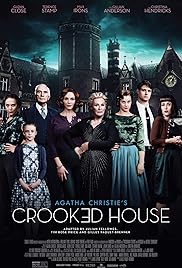
I'm not quite sure what to make of Crooked House, Channel 5's brand new version of Agatha Christie's 1949 stand-alone novel, the credits of which rolled a few minutes ago. But then, my feelings about the book, which I read as a teenager, are also equivocal. I'll always be a Christie fan, and the Queen of Crime herself made clear that this was a favourite among her novels. And yet...
All those years ago, I felt there were two problems with the book. First, there are just too many possible suspects in the death of Aristide Leonides, one of those nasty, rich old men who were constantly bumped off in Golden Age detective novels. Second, the detective, Charles Hayward, is insufficiently memorable. No wonder, I've always thought, that Christie never wrote another novel about him. On the other hand, the solution to the puzzle is an exceptionally daring example of Christie's commitment to the concept of the "least likely person" as culprit.
The same pros and cons apply to the TV film. The cast is stellar, almost inevitably: Glenn Close, Gillian Anderson, Terence Stamp (improbably playing a Scotland Yard detective), Amanda Abbington, et al. Julian Fellowes, no less, had a hand in the script (I'd like to think he wasn't responsible for the anachronisms in some pieces of dialogue). But we had so little time to appreciate all the cameos. And Max Irons, son of Jeremy, was competent but not charismatic as Charles Hayward, now reinvented as a down-on-his-luck private eye. I found the background music weirdly intrusive at times, and I was confused about when the story was meant to be set. The references to Ruth Ellis and some other oddments suggest that it had been moved to the second half of the Fifties. But if that was so, I've no idea why it was done.
Nevertheless, there were aspects that I enjoyed. This version brought out the darker aspects of Christie's worldview, and even if this was done simply because darkness is fashionable, I felt it was the right direction to take this particular story, which is grim rather than jolly. And the finale, much changed from the book's, struck me as very effective, given that the shock twist is rather hard to take. I'd be interested to hear what other viewers made of it all. .
Monday, 13 October 2014
Nigel Balchin and Better Dead
I can't quite believe it, but it seems to be more than five years since I last mentioned Nigel Balchin on this blog. At one time of day, Balchin was a big name, a high calibre writer who wasn't afraid to write commercial and popular fiction, and who seemed to reap the rewards. Yet nowadays he seems to be forgotten by most people. I guess the last time his name was in the spotlight was almost ten years ago, when Separate Lies was released - a film written and directed by Julian Fellowes, and based on Balchin's book The Way Through the Wood.
I've been interested in Balchin since my teens, and for a very specific reason. It so happened that by chance, when my parents were out, I watched a Saturday evening drama on television that was a detective story. I found it engrossing, and I was especially struck by the memorable final twist. The show was called Better Dead, and it was really a sort of Golden Age mystery, updated to the Sixties. Ron Moody, a wonderful actor, played the amateur sleuth. Because I was the sort of teenager who notices these things, I spotted on the credits that the play was written by Nigel Balchin (I know, teenagers shouldn't care about credits, but I always wanted to know about writers, not actors or celebrities...)
Having enjoyed Better Dead very much, I set out to find what else Balchin had written. A good friend of mine told me about a novel by Balchin that he happened to have read - the excellent Seen Dimly Before Dawn - and I soon discovered Balchin's masterpiece, The Small Back Room, a thriller about a bomb disposal expert, as well as other books like Darkness Falls From the Air. None of these, however, were whodunits, and after a while, I drifted away from Balchin, though I've always admired his writing.
In recent times, I've come into contact with Derek Collett, who has set up an excellent website about Balchin, and has also written a biography of the author, which I very much hope will be published before too long - I'm dying to read it. I've quizzed Derek about Better Dead - he hasn't seen it, though he's shared with me what he knows about it - and I have started wondering if I'm the only person, after all these years, who has any memory of it. I now think that Balchin was toying with the idea of writing a Golden Age TV series featuring Moody's character - but it didn't happen, because he died, and in fact Better Dead seems to have been the last thing he wrote. What I'd really love to do is to track down the script - but it seems the family don't have a copy, and Anglia TV, which produced the original show, is no more. If any reader of this blog can point me in the right direction to find the screenplay, or more information about it, I'd be most grateful.
.
I've been interested in Balchin since my teens, and for a very specific reason. It so happened that by chance, when my parents were out, I watched a Saturday evening drama on television that was a detective story. I found it engrossing, and I was especially struck by the memorable final twist. The show was called Better Dead, and it was really a sort of Golden Age mystery, updated to the Sixties. Ron Moody, a wonderful actor, played the amateur sleuth. Because I was the sort of teenager who notices these things, I spotted on the credits that the play was written by Nigel Balchin (I know, teenagers shouldn't care about credits, but I always wanted to know about writers, not actors or celebrities...)
Having enjoyed Better Dead very much, I set out to find what else Balchin had written. A good friend of mine told me about a novel by Balchin that he happened to have read - the excellent Seen Dimly Before Dawn - and I soon discovered Balchin's masterpiece, The Small Back Room, a thriller about a bomb disposal expert, as well as other books like Darkness Falls From the Air. None of these, however, were whodunits, and after a while, I drifted away from Balchin, though I've always admired his writing.
In recent times, I've come into contact with Derek Collett, who has set up an excellent website about Balchin, and has also written a biography of the author, which I very much hope will be published before too long - I'm dying to read it. I've quizzed Derek about Better Dead - he hasn't seen it, though he's shared with me what he knows about it - and I have started wondering if I'm the only person, after all these years, who has any memory of it. I now think that Balchin was toying with the idea of writing a Golden Age TV series featuring Moody's character - but it didn't happen, because he died, and in fact Better Dead seems to have been the last thing he wrote. What I'd really love to do is to track down the script - but it seems the family don't have a copy, and Anglia TV, which produced the original show, is no more. If any reader of this blog can point me in the right direction to find the screenplay, or more information about it, I'd be most grateful.
.
Monday, 8 September 2014
The Tourist - movie review
Any film set mainly in Venice has an in-built appeal to audiences, and The Tourist, released four years ago, boasts excellent scenes set in that loveliest of cities, as well as a terrific cast. This is headed by Angelina Jolie as Elise Ward, and Johnny Depp as Frank Tupelo, and also includes Timothy Dalton, Steven Berkoff, and Rufus Sewell. Add to that a screenplay whose writers include Julian Fellowes and Christopher McQuarrie, and you have a sure-fire hit on your hands. Or do you?
When I watch a relatively recent film, I like to do so without knowing too much about it, so I can approach it without preconceptions. After I'd seen The Tourist, I was intrigued to find that there has been extensive debate as to whether it's a comedy, a romance or a thriller, as I too struggled to work out what kind of a film I was watching. To some extent, it doesn't matter, as long as you enjoy the film, and I did enjoy The Tourist. But I did feel that some unevenness of approach meant it wasn't quite as successful as it might have been. It was as if the film-makers couldn't make up their minds what they were creating.
The set-up is that Jolie is being watched in Paris - we gather, by British cops - because she has connections to a villain called Alexander Pierce. She receives a message from Pierce telling her to take a train to Venice, and pretend that a stranger bearing a resemblance to Pierce is the man himself. This she does, leading to an encounter with an American maths teacher played by Depp. From there, the complications increase.
There were some fun moments along the way, and some nice twists as well, although I found it hard to suspend disbelief. Berkoff plays a nasty gangster in an enjoyably over the top way, but some of the tension depends on the stupidity of one of the cops (Paul Bettany) and I found this hard to swallow. The Tourist has received very mixed reviews, but as long as one expects from it nothing more than pleasing light entertainment, I don't think it disappoints. Not a classic, but not a bad way to spend a relaxing hundred minutes.
When I watch a relatively recent film, I like to do so without knowing too much about it, so I can approach it without preconceptions. After I'd seen The Tourist, I was intrigued to find that there has been extensive debate as to whether it's a comedy, a romance or a thriller, as I too struggled to work out what kind of a film I was watching. To some extent, it doesn't matter, as long as you enjoy the film, and I did enjoy The Tourist. But I did feel that some unevenness of approach meant it wasn't quite as successful as it might have been. It was as if the film-makers couldn't make up their minds what they were creating.
The set-up is that Jolie is being watched in Paris - we gather, by British cops - because she has connections to a villain called Alexander Pierce. She receives a message from Pierce telling her to take a train to Venice, and pretend that a stranger bearing a resemblance to Pierce is the man himself. This she does, leading to an encounter with an American maths teacher played by Depp. From there, the complications increase.
There were some fun moments along the way, and some nice twists as well, although I found it hard to suspend disbelief. Berkoff plays a nasty gangster in an enjoyably over the top way, but some of the tension depends on the stupidity of one of the cops (Paul Bettany) and I found this hard to swallow. The Tourist has received very mixed reviews, but as long as one expects from it nothing more than pleasing light entertainment, I don't think it disappoints. Not a classic, but not a bad way to spend a relaxing hundred minutes.
Subscribe to:
Posts (Atom)