Showing posts with label Philip Gooden. Show all posts

Monday, 7 March 2022

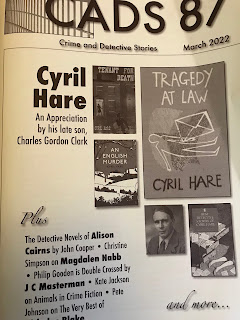
CADS 87


One of the beauties of Geoff Bradley's magazine (or fanzine) CADS is that you never quite know what each new issue will bring. There are contributors who feature regularly, such as Marv Lachman, Liz Gilbey, Mike Ripley,  Philip Scowcroft, Barry Pike, and Jamie Sturgeon, as well as others who cover an extraordinarily wide range of subjects. As a result, I always come away from reading each new issue with something else to look out for.

This is certainly true of the latest issue, CADS 87. For instance, I was unaware of the two detective novels of Alison Cairns, which John Cooper (a sound judge) writes about with considerable enthusiasm. I was familiar with Philip Levene, the radio and TV writer whom Melvyn Barnes discusses in a fascinating piece, but I wasn't aware of the full extent of his work. As a result, I've had a chance, thanks to YouTube, to listen to a couple of his entertaining radio plays. And this in turn has led me to other radio discoveries.

One piece I was glad to see again was a long appreciation of Cyril Hare by his son Charles. Many years ago, Charles sent it to me, along with the initial pages of his father's final novel, which he wondered if I might be interested in completing. Unfortunately there wasn't enough material to build on, but it was fascinating to read. Charles died a few years ago, but his article is full of interesting observations.

My own contribution covered some material which I wasn't able to accommodate in The Life of Crime - a piece dealing with correspondence from Fergus Hume, the American writer Elizabeth Fenwick, and W.J. Burley. But there's much more to enjoy in CADS 87, including a piece by Philip Gooden on J.C. Masterman and an article by Pete Johnson about Nicholas Blake's best books. For fans of crime fiction of any vintage, CADS is a great read and a wonderful resource - strongly recommended.  

Wednesday, 31 July 2013

Philip Gooden and Michael Innes

Philip Gooden is a thoughtful and interesting writer, of high quality crime fiction and much else besides, who was Chair of the CWA a few years back. He and I talked about Michael Innes recently, and I asked if he'd like to write a few lines for the blog on the subject of a personal encounter he had with Innes, in his role as academic rather than novelist. As for me, I think I've been unlucky with Innes - I tried one or two of his later novels as a teenager, and they didn't grab me. But he was a major figure of his era, and Philip's enthusiasm for him - he's very knowledgeable about literature - makes mey feel I should give him another try. And I've certainlly always liked Innes' short stories, anyway, which are slight yet very entertaining.


Here's what Philip has to say, which offers a most intriguing glimpse of the great man at close quarters:

"Michael Innes wrote dozens of golden age whodunnits, most of them featuring John Appleby, the detective who rises to become Commissioner at Scotland Yard. Under his real name, J.I.M.Stewart, he produced a substantial quantity of straight novels as well as academic studies. (Innes was his middle name.) Stewart was a long-time Fellow of Christ Church, Oxford, and his crime fiction regularly had the ‘donnish’ label attached to it.       


When I was at university in the late ’60s, I went to see Stewart lecture because I’d enjoyed a couple of the Appleby books and was curious to see him in academic action. Appleby and donnishness perhaps represented the antithesis of almost everything that was happening in universities in 1968/9, and Stewart looked a bit of a throwback compared to trendier lecturers like Christopher Ricks or John Carey. With his well-cut suit and silvery, slicked-back hair, he reminded me of an uncle of mine who was an accountant. 


Stewart had written all or most of the ‘modern’ volume of the Oxford History of Literature, which first appeared in 1963. This was a time when the cut-off date for literary studies at Oxford was 1945, so the modernists he discussed were authors like Thomas Hardy, Henry James and James Joyce. I think that he was talking about Joseph Conrad that morning. The lecture wasn’t very well attended and, disappointingly, he didn’t really address the few people in the room but merely stood at the lectern and read  -  head down  -  from the relevant chapter in his book. The only moment I remember is that he had evidently changed his mind about something he’d written for he suddenly glanced up and said: “That’s nonsense, by the way.” He didn’t expand on why it was nonsense but went back to reading from his script.


J.I.M. Stewart’s straight novels are pretty well neglected these days, which is a pity as in their circuitous way they have quite a bit of charm and narrative dexterity. In particular his quintet, A Staircase in Surrey, is difficult to put down (round about the time you’ve reached volume 3). So it’s good to see some of the Appleby books are reprinted by House of Stratus and also available on Kindle."