Showing posts with label Roy Vickers. Show all posts

Tuesday, 19 February 2019

Agatha Again


Image result for hercule poirot greenshore

In my young days, I had a recurrent dream. It was a dream in which I discovered an Agatha Christie novel I'd never read. Yes, I'm afraid that I was so hooked, and so frustrated when I'd read her complete works (up to that point) in the genre that I yearned to find a new one. And to this day, when new Christie mysteries come to light, I'm very pleased.

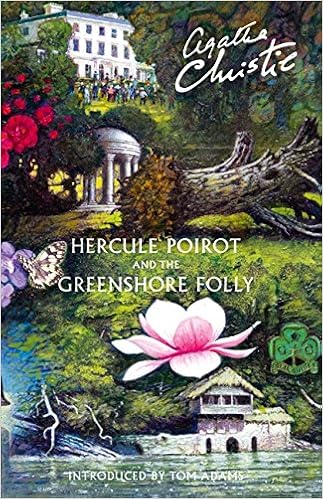
I've just caught up with Hercule Poirot and the Greenshore Folly, a novella written in 1954, but not published until 2014. Christie turned the story into the novel Dead Man's Folly, a mystery for which I've always had a soft spot, even though many Christie purists assure me it's not one of her best. This edition has wonderful jacket artwork by Tom Adams, who was responsible for so many of the covers of Fontana paperback editions of Christie that I devoured in my youth. He also contributes a foreword, and in addition there are pieces by Mathew Pritchard and John Curran.

The novella is a truncated version of the novel, but I was pleased to read it. And it's a lovely production, with illustrated endpapers and a colour reproduction of Adams' artwork for Dead Man's Folly. Incidentally, if you fancy buying the original typed ms of the novella, you can pick it up on Abebooks for a mere £10,000. But if that's a bit too much of a stretch even for a completist, I can definitely recommend the Harper Collins edition!

An early and rare Christie short story is the highlight of another Harper Collins publication, this time dating from last summer. Bodies from the Library is an anthology edited by that leading researcher Tony Medawar. It comes as something of a shock to me to recall that Tony and I first met almost thirty years ago, when we both took part in a Mastermind quiz at the 1990 London Bouchercon. Since then, he's made many discoveries, often reporting them in CADS (whose editor Geoff Bradley kept score in the same quiz.) One of the most interesting is a lost Christie treasure hunt story, set on the Isle of Man and called "Manx Gold." It can be found in While the Light Lasts.

The Christie story in the book is "The Wife of the Kenite", which dates back to about 1922, and first appeared in an Australian magazine. The plot twist is one she used subsequently, not least in a splendid radio play, but this apprentice effort shows already the slickness of her storytelling. The anthology as a whole takes its title from the Bodies from the Library conference, which has become a highly enjoyable event based in the British Library over the last few years, and which will return in June.

The anthology doesn't have a connecting theme, and the stories are a random assortment from some notable names. I was pleased to see two long-time favourite stories of mine making an appearance - Cyril Hare's "The Euthanasia of Hilary's Aunt" and A.A. Milne's "Bread upon the Waters". Both are very well-crafted stories (Milne's makes me wish that he'd written more extensively in the genre), and the same is true of a Roy Vickers story I hadn't read, "The Starting-Handle Murder". This one dates from 1934, and forms part of Vickers' long-running and celebrated series of short stories about the Department of Dead Ends.


Thursday, 20 June 2013

Motive: Universal TV review

Motive is a new television series shown on the Universal channel which began last week. I decided to watch the first episode of this North American cop show because it has an unusual premise. The viewer knows throughout who is the killer and who is the victim. This is because they are captioned "KILLER" and "VICTIM" in large letters on the screen at the start of the show. The real question is - what is the motive for the crime?

This is a clever spin on the classic detective plot. It was Richard Austin Freeman, back in the early years of the last century, who first came up with the idea of the detective story which starts out by showing the reader the culprit committing the crime, and then describes the detective work that led to the solution of the mystery. Freeman was a talented and inventive writer, and I mean to say more about him on this blog in the future.

Freeman's idea of the "inverted" story has been adapted many times, for instance by Roy Vickers in his stories about the Department of Dead Ends, and in the hit TV show Columbo. But I can't think of anyone who has tweaked the detective story in quite the same way as happens in Motive. For that touch of originality alone, the show deserves praise. Slightly less original is the decision to cast two exceptionally attractive women, Kristin Lehman (as the cop, Angie Flynn) and Lauren Holly (as the pathologist) in lead roles.

The first episode involved the killing of a teacher by a pupil. Why did the lad do it? I have to say that the mysterious motive wasn't especially memorable, and this was a bit of a disappointment. Overall, I'd say that the show was efficient rather than brilliant. But the premise alone makes it worthy of note. Will I watchi it regularly? Unlikely, because life is short. But I'd be quite happy to watch an occasional future episode.

Friday, 4 January 2013

Forgotten Book - Murder of a Snob

Roy Vickers was a prolific author who is best known for his entertaining short stories about the Department of Dead Ends, but his novels have long been out of print. My first Forgotten Book for 2013 is one of his last books, Murder of a Snob, which was published in 1949, and has now reappeared under Pan Macmillan's Bello imprint. The Bello list features numerous Vickers titles, many of them hitherto impossible to find.

"Samuel Cornboise was murdered because he was a snob" is a first sentence almost worthy of a Francis Iles or a Ruth Rendell. I wouldn't pretend, though, that Vickers is in the same league as a writer. Yet this book shows what he was capable of. The plot is elaborate, making use of Vickers' legal knowledge (he trained as a barrister before turning to journalism) and, although there is only one murder, suspense and interest is maintained quite well from start to finish. The victim's snobbery is a personality flaw which clearly interested Vickers, because he wrote an entirely separate Dead Ends story with a similar title. My guess, for what it's worth, is that Vickers had suffered a good deal from snobbery, and found writing about the subject cathartic.

The victim, who has the title of Lord Watlington, is a self-made man who is bludgeoned to death in his own home. Ralph, his nephew and heir, confesses to the crime - but is he guilty? There are several possible suspects, including the lovely Claudia, whose disreputable past had so annoyed his Lordship when Ralph decided to marry her, an artist and his lover, the deceased's wife (from whom he was long separated) and Querk, a crafty chap who looked after Watlington's business affairs.

I'm very glad that print on demand and digital publishing make obscure books like this available again at affordable prices. Vickers is well worth a look. I am sure he wrote too much, and I think he was better suited to short stories than novels because in the longer form he found it difficult not to digress.But there are some nice touches in this story which make it well worth reading.

Friday, 7 December 2012

Forgotten Book - The Department of Dead Ends

The Department of Dead Ends is Roy Vickers' most famous book. The eponymous Department is also his most famous creation - a fictional part of Scotland Yard, presided over by Detective Inspector Rason, which collected seemingly trivial and inconsequential bits and pieces associated with unsolved cases, and every once in a while managed to interpret those stray scraps of evidence so as to pin the crime on a hitherto unsuspected culprit.

Julian Symons and Ellery Queen were among the very good judges who lauded the "inverted mystery" short stories featuring the Department, and thanks to their advocacy, these stories are by far the best known of the countless stories that Vickers wrote. Is the praise deserved? I think so. There is an element of formula about the stories, once you have read several, and I think it's best to read them in small quantities. But that's true, in my opinion, of the great Father Brown stories too. You can have too much of a good thing, certainly, but I am quite clear that the Dead Ends stories are good thing.

"The Rubber Trumpet", the first of the stories, is justly famous, but several others are equally good. One story is plainly based on the Brides in the Bath case, while another, the excellent "The Henpecked Murderer", explicitly references the Crippen case. I hadn't read this story before, or been aware of it, and I though Vickers used the elements of the Crippen story very cleverly to create an intriguing tale.

Vickers' preoccupation with snobbery and social climbing is very evident in this collection, happily made available to modern readership by Bello - so much so that one senses he was working out "issues" of his own. The stories are very crisp and entertaining, and some of the writing - for instance, the opening paragraph of "The Yellow Jumper" - is very good indeed. This is a genuine classic.