Showing posts with label Tony Medawar. Show all posts

Monday, 20 June 2022

A British Library Weekend


In my online writing course Crafting Crime, I make the point that confidence counts for a good deal in writing. But confidence is fragile (there are plenty of lived examples in The Life of Crime, some of them rather poignant) and writers often find their morale needs boosting. Well, having just returned from London after an exhilarating weekend, I can say that I'm in very good heart, for a host of reasons. One of these, I must say, is that it was fantastic to see so many copies of my books (not to mention my Golden Age map, This Deadly Isle) for sale in the British Library shop. In fact, I don't think I've ever seen so many of my own books in a shop, anywhere....


At first, though, it seemed that things might go seriously awry. An event was planned for Friday, which would involve me, the Rev. Richard Coles and Laura Wilson in conversation at the British Library. Many tickets were sold, and I was really looking forward to it. But then disaster struck. As a result of a couple of electrical fires, it became impossible for the show to go on as planned. It was to be livestreamed, but during the course of a convivial lunch with John and Jonny of the Library's publications team, I learned that this was not going to be possible. So it became a recorded event, and part of it would involve me giving an impromptu presentation. It was all very unexpected, but I drew fresh energy from a convivial afternoon get-together with Moira Redmond, Jim Noy, Chrissie Poulson and others, and as things turned out, all went well. Richard, whom I'd never had a chance to talk to previously, but whose new detective novel I read over the weekend, was not only charming but generous in his comments about my writing, and Laura did a great job. I gather that everyone who paid for tickets will be refunded and the event will be made available on an open access basis. 


The following day, Bodies from the Library was due to take place after a three-year absence (though as with Alibis from the Archive, there was an online-only version last year). The volunteer team and the British Library staff worked tirelessly to make sure that it could go ahead, even though it was no longer possible for the Knowledge Centre to be used. The whole event was held in a rapidly reconfigured Terrace Restaurant. And it went really well. Jake Kerridge, Moira, Chrissie, Tony Medawar, Caroline Crampton, John Curran, and David Brawn were all very good and I enjoyed my session, talking to Chrissie about The Life of Crime. 


It was also wonderful to see so many old friends and to meet some nice people for the first time, including fellow Head of Zeus author Tom Mead. Online events are invaluable and, I'm sure, here to stay, but you can't beat the personal contact that comes with a live event. Twenty-five or so of us got together on Saturday evening for drinks and a meal, a nice way to round off a day that almost didn't happen, but - thanks to the hard work and dedication of those who turned potential disaster into a triumph - proved to be a great success. 


Wednesday, 23 February 2022

A Medawar Medley


I first met Tony Medawar way back in 1990 when we both attended the London Bouchercon and both took part in a Mastermind quiz. We've been friends ever since. Tony was particularly busy last year and this post seeks to round up some of his achievements. In addition to being Director of the International Agatha  Christie Festival in Torquay - a very enjoyable event which I was delighted to participate in, and well worth keeping in mind for this September - he continued his researches into Golden Age fiction, while a number of books published by HarperCollins featured his introductions.

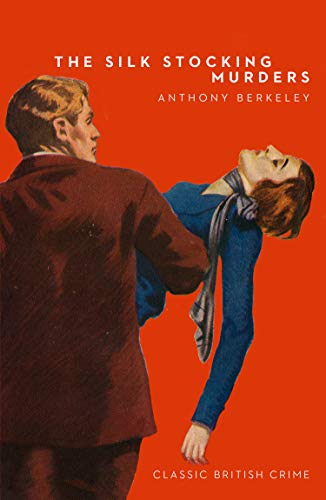
Like Tony, I am a long-time Anthony Berkeley fan, so I was glad to see the reappearance of The Wychford Poisoning Case and The Silk Stocking Murders, two novels from the 1920s which feature Roger Sheringham. Tony has also superintended the publication of The Wintringham Mystery, which was the original title of the story later published under the pen-name A.Monmouth Platts as Cicely Disappears. This is an exceptionally rare book. I was loaned a pristine, dust-jacketed copy by a member of the author's family (and looked after it very carefully, believe me, before sending it back) and reviewed it on this blog a few years ago. It's fair to say that I don't rank it anything like as highly as the Sheringham novels. But now there is an affordable paperback edition, fans can judge for themselves.

Tony has also edited the fourth anthology of stories in his Bodies from the Library series. Bodies from the Library 4 may not have an unexpected title, but it contains some genuine rarities that will make the mouths of many a Golden Age fan water. There are, for instance, stories by both Edmund Crispin and Ngaio Marsh that have never been published before.

The other ingredients form quite a mix. There are a couple of radio plays and a sequence of six short mysteries by authors including Peter Cheyney which first appeared in the Sunday Dispatch. The highlight, and one which I think will make this book a must-buy for some traditional mystery lovers is a novella by Christianna Brand, 'Shadowed Sunlight', which has again not been available until now. My own favourite is Crispin's 'Child's Play', a dark and uncharacteristic but memorable story. It doesn't feature Gervase Fen, and maybe that was why it never saw the light of day in Crispin's lifetime, but I'm extremely surprised he seems not to have managed to get it published. 


Wednesday, 22 September 2021

The International Agatha Christie Festival and exploring the south west


Last year the pandemic put paid to my plans to take part in the International Agatha Christie Festival once again. Happily this year, it all worked well and the dauntingly lengthy journey to Torquay was rewarded by plenty of sunshine and good company as well as some enjoyable stops along the way. I did, however, under-estimate just how long it would take me to drive from Rye to Torquay - basically, a whole day - and was very, very glad that I'd decided to break the journey back home to Cheshire, stopping in the delightful west country.


The director of the Christie festival these days is Tony Medawar, who is well-known to fans of vintage detective fiction as a result of his many contributions to CADS as well as, more recently, the popular anthologies of rare stories that he compiles for HarperCollins' Bodies from the Library series. (I hope to be reviewing the latest title at a later date.) Tony put together an impressively varied programme and invited me to do a couple of events. The first was a talk on 'Crafting Crime' and the second a workshop for a group of aspiring crime writers.


The talk was one I'd not done before, but I was pleased with the reaction as well as the chance to meet a number of delightful people, several old friends and some I'd not met previously (photo credit: Caroline Raeburn). I've done quite a few workshops but I felt the group I talked to at Torquay was especially good at coming up with interesting material in the impromptu exercises. Shortly I'll be launching an online crime writing course; it's called (surprise, surprise), 'Crafting Crime', and I'll talk more about it on this blog before long, but it was good to have the chance to conduct a face to face workshop at long last, after innumerable Zoom sessions. It was also good to return to the Grand (see the top two photos) where I stayed at the CWA conference in 1990, which coincided memorably with the Christie Centenary celebrations.


Wending our way back home took us through Devon and Somerset, two delightful rural counties that I don't know as well as I'd like to. Where possible I avoided the motorways and this made the long drive even longer but more bearable. Highlights included Dawlish (blacks swans and all...), Tiverton, Dulverton, Watchet, Monksilver (with its famous grotesque), Dunster Castle, Selworthy (the climb up to the Iron Age fort of Bury Castle was demanding, but the views made it worthwhile), and Porlock Weir. Calling in at Cullompton (E.M. Delafield's old stamping ground) I was impressed by the library, which seemed like a model of a 21st century community hub.  And towards the end of an epic trip, massive queues on the M6 prompted a return to Shugborough near Stafford. Gorgeous places in a green and pleasant land.


Wednesday, 22 July 2020

Bodies from the Library 3 - edited by Tony Medawar


Bodies from the Library 3 eBook: Medawar, Tony: Amazon.co.uk ...

I've mentioned Tony Medawar before on this blog as the leading researcher of obscure crime fiction. He's a great fan of Golden Age mysteries who has uncovered some fascinating material over the years. An example was the Agatha Christie competition story "Manx Gold", which fascinates me. Tony is currently developing a niche as an editor of story collections, including the Bodies from the Library series, which has now reached its third installment. In addition, he's become the supremo of the Agatha Christie International Festival in Torquay, an event I was eagerly anticipating until the pandemic intervened.

I have a vivid memory of my first encounter with Tony. It was at the London Bouchercon, way back in 1990, before I'd published a single piece of crime fiction. We happened to be contestants in a Mastermind quiz. The quizmaster was Maxim Jakubowski, himself a supremely prolific and versatile anthologist. The score was kept by Geoff Bradley, the editor of CADS. On that pleasant afternoon I never imagined that, thirty years on, Geoff, Tony, Maxim, and I would still be in regular contact, having all sorts of criminal conversations. These are three people from whom, in different ways, I've learned a lot.

The other contestants in the quiz, by the way, were Jim Huang, an American crime fan, and the writer Sarah J. Mason, who also took part with me in a re-run of the quiz at the 1995 Nottingham Bouchercon, along with two very knowledgeable Americans, Marvin Lachman and Edward D. Hoch. There is discussion about the quizzes in Marvin's admirable book The Heirs of Anthony Boucher.

Turning to Bodies from the Library 3, like its predecessors it is a mixed bag, with the main connecting link that most of the stories are unknown or little-known efforts by Golden Age writers. (Six stories are also linked by a theme: an orange that saves someone's life, of all things. Of these little tales, Ethel Lina White makes the best attempt to come up with a strong story.) I'd already come across a handful of the entries in the book, including an extremely good Agatha Christie, "The Incident of the Dog's Ball". There are extensive notes about the contributors, and I was especially pleased to learn more about the enigmatic Lynn Brock.

One of the best stories, I felt, came from that talented but rather inconsistent writer Christopher Bush. "The Hampstead Murder" is pleasingly different, and I really liked it. Bush wrote far too much, but this story shows just what he could do on a good day. There's also a story by Christopher St John Sprigg, which makes use of his interest in aeronautics, although this particular mystery is not in the same league as his novel with a similar background, Death of an Airman.

There are a couple of stories by American writers, and two plays, including one by Ngaio Marsh that was previously unknown to me. Although most of the stories have been published before, this was often in obscure magazines (as with the Bush story) and some have never previously seen the light of day.

It is interesting to speculate why this might be. For example, John Curran, who was the first to reprint the Christie story, theorised that she opted to use key elements of the plot for the novel Dumb Witness, and that seems highly plausible. Whatever the reason, it's a story that Poirot fans are sure to enjoy. The best discovery in the book is "The House of the Poplars" by Dorothy L. Sayers, and I'd be fascinated to know why it's never been printed before. While it's no masterpiece, it's certainly good enough to have been published. Did Sayers have reservations about it, possibly because the ending is slightly anti-climactic? Perhaps, but I'm really not sure. At least now, thanks to Tony, we have a chance to read for ourselves a lost story by one of the giants of the Golden Age. 


Wednesday, 27 November 2019

Bodies from the Library 2, edited by Tony Medawar


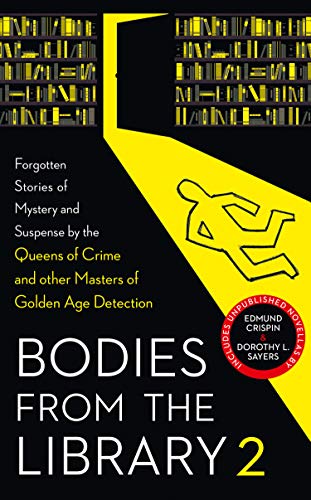
The title and contents of this HarperCollins anthology are inspired by the Bodies from the Library conference, which has for the past five summers been held at the British Library and brought together fans of Golden Age detective fiction from all over the world. Tony Medawar, who has been researching the genre for a good thirty years, has conceived the idea of a series of books gathering stories (and radio plays) which he has, in many cases, rescued from obscurity.

Tony is a particular expert on Agatha Christie and the first Bodies book included an excellent rare story by the Queen of Crime. She features again in this book, which I think represents an advance on its predecessor in terms of the overall range and quality of content. There are two particular stand-out contributions, one a long-lost Lord Peter Wimsey story and the other a novella by Edmund Crispin. Rare finds indeed.

The Dorothy L. Sayers story is called, simply and splendidly, "The Locked Room". There is, arguably, a question mark over one aspect of the plot, which may explain why the story (which evidently dates from the late 20s) wasn't included in the Wimsey collections. It's a mystery to me why Crispin's "The Hours of Darkness" disappeared from sight. It's a very pleasing case for Gervase Fen, which is not even mentioned in David Whittle's magisterial biography of Crispin.

The other contributions are a very diverse assortment. So there's a story by S.S. Van Dine,and three others by American authors: Clayton Rawson, Jonathan Latimer (not an author normally associated with the Golden Age, a term which has to be interpreted broadly in the context of this book), and Q. Patrick, whose work in various incarnations I've always enjoyed. The Patrick story is also a novella.

There are several other notable names in the book, such as Margery Allingham and E.C.R. Lorac, but I particularly liked "No Face" by Christianna Brand and the characteristically amusing "Before and After" by Peter Antony. There's even a previously unpublished play by John Rhode, "Sixpennyworth", which Tony speculates may have been written for a local am dram group.

Wednesday, 2 October 2019

Murder She Said: The Quotable Miss Marple

Murder She Said: The Quotable Miss Marple is a stocking-filler published, in extremely good time for Christmas, by HarperCollins. It follows a similar little book of Hercule Poirot quotes, Little Grey Cells, which landed on the shelves a couple of years back. The earlier book was put together by editor David Brawn; the new one is the work of Tony Medawar.

Like the Poirot book, this one includes an interesting bonus feature, namely a short essay by Agatha Christie herself: "Does a Woman's Instinct Make Her a Good Detective?" This piece dates from 1928, and was originally published in The Star newspaper to coincide with final publication of the first set of Miss Marple short stories (there is also a bibliography of the Marple short stories, most of which appeared between 1927 and 1931, as well as an intro to the book by Tony Medawar).

The quotes are grouped into eight sections: the art of conversation, men and women, crime and detection, the young, murder, Marple on Marple, human nature, and life. Here is one of my favourites, from the very first Agatha Christie novel that I read, The Murder at the Vicarage:

"Observing human nature for as long as I have done, one gets to expect not very much from it."

Cynical, of course, but in the past there have been times in my life (especially during my days as a partner in a law firm) when I have, despite my instincts to the contrary, felt much the same!


Tuesday, 19 February 2019

Agatha Again


Image result for hercule poirot greenshore

In my young days, I had a recurrent dream. It was a dream in which I discovered an Agatha Christie novel I'd never read. Yes, I'm afraid that I was so hooked, and so frustrated when I'd read her complete works (up to that point) in the genre that I yearned to find a new one. And to this day, when new Christie mysteries come to light, I'm very pleased.

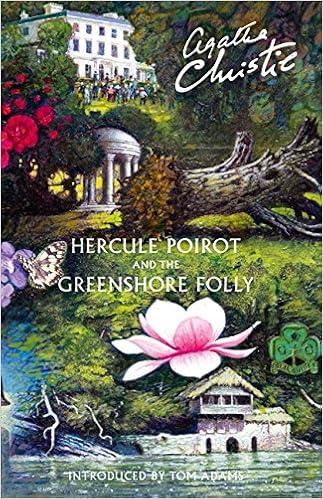
I've just caught up with Hercule Poirot and the Greenshore Folly, a novella written in 1954, but not published until 2014. Christie turned the story into the novel Dead Man's Folly, a mystery for which I've always had a soft spot, even though many Christie purists assure me it's not one of her best. This edition has wonderful jacket artwork by Tom Adams, who was responsible for so many of the covers of Fontana paperback editions of Christie that I devoured in my youth. He also contributes a foreword, and in addition there are pieces by Mathew Pritchard and John Curran.

The novella is a truncated version of the novel, but I was pleased to read it. And it's a lovely production, with illustrated endpapers and a colour reproduction of Adams' artwork for Dead Man's Folly. Incidentally, if you fancy buying the original typed ms of the novella, you can pick it up on Abebooks for a mere £10,000. But if that's a bit too much of a stretch even for a completist, I can definitely recommend the Harper Collins edition!

An early and rare Christie short story is the highlight of another Harper Collins publication, this time dating from last summer. Bodies from the Library is an anthology edited by that leading researcher Tony Medawar. It comes as something of a shock to me to recall that Tony and I first met almost thirty years ago, when we both took part in a Mastermind quiz at the 1990 London Bouchercon. Since then, he's made many discoveries, often reporting them in CADS (whose editor Geoff Bradley kept score in the same quiz.) One of the most interesting is a lost Christie treasure hunt story, set on the Isle of Man and called "Manx Gold." It can be found in While the Light Lasts.

The Christie story in the book is "The Wife of the Kenite", which dates back to about 1922, and first appeared in an Australian magazine. The plot twist is one she used subsequently, not least in a splendid radio play, but this apprentice effort shows already the slickness of her storytelling. The anthology as a whole takes its title from the Bodies from the Library conference, which has become a highly enjoyable event based in the British Library over the last few years, and which will return in June.

The anthology doesn't have a connecting theme, and the stories are a random assortment from some notable names. I was pleased to see two long-time favourite stories of mine making an appearance - Cyril Hare's "The Euthanasia of Hilary's Aunt" and A.A. Milne's "Bread upon the Waters". Both are very well-crafted stories (Milne's makes me wish that he'd written more extensively in the genre), and the same is true of a Roy Vickers story I hadn't read, "The Starting-Handle Murder". This one dates from 1934, and forms part of Vickers' long-running and celebrated series of short stories about the Department of Dead Ends.


Monday, 18 June 2018

A very brief breather...


I've arrived home after an action-packed few days in London. Whilst I was in the capital, I received the delightful news that The Story of Classic Crime in 100 Books has been shortlisted for a Macavity award by Mystery Readers International. The book has now received five major award nominations, three in the US, two in the UK, something I never dreamed of a few years ago when I first became involved with the British Library.

My trip included a variety of CWA events, notably hosting the annual lunch for former CWA chairs, an extremely convivial occasion in Covent Garden, a CWA board meeting, and the Detection Club's summer dinner at the Garrick Club. There was also a meeting with publishers to discuss marketing my new novel - more news about that very soon. I caught up with a number of old friends, including Tim Benson, with whom I went to school; among other things, he's now a guide at the Royal Academy, and he took me around the Summer Exhibition. If you like art, it's really a must-see.

Saturday saw the fourth Bodies from the Library conference at the British Library, and it proved to be another enjoyable occasion. The only downside is that because the programme is so full of things to do, there's never enough time to chat to all the people with whom one would like to catch up. But you can't have everything, and I'm delighted that Bodies is to return next year.

Christine Poulson hosted a conversation between Tony Medawar and myself about Golden Age anthologies, and it was good to see Tony again. We first met at, of all things, a Mastermind crime quiz at Bouchercon 1990, in London, before I was a published novelist. A lot of water under the bridge since then...Later in the morning I gave a talk about Richard Hull, and the various sessions included a panel about Francis Durbridge, a talk about Christianna Brand, one about crime dossiers, and a slightly bizarre Ellery Queen radio mystery from the 1940s. The final panel event, pictured, saw us discussing "Desert Island Detectives". Just to be quirky, I chose Ambrose Chitterwick...

There are detailed reports of the day on two of my favourite classic crime blogs, In Search of the Classic Mystery, from which I've taken the photo (well, crime is our shared enthusiasm...), and Cross Examining Crime. I was also delighted to chat to two more excellent bloggers, Jim and  Dan, with whom I recorded a podcast about impossible crimes. More about this another day.

It was good to meet Melvyn Barnes, and I hope to review his book about Durbridge, as well as Tony's new anthology, on this blog before long. In the meantime, I'm enjoying a breather today. Only two meetings, and a whole 24 hours of catch-up time before my next library talk tomorrow evening, which will be followed by a trip to the Lake District for a charity event...


Monday, 2 October 2017

CADS 76

The arrival of a new issue of CADS is always a cause for celebration. Geoff Bradley's "irregular magazine of comment and criticism about crime and detective fiction" has now reached issue 76. That very irregularity is one of the pleasures of CADS - one never quite knows when the next issue will arrive, a touch of quirkiness that I find very attractive.

It comes as quite a shock to me to realise that I've known Geoff for 27 years. We first met at a memorable Bouchercon in London in 1990. I'd read that there was to be a quiz about crime fiction, so I expressed an interest. What I hadn't realised was that it was to be closely modelled on BBC TV's Mastermind, and when I said that my special interest was "detectives", that meant the questions in the special round ranged far and wide. Geoff kept score, and Maxim Jakubowski set the questions. I'd never met Maxim until then either - now he is one of the CWA's two Vice Chairs and I am the Chair. Who would have predicted that? Not me.

One oft the other three contestants (the others were Sarah J. Mason, a writer with whom I'm still in touch, and Jim Huang from the States) was Tony Medawar. Tony is someone else I'd never met before that day. Since then, I think I've learned more from his researches than from the research of any other Golden Age fan, with the possible exceptions of John Curran and Barry Pike. In CADS 76, Tony is at it again, with a terrific article about "the lost cases of Lord Peter Wimsey". For any Sayers fan, that is a must-read.

As usual, there is plenty of other good stuff. Pete Johnson writes about Andrew Garve, and Barry Pike about Reggie Fortune, while Kate Jackson, who has emerged in recent times as a prolific and interesting blogger, contributes a thoughtful article about mystery fiction and individualism. Liz Gilbey and John Cooper are among a range of other knowledgeable contributors, and I was especially pleased to read John's discussion of the books of Kay Mitchell. Kay's an old friend of mine who has not published a book, sadly, for a very long time, but her work is definitely worth seeking out. I have to confess that three books of mine are reviewed in this issue, but I can promise you that isn't why I recommend this magazine. Over the years, CADS has made a contribution to research about the genre that is both unique and invaluable.

Monday, 19 June 2017

Bodies from the Library

I'm back from a brief but exhilarating trip to London, the highlight of which was the third Bodies from the Library event at the British Library on Saturday. The speakers and organisers had met the previous evening for a convivial meal, and I was also delighted to meet Professor Elinor Shaffer, sister-in-law of Peter and Antony Shaffer. This followed a catch-up with my former agent, Mandy Little, now retired, who had faith in  my writing before I published a single novel. It was Mandy who sold All the Lonely People, my first book, and I'll always be grateful to her.

I was asked to open and close Bodies, and between 10 am and 5.15 there was a lot happening. Jake Kerridge moderated a panel featuring Len Tyler, Seona Ford of the Dorothy L. Sayers Society and me, and we talked about aspects of the Golden Age. Tony Medawar spoke about John Rhode, Kirsten Saxton talked enthusiastically about The Incredible Crime, and John Curran about crossword puzzles and classic crime. Then Rob Davies interviewed me about The Story of Classic Crime in 100 Books.

The book was on sale at the event, and upwards of 80 copies were sold. I've never sold anything like as many hardbacks on a single occasion. Plenty of copies of Taking Detective Stories Seriously were also sold - very gratifying. The afternoon events included a Sayers radio play, talks on Elizabeth Daly, Ethel Lina White, Ronald Knox and Edmund Crispin, and a panel in which the speakers talked about their favourite classic crime novels.

For me the day was something of a whirl, just as Alibis in the Archive was the previous week, I was delighted to have the chance to say hello to a lot of nice people, and even send a recorded message to fans of the Detection Club in Brazil (didn't expect that!) but of course there's never enough time during such concentrated events. The main thing was that several people expressed the view that this was the best Bodies yet, and we are all hoping that it will happen again next year. The atmosphere was hugely positive.

There being no rest for the wicked, I then hosted a CWA reception immediately afterwards, announcing that the winner of the 2017 CWA Dagger in the Library is Mari Hannah. The shortlist was very strong and so it was a particular pleasure to congratulate Mari. After dinner with a few friends,,I  must admit that I was quite exhausted. But it was worth it. A grand day.


Monday, 13 June 2016

Bodies from the Library

IMAG0882_BURST002_COVER.jpg

I'm back home - briefly -after an exhilarating trip to London for the second Bodies from the Library conference at the British Library. This was a highly successful event, one in which I was delighted to take part, and during the afternoon coffee break one of the attendees made things even more memorable by kindly telling me that she'd just heard that The Golden Age of Murder has been shortlisted for the Macavity award from Mystery Readers International. Not so long ago, if you'd told me that a book of mine would win three awards and be listed for three more, I'd have thought you were pulling my leg in a rather cruel way. But yes, it has actually happened...

Less of a surprise were two announcements about personal projects of mine which I'm very excited about. For one day only, copies of the new edition of Anthony Berkeley's The Poisoned Chocolates Case, a title in the British Library's Crime Classics series, were on sale - official publication is in October. And this edition contains not only an intro that I've written, but more importantly, a seventh solution (in addition to the six solutions Berkeley came up with) by Christianna Brand, first published in the US in the 70s. And there is a brand new solution written by me. This is a project that was, for me, enormous fun, and a large number of copies of the book were sold on the day. More about this one in October...

During my conversation with Rob Davies of the British Library, we also announced that next year will see the publication of my new non-fiction book The Story of Classic Crime in 100 Books. This book has occupied a good deal of my time over the past 18 months, and I recently finished work on the manuscript. It's very different from The Golden Age of Murder, even though there is an element of overlap in terms of the period covered, and I hope that crime fans will find it full of interesting - and often unexpected - material.

The first session of the day featured another book with which I'm very happy to be associated. This is The Sinking Admiral, by the Detection Club. Simon Brett, who masterminded the book, discussed it with me, and two other contributors, Janet Laurence and Stella Duffy. It was also announced that Stella has been awarded an OBE, and that she has been engaged to write a completion of an unfinished Ngaio Marsh novel: something to look forward to. As for The Sinking Admiral, it sold out by mid-morning.

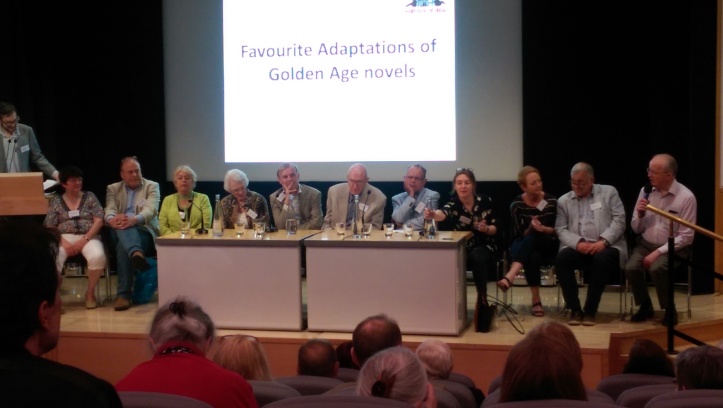
Tony Medawar talked about Anthony Berkeley, while Len Tyler and Susan Moody championed Philip MacDonald and Georgette Heyer, and Barry Pike discussed the work of H.C. Bailey. Dolores Gordon-Smith focused on G.K. Chesterton, while Jennifer Henderson, biographer of Josephiine Tey, talked about Tey as a Scottish writer. John Curran discussed the Collins Crime Club - and his book on the subject is another that will be eagerly anticipated. Finally there was a group panel in which we picked favourite screen adaptations of Golden Age novels.

Dinners on the Friday and Saturday evenings provided plenty of opportunities for socialising, and I was delighted to meet Taku Ashibe, from the Honkaku Mystery Writers' Club of Japan, (modelled on the Detection Club) who presented me with several books, including one of his own. Saturday itself was extremely hectic, and although I had the chance to chat to a number of attendees, there simply wasn't time for as many conversations as I'd have liked. But you can't have everything, and overall this was a wonderful day, full of good things, and pleasant people. What more could you want?

The photo at the top of this post appears on an account of the day on Puzzle Doctor's splendid blog, In Search of the Classic Mystery Novel. Further perspectives on the day may be found on the similaly enjoyable Past Offences blog and Cross Examining Crime.
.


Monday, 12 October 2015

CADS 71

It's always a delight to receive the latest copy of CADS, which celebrated its 30th birthday not long ago. This is issue 71 of Geoff Bradley's "irregular magazine of comment and criticism about crime and detective fiction" and it's a very strong issue, with lots of good things. In all honesty, I should add that from my perspective one of them is a long and lovely review of The Golden Age of Murder by Doug Greene, one of the genre's great experts. I'm glad to say the book also attracts quite a bit of comment in the letters column. But part of the significance of the review is that Doug also contributed to the very first issue of CADS all those years ago, and this underlines the point that Geoff's work attracts a great deal of loyalty, such is its quality.

The issue begins brilliantly with an article by Tony Medawar about a collaborative project that, sadly, never saw the light of day. A diverse group of leading writers got together in 1975 to write a round-robin mystery, rather in the manner of The Floating Admiral, although not all the contributors were members of the Detection Club. Those who were included Harry Keating, Christianna Brand, Len Deighton and (improbably, you may think) Patricia Highsmith. The story was meant to be recorded on LP and cassette, but the full and final version failed to materialise. What a shame.

I've asked Len about this, and 40 years on, he has no memory of the project whatsoever. The memories of other contributors also seem to be lost. This is not unusual - I found when researching The Golden Age of Murder that people's memories are very fallible, and my experience as a lawyer interviewing witnesses taught me as much, many years ago. This makes me feel a bit better when my own memory proves fallible, as it often does. In reality, 'facts' are very often a matter of opinion or questionable recollection, and that's true even in the case of 'facts' recorded in apparently authoritative documents.

If there were a league table of the most notable researchers into the Golden Age, who battle constantly with such difficulties, I'd probably put Tony at the top of the list. His second article in the issue covers a hitherto unknown story by Anthony Berkeley. Quite a find. Barry Pike and John Cooper are leading experts on GA fiction of very long standing, and both contribute very interesting articles. John's tackles Fiona Sinclair, of whom I'd never even heard. She sounds well worth checking out.

There are many other good things too. Examples include Scott Herbertson's report on the Bodies in the Library conference, Mike Ripley's piece on Eric Ambler, and Kate Jackson's article about the Chinese detective Lily Wu, who was also new to me. Compared to the likes of Barry, John and  Tony, Kate is one of the new voices among young GA enthusiasts, and the quality of her writing and research suggests to me that she will become a leading figure among critics of the genre in years to come. Well, that's for the future, but in the meantime, if you like traditional crime fiction, CADS 71 is a must-buy.


Monday, 25 May 2015

CADS 70

The arrival of a new issue of CAD is always a cause for celebration, and I have just devoured issue 70 of Geoff Bradley's splendid and long-running magazine for crime fiction lovers. Once again, the contents range far and wide. If you are a fan of the genre and you don't know CADS, do check it out. I'm confident that you will be impressed.

Several long-standing contributors are again featured. They include Barry Pike, continuing his series about the Mr Fortune series of H.C.Bailey. The fact that I've developed an increasing admiration for Bailey is largely due to Barry's advocacy; I still find Bailey's style irksome, but I've been persuaded that at his best, he was a very powerful and unusual writer.  There are no fewer than three short pieces by the indefatigible Philip Scowcroft, one of them dealing with Val Gielgud, whose detective fiction is discussed surprisingly seldom. Tony Medawar contributes another "On This Day" snippet, and Mike Ripley writes about Peter Cheney, while there is a poignant final contribution from the late Bob Adey.

Geoff talks about Bob in his editorial notes, and there is also a wonderful piece by Scott Herbertson about someone else who, in a very different way, is also a huge loss to the crime fiction community, P.D. James. I very much enjoyed John Cooper's essay about Henry Wade's Inspector Poole, while Curt Evans writes about Ianthe Jerrold, two of whose detective novels are happily available again after a long gap.

I haven't written as much for CADS in recent years as I've wished, because of the demands of The Golden Age of Murder (which to my amazement has just been reviewed in, of all places, The Wall Street Journal) and other projects, but this time I've contributed an essay which talks about the influence that CADS has had on my book. As anyone who has read the book, and in particular the end notes, will see, that influence has been quite considerable and has spanned many years. Had it not been for what I have learned from CADS, I would still have written the book, but it wouldn't have had as much information in it. I'm one of many writers and crime fans who has cause to thank Geoff for his decades of hard work as editor.

Monday, 5 January 2015

Bodies from the Library

Fresh and exciting evidence of the striking growth of interest in Golden Age fiction is supplied by the announcement that Bodies from the Library, a one day conference, will take place at the British Library on Saturday 20 June. The organisers have set up a website as well as a Facebook page, and I am optimistic that this venture will attract a great deal of interest.

John Curran, the pre-eminent expert on Agatha Christie, is a guiding spirit behind the setting up at the conference. It sprang from discussions at Crimefest last year about the fact that, over the years, Golden Age fiction has not been discussed very often at crime conventions (other than the Forgotten Authors panel at Crimefest and some of the papers given at St Hilda's each year). As a result, John, Mike Linane and fellow enthusiasts including Liz Cooper, Norman Home, and Susan Cooper decided it would be a good idea to set up a dedicated conference. Naturally, I think they were absolutely right. But putting on a conference, especially when starting out, is very hard work. 

John, Mike and company have done a great job, gaining enthusiastic and valuable backing from both the British Library and Harper Collins. They are in the process of finalising what will be a packed programme. The speakers include the pre-eminent publishers of Golden Age-related books, David Brawn of Harper Collins,and Rob Davies of the British Library. Other speakers include Jake Kerridge of the Daily Telegraph, and Barry Pike and Tony Medawar, two of the leading authorities on Golden Age fiction. If you like traditional fiction, the chance to hear Barry, John and Tony really should not be missed.

Contemporary novelists with a strong interest in the Golden Age will be speaking; they include Len Tyler, Dolores Gordon Smith, and me. At least one leading present day crime writer is likely to be added to the list shortly.This is a ground-breaking event, and I'm very glad to be part of it. I hope that some of the GA fans who read this blog will be able to attend. 

A few words from Mike Linane: :"Golden Age is a huge topic and to have a day where true experts talk about their favourite authors and suggest books to read as well as hearing from the publishers what they take into account before republishing out of print titles as well as finding out about todays authors who are carrying on in the GA tradition.   There's something for everyone and I am sure the entire audience will leave at the end of the day with a list of books they are desperate to read  Oh,  and there are goody bags and spot prizes as well!"


Wednesday, 19 March 2014

CADS and the CADS dinner


Anyone who enjoys classic crime fiction - and probably anybody who enjoys crime fiction generally - is likely to find CADS, a fanzine edited by Geoff Bradley, a mine of information and entertainment. I missed its first issue, more than 20 years ago,but I contributed an article to issue 6 and have been a devotee of this irregular magazine for crime fans ever since. It really is a terrific read. It doesn't have a website,but I'll be happy to give Geoff's contact details to anyone who gets in touch with me.

The latest issue of CADS, number 67, is as usual full of good things. An example is Curt Evans' article about the novels of Emma Lou Fetta. If you've never heard of Emma Lou, well, neither had I. That's the beauty of CADS - you discover things that you would really never find elsewhere. The list of the contributors is a roll-call of the leading experts, not just in Britain but elsewhere, of crime fiction's most knowledgable people. To take a few names at random from this issue - Bob Adey, the world's greatest expert on the locked room mystery, Arthur Vidro, editor of Give Me That Old-Time Detection, John Cooper and Barry Pike, authors of Collecting Detective Fiction, John Curran, the leading expert on Dame Agatha, Liz Gilbey and Philip L. Scowcroft, plus many more. Fascinating.

A tradition has grown up of crime fans meeting once a year for dinner in London - it's organised by Tony Medawar, and is known as the CADS dinner. I managed to attend this year,and took these photos. As usual the evening was great fun. The only snag was that there wasn't time to have a long conversation with everyone present, but the company was certainly excellent. And among those attending were Geoff, Barry Pike - and Doug Greene, well-known as the man behind that wonderful publisher Crippen and Landru, and biographer of John Dickson Carr.

Doug's contribution to crime fiction scholarship is to be honoured later this year by way of a festschrift compiled by Curt Evans. The list of contributors is very impressive, and the range of crime fiction subjects eclectic. I'm really looking forward to reading what they have to say. In the meantime, there is enough in CADS 67 to keep me happily occupied for quite a while.

Friday, 4 October 2013

Forgotten Book - Cicely Disappears


Today's Forgotten Book is one that I'm fairly confident few readers of this blog will have encountered. What's more, it was written by one of the finest novelists of the Golden Age. It's a fabulous rarity,conceivably the most sought-after of all Golden Age mysteries, and I was lucky enough to be loaned a dust jacketed copy in superb condition. I've no idea how much it was worth, but quite a bit, and you can be sure I took good care of it before returning it to its owner.And for good measure, it is a novel with a curious history. What's not to like? Well.....

The book is Cicely Disappears, and the author is A.Monmouth Platts. Now, if that name is unfamiliar to you, I should add that it's a pseudonym, composed of the names of two houses owned by Anthony Berkeley Cox, whose much better known pen-names were Anthony Berkeley and Francis Iles. Regular readers of this blog will be well aware that I'm a fan of Berkeley-Iles. He really was an interesting writer.

This particular story began life as a serialisation published by The Daily Mirror, of all newspapers,under the by-line of A.B. Cox. The Mirror ran a competition with prizes for those who guessed the solution correctly.The story was at that stage called The Wintringham Mystery, and Tony Medawar, a great researcher into the Golden Age, published a piece in CADS some time ago explaining that Agatha Christie's husband Archie was one of the runners-up. Did Agatha enter the competition under Archie's name, I wonder?

Berkeley made some changes to the story, and published it as a novel under his new pen-name a year later. So, what of the story? It's a book of legendary rarity, but I am afraid I think this is a case where obscurity is deserved. Really, the changes to the story are largely padding, and the mystery of Cicely's fate is dragged out in a way that tempts one to skip to the end. I'm so glad I have had the chance to satisfy my curiosity by reading this particular forgotten novel, but I'm afraid the final verdict is that those who are less fortunate are not really missing out. The books that appeared under the Berkeley and Iles names are infiinitely better.


Wednesday, 20 June 2012

CADS 63


CADS 63, edited by the tireless Geoff Bradley, has just been published, and once again it’s packed with interesting and often esoteric information about crime fiction past and present, but predominantly past. I can’t remember a single issue – and I’ve read them all – when I haven’t been introduced to a book or author that I’ve enjoyed, yet otherwise might not have bothered with. The joy of CADS is that you have so many encounters with the unexpected.


These include – for instance – two assessments by John Cooper of a selection of books by writers who are today under-rated, Francis Beeding and Clifford Witting; this highlighted a number of books I’m keen to seek out. Tony Medawar contributes a nice little article about Jacques Futrelle, who died on the Titanic, and there are good pieces by a range of the usual suspects, including Bob Adey, Barry Pike and Liz Gilbey.


Curt Evans’ latest piece of mystery scholarship, an attempt to puzzle out which of the ‘joint’ books by G.D.H. Cole and his wife Margaret were written as solo efforts by one or other them inevitably depends on a mixture of logical deduction and guesswork,  but the arguments are well presented, and may be as close as we come to finding out the truth about this slightly odd collaboration. I'm looking forward eagerly to reading Curt's new book about three relatively neglected Golden Age mysteries - more about this in due course.


On a personal note, I was grateful for Chris Simpson’s review of Waterloo Sunset, and also to Geoff and to Bob Cornwell, for including me in their long running feature, the CADS Questionnaire. By their kind permission, the Questionnaire will also appear on the ‘interviews’ page of my website. But really, if you’re keen on the genre and its history, there is no substitute for buying the magazine. An absolute bargain, unreservedly recommended.    


Saturday, 29 May 2010

Convention reflections


For the last in my series of posts about Crimefest, I’d like to reflect on the appeal of crime fiction conventions, perhaps especially for the benefit of any readers of this blog who have not attended such a convention, and wonder whether they would enjoy such an event, or whether they would feel a bit isolated.

My first crime convention was 20 years ago this autumn – the Bouchercon that was held in London. At the time, I had not enjoyed any success whatsoever as a crime writer, although I had joined the Crime Writers’ Association on the strength of writing and reviewing about the genre. I knew a few of those who attended, but not many. However, it was an eye-opening experience. Among many others, I got to meet Patricia D. Cornwell, who had just published her first novel, Maxim Jakubowski, Geoff Bradley of CADS and the great Golden Age expert Tony Medawar. I’m still in regular contact with Maxim, Geoff and Tony – not Patsy Cornwell, though, alas!

The event was so much fun – even for someone who is not naturally very sociable, like me - that I was hooked, and since then I’ve attended conventions in various different parts of the UK, as well as at Toronto, Seattle, Philadelphia, Las Vegas and Washington. I don’t claim that every event has been perfect, but each time I have met pleasant people for the first time, and had the chance to renew existing friendships. As well as to talk crime long into the night with like-minded people on countless occasions. Can’t be bad, can it?

And here are some photos from Crimefest featuring some of those people whose company I've shared with such pleasure. The first photo shows me with Mike Stotter, editor of that great online magazine Shots, followed by blogger Peter Rozovsky, top crime fiction guru and reviewer Ali Karim, and finally the Monkey Coalition pub quiz team: Carol, Ann, Karen, Cath, me and Rik. Photos courtesy of Ali, Mike and Karen.