Showing posts with label John Rhode. Show all posts

Friday, 4 February 2022

Forgotten Book - Death in the Hopfields

It is often said - not least by me - that one of the reasons why Golden Age detective fiction is enjoying considerable popularity to this day is that the books present a picture of a vanished world. We can learn a great deal about society, in particular English society, from crime novels written between the two world wars. If the past is a foreign country, Golden Age novels are often pretty good tour guides.

A picture of a long-gone society emerges clearly and in considerable detail in John Rhode's 1937 novel Death in the Hopfields. Set in Kent, 'the garden of England', this story explores the way that hop-pickers, often from the East End of London would descend upon rural communities to help pick the hops. As ever, coping with this kind of influx of seasonal workers had pros and cons, and Rhode explores these at considerable length. I found this background extremely interesting. Today, things are done very differently. From the 1960s, mechanisation changed the way the work was carried out.

It is as well that the background is rich in interest, because the detective story itself is less than gripping. Nick Fuller has reviewed the book on his admirable blog The Grandest Game in the World and has included a number of contemporary reviews. Even in 1937, it's clear that a number of critics were unimpressed by the detective elements and the glacial pace with which developments unfold. The suggestion by Torquemada that the background includes a lot of padding is not, I'm afraid, unfair. No wonder the Spectator found it 'heavy going'. 

So what is the mystery about? Well, the starting point is a jewel theft and a case of arson follows. There appears to be an obvious suspect, but Dr Priestley gets involved, and needless to say, he is the one to put his finger on the truth, although by that stage I'd lost interest. Rhode clearly had a good idea for the disposal of a body, but what might have made a great short story is a very stodgy novel. I should say that the Puzzle Doctor liked this novel much more than I did. Overall, though, this is a book which vividly illustrates the problem of novelists who produce too many books too quickly. It's inevitable that quality will suffer.

Friday, 12 November 2021

Forgotten Book - Proceed with Caution aka Body Unidentified


Fashions change in crime writing, as in everything else. I doubt very much whether anyone today would give their crime novel the drab title Proceed with Caution. Yet that's just what John Rhode did, back in 1937. (His American publishers called it Body Unidentified, which is at least an improvement.) And it's even less likely that a modern crime novel's opening words would be: 'Things happen like that,' said Superintendent Hanslet, 'There are times at the Yard when things are as dull as ditchwater.'

After this soporific start, things can only get better. Thankfully, they do. In the prologue, Dr Priestley is told about two distinct cases being investigated by his Scotland Yard chums Superintendent Hanslet and Inspector Waghorn respectively. Both detectives are convinced that their cases are open and shut affairs, but of course three things are entirely predictable. First, the mysteries are much more complex than they seem at first. Second, they will turn out to be connected. And third, our armchair amateur detective will be quicker on the uptake than the professional cops.  

Hanslet's case involves some valuable diamonds that have gone missing, along with a Hatton Garden jeweller. Waghorn's case is a murder mystery of a Gothic nature, although it wasn't Rhode's style to make the most of the bizarre trappings of a case involving a deserted motor hearse and a body rendered unrecognisable after being dunked in a tar boiler used for road repairs. The tar boiler murder concept would, I feel, definitely suit a Rachel Savernake story, but Rhode is more concerned with timetables, alibis, and disguises than the vivid evocation of atmosphere.

I've realised belatedly that the best way to read Rhode is to rattle through his stories quickly. This is so even though I like to try to figure out the answers to Golden Age whodunit mysteries and also to try to understand how the author crafted his puzzle. Quite early on, I realised who was the villain of the piece, and rather than get bogged down in the minutiae of travel times which occupy a sizeable portion of text, I took pleasure in the way Rhode set about pulling the wool over the eyes of his readers. We never get to understand the mindset of the murderer - the motive is taken for granted - and this lack of interest in criminal psychology is one of Rhode's weaknesses, while the book is wrapped up with almost unseemly haste once the good doctor has explained things.. But there are plenty of nice little touches, and overall I'd rate this book as among the best Rhodes that I've come across.  

Friday, 5 November 2021

Forgotten Book - Dead on Time


Nigel Moss is a connoisseur of vintage detective fiction who has recommended a number of interesting writers to me. He was the very first person to encourage me to read John Bude, about a decade ago - some time before the British Library commissioned me to introduce The Cornish Crime Murder and The Lake District Murder. And he was also the first to urge me to give Clifford Witting a try. I made a slowish start with Witting, but the more I've read him, the more his agreeable writing has grown on me.

Dead on Time, first published in 1948, is a good example of his work. It's a murder mystery that isn't lacking in ingenuity. I read this book immediately after finishing a decent effort by John Rhode. One similarity is that in this book, like a number of Rhode's, the good old English pub plays a prominent part in the storyline. The Blue Boar in Lulverton is the scene of the fatal poisoning of Jimmy Hooker, and a plan of the ground floor of the inn is duly provided. 

The criminal's modus operandi here is crafty enough to be worthy of Rhode, but its strength lies in its simplicity, whereas Rhode's schemes are often highly complex. As a general rule, Witting scores over Rhode in terms of characterisation and prose style.There's a lightness, a touch of good nature about his storytelling (as with Bude and indeed George Bellairs) that has genuine appeal. Rhode was capable of pleasing touches of humour, but he was much more prolific than Witting, and such industry, although admirable, isn't conducive to elegant writing.  

The first half of the book is very enjoyable, but the story becomes thrillerish and less engaging prior to a good climax and the revelation of the pub killer. Not a masterpiece, then, but a decent story, well worth reading. And yes, the rabbits on the dust jacket cover are relevant to the story... 

Friday, 1 October 2021

Forgotten Book - Nothing but the Truth


Thanks to a book collector's kindness, I've come into possession of a number of hard-to-find Golden Age or GA-influenced novels and I've started to work my way through them. I decided to give John Rhode's Nothing But the Truth a go. It first appeared in 1947 and although pretty obscure, it's been discussed on a few blogs, such as Noah's Archives. I agree with Noah's suggestion that the social history is really the most interesting part of the story. The dust jacket of the novel shows an AA sentry box of the kind once familiar on British roads, and in such a box...a body is found. A great idea for a crime scene and one of the most interesting features of the book.

The story begins with a solicitor entertaining an irascible client called Watlington, one of those rich and unpleasant people who so regularly fall victim to dastardly deeds in vintage crime fiction. As a result of a strange sequence of events involving a drunken chauffeur and a policeman called Fawkes, Watlington goes missing. When a corpse is subsequently discovered, many miles away, in the AA box, with its features unrecognisable, the seasoned mystery fan is likely to suspect one of those identity switches so common in Golden Age fiction. But suffice to say that Rhode follows an unorthodox path in this novel.

Unorthodox, and rather odd. There are the makings of a good story here, but the mystery is developed laboriously, with a good deal of repetition. Ultimately, Jimmy Waghorn of Scotland Yard comes on to the scene, and he resorts to consulting Dr Priestley, but the Great Detective makes only fleeting appearances, and acts as an armchair detective with his secretary Harold doing some legwork. One of the strange things about the story is that, despite Rhode's customary emphasis on accuracy in technical details, the account of the effects of the two drugs which feature in the plot is far from convincing.  

A reader whose main interest lies in motive and characterisation will be disappointed by this one. I felt that Rhode could have played fair had he adopted a different story structure, but his chosen method for telling the story means that a key character remains hidden from view. I found this frustrating. I can cope with a bit of lazy writing in a crime novel, but I'm afraid there's far too much of it here. Overall, this is one of those detective stories that, despite those unorthodox elements, amply justifies the description 'humdrum'.  

Friday, 28 August 2020

Forgotten Book - These Names Make Clues


Image 1 of 1 for undefined

Earlier this year, I was fortunate enough to lay my hands on an inscribed copy of E.C.R. Lorac's These Names Make Clues, an uncommon Collins Crime Club title from 1937; no dust jacket (the one in pictured is an image from Mark Terry's fascinating site of facsimile wrappers), but still a treasured possession. All the more so because the story is an enjoyable one. In fact I'd rate this as one of the more interesting Loracs.

A key reason for my enthusiasm is that this book is more in the realm of the classic "closed circle" puzzle mystery than some of the author's other work. Inspector Macdonald is invited to a Treasure Hunt evening convened by a publisher called Graham Coombe, who shares a big house in London with his sister Susan. His fellow guests are mystery writers, but part of the fun is for their identities to be concealed under pseudonyms.

The seasoned crime fan won't be surprised to learn that this pleasant idea backfires when a death takes place during the treasure hunt. The deceased was an author called Andrew Gardien, and the suspects are the Coombes and the novelists. Complications ensue when Gardien's literary agent is also found dead. Were either of the deaths murder? Macdonald investigates, abetted by a breezy young journalist called Vernon.

What fascinates me particularly about this novel, published in the year that Lorac was elected to membership of the Detection Club, is that there are strong reasons to infer that her initial experience of the Club supplied the inspiration for the story and some of the characters. Coombe may be Billy Collins, but I'm fairly sure that Gardien was inspired (albeit not in terms of his personality) by John Rhode.

I also suspect that Rhode influenced (maybe even suggested to her; he was a generous man) Lorac's choice of m.o. in relation to the two deaths. Other characters seem to me to bear traces of Douglas and Margaret Cole, and Baroness Orczy. As for the plot, it boasts variety and ingenious touches aplenty, though to my mind it's not really a "fair play" whodunit, given that a key fact is revealed rather late on. Definitely a book that deserves better than the obscurity which has been its fate since the 1930s.

Wednesday, 27 November 2019

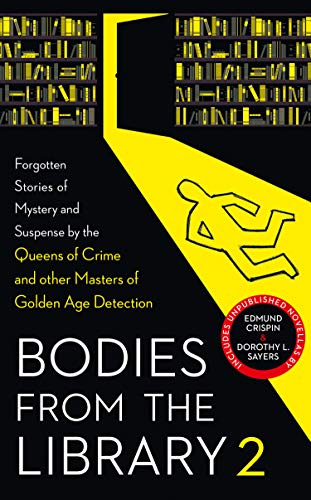
Bodies from the Library 2, edited by Tony Medawar


The title and contents of this HarperCollins anthology are inspired by the Bodies from the Library conference, which has for the past five summers been held at the British Library and brought together fans of Golden Age detective fiction from all over the world. Tony Medawar, who has been researching the genre for a good thirty years, has conceived the idea of a series of books gathering stories (and radio plays) which he has, in many cases, rescued from obscurity.

Tony is a particular expert on Agatha Christie and the first Bodies book included an excellent rare story by the Queen of Crime. She features again in this book, which I think represents an advance on its predecessor in terms of the overall range and quality of content. There are two particular stand-out contributions, one a long-lost Lord Peter Wimsey story and the other a novella by Edmund Crispin. Rare finds indeed.

The Dorothy L. Sayers story is called, simply and splendidly, "The Locked Room". There is, arguably, a question mark over one aspect of the plot, which may explain why the story (which evidently dates from the late 20s) wasn't included in the Wimsey collections. It's a mystery to me why Crispin's "The Hours of Darkness" disappeared from sight. It's a very pleasing case for Gervase Fen, which is not even mentioned in David Whittle's magisterial biography of Crispin.

The other contributions are a very diverse assortment. So there's a story by S.S. Van Dine,and three others by American authors: Clayton Rawson, Jonathan Latimer (not an author normally associated with the Golden Age, a term which has to be interpreted broadly in the context of this book), and Q. Patrick, whose work in various incarnations I've always enjoyed. The Patrick story is also a novella.

There are several other notable names in the book, such as Margery Allingham and E.C.R. Lorac, but I particularly liked "No Face" by Christianna Brand and the characteristically amusing "Before and After" by Peter Antony. There's even a previously unpublished play by John Rhode, "Sixpennyworth", which Tony speculates may have been written for a local am dram group.

Friday, 18 May 2018

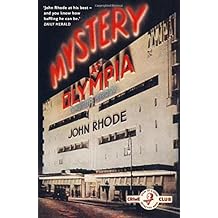
Forgotten Book - Mystery at Olympia


Mystery at Olympia

Not so long ago, the prospect of five of John Rhode's detective novels being republished as mass market paperbacks seemed as unlikely as the solutions to some of his more technically complicated mysteries. Rhode's books have long been popular with collectors (or at least, collectors with deep pockets), but the consensus in the publishing world was that there was no real market for them. But the British Library republished two of his Miles Burton novels with considerable success, and this breakthrough has been followed up by Harper Collins, with, so far, three more titles in paperback, plus a hardback of The Paddington Mystery due in June.

I've reviewed Death at Breakfast and Invisible Weapons previously; now it's time to take a look at Mystery at Olympia. This is a story which, on its first appearance in 1935, had a topicality and freshness about its opening scene. Rhode tried to keep up to date, and here he sets the first chapter at the Olympia Motor Show. Among the visitors is Dr Oldland, a chum of Dr Lancelot Priestley, and his professional skills are called upon when an elderly man collapses and dies from no apparent cause. The deceased, it turns out, rejoices in the name of Nahum Pershore, and Superintendent Hanslet soon has reason to suspect that he was murdered - but how, and by whom?

When Pershore's household is investigated, it becomes apparent that there have been some very strange goings-on in the run-up to his death. Someone shot him in the leg, but he made light of it, for some reason. The parlour-maid has been poisoned with arsenic. And another attempt seems to have been made on his life. In this story, unlike many of Rhode's, there's a good-sized cast of potential suspects, with a range of motives, and suspicion shifts around them in pleasing fashion.

So there are plenty of things to like about Mystery at Olympia. That said, it's also a novel that demonstrates Rhode's habitual failings. The first chapter devotes rather more than two pages to a discussion of a new motoring transmission device, but it proves not to have anything to do with the plot, and is simply a form of heavy-handed satire, when - speaking personally - I'd have been more entertained by a page or two devoted to satirising an obsession with cars. But that would have been too much for Rhode, whose love of motoring is also evident from the rather tedious The Motor Rally Mystery.

The murder method struck me as much more chancy than Rhode would have us believe, while the motive is thinly sketched. The same is true of books like The Motor Rally Mystery and Shot at Dawn, where Rhode's lack of interest in humanising his killers makes one as indifferent to their psychology and their fate as Dr Priestley, whose behaviour at the end of this novel offers an intriguing example of a Great Detective doing justice in his own inimitable way. Not a masterpiece, then, but certainly worth a look.


Friday, 16 March 2018

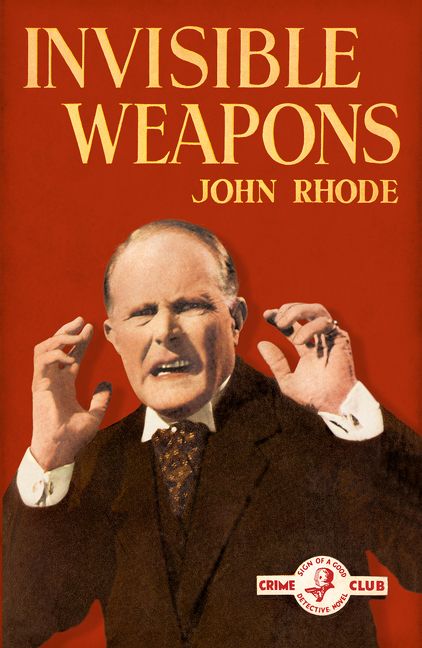
Forgotten Book - Invisible Weapons


Image result for invisible weapons john rhode

Invisible Weapons, first published in 1938, is one of John Rhode's innumerable mysteries; it's been hard to find for many years, but has now reappeared in a new paperback edition from Harper Collins. Rhode fans will, I'm sure, be absolutely delighted, as the chances of finding a first edition in decent nick at an affordable price are negligible. And it's a story which, in many ways, strikes me as typical of Rhode, both in terms of his strengths and his weaknesses.

Let's take the strengths first. The book is divided into two parts, and concerns two distinct crimes (although it's surely not a spoiler to reveal that there is a connection between them). The first victim is an elderly man, who is murdered in highly mysterious circumstances in the home of a doctor, while a police officer is present in the house. It's a locked room killing, and nobody can figure out how the crime was committed, even though there are strong reasons to suspect the doctor, who has been living beyond his means, and whose wife was the deceased's heir.

When the riddle is finally solved by Dr Lancelot Priestley, it turns out to be a variation of an old trick, but very pleasingly handled. There's also a complicated puzzle about the death of a rich and soon-to-be-married man in the second half of the book. Once again, Rhode deals with the mechanics of the crime in an assured way. He was a man with a practical turn of mind, and like Dorothy L. Sayers, he was rather more interested in howdunit than whodunit.

But, unlike Sayers, he had no ambitions as a literary stylist, and therefore the culprit's ingenious m.o. is the focus of interest. The culprit's character and motivation are of very subordinate importance, and here, as so often with Rhode, I found this a little frustrating. A murderer who indulges in such over-elaboration really deserves to have his crime investigated by a sleuth as formidable as Priestley!

Friday, 9 February 2018

Forgotten Book - The Paddington Mystery

John Rhode published The Paddington Mystery in 1925, shortly after beginning a career as a crime writer, and this novel is notable because it introduces Dr Lancelot Priestley, the veteran professor of mathematics who was to become one of the most renowned amateur "great detectives" of the Golden Age. I was especially thrilled to acquire my copy of this book a short while ago, because although it is not a first edition, it once belonged to the Detection Club and bears the bookplate of their library; Rhode not only donated it, but signed it.

The story begins with amiable but raffish young Harold Merefield (pronounced "Merryfield", we're told) going home one night only to find a corpse. The identity of the dead man is not traced by the police, but since the deceased appears to have met his end  through natural causes, Harold doesn't find himself locked up on a murder rap. Unfortunately, the incident doesn't do his reputation any good, and makes it less likely than ever that he'll ever be able to rekindle his romance with Priestley's attractive daughter April. His association with a dubious woman called Vere doesn't help, either.

Harold decides to take the bull by the horns and consult Priestley. Although the older man can be irascible as well as cerebral, he has a kindly side to his nature, and is already on good terms with the police because of his interest in detection. He takes a keen interest in what the Press call "the Paddington Mystery" and starts to make enquiries.

So far, so good. Unfortunately, the story is pretty thin. It would have made a high calibre short story, but the eventual explanation goes on almost interminably, and the main twist is foreseeable, although there is one element of it that is rather pleasing and unusual. Not a masterpiece, by any means, but a book of historic interest. And it's pleasing to report that the book will be reissued in the Detective Story Club next June. Tony Medawar has written an intro which I'm sure will be informative.

Friday, 5 January 2018

Forgotten Book - Death at Breakfast


Image result for john rhode death at breakfast

John Rhode was probably at the height of his fame when he published Death at Breakfast in 1936. It's long been a hard-to-find novel, but not any more, thanks to a paperback reissue by Harper Collins which uses the splendid (if not quite true to the storyline) original cover artwork. It's another example of a reissue that, a few years ago, would have seemed an impossible dream.

But is it any good? Well, yes, I think it is. This isn't an entry in the publishers' Detective Story Club, so there is no introduction, but there is a prologue - not a device that Rhode commonly used, I believe, though I have to say that there are over 100 of his detective novels that I haven't read. We're introduced to the miserly and unpleasant Victor, who is anticipating some kind of mysterious windfall. Suffice to say, the reader is not heartbroken when Victor quickly meets his death as a result of nicotine poisoning.

At first, suspicion falls on his half-sister and her brother. But soon it becomes clear that the mystery is more complex than seemed to be the case. Superintendent Hanslet and young Jimmy Waghorn make a nicely contrasted pair of detectives, but for all their talents, they find it necessary to consult Dr Lancelot Priestley when the puzzle become hard to solve.

Hanslet is not impressed by some of Priestley's reasoning, and naively concludes that the great man, who is getting on in years, may be losing his grip. Nothing, of course, could be further from the truth. I figured out the central trick in the story quite some time before the two cops, but that didn't much lessen my pleasure in an entertaining mystery. Rhode was a capable craftsman, and he built his plots with care. This is a pretty good one.

Friday, 8 September 2017

Forgotten Book - Night Exercise

The story of the Home Guard is truly fascinating, and it's why - in addition to great writing and superb acting - Dad's Army became such an enduringly popular sitcom. The notion of ordinary people, not able to take part in active military service for whatever reasons, banding together to defend Britain against a feared and formidable invading force, is intensely appealing. The story of the Home Guard tells us a lot about human nature.

My father was in the Home Guard. He was a young man when the Second World War began, but he wasn't able to follow his older brother into the Services because he had a "reserved occupation" as a draughtsman, and became involved in work on the Mulberry Harbours. When I was small, he told me a lot of funny stories about his time in the Home Guard, and I'm sorry that I can't remember them. He had a gift for storytelling, and I wish he'd applied it to writing fiction, but he didn't think that writers were people like us. When the first episode of Dad's Army was shown, naturally we watched it, and became instantly hooked. He was a big fan of the show, though in his sardonic way, he suggested that the reality was even crazier than the fiction.

All this explains why I was delighted when Seona Ford presented me with a copy of Night Exercise, a 1942 novel by John Rhode, which centres around Home Guard activity in a rural community. The book was called Dead of Night in the US; perhaps the American publishers feared that readers would get the wrong idea of what the book was about. The first part of the book, in fact, gives a detailed (and, by Rhode's standards, absolutely gripping) account of a Home Guard exercise overseen by a Major Ledbury. The detail is very convincing, and I feel sure Rhode must have based it on Home Guard activities he was involved with; Ledbury seems rather like a self-portrait.

Ledbury is plagued by a visiting senior officer, Chalgrove, who is so obnoxious that it is soon clear that he is destined to be murdered. And he does go missing after the exercise - but what, in fact, has really happened to him? Is he dead, or has he vanished for reasons of his own? This is an unusual Rhode book in that Dr Priestley doesn't appear. And indeed, the detective element of the story is pretty slight. If you're after an elaborate whodunit, you'd better look elsewhere. But if you're interested in a highly credible, contemporary snapshot of life in the Home Guard at a time when British people were at risk of conquest by the Nazis, you couldn't do much better than read this one.


Friday, 13 January 2017

Forgotten Book - The Viper

Sometimes the question of what counts as a "forgotten book" is open to debate. One might use that term to refer to books by living authors that have been out of print for a long time, for instance, But I think there can't be any doubt that Roy Horniman's 1928 novel The Viper qualifies for the description of "forgotten". I've never come across any discussion of it anywhere.

If you do an internet search for the book, you may however find that I mentioned it here rather more than seven years ago. At the time, I'd just purchased a copy, though I confess that I've only just got around to reading it. I mentioned The Viper in the context of a discussion about Roy Horniman's most renowned book, Israel Rank. Though "renowned" is a relative term here; Israel Rank is a fascinating novel, but compared to the film version, that wonderful classic Kind Hearts and Coronets, it is still somewhat undeservedly neglected.

Why did it take me so long to read the book? One reason is that I was deterred by the opening paragraph, one of the dullest one could imagine, which is about train times from Weston-super-Mare to London. It makes the more tedious passages of John Rhode/Miles Burton seem as sparkling as Simon Brett or Colin Watson. But soon the story warms up, and it becomes clear that one of the travellers on that train is a sociopathic monster.

This fellow is a con man who is prepared to stop at nothing to get his way. He has his eye on a fortune, and he is ready to kill the innocent in order to lay his hands on it. In this respect, at least, there is some overlap with the famous storyline of Israel Rank. Perhaps Horniman was aiming for a comparable effect. But I can't claim that this book is a classic, although there are some nice ironic touches. Instead, what we have is a thriller that is, thank goodness, livelier than that opening paragraph suggested. Not a masterpiece, by any means, but quaintly readable.  

Friday, 21 October 2016

Forgotten Book - The Motor Rally Mystery

The Motor Rally Mystery, first published in 1933, is a John Rhode novel featuring Dr Priestley. The context for the story is a round-Britain rally, evidently inspired by a real life counterpart, which sounds more like a feat of endurance than anything else. Drivers talk quite light-heartedly about falling asleep at the wheel, and when two bodies are discovered in the crashed car of a competitor, it seems to be the result of an accident.

The discovery is, however, made by a group of three men travelling in a rival car, one of whom happens to be Harold Merefield, Dr Priestley's secretary and general dogsbody. The good doctor is intrigued by the story of the car crash, and he and his old chum Superintendent Hanslet start to look into the circumstances. It begins to look as though it may not have been an accident - but how can the crash have been contrived deliberately?

At least half the book is devoted to attempts to answer this question, and you couldn't have a clearer illustration of the difference between this type of  Golden Age fiction and present day crime crime fiction. This is a story where Rhode's interest focuses almost exclusively on the ingenious scheme dreamed up by the killer (yes, I don't think it's giving away too much to say that this is a murder story!) at the expense of pretty much everything else.

I must admit that I rather lost the will to live as the doctor and his friends analysed tyre tracks. There's an odd paradox here, in that while certain technicalities are explored in excruciating detail, the introduction into the story of a character whose role clearly points to a potential murder motive is paid little or no attention. Even by the standards of Golden Age whodunits, Rhodes' lack of interest in characterising the culprit, and at least one other suspect, is striking. For good measure, he doesn't bother with a "fair play" plot, with Priestley conducting some of the key inquiries off stage. All in all, I was very disappointed with this one. A clever murder method can be a pleasing ingredient of a mystery, but here it's the be-all and end-all. I've only read a portion of John Rhode's output, but this is the feeblest book of his that I've read so far.

Friday, 23 September 2016

Forgotten Book - Till Death Do Us Part

Another Forgotten Book today from one of my favourite maestros of the Golden Age. First published in 1944, Till Death Do Us Part is a very well-regarded novel by John Dickson Carr, and I'm not about to dissent from the reviewers' chorus of approval. The setting is an English country village (there is even a cricket match, as well as a village fete), nicely evoked by this most Anglophile of American writers, and the detecting is done by Carr's premier sleuth, Dr Gideon Fell.

Richard Markham is, at the start of the story, blissfully happy. He's just become engaged to be married to the delightful, if rather mysterious, Lesley Grant. But in a crime novel, every silver lining has a cloud, and unfortunately one of the star attractions at the village fete is a fortune teller. Dick learns that the fortune teller is Sir Harvey Gilman, a famous criminologist, and before long he is being told something rather terrible - Lesley Grant is not the woman she appears to be.

Dick Markham learns that Lesley has been associated with three poisonings; in each case the victim was the man in her life. There was never any evidence to establish her guilt of murder, but the coincidence is appalling. Dick is not, however, destined for an early grave. In fact, it is the fortune teller who meets an unnatural end - poisoned in exactly the same way as Lesley's three supposed victims.

The plot twists and turns very nicely. One of the characters, Major Price, was evidently based on Carr's chum, the author John Rhode (who was also the model for Colonel March in another set of Carr stories). I thought I had solved the puzzle, but Carr bamboozled me - very satisfying in a fair play whodunit in the classic mould. This is an ingenious and highly enjoyable story, with a very pleasing solution and a brisk narrative pace. It's one of Carr's best books, I think.


Friday, 29 July 2016

Forgotten Book - The Davidson Case


Today's Forgotten Book dates from 1929, and is an early case featuring Dr Priestley, John Rhode's cerebral and rather curmudgeonly Great Detective. The Davidson Case is an enjoyable mystery. I figured out the culprit's secret at a fairly early stage, but that didn't spoil the book for me, which strikes me as one of the best Rhodes I've read to date. (He also wrote as Cecil Waye and as Miles Burton, and two Burtons have been chosen for inclusion in the British Library's series of Crime Classics.)

The book has a background in business, something that was - perhaps surprisingly - quite common in Golden Age stories, especially those written by people like Rhode and Freeman Wills Crofts, who had extensive business experience. Guy Davidson's unpleasant cousin, Sir Hector, has taken charge of the family firm, and his behaviour - which includes getting rid of a senior employee called Lowry - is causing Guy concern. Sir Hector seems unstoppable, but when he is found dead after a train journey, Guy is able to take control of the company, and order seems to have been restored.

Until, that is, the police start to suspect Guy of having murdered Sir Hector. Priestley assists the police, but finds some aspects of the case troubling, and refuses to testify in court. Rhode offers a pleasing sequence of plot twists, and "justice" is mentioned in the very last sentence, a reminder of the extent to which notions of justify preoccupied Golden Age writers. I found the story held my attention from start to finish.

One line I enjoyed particularly came when Priestley and his secretary Harold pursue their investigations into Guy's activities. "Really, my boy," the great sleuth says, "the public house is the finest possible place in which to obtain information" There speaks Rhode, a pub-lover who enjoyed a pint or three (one can't quite imagine Poirot saying something similar to Hastings, can one?) A good book, well worth a read.

Friday, 20 March 2015

Forgotten Boo - Mystery in the Channel

Mystery in the Channel, by Freeman Wills Crofts, was first published in 1931, the same year as last week's Forgotten Book, The Secret of High Eldersham. The two novels are very different, and this illustrates the point that the range of Golden Age fiction - even in the case of authors such as Crofts and John Rhode/Miles Burton, who are often lumped together and labelled "humdrums" - is actually quite extensive.

A steamer sailing from Newhaven to Dieppe comes across a yacht which has an apparently dead man on deck. The crew board the yacht and find another corpse down below. What on earth has happened?Wisely, a decision is taken to call in Scotland Yard, and the case is passed to Inspector French, that most dogged of detectives.

It soon emerges that the dead men were prime movers in a dodgy financial business. Were they fleeing their creditors, and if so, who made their escape from justice more permanent than they'd intended? In 1931, this was a highly topical story-line, and Crofts makes it very clear, all the way through the book, that he is contemptuous of those who exploit the financially vulnerable. His sympathy is for the victims of the swindlers, ordinary people who face ruin.

I enjoyed this story. It is well-constructed, as usual with Crofts, and suspicion shifts from one candidate to another in a very satisfying way. There's a good, dramatic climax, too. All in all, a good example of Crofts' skill at plotting, and a story that is sufficiently "different" to be well worth remembering.

Friday, 13 March 2015

Forgotten Book - The Secret of High Eldersham

The Secret of High Eldersham, first published in 1931,was the second book that John Rhode (or, to be precise, Cecil John Street) wrote under the name Miles Burton. The first,was a thriller, and this book too is more of a thriller than a detective story. However,it is significant because it introduces Desmond Merrion, the clean-cut hero who went on to feature in dozens of Burton's books, including a post-war story, Heir to Lucifer, which I featured in this column recently..

The author was a great pub-goer, and it's typical of him that the first scene is devoted to a discussion about a publican's wish to move from one pub to another. How this bears on the plot becomes evident much later. After this preamble, the action moves forward five years, and the man who takes over from him as landlord of a pub in the remote East Anglian village of High Eldersham is found to have been murdered.

At first, it appears that the identity of the culprit is obvious, but the individual in question appears to have a cast-iron alibi. Well, we know about alibis in Golden Age stories, don't we? However, this isn't one of those railway timetable stories of the kind associated with Freeman Wills Crofts, and soon the plot thickens. The police are out of their depth, and Merrion lends a hand. He also takes an interest in Mavis, daughter of the local squire...

This book is very highly rated by Barzun and Taylor, those great American experts in Golden Age fiction, and I'm glad finally to have got round to reading it. For me, the particular appeal of the book lies in the rather spooky setting - East Anglia is a fascinating part of the country that has often featured in fine crime novels. It's also somewhere I'd like to revisit before long.


Friday, 20 February 2015

Forgotten Book - Heir to Lucifer

I've mentioned John Rhode (whose real name was Cecil John Street) several times in this blog. He was a prolific writer, and in addition to countless Rhode books, he wrote a long series under the name Miles Burton. Over the years I've picked up numerous Burtons, but only in recent times have I got round to reading some of them. One of them is Heir to Lucifer, first published in 1947, and it's my Forgotten Book for today.

Although it is a post-war book, it seems on the surface to be a classic country house mystery. Desmond Merrion, late of Naval Intelligence, is Burton's regular amateur sleuth, who made his debut in a much earlier book, The Secret of High Eldersham, that I read a few weeks back and will probably cover one Friday soon. The book opens with Merrion and his wife Mavis setting off for the small resort of Croylehaven, because Mavis has been under the weather. It's not an ideal choice, since mystery and mayhem promptly ensue - yet with each violent death, Mavis seems to perk up a bit more...

Croylehaven is dominated by Castle Croyle, home to the eponymous Lucifer, a rich old man surrounded by relatives who are financially dependent on him. Usually, this set-up means that the old chap will soon be a goner,but this is an unusual book. Lucifer survives, although a small boy is killed, an attempt is made on Lucifer's life, and a murder victim's corpse is discovered at an ice-house. By this time, the Merrions have become honoured guests at the Castle, forever popping in and out - the way you do when violent deaths keep occurring.

This is an odd book and its resolution is strange, untypical and rather disturbing. Yet I found it readable and interesting. Rhode/Burton does a pretty good job of making sure that you never know what to expect, and he certainly confounded my theory about the crime. There's a touch of darkness and irony about the ending that would, I suspect, have appealed to Rhode's Detection Club colleague Anthony Berkeley. Definitely worth a look, and by no means as conventional as the basic ingredients might suggest..

Friday, 14 November 2014

Forgotten Books - Hendon's First Case

I've warmed to John Rhode, author of today's Forgotten Book, Hendon's First Case, which originally appeared in 1935. When I first read Rhode, a long time ago, I found his work less than enthralling, and this reaction chimed in with a widespread consensus that Rhode's work was rather dull. Julian Symons thought so,and so did Harry Keating, along with other good judges. Dissenters who argued Rhode's merits were heavily outnumbered. However, Barry Pike and Stephen Leadbeater were among his advocates years ago, and I recall lively discussion about Rhode and other "humdrum" writers at the Shots on the Page convention at Nottingham in the Nineties. Over the years, too, I noticed how eagerly sought after Rhode's novels are, and I started coming across collectors who not only liked Rhode, but were prepared to pay prices I found startling for some of his scarcer titles.

A few years ago, I decided to give him another try, and was more impressed. Perhaps you just have to be in the right mood to enjoy Rhode -although I think much depends on which book you read. He wrote far too much, and didn't take as much care over his writing as he did over the elaborate murder methods used by his criminals. I now think, however, that if you pick the right book, you can find plenty of interest in John Rhode, while Curt Evans in particular has sung his praises to such good effect that Rhode's fan base continues to grow..

For me, much of the appeal of Hendon's First Case lies in the light it casts on developments in police work. This was actually a very topical book indeed when it first came out. The eponymous Hendon is the police college that turned out a new breed of well-educated officer, and the theme of the story is the contrasting methods and outlooks of traditional policemen, such as Rhode's Superintendent Hanslet, and younger men like Cambridge-educated Jimmy Waghorn. In this story Waghorn makes his debut; he went on to become an important series character. Rhode explains the tensions between the old style of police work and the new, and does a very good job of integrating those tensions with the narrative.

The plot involves ptomaine poisoning, and there is a characteristically clever idea behind the crime at the heart of the novel. There is also extensive discussion of ciphers, although Rhode delves into too much detail here for modern reader tastes. Where the book falters is in the finale. Once the cunning scheme has been explained, Rhode (like his amateur detective Dr Priestley, who of course is even smarter than Hanslet and Waghorn put together) loses interest. The story is wrapped up in a perfunctory way, and the last few pages read as though written by a man desperate to meet a deadline (all writers know that feeling,but it's a big mistake to rush an ending.) Not a masterpiece, then, but a book that is clever, and noteworthy for the material about British policing..


Friday, 13 June 2014

Forgotten Book - Vegetable Duck

John Rhode, like so many of his Detection Club colleagues, was fascinated by true crime, and he was one of those novelists (Raymond Chandler, Dorothy L. Sayers, Margery Allingham and recently P.D. James, are others) who was enthralled by the mystery surrounding the Wallace case. Did the mild-mannered insurance agent William Wallace batter his wife Julia to death with a poker, or was someone else guilty? To this day, there is not a total consensus. Sayers suspected he was innocent, but I'm not sure Rhode took the same view.

He adapted the case for fictional purposes in The Telephone Call in 1948, but he'd also made use of it four years earlier in Vegetable Duck, which is my Forgotten Book for today. Here is where I confess my ignorance - "vegetable duck" is apparently a delicacy of sorts, a marrow stuffed with mince, which happens to be the favourite foodstuff of one of the characters in the novel. I must admit, though, that I'd never heard of it. And it's not on the menu at any of the happily numerous pubs which do meals in this neck of the woods!

Rhode makes explicit reference, more than once, to the Wallace case in this book. The circumstances of the murder are very different from those in the original crime - you guessed it, the vegetable duck is poisoned - and the setting is a reasonably prosperous part of London rather than a northern city. But the type of "alibi" put forward by Wallace is used by the victim's husband here. Dr Priestley utters words of wisdom in the background, but the main detecting is done by a cop, Jimmy Waghorn, who often featured in Rhode stories.

I enjoyed this book. It was crisp and readable, and contained a number of points of interest. Rhode's technique means that I was able to spot the culprit on first appearance, but the means by which the dreadful deed were done remained unclear to me at that stage. "Means" fascinated Rhode rather more than they do me, or most other modern writers. But he was a capable performer, and this is a good example of his post-war work.