Showing posts with label Inspector Macdonald. Show all posts

Friday, 16 September 2022

Forgotten Book - The Devil and the C.I.D.


E.C. R. Lorac published The Devil and the C.I.D. in 1938, the year after her election to membership of the Detection Club, and at a point in her career where her confidence was high. Her two previous books, Bats in the Belfry and These Names Make Clues, are among her best. The Devil and the C.I.D. is, I think, a great title and the opening of the story is truly memorable.

Our old chum Inspector Macdonald is driving through central London in a 'pea-soup' fog, atmospherically described. He leaves his car briefly to help a woman in distress and unwisely leaves his car unlocked. When he gets back, there is a corpse in the back of the car. What is more, the deceased is dressed up as Mephistopheles, and has been murdered. Poor old Macdonald is embarrassed into solving the crime.

This isn't an entirely orthodox detective mystery and I don't want to say too much about the sequence of events that unfolds. There's an interesting mix of characters and this is one of those Lorac books where we are given a clear insight into Macdonald's essential humanity. He is a pleasing creation, and by no means as anonymous or humdrum as a number of other Scotland Yard men from the Golden Age, even if he's neither an Alleyn nor an Appleby.

One of the reasons I find Lorac's books appealing is that she was equally good at conveying urban and rural settings. She doesn't over-indulge in description, but we get a picture of London in this book, as well as in several others she wrote in the mid to late 30s. A few years later, she was writing quite lyrically about Lunesdale in Lancashire, a very different part of the world, with equal authority.  


Friday, 25 March 2022

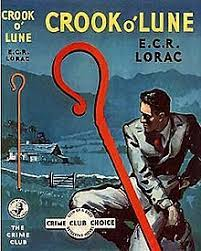
Forgotten Book - Crook O'Lune aka Shepherd's Crook


E.C.R. Lorac has become of the most popular authors in the British Library's Crime Classics series, something which causes me considerable pleasure. I am a fan, but it's also true to say that because she was so productive I still have a lot of entertaining reading ahead of me. The latest book I've devoured is Crook O'Lune, published in 1953. It is a good one, and what's more, as I explained on Monday, it prompted a very enjoyable trip to Lorac country last weekend.

At first, though, I wasn't sure if I was going to love the story. It begins slowly -very slowly. Gilbert Woolfall arrives at Kirkholm Station (based on the real-life Hornby station, which no longer exists) and enjoys an exhilarating walk through fell country. He has inherited a house at High Gimmerdale - which is a fictional version of Roeburndale. In the first three chapters, Lorac presents us with a lot of background information, and although it is relevant, it does mean that the pace and mood are rather low-key. I'm surprised she didn't try to integrate the factual material into the story in a more exciting way.

That said, things begin to warm up once Chief Inspector Macdonald arrives on the scene. He is on holiday - and is thinking of buying a farm in the area - but we all know what happens when fictional detectives go on holiday, don't we? Soon there are stories about sheep-stealing and before long there is a case of arson which has fatal consequences.

From then on, we have Lorac at her best. The characters are well-drawn and presented, for the most part, with compassion as well as insight. The setting is especially well evoked and you can tell how much she loved the area in which she lived. The story, too, turns out to be a pretty good one. All in all, it's well worth hunting for this mystery.

Sunday, 20 March 2022

A pilgrimage to Lorac country

I'm back from a short but exhilarating trip to the countryside E.C.R. Lorac knew so well in and around the north of Lancashire and the Lune valley. The inspiration for this little pilgrimage was Crook O'Lune, her novel of 1953, which is set in the fictitious environs of High Gimmerdale. I'll write about the book in a future Forgotten Books post, but for now I'll concentrate on the visit.

I was lucky to have as my guides on Saturday afternoon Lena and David Whiteley, who have given me a great deal of help in my researches into Lorac's life and work. Lena knew Carol Rivett, who wrote as Lorac and as Carol Carnac, and has very warm memories of her. She and David know the area like the back of their hands and they kindly took me to Roeburndale, which was the real-life model for the setting of the story.


This is sheep farming country (the US title for the book was Shepherd's Crook). The Trough of Bowland is in one of the least densely populated parts of England and it was fascinating to explore the area - our route was eventually blocked by a gate. Two bikers managed to get through, on their way to Slaidburn, which was my next destination. The sat nav, however, took me the long way round. It was a delightful journey as the sun set over the quiet fells.

Lorac often disguises her settings, but in the novel, Chief Inspector Macdonald goes to the Hark to Bounty pub in Slaidburn and enjoys a dinner there. I was pleased to discover that not only is the Hark to Bounty a real pub, they have accommodation too. So we emulated Macdonald (a first-rate steak and ale pie was my choice, not sure what the detective ate!) and went one better, by staying the night as well. It seems from what we were told that Lorac too may have stayed at the Hark to Bounty, I think she must have been impressed, since in truth there was no obvious need for Macdonald to go there; I suspect she just wanted to give them a plug - and why not? Slaidburn is a lovely village and it was good to explore it on a beautiful Sunday morning after a filling breakfast which leaves me needing to lose weight! All in all, a great trip. And an enjoyable book, too.   


Friday, 28 August 2020

Forgotten Book - These Names Make Clues


Image 1 of 1 for undefined

Earlier this year, I was fortunate enough to lay my hands on an inscribed copy of E.C.R. Lorac's These Names Make Clues, an uncommon Collins Crime Club title from 1937; no dust jacket (the one in pictured is an image from Mark Terry's fascinating site of facsimile wrappers), but still a treasured possession. All the more so because the story is an enjoyable one. In fact I'd rate this as one of the more interesting Loracs.

A key reason for my enthusiasm is that this book is more in the realm of the classic "closed circle" puzzle mystery than some of the author's other work. Inspector Macdonald is invited to a Treasure Hunt evening convened by a publisher called Graham Coombe, who shares a big house in London with his sister Susan. His fellow guests are mystery writers, but part of the fun is for their identities to be concealed under pseudonyms.

The seasoned crime fan won't be surprised to learn that this pleasant idea backfires when a death takes place during the treasure hunt. The deceased was an author called Andrew Gardien, and the suspects are the Coombes and the novelists. Complications ensue when Gardien's literary agent is also found dead. Were either of the deaths murder? Macdonald investigates, abetted by a breezy young journalist called Vernon.

What fascinates me particularly about this novel, published in the year that Lorac was elected to membership of the Detection Club, is that there are strong reasons to infer that her initial experience of the Club supplied the inspiration for the story and some of the characters. Coombe may be Billy Collins, but I'm fairly sure that Gardien was inspired (albeit not in terms of his personality) by John Rhode.

I also suspect that Rhode influenced (maybe even suggested to her; he was a generous man) Lorac's choice of m.o. in relation to the two deaths. Other characters seem to me to bear traces of Douglas and Margaret Cole, and Baroness Orczy. As for the plot, it boasts variety and ingenious touches aplenty, though to my mind it's not really a "fair play" whodunit, given that a key fact is revealed rather late on. Definitely a book that deserves better than the obscurity which has been its fate since the 1930s.

Friday, 31 March 2017

Forgotten Book - The Murder on the Burrows

My Forgotten Book for today is The Murder on the Burrows, which in 1931 launched the long and pretty successful career of E.C.R. Lorac. For a debut novel from the Golden Age, it stands up to present day scrutiny rather well, There are a few awkwardnesses about the writing, admittedly. For instance, I think she confuses the ranks of superintendent and sergeant. What's more, the chap who was to become her series cop, Inspector Macdonald (sometimes called Chief Inspector in the story) is given the first name James, although he became Robert in later books.

Overall, though, the story is a good one, and it gets off to a swift start when two men discover an apparently abandoned motor car on the Burrows at Bideford Bay. (This area was a favourite holiday spot for the author). The car proves to contain a dead body inside it, though it soon becomes apparent that the crime was committed elsewhere.

When Scotland Yard is called in, Macdonald focueses his inquiries in London. The dead man had a Russian name, but in reality he was an Englishman who had become a Communist. Lorac does  not dwell on the political aspects of the story, but the deceased is treated rather sympathetically. My impression is that her politics were, at least at this point in her life, left of centre, though I doubt she was one of those Golden Age writers who flirted with Marxism. But there's a liberal flavour to her work in the 30s.

Lorac was keen on music, and this is evident when a classical pianist enters the story. Macdonald is roughly in the Inspector French tradition of persistent, if likeable cop, though the fictional detectives who are name-checked are Poirot and Lynn Brock's Colonel Gore (who at that time was much better known than he is today). Macdonald needs to return to the Burrows to resolve matters, and all  in all the story is neatly constructed. If you could find a first edition of this rare novel in a dust jacket, it would be worth a great deal of money. Lorac has been a collectible writer for some time, and this is a rare title. But I'm glad I managed at least to track down a second hand reprint.

Friday, 2 December 2016

Forgotten Book - Policemen in the Precinct


E.C.R. Lorac published Policeman in the Precinct,,my Forgotten Book for today, in 1949. It's an enjoyable read, and the setting is the precinct of Paulborough Abbey, a fictitious place located somewhere around the Cotswolds. The Abbey and its environs are well realised, suggesting a real life model, though I'm not quite sure what the "original", if there is one, might be. Lorac wanted to disguise the place, perhaps because she has harsh things to say about the gossipy behaviour of the locals, and the selfish, high-handed attitudes of the Dean.

In fact, I found her portrayal of the small world of the Abbey precinct even more interesting than the whodunit puzzle. In saying this, I must add that the "mystery" element of the story is certainly not weak or flimsy. No fewer than four suspicious deaths (not all of them necessarily involving murder) take place, and one of them reminded me of a similar crime in Agatha Christie's Dead Man's Folly, published seven years later. Suspicion switches around a small (perhaps too small?) cast of suspects before Chief Inspector Macdonald figures out the truth.

The key death is that of a malicious gossip called Mrs Mayden. Although this is not a "poison pen letter" story, the point is made that the spreading of unkind rumours about Paulborough people by word of mouth is in the same vein as an outbreak of spiteful letters. Mrs Mayden was a religious fanatic, and Lorac clearly has no time for such folk, or for people who enjoy backbiting.

Macdonald voices sentiments which surely express Lorac's own views: "I''m probably incapable of judging the high ecclesiastic fairly. I'm a Protestant by nature, and priestly arrogance gets all my hackles up".At one point he advocates rehousing the inhabitants of the precincts in the poorest cottages in town:"They might then find so much to do that they might mend their ways of taking excessive interest in their neighbours' visitors.."

Macdonald's humane outlook on life is emphasised, and we also learn a bit about his background. He describes himself as a "London Scot", whose father, a journalist, came from Inverness to London. Macdonald served in the London Scottish during the war, before going up to Oxford, but his father's death during his first year as a student meant that he had to earn a living, prompting a decision to join the Metropolitan Police. He's a bachelor whose batman used to do his chores, before both the batman and his home were bombed out of existence in 1941. Macdonald moved to a modern block of flats, still facing the river, but finds it "a poor way of living, and London seems to have altered such a lot since..I was a boy". This story is a good one, and Macdonald is a very likeable character.

Friday, 18 November 2016

Forgotten Book - Murder by Matchlight


Image result for lorac murder by matchlight

E.C.R. Lorac was not one of the Golden Age's most famous Crime Queens, but she was, perhaps, a Crime Princess. Not quite Christie, Sayers, or Allingham, but a very good writer of detective fiction nonetheless. My parents enjoyed her books in the Fifties, and I used to buy old copies for them when I came across them in catalogues or shops. Having eventually inherited the books, I'm now working my way through them. Fellow Lorac fan Geoffrey McSkimming told me that Murder by Matchlight is one of his favourites, and it's my Forgotten Book for today.

The first thing to say is that Geoffrey is a good judge. This short and snappy novel is a very good read indeed. A well-structured detective story in its own right, it also gains immeasurably from its wonderful presentation of life in wartime London during the blackout. Lorac wasn't the only crime writer to make good use of the blackout as a setting for murder, but I doubt it was often better done, and better integrated into the plot, than here. (So do let me know if you have any favourite rival candidates.)

A young analytical chemist is at a loose end one evening after his girlfriend is unavoidably detained elsewhere. He wanders into Regent's Park, and when someone strikes a match to light up the darkness for a moment, in the matchlight he sees a man with an unusual face. He also hears a thud - and guess what? Someone turns out to have been murdered.

Lorac's regular cop, the amiable but persistent Macdonald, leads the investigation, and finds that the deceased was himself a man of mystery, masquerading under an assumed name. A varied cast of suspects includes a conjuror called Rameses, who lived in the same building as the dead man; fellowtenants also come under Macdonald's microscope. Suspicion shifts around from nne person to another until a satisfying solution is put together. A good mystery.

Friday, 1 April 2016

Forgotten Book - The Organ Speaks


When The Organ Speaks was first published in 1935, Dorothy L.Sayers wrote a rhapsodic review in The Sunday Times, saying that it had an aesthetic value she hadn't previously found in the work of E.C.R. Lorac. She said the story was "highly original, highly ingenious, and remarkable for atmospheric writing and convincing development of character".

High praise, which makes it surprising that the book has disappeared so completely from sight. When copies do surface on the internet or in an auction, they tend to go for high prices. It's taken me a long time, consequently, to track the story down, and see whether it appealed to me as much as it did to Sayers. Now I've read the book, I can see why she liked it, though in my opinion it's  not as successful as the slightly later Bats in the Belfry.

The opening is dramatic. The body of a man called Loudon is founded in a music pavilion in Regent's Park. He has been playing the organ, but has died in the most mysterious circumstances. The cause of death is soon revealed, though. (This is not one of those stories of the type favoured by the likes of John Rhode, where the discovery of a complex murder method comes at the climax.) The challenge for Inspector Macdonald is to find whodunit.

I agree that it's a well-written book, and highly readable. If I were, like Sayers, very knowledgeable about classical music, I might have admired it even more. For me, the whodunit mystery is not particularly impressive, and I'm not sure Lorac played entirely fair in terms of enabling us to deduce the motive. Sayers was less interested in the whodunit aspect of a story than, say, Agatha Christie (or me) and that may be why she valued it so highly. That said, it's definitely worth reading - if you are lucky enough to find a copy.