Showing posts with label John Bude. Show all posts

Friday, 5 November 2021

Forgotten Book - Dead on Time


Nigel Moss is a connoisseur of vintage detective fiction who has recommended a number of interesting writers to me. He was the very first person to encourage me to read John Bude, about a decade ago - some time before the British Library commissioned me to introduce The Cornish Crime Murder and The Lake District Murder. And he was also the first to urge me to give Clifford Witting a try. I made a slowish start with Witting, but the more I've read him, the more his agreeable writing has grown on me.

Dead on Time, first published in 1948, is a good example of his work. It's a murder mystery that isn't lacking in ingenuity. I read this book immediately after finishing a decent effort by John Rhode. One similarity is that in this book, like a number of Rhode's, the good old English pub plays a prominent part in the storyline. The Blue Boar in Lulverton is the scene of the fatal poisoning of Jimmy Hooker, and a plan of the ground floor of the inn is duly provided. 

The criminal's modus operandi here is crafty enough to be worthy of Rhode, but its strength lies in its simplicity, whereas Rhode's schemes are often highly complex. As a general rule, Witting scores over Rhode in terms of characterisation and prose style.There's a lightness, a touch of good nature about his storytelling (as with Bude and indeed George Bellairs) that has genuine appeal. Rhode was capable of pleasing touches of humour, but he was much more prolific than Witting, and such industry, although admirable, isn't conducive to elegant writing.  

The first half of the book is very enjoyable, but the story becomes thrillerish and less engaging prior to a good climax and the revelation of the pub killer. Not a masterpiece, then, but a decent story, well worth reading. And yes, the rabbits on the dust jacket cover are relevant to the story... 

Friday, 28 February 2020

Forgotten Book - Dance for a Dead Uncle

I first became aware of Charles Ashton's work when I was offered the chance to buy an inscribed copy of his last novel, Dance for a Dead Uncle, from the estate of the late Bob Adey. I discovered that it was a locked room mystery, one of three by this author catalogued in Bob's Locked Room Murders. So I took the plunge and bought it, reasoning (rightly or wrongly) that I'd never get a similar chance again.

It's fair to say that Ashton was a fairly obscure writer even in his own lifetime, though in recent times Pietro dePalma and John Norris (two good judges) have heaped praised on his work. He must have been very pleased when his debut novel, Murder in Make-Up, received a pretty complimentary review from Dorothy L. Sayers in the Sunday Times in early 1935. She felt it was "agreeably written"and gave "considerable promise of good work to come". The book featured Jack Atherley, who became a series character, and it also benefited from Ashton's knowledge of the film world; he'd appeared in a considerable number of movies himself before the coming of the talkies seems to have put paid to his career on the silver screen.

Dance for a Dead Uncle was his last novel. It appeared in 1948, when he was 64 (he did, however, live until 1968). I think it's fair to say that by the time this book appeared, his approach to the genre belonged to the past. It's very much in the Golden Age style and not just because of the impossible crime plot. Atherley doesn't appear; the detecting is done by a likeable but lightly sketched Scotland Yard man.

But judged as a Golden Age story, it's not at all bad, in a quiet, undemonstrative way. If, for instance, you like John Bude, you'll probably enjoy this one. The set-up is intriguing, as a deceased spiritualist asks two sceptical nephews to take part in a rather odd, not to say unlikely, arrangement in a locked room where his coffin is to be found. You've guessed it - one of the nephews is duly murdered. But how was it done, by whom, and why? I didn't figure out the answers to these questions, and although the story lacks the atmospheric vigour of John Dickson Carr, it's quite a good example of the classic locked room mystery. I can see why Bob tracked down a copy and kept in his wonderful collection.

Sunday, 4 November 2018

The Christmas Card Crime


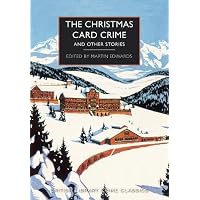
The Christmas Card Crime and Other Stories (British Library Crime Classics)

So much has been going on lately that I've not even blogged  until  now about my latest anthology in the British Library Crime Classics series. It's a seasonal compilation, The Christmas Card Crime and other stories, and it's my third anthology of this type, following Silent Nights and Crimson Snow. In all, I've edited eleven collections of short stories for the BL, and there's another to come in the first part of 2018, Deep Waters.

With this book, I wanted to concentrate on less familiar winter and Christmas stories. The three which I think dedicated crime fans are most likely to have encountered are those by Baroness Orczy, John Dickson Carr, and Cyril Hare, but there are some pretty rare tales, including the title story, written by Donald Stuart. Stuart was one of several pen-names written by the author best known as Gerald Verner, and whose real name was J.R.S. Pringle.

There's a relatively unfamiliar story by Ronald Knox, and also one by Francis Durbridge. John Bude and John Bingham, two very capable novelists who seldom wrote short stories, are also represented, while other contributors include E.C.R. Lorac and Julian Symons, both of whom are, like Bude, the authors of a number of novels in the Crime Classics series.

Apparently, this book shot into the independent bookseller bestseller lists, and last time I looked, it was also riding high in the Amazon crime anthology bestseller charts. Last week, the kindle version and the paperback featured at number one and number two respectively. Whatever one thinks of bestseller charts, that can't be bad.

So, here's hoping that this book will (along with Gallows Court, obviously....) help to solve your Christmas present buying dilemmas! And I'd also like to recommend another British Library title which is sure to be a highly popular stocking filler. This is Kate Jackson's The Pocket Detective, a compilation of puzzles for fans of the Crime Classics series. I'm working my way through it right now, and having a great deal of fun.

Friday, 10 March 2017

Forgotten Book - A Twist of the Rope

The revival of interest in the crime fiction of John Bude is nothing less than astonishing. A few years ago, I was barely aware of him, and had read none of his books. Then Nigel Moss, a keen collector of Golden Age fiction, and one of the most knowledgeable authorities on the subject, told me how much he liked Bude's work, and kindly gave me a copy of one of the author's books. Some time after that, the British Library asked me to write introductions to Bude's first two mysteries, which they were planning to reprint.

The rest is history. The Cornish Coast Murder and The Lake District Murder proved hugely popular, and have since been followed in the Crime Classics series by The Sussex Downs Murder, The Cheltenham Square Murder, and Death on the Riviera. Another Bude novel is also due to appear in the series in due course - more of that at a later date. Meanwhile, I've been trying to find out as much about Bude and his work as I can, not least from members of his family, whose help has been invaluable.

Despite the success of the Bude reprints, his other books are still very hard to find, but my Forgotten Book for today is his penultimate novel, published in 1958. A Twist of the Rope is praised by Herbert Harris in an essay about Bude in Twentieth Century Crime and Mystery Writers, dating back to 1980, and this tempted me to have a look at the story. It's a pacy novel, a thriller in much the same style and mood as those black and white crime B-movies that were popular in the late 50s..

It's a multiple viewpoint story. A deranged serial killer has escaped from an asylum, and takes refuge with an astonishingly obliging woman - I have to say that I found the police's failure to pick him up quickly rather unimpressive. We also follow the intertwined lives of several other people in the same small town, including a young guitar player called Johnny who falls for a rich but flaky young woman. When the girl is killed, it seems at first that the crazy serial killer is responsible. But Bude shifts the suspicion for the crime around quite neatly. It's a sound mystery, very much in keeping with its period, and reflecting Bude's desire to move with the times and update his approach to the genre, something he accomplished quite effectively.


Monday, 29 February 2016

Serpents in Eden and other British Library Crime Classics


The British Library is responding to reader demand by continuing to publish a diverse range of titles in its Crime Classics series. The latest John Bude book, Death on the Riviera, which is in my opinion highly enjoyable, is selling tremendously well, while my anthology Murder at the Manor is also going great guns. The next anthology in the series, Serpents in Eden, is now out, and here I've gathered together stories about crime in the countryside. Some great writers features - Conan Doyle, E.C. Bentley, Margery Allingham and the under-valued H.C. Bailey among them. And there are also some less familiar names, including Leonora Wodehouse - yes, the daughter of the legendary P.G....

I'd also like to mention two other novelists whose work is due to appear in the series shortly. The first is Miles Burton, one of the aliases of Major John Cecil Street - crime fans know him best as the ultra-prolific John Rhode. The BL have opted to publish two of his stories about Desmond Merrion - The Secret of High Eldersham and Death in the Tunnel.

A writer who was, I have to confess,previously unknown to me before the BL identified his potential is John Rowland. He usually wrote about Inspector Shelley, who features in Murder in the Museum and Calamity in Kent. In writing my introductions to the books, I benefited greatly from information supplied by Fytton  Rowland, son of the author, and I discovered that Rowland was an interesting chap whose other writing included a tribute to Eden Philpotts and a number of true crime books -including a significant study of the Wallace case.

There's plenty more to come in the second half of the year, including another anthology, and a book that has a quite unique dimension; I'm especially excited about the latter project. At present, my lips are sealed, but all will be revealed before too long!

Friday, 3 October 2014

Forgotten Books - Forgotten No More?


Over the years that I've been writing this blog, many pleasurable things have happened as a result of my posts. The response to my snippets about "forgotten books" has been especially heartening. I've been a fan of Golden Age books - as well as contemporary mysteries, of course - for many years. Before the internet came along, however, I knew relatively few people who shared this fascination to anything like the same extent. Christie, Sayers, Allingham, Tey, and Marsh were consistently popular,but that was about it, in my experence. How things have changed. Now I am in touch with people all around the world who enjoy Golden Age fiction,and I've learned a great deal from them.

There's remarkable enthusiasm for the Golden Age in Britain right now. I know several people whose collections of rare titles make mine seem inconsequential by comparison, and in the past few years I've met scores of men and women whose delight in 'forgotten books' matches my own. Significantly, the 'Forgotten Authors' panel at Crimefest is so popular that it has become a very well attended annual event. Preparations for next year's session are already underway. There is a genuine appetite among readers across the UK, as well as further afield, for older books, including some that until recently were very obscure indeed. A number of publishers - Ostara and James Prichard's Langtail Press are admirable examples that spring to mind - have brought old books back into print at affordable prices. And the British Library has lately been doing absolutely sterling work in this field, with their Crime Classics series.

It's only eight months since I blogged about J. Jefferson Farjeon's Mystery in White, and since then, the BL has not only decided to publish it, but invited me to write an intro for the new edition. Now I've been told (and kindly permitted to share the news) that early sales have been so high that publication has been brought forward to this week. By the time you read this post, about five thousand copies of the book will have been sold in no time. I wonder if the original book sold as many in all the years it was available. (The answer may be yes, as Farjeon was a popular writer in his day, but many perfectly good contemporary novels fail to sell this many copies, let alone with such speed..)


Two highly successful titles in the series have been the first two crime novels written by John Bude. As a result, I was delighted to hear from the author's daughter, who has given me fresh information about her father, and about his involvement with the Crime Writers' Association in its early days. This will all help to bolster the material we have in the CWA archives - and the archives are a topic that I'll write about at greater length in the future. In a month's time copies of Bude's third book, The Sussex Downs Murder, will be available from Waterstones, who, I understand, have exclusive rights to sell it until mid-January. The fact that such a major bookshop is excited about a reissue of a book by John Bude is really pleasing. It wouldn't have happened ten, or even five years ago, I'm sure. Naturally, I was delighted when I was asked to write an intro to that book too.


And there's one more book from the BL that Golden Age fans can start looking forward to right now, again exclusively from Waterstones at first. This is Murder in Piccadily by Charles Kingston. I hadn't heard of either author or book until fairly recently, but plunged into research mode once the BL mooted its publication as a possibility and duly wrote another intro. All the indications at this stage are that this too will be a reissue that sells really well. Next year will see more titles in this series from the BL and I'm confident that the programme for 2015 (and for 2016, come to that) will, when public knowledge, appeal to a great many people, including those who in the past may not have been especially interested in period mysteries.

There are several reasons why these books are enjoying such success. The British Library takes a huge amount of credit, both for its enthusiastic marketing and its terrific cover artwork. But books don't sell unless readers want to buy them, and the excellent sales figures must be an accurate reflection of customer demand, primarily in Britain, but also overseas I'm also really pleased that my US publisher, the splendid Poisoned Pen Press, has recently become involved with distribution of titles in the States. And with The Golden Age of Murder due to be published next May, I'm daring to hope that, for once in my life, I've got my timing right...


Thursday, 21 November 2013

Murder in Cornwall and the Lake District


I'm able to share some exciting news - well, exciting for me and, I hope, some of the Golden Age fans among you. In the new year, the British Library will be publishing two more rare Golden Age novels, and each book will include a new introduction, written by me. The novels are both written by John Bude, and were his first two published detective stories.

John who? Well, until a couple of years ago, I'd never heard of John Bude either. Then I visited a friend who has a wonderful collection of Golden Age books,and he told me that he thought Bude was very under-rated. He was even kind enough to give me a copy of one of Bude's later books, Death in Ambush. Before long, I discovered that Bude was actually a member of the small group that founded the Crime Writers' Association, exactly sixty years ago. But he died about four years later and his reputation soon died too.

A pity,because my friend is right - Bude writes both readably and entertainingly. His work may not have been stunning enough to belong with the greats, but there is a smoothness and accomplishment about even his first mystery, The Cornish Coast Murder, which you don't find in many debut mysteries. I was, naturally, fascinated to discover that his second book was set in the Lake District, and I felt he captured the atmosphere of the area rather more interestingly than the more acclaimed Newton Gayle, whose Sinister Crag I discussed here a while back.

The British Library has, I think, done a very good job with the artwork for the covers, and I'm really pleased to be associated with these revivals. Bude's two long lost novels are well worth reading - I wouldn't describe either as a complex whodunit, but the setting and characterisation is definitely a cut above what most of his contemporaries managed. And of course I hope that more Golden Age reprints will follow before long.