Showing posts with label Gerald Verner. Show all posts

Monday, 9 March 2020

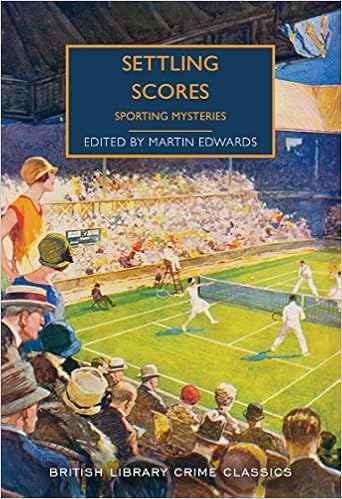
Settling Scores


Tomorrow sees the publication in the UK of my latest anthology in the British Library's series of Crime Classics. The unifying theme of Settling Scores is not revenge, but sport. Each story is not only by a different author, but it features a different sport. I'm not aware of any other crime anthology which is quite the same; there was a splendid book edited almost 80 years ago by Ellery Queen, Sporting Blood, but that one included poker, chess, and butterfly collecting.

I'm often asked what my favourites are among my own books - assuming that I do have favourites. Well, I never release a book on an unsuspecting world unless I'm happy with it, and it seems worthy of publication. And naturally it's a matter of personal and professional pride to try to make sure that each book is as good as it possibly can be. That said, inevitably there are books which give rise to different feelings - especially after a lapse of time. And different levels of satisfaction too.

Among my British Library anthologies, I'm especially proud of Foreign Bodies, because of its ambition, and several others, such as The Measure of Malice, strike me as interestingly different from the general run of anthologies. And Settling Scores is right up there, partly because there are some fascinating stories, and partly because I find it intriguing to see how different authors have set about integrating a sporting background into their narrative. I'm hopeful the book will do well.

So what of the specific contents? There's a long story by Julian Symons, set around Wimbledon, and a characteristically accomplished one by Celia Fremlin which is a bit different because it concerns a school sports day. And then there are stories by little-known figures such as F.A.M. Webster, David Winser, and Gerald Verner. Each of these three men, by the way, had a very interesting life, and I recently read a biography of Verner by his son Chris which I'm hoping will be published fairly soon. In the meantime, if you like sport, or if you hate sport but love crime fiction, do consider giving Settling Scores a try...

Sunday, 4 November 2018

The Christmas Card Crime


The Christmas Card Crime and Other Stories (British Library Crime Classics)

So much has been going on lately that I've not even blogged  until  now about my latest anthology in the British Library Crime Classics series. It's a seasonal compilation, The Christmas Card Crime and other stories, and it's my third anthology of this type, following Silent Nights and Crimson Snow. In all, I've edited eleven collections of short stories for the BL, and there's another to come in the first part of 2018, Deep Waters.

With this book, I wanted to concentrate on less familiar winter and Christmas stories. The three which I think dedicated crime fans are most likely to have encountered are those by Baroness Orczy, John Dickson Carr, and Cyril Hare, but there are some pretty rare tales, including the title story, written by Donald Stuart. Stuart was one of several pen-names written by the author best known as Gerald Verner, and whose real name was J.R.S. Pringle.

There's a relatively unfamiliar story by Ronald Knox, and also one by Francis Durbridge. John Bude and John Bingham, two very capable novelists who seldom wrote short stories, are also represented, while other contributors include E.C.R. Lorac and Julian Symons, both of whom are, like Bude, the authors of a number of novels in the Crime Classics series.

Apparently, this book shot into the independent bookseller bestseller lists, and last time I looked, it was also riding high in the Amazon crime anthology bestseller charts. Last week, the kindle version and the paperback featured at number one and number two respectively. Whatever one thinks of bestseller charts, that can't be bad.

So, here's hoping that this book will (along with Gallows Court, obviously....) help to solve your Christmas present buying dilemmas! And I'd also like to recommend another British Library title which is sure to be a highly popular stocking filler. This is Kate Jackson's The Pocket Detective, a compilation of puzzles for fans of the Crime Classics series. I'm working my way through it right now, and having a great deal of fun.

Monday, 6 February 2017

Gerald and Chris Verner - a fascinating collaboration

Gerald Verner was a prolific writer of crime and thriller stories, sometimes under his own name, sometimes under pseudonyms. I've recently become interested in his work, and luckily enough I was put in touch with his son Chris and his agent Philip. Chris told me about a project that he undertook, concerning The Snark Was a Boojum! I was duly intrigued, and I asked if he'd consider talking about it in a guest post. He was kind enough to agree, and this is his story:

"My father began a trilogy featuring his flamboyant artist-detective Simon Gale with “Noose For A Lady” published by Wright & Brown in 1952, the novel of his BBC eight part Radio Serial Play of the same name. The book was made into a 73 min film in 1953 by Insignia Films Directed by Wolf Rilla which has recently been ‘discovered’ and released on DVD. A second book to feature Simon Gale “Sorcerer’s House” was published by Hutchinson in 1956. A third book “The Snark Was A Boojum!” was announced in the press the following year, begun but due to various personal problems never completed.

The murderer based his crimes on selected verses from Lewis Carroll’s nonsense poem “The Hunting of the Snark”. The book was divided into three parts commencing with The Vanishing. Part two was The Hunting, concluding with part three The Snark! There were two versions of Part One of the book, a third person account and a revised version in the first person, describing events seen through the eyes of Jeff Trueman, a guest at Hunter’s Meadow. I read the revised version and immediately understood why my father had made the changes - the story works much more intimately. In 2015, persuaded by Gavin O’Keefe at Ramble House, I resolved to finish it. I began a process of completely revising the story from the beginning, major additions and rewrites for part two, and adding the final part, the solution: The Snark!

As I typed up Part One, I jotted down Gale’s character traits by looking up passages in Noose for a Lady and Sorcerer’s House. This also helped me to avoid inconsistency in the writing style, enabling me to adapt or borrow elements of the two books when my father’s pages ran out… Of course, eventually they did run out. It was like travelling along on a train and suddenly noticing there were no more rails ahead. I was suddenly on my own! In moving forward, I also had to go backwards and rewrote most of Part Two, cutting quite a lot out and putting different scenes in to make my plot work. The story wouldn’t let me go, and I couldn’t let it go, because I realised I would never be able to pick it up again once it had gone out of my head. Bit by bit I laid down new track, and inched along it, giving chapters to my wife Jenny to read, in order to get the point of view of someone not down in the cake mix. If it didn’t feel right I worked it again until it did. It was an intense process and I thoroughly enjoyed it. Suddenly, the book was finished, and in the surprisingly short time of 35 days.

I sent the completed manuscript to my agent Philip Harbottle with some trepidation on 16th April. The following day Harbottle sent an email to Gavin O’Keefe: “I have some exciting news for you!”  Then all hell broke loose! Four days later Ramble House issued a contract, a proof of the book, and a draft of the cover design by Gavin L. O’Keefe! By the 24th April the paperback was on sale at Amazon. That must be some kind of a record."


Wednesday, 14 January 2015

Noose for a Lady - film/DVD review

Noose for a Lady is a 1953 whodunit film which seemed to have been well and truly forgotten until its recent release in DVD form. Having just watched it, I must say I'm glad it's been resurrected, because it presents a highly traditional whodunit in the space of just over 70 minutes and provides decent entertainment from start to finish. The director, Wolf Rilla, by the way, later became renowned for The Village of the Damned, based on John Wyndham's classic sci-fi novel The Midwich Cuckoos.

The set-up is very familiar. A woman has been convicted of murdering her husband and sentenced to death. An appeal fails, and her fate seems to be sealed by the time a cousin (Dennis Price, that great post-war smoothie) returns from Uganda and decides she is innocent, and must be saved. So we have a clock-race element coupled with a hunt for a killer among the genteel family and social circle of the dead man.

Suspicion shifts pleasingly from one suspect to another. Is the killer the suave doctor (Ronald Howard) or the dodgy collector of knick-knacks (Charles Lloyd Pack, father of Roger Lloyd Pack, and grandfather of Emily Lloyd)? Or perhaps a retired soldier with a discreditable past, or the local busy-body, or the pretty girl Price's character fancies? Or...well, you get the picture.

The film is based on a novel by Gerald Verner, which in turn appears to have been based on a radio serial - this would explain why it is very dialogue-heavy. I've never read anything by Verner, but he was certainly prolific, with well over one hundred novels to his credit. He also adapted Agatha Christie's Towards Zero for the stage. It seems that Edgar Wallace was a major influence on him, but this story is more in the Christie vein. It's a competently made, unpretentious film, and like so many hitherto neglected books and films, it's now enjoying a new lease of life as it becomes, happily, cheaper and easier to make such work available to a new generation of fans at modest cost.