Showing posts with label Nigel Moss. Show all posts

Friday, 5 November 2021

Forgotten Book - Dead on Time


Nigel Moss is a connoisseur of vintage detective fiction who has recommended a number of interesting writers to me. He was the very first person to encourage me to read John Bude, about a decade ago - some time before the British Library commissioned me to introduce The Cornish Crime Murder and The Lake District Murder. And he was also the first to urge me to give Clifford Witting a try. I made a slowish start with Witting, but the more I've read him, the more his agreeable writing has grown on me.

Dead on Time, first published in 1948, is a good example of his work. It's a murder mystery that isn't lacking in ingenuity. I read this book immediately after finishing a decent effort by John Rhode. One similarity is that in this book, like a number of Rhode's, the good old English pub plays a prominent part in the storyline. The Blue Boar in Lulverton is the scene of the fatal poisoning of Jimmy Hooker, and a plan of the ground floor of the inn is duly provided. 

The criminal's modus operandi here is crafty enough to be worthy of Rhode, but its strength lies in its simplicity, whereas Rhode's schemes are often highly complex. As a general rule, Witting scores over Rhode in terms of characterisation and prose style.There's a lightness, a touch of good nature about his storytelling (as with Bude and indeed George Bellairs) that has genuine appeal. Rhode was capable of pleasing touches of humour, but he was much more prolific than Witting, and such industry, although admirable, isn't conducive to elegant writing.  

The first half of the book is very enjoyable, but the story becomes thrillerish and less engaging prior to a good climax and the revelation of the pub killer. Not a masterpiece, then, but a decent story, well worth reading. And yes, the rabbits on the dust jacket cover are relevant to the story... 

Friday, 1 May 2020

Forgotten Book - Death of a Frightened Editor

Dean Street Press have done excellent work in reviving a wide range of vintage detective fiction titles and one of their latest rediscoveries is the husband and wife partnership of E. and M.A. Radford. These books benefit from informative introductions by Nigel Moss, and I've just read Death of a Frightened Editor, which was first published in 1959.

This is a novel brimming with Golden Age tropes. We have an apparent "closed circle" of suspects, the seven people who regularly travel in the first class coach of the London to Brighton train, all of whom seem to have a reason to wish the eighth person dead. We have poisoning by strychnine. We have a character leading a double life. We have gossip and mischief-making in country houses. We have a disparity between the victim's legitimate earnings and his evident wealth. We have a scientific puzzle worthy of Austin Freeman. We have...well, you get the picture.

The lead detective is Doctor Manson, who is not only a scientific expert in the Thorndyke class but happens to work for Scotland Yard. The technical trickery at the heart of the plot is rather neat - as with the Cecil M. Wills book I reviewed here last week. Mind you, I was rather baffled as to why this particular group of seven suspects should travel so regularly with the unpleasant victim.

The Radfords only turned to crime writing in their fifties, but they became quite prolific. I enjoyed a passing reference to the then fledgling Crime Writers' Association - my guess is that members of the CWA at that time liked to mention it in their books in order to boost its public profile. In many ways, this book reads as though it was written in the mid-30s - it's very different from the kind of novel that Julian Symons and Margot Bennett were publishing in the late-50s, in terms of plot, characterisation, and prose style. And it's a reminder that, long after the Golden Age, there were still plenty of writers around who were working in the traditional vein. 

Friday, 17 April 2020

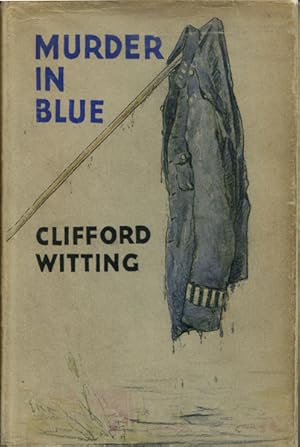
Forgotten Book - Murder in Blue


clifford witting - murder in blue - AbeBooks

Murder in Blue, published in 1937 by Hodder & Stoughton, was the first detective novel of Clifford Witting. It was an auspicious debut, proclaimed by Hodder as "a first-class detective story...about the murder of a policeman". It's interesting to compare the first edition of this book with first editions written by debut authors today. Now, readers are always presented with information about the author. Publishers are keen, almost to the point of obsession sometimes, to focus on an author's "platform", i.e. the means by which, it's thought, he or she can attract readers. It was very different in 1937. We are not told a word about Witting.

So who was he? I don't possess a lot of biographical information but I do know that Clifford Witting (1907-68) was educated at Eltham College and worked for many years for Lloyds Bank. He enjoyed a long career as a crime novelist, spanning 27 years, but was much less prolific than many others who started during the Golden Age. In that time he published sixteen novels. Quite possibly, like Cyril Hare for instance, his day job reduced his literary output. But lack of productivity is no bad thing if it is matched by a corresponding increase in quality. He wrote accomplished traditional mysteries and in 1958 he was elected to membership of the Detection Club, a sign of the esteem in which he was held by fellow practitioners.

Nick Fuller writes about Witting on the excellent gadetection site, and asks why he is so obscure, given the engrossing nature of his stories. It's a good question. I missed out on Witting for many years and it was only because of the advocacy of Nigel Moss, an excellent judge, that I sampled him. I'm glad I did, because all the books of his that I've read have merit.

Narrated by a likeable bookseller, John Rutherford, and set in a thinly disguised Sussex, Murder in Blue introduced Detective Inspector  Charlton, who was to become a series character. There's more focus on characterisation and setting than you find in, say, most of the Freeman Wills Crofts books, and definitely more humour. Witting was witty! The story begins extremely well thanks to Witting's smooth narrative style, although I felt it sagged in the later stages. Overall, however, a decent start to a career of under-valued accomplishment.


Friday, 18 October 2019

Forgotten Book - A Bullet for Rhino

Clifford Witting (1907-68) is one of those writers who flew somewhat under the radar. His work isn't often discussed, but he was elected to membership of the Detection Club ten years before his death, and his books are admired by such knowledgeable aficionados as Barry Pike and Nigel Moss. Nigel it was who lent me his copy of A Bullet for Rhino, originally published in 1950, and I'm glad he did.

This was the ninth case for Inspector Harry Charlton, a likeable fellow who happens to be an old boy of Mereworth School. He's invited to a reunion, at which, he's told, his well-known but highly controversial contemporary "Rhino" Garstang will be present. But it becomes clear that someone is anxious for him not to attend. It's clear (and not merely from the title) that murder is in the air. And as soon as we are introduced to Rhino, it's clear that he is a very suitable victim. He is one of those Golden Age victims who makes a point of giving people reasons to kill him. Most unwise.

Even though this is a post-war novel, it certainly has a Golden Age flavour. The restricted private school setting, so popular with Golden Age novelists, contributes to this. And Charlton here acts rather like an amateur detective, with the local cops taking charge when someone tries to blow up Rhino. The clever finale in particular seemed to me to be more typical of a Golden Age mystery than a conventional police story.

A cricket match at the school plays quite a significant part in the storyline, and as a cricket fan myself, I found this pleasing. Possibly those who aren't cricket lovers may be less impressed, but again cricket, with its ethos of fair play, is very much a game in keeping with the Golden Age tradition. All in all, I liked this book and felt Nigel's recommendation was spot on. 


Friday, 22 February 2019

Forgotten Book - The Strange Case of Harriet Hall

Dean Street Press have done great work in recent years, making available again a very large number of previously obscure Golden Age mysteries. Although their main market is in ebooks, they also issue print versions which are nicely produced paperbacks and which are well worth seeking out if you prefer that format (as I do). Their approach has enabled them to print long runs of the works of certain authors, such as Punshon and Bush, and this is a valuable service for readers. Not so much because thousands of people will want to read the complete works, but because at long last fans have the chance to pick and choose titles, according to their taste.

The Press's latest ventures have been to reissue books by authors I haven't previously read, Moray Dalton and E. and M. Radford. Another merit of their approach is that they include informative introductions. The Dalton books are introduced by Curtis Evans, and the Radford books by Nigel Moss. And in the case of Dalton's The Strange Case of Harriet Hall, there is also a very useful afterword which deals with a subject that would otherwise be a spoiler.

Moray Dalton was the pen-name of Katherine Dalton Renoir (1881-1963), who wrote a couple of early novels before indulging in criminal fiction from 1924 to 1951. In that time, she produced no fewer than 29 books, but they have long been hard to find; now Dean Street Press has issued five, and there may well be more to come. In her early days, she shared a publisher with E.C.R. Lorac, but never achieved anything approaching Lorac's success.

On the evidence of this book, Dalton was a good writer. She has a nice turn of phrase, and her interest in character is striking. I was impressed. There is also a memorable plot twist before the story is half-way through. On the debit side, there is a certain lack of focus about the story. We begin with one likeable character who has an odd encounter with Harriet Hall before attention switches to tensions within the Dene family, which comprises a mother and three siblings. The Denes clearly fascinated Dalton, and relations within the family become central to the story. I felt that the later plot developments didn't exactly reflect a commitment to fair play plotting, and I sensed that Dalton was less concerned about unravelling the mystery in a satisfactory fashion than most Golden Age writers. This may help to account for her obscurity. But her prose, straightforward and readable, is of a quality to make this novel well worth reading. 

Friday, 25 January 2019

Forgotten Book - The Middle Temple Murder


Image result for middle temple murder

This year marks the centenary of the book that made J.S. Fletcher's name. So it is fitting that The Middle Temple Murder should now make an appearance in the Detective Club series of reprints. And the first thing to say is that it's certainly worth reading if you're not familiar with it. This edition also benefits from an introduction by Nigel Moss, who makes the point that the plot is "well-constructed, complex and entertaining". As he says, Fletcher doesn't leave loose ends, and the storyline is rather pacier than many others of the period immediately before the arrival on the scene of Agatha Christie.

Frank Spargo, a young newspaperman, happens to discover the body of a murdered man in the entrance to Middle Temple Lane, a part of legal London that lawyers like Nigel (and me) are very familiar with. Spargo is a likeable character, and he lurked in the recesses of my mind when I first thought up Jacob Flint, the journalist in Gallows Court. As Nigel points out, the book has "a surprisingly modern feel, brisk and light." A bonus is the inclusion of a short story, "The Contents of the Coffin", which Fletcher drew on for a strand of the plot of the novel. The short story features Archer Dawe, an inquiry agent who doesn't appear in the novel.

Fletcher continued to write through the Golden Age, although in style and focus his detective fiction really belonged to an earlier period. He was extraordinarily prolific, and that counted against him. Like so many other mass producers of crime fiction, he struggled to maintain quality control. But at his best, he wrote very agreeable stories. By common consent, this is the best of them, although I suspect there may be a few little-known gems lurking in his backlist.

Harper Collins have announced that, following this title's publication, they are pausing the Detective Club hardback reprint series. I hope that it returns one day, but already the project has made a very welcome contribution to the revival of interest in Golden Age fiction. It's a highly eclectic series, including books by everyone from Gaboriau to Agatha Christie and many wonderful obscure titles as well. I have been very happy to contribute intros to five books in the series, and it's been especially gratifying to see two novels by Donald Henderson back in print after many years of being absent from the shelves. The editor who has overseen the series from day one is David Brawn, and fans of classic crime owe him a real debt of gratitude. 


Friday, 10 March 2017

Forgotten Book - A Twist of the Rope

The revival of interest in the crime fiction of John Bude is nothing less than astonishing. A few years ago, I was barely aware of him, and had read none of his books. Then Nigel Moss, a keen collector of Golden Age fiction, and one of the most knowledgeable authorities on the subject, told me how much he liked Bude's work, and kindly gave me a copy of one of the author's books. Some time after that, the British Library asked me to write introductions to Bude's first two mysteries, which they were planning to reprint.

The rest is history. The Cornish Coast Murder and The Lake District Murder proved hugely popular, and have since been followed in the Crime Classics series by The Sussex Downs Murder, The Cheltenham Square Murder, and Death on the Riviera. Another Bude novel is also due to appear in the series in due course - more of that at a later date. Meanwhile, I've been trying to find out as much about Bude and his work as I can, not least from members of his family, whose help has been invaluable.

Despite the success of the Bude reprints, his other books are still very hard to find, but my Forgotten Book for today is his penultimate novel, published in 1958. A Twist of the Rope is praised by Herbert Harris in an essay about Bude in Twentieth Century Crime and Mystery Writers, dating back to 1980, and this tempted me to have a look at the story. It's a pacy novel, a thriller in much the same style and mood as those black and white crime B-movies that were popular in the late 50s..

It's a multiple viewpoint story. A deranged serial killer has escaped from an asylum, and takes refuge with an astonishingly obliging woman - I have to say that I found the police's failure to pick him up quickly rather unimpressive. We also follow the intertwined lives of several other people in the same small town, including a young guitar player called Johnny who falls for a rich but flaky young woman. When the girl is killed, it seems at first that the crazy serial killer is responsible. But Bude shifts the suspicion for the crime around quite neatly. It's a sound mystery, very much in keeping with its period, and reflecting Bude's desire to move with the times and update his approach to the genre, something he accomplished quite effectively.


Monday, 1 June 2015

All the Fun of the Book Fairs


One of the sub-plots, so to speak, of The Golden Age of Murder concerns the stories that are evident, or implicit, in some of the inscriptions by authors in their Golden Age whodunits. This is a subject that has intrigued me for a number of years, and in the book,I've discussed inscriptions by Agatha Christie, Henry Wade, and others that I find appealing. But of course, it is rather hard to track down such books.

I succumbed to temptation, therefore, when down in London on Friday..For the first time,two major book fairs, one run by the PBFA, the other a major international event, were run in tandem, with a shuttle bus linking the two events. I met up with a couple of friends, including the doyen of Golden Age commentators, Barry Pike, and set about haunting the bookstalls.

There were many fascinating books on display. Some of them would have been totally irresistible had they been affordable. But I did pick up a number of titles. Most of these come from the collection of the late Bob Adey, who assembled many treasures over the course of about fifty years. I've never seen such a remarkable collection, and I'm glad that I've been able to acquire just a few of them. Among those that were out of reach,by the way, were two editions of the famously rare The Curious Mr Tarrant, by C. Daly King. One of them had an ownership signature of Ellery Queen - wow...

My haul was more modest, but I was very pleased with it nonetheless, and I did find some very interesting inscriptions. One example is to be found in a copy of Robert Player's first book, The Ingenious Mr Stone, and another in John Dickson Carr's Fire, Burn! - Carr often wrote lengthy inscriptions, and this is a good one, though not easy to read! The Evelyn Elder novel in the picture above is not inscribed, but it was such a lovely copy that I couldn't resist it, knowing that I'm never likely to see another.

I'll be talking more about the inscribed books on another occasion, but suffice to say that it was a thoroughly satisfying pair of events. And it was rounded off by most enjoyable dinner with Barry Pike and a notable collector, my friend and fellow employment lawyer Nigel Moss. Barry has, by the way, already written his talk on Allingham and Sayers for the Bodies from the Library conference on 20 June, and I'm sure fans of those two writers would love to hear it. Book now while a few tickets remain available - the event is expected to sell out.