Showing posts with label Clifford Witting. Show all posts

Friday, 21 July 2023

Forgotten Book - Let X be the Murderer


One of the sessions at Bodies from the Library was a conversation between Richard Reynolds, formerly a great bookseller at Heffers in Cambridge, and Robert Hyde of Galileo Publishing, an indie press based in the same city. They were discussing the life and career of Clifford Witting, a writer whose work I've discussed several times on this blog. And very interesting it was too.

The latest Galileo title is Witting's Let X be the Murderer, which was first published in 1947. Once again it features Inspector Charlton, an amiable but shrewd detective. In this story, DS Martin takes a phone message from elderly Sir Victor Warringham, who makes the extraordinary claim that a ghost has just attempted to strangle him.

So begins an intriguing mystery. Charlton accompanies Martin to Sir Victor's home, Elmsdale, but they find that a couple called Harler are reluctant to allow them to see the old man and they claim he is mentally infirm. On the other hand, the housekeeper Mrs Winters - who has clearly taken a dislike to the Harlers - clearly thinks that there's nothing wrong with the old man's mind. When a solicitor turns up on the scene, it's apparent that Sir Victor is contemplating making a new will. In a vintage detective novel, we all know what that means, don't we?

Except that the death which follows is not the one you might expect. And Witting continues to spring surprises as the story proceeds. The book is written in his characteristically light, agreeable style, and although the cast of characters is limited, he manages to juggle suspicion around very nicely. Overall, I'd say this is one of the best Wittings I've read. The cover artwork, it must be said, owes a great deal to the British Library house style, and I'm not quite sure why Galileo don't have the confidence to come up with a distinctive style of their own. They are doing good work by reviving Witting's novels, and reminding us that there are plenty of entertaining writers out there whose work has been unavailable for far too long.

Friday, 8 April 2022

Forgotten Book - Mischief in the Offing


Sussex isn't a county that I know particularly well, but during my last two visits to Rye, I've made a point of travelling round and enjoying the county's coastline and the rural landscape. It's a nice part of the world, for sure. So I was tempted by the setting of Clifford Witting's Mischief in the Offing. The action of the story takes place in Wilchiston, a thinly veiled version of the village of Alfriston. 

The story begins with the arrival of a strange visitor at John Denman's cottage. An attractive young woman called Kay Forrester turns up, seeking sanctuary. She claims to have been molested by a man with a gun. John is a likeable fellow, but he soon has reason to believe that she isn't telling him the truth. And then a shot is fired at the cottage.

This is a good start, but after that the pace falters, to put it mildly. Witting's writing style can fairly be described as discursive, but here 'rambling' might be a better word. There's a lack of focus in the storyline and I found it difficult to care much about what was happening. Yet there are compensations, including the agreeable presentation of rural life (including a game of stoolball) and touches of Witting's amiable humour.

This book appeared in 1958, at the time Witting was elected to membership of the Detection Club, and there are one or two nice plot features, including a revelation in the final sentence. For me, though, the story lacked tension. I like the fact that Witting was not content to rest on his laurels as a writer, and didn't keep resorting to the same-old,same-old. But this one is a decidedly minor entry in his catalogue.

Friday, 5 November 2021

Forgotten Book - Dead on Time


Nigel Moss is a connoisseur of vintage detective fiction who has recommended a number of interesting writers to me. He was the very first person to encourage me to read John Bude, about a decade ago - some time before the British Library commissioned me to introduce The Cornish Crime Murder and The Lake District Murder. And he was also the first to urge me to give Clifford Witting a try. I made a slowish start with Witting, but the more I've read him, the more his agreeable writing has grown on me.

Dead on Time, first published in 1948, is a good example of his work. It's a murder mystery that isn't lacking in ingenuity. I read this book immediately after finishing a decent effort by John Rhode. One similarity is that in this book, like a number of Rhode's, the good old English pub plays a prominent part in the storyline. The Blue Boar in Lulverton is the scene of the fatal poisoning of Jimmy Hooker, and a plan of the ground floor of the inn is duly provided. 

The criminal's modus operandi here is crafty enough to be worthy of Rhode, but its strength lies in its simplicity, whereas Rhode's schemes are often highly complex. As a general rule, Witting scores over Rhode in terms of characterisation and prose style.There's a lightness, a touch of good nature about his storytelling (as with Bude and indeed George Bellairs) that has genuine appeal. Rhode was capable of pleasing touches of humour, but he was much more prolific than Witting, and such industry, although admirable, isn't conducive to elegant writing.  

The first half of the book is very enjoyable, but the story becomes thrillerish and less engaging prior to a good climax and the revelation of the pub killer. Not a masterpiece, then, but a decent story, well worth reading. And yes, the rabbits on the dust jacket cover are relevant to the story... 

Friday, 17 April 2020

Forgotten Book - Murder in Blue


clifford witting - murder in blue - AbeBooks

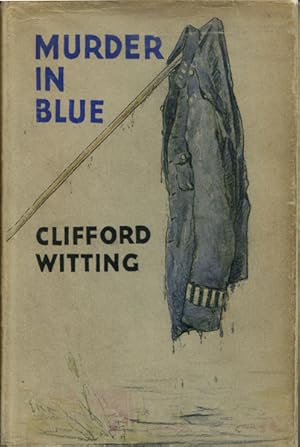
Murder in Blue, published in 1937 by Hodder & Stoughton, was the first detective novel of Clifford Witting. It was an auspicious debut, proclaimed by Hodder as "a first-class detective story...about the murder of a policeman". It's interesting to compare the first edition of this book with first editions written by debut authors today. Now, readers are always presented with information about the author. Publishers are keen, almost to the point of obsession sometimes, to focus on an author's "platform", i.e. the means by which, it's thought, he or she can attract readers. It was very different in 1937. We are not told a word about Witting.

So who was he? I don't possess a lot of biographical information but I do know that Clifford Witting (1907-68) was educated at Eltham College and worked for many years for Lloyds Bank. He enjoyed a long career as a crime novelist, spanning 27 years, but was much less prolific than many others who started during the Golden Age. In that time he published sixteen novels. Quite possibly, like Cyril Hare for instance, his day job reduced his literary output. But lack of productivity is no bad thing if it is matched by a corresponding increase in quality. He wrote accomplished traditional mysteries and in 1958 he was elected to membership of the Detection Club, a sign of the esteem in which he was held by fellow practitioners.

Nick Fuller writes about Witting on the excellent gadetection site, and asks why he is so obscure, given the engrossing nature of his stories. It's a good question. I missed out on Witting for many years and it was only because of the advocacy of Nigel Moss, an excellent judge, that I sampled him. I'm glad I did, because all the books of his that I've read have merit.

Narrated by a likeable bookseller, John Rutherford, and set in a thinly disguised Sussex, Murder in Blue introduced Detective Inspector  Charlton, who was to become a series character. There's more focus on characterisation and setting than you find in, say, most of the Freeman Wills Crofts books, and definitely more humour. Witting was witty! The story begins extremely well thanks to Witting's smooth narrative style, although I felt it sagged in the later stages. Overall, however, a decent start to a career of under-valued accomplishment.


Friday, 18 October 2019

Forgotten Book - A Bullet for Rhino

Clifford Witting (1907-68) is one of those writers who flew somewhat under the radar. His work isn't often discussed, but he was elected to membership of the Detection Club ten years before his death, and his books are admired by such knowledgeable aficionados as Barry Pike and Nigel Moss. Nigel it was who lent me his copy of A Bullet for Rhino, originally published in 1950, and I'm glad he did.

This was the ninth case for Inspector Harry Charlton, a likeable fellow who happens to be an old boy of Mereworth School. He's invited to a reunion, at which, he's told, his well-known but highly controversial contemporary "Rhino" Garstang will be present. But it becomes clear that someone is anxious for him not to attend. It's clear (and not merely from the title) that murder is in the air. And as soon as we are introduced to Rhino, it's clear that he is a very suitable victim. He is one of those Golden Age victims who makes a point of giving people reasons to kill him. Most unwise.

Even though this is a post-war novel, it certainly has a Golden Age flavour. The restricted private school setting, so popular with Golden Age novelists, contributes to this. And Charlton here acts rather like an amateur detective, with the local cops taking charge when someone tries to blow up Rhino. The clever finale in particular seemed to me to be more typical of a Golden Age mystery than a conventional police story.

A cricket match at the school plays quite a significant part in the storyline, and as a cricket fan myself, I found this pleasing. Possibly those who aren't cricket lovers may be less impressed, but again cricket, with its ethos of fair play, is very much a game in keeping with the Golden Age tradition. All in all, I liked this book and felt Nigel's recommendation was spot on. 


Friday, 23 August 2019

Forgotten Book - Midsummer Murder


Image result for clifford witting midsummer murder

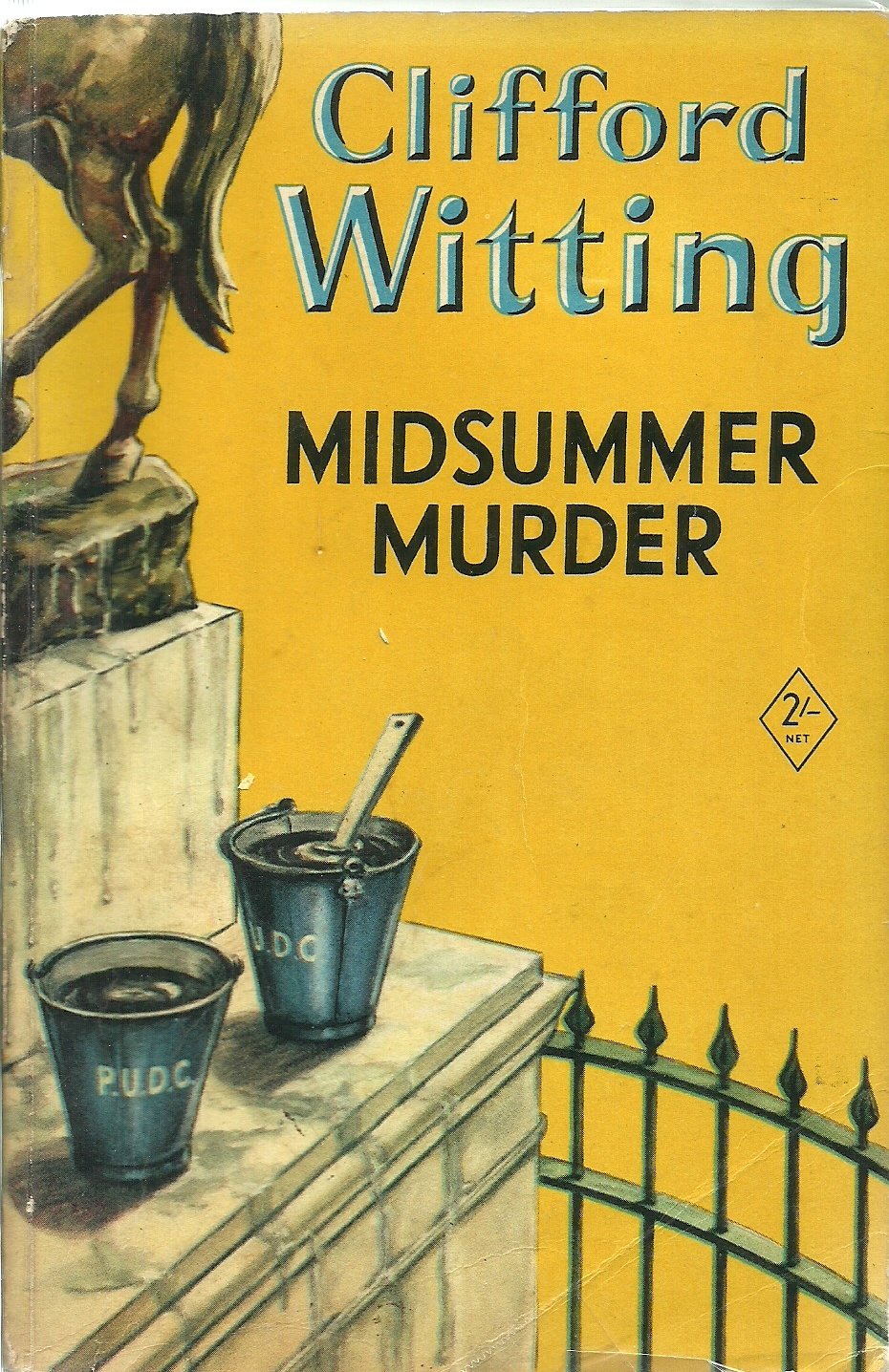
I've read a couple of books by Clifford Witting, which I'd rank as very competent Golden Age stories, towards the top end of the second division. And now I've devoured Midsummer Murder, his second novel, which I found extremely enjoyable. It's a story about a series of sniper killings in a small town, and it comes complete with map of the crime scene and an ironic reference to the Detection Club in the very last sentence.

Witting was a witty writer, and occasionally he overdoes the facetiousness. There's also a bit too much authorial  intervention for modern tastes (although that amusing final sentence makes up for it, in my opinion). But I'd say that he is a writer whose work is likely to appeal to anyone who is a fan of George Bellairs. And on the basis of what I've read, I'd add that he's the superior crime novelist. Indeed, twenty years after his jokey reference to the Detection Club, he was elected to become a member.

The story begins, I was pleased to note, on my birthday, in July, in the tranquil setting of Paulsfield, soon to be tranquil  no more. A workman is shot while cleaning a statue in the town square, an extraordinary crime which is apparently motiveless. For a long time I wondered if we were looking at a riff on The ABC Murders. I don't think it's a spoiler to say that this is not a book of that kind, and although (I choose my words with care) some readers will quibble about the slenderness of the connecting link between the deaths that plague Paulsfield, that didn't spoil my enjoyment.

Indeed, a great pleasure of this book is the characterisation, which is consistently amusing and appealing. Among the cast is a widow whose voluminous card index system contains masses of information about the local inhabitants. Inspector Charlton and Sergeant Martin make a likeable investigating duo, and although the book is perhaps a little longer than it needed to be, it held my interest from start to finish. Recommended.

Friday, 8 April 2016

Forgotten Book - Measure for Murder

My Forgotten Book for today is Clifford Witting's Measure for Murder. Witting's name isn't well-known these days, but he retains a number of admirers, and those picky (and knowledgeable) critics Jacques Barzun and Wendell Hertig Taylor rated this particular novel a classic, including it in a series of fifty crime classics from the first half of the twentieth century.

Witting's series detective, Inspector Charlton, makes an appearance in this book, but not until half way through. The structure is unusual. We are told about the discovery of a murder at the start of the book, but then we go back in time and follow a story told by Vaughan Tudor, which sets the scene for the crime.

Tudor is quite a likeable character, and he describes how, after an unsatisfactory spell as a bank clerk, he became an estate agent in a small town, and involved himself in the activities of a newly formed amateur dramatic society. The society gets off to a good start, but tensions mount as Tudor, and one or two of his colleagues, become enamoured of a very attractive actress. Preparations for the staging of Measure for Measure are disrupted by several untoward incidents - and then murder is committed.

The book is set just before, and just after, the start of the Second World War,and I was interested by Tudor's account of small town life at that troubled period of our history. The murder mystery, however, I found less satisfactory. There are too many characters, and the story felt very cluttered. I also found the motive and identity of the culprit less than totally convincing. But Witting's prose is light and agreeable, and he eventually earned membership of the Detection Club.

Wednesday, 20 June 2012

CADS 63


CADS 63, edited by the tireless Geoff Bradley, has just been published, and once again it’s packed with interesting and often esoteric information about crime fiction past and present, but predominantly past. I can’t remember a single issue – and I’ve read them all – when I haven’t been introduced to a book or author that I’ve enjoyed, yet otherwise might not have bothered with. The joy of CADS is that you have so many encounters with the unexpected.


These include – for instance – two assessments by John Cooper of a selection of books by writers who are today under-rated, Francis Beeding and Clifford Witting; this highlighted a number of books I’m keen to seek out. Tony Medawar contributes a nice little article about Jacques Futrelle, who died on the Titanic, and there are good pieces by a range of the usual suspects, including Bob Adey, Barry Pike and Liz Gilbey.


Curt Evans’ latest piece of mystery scholarship, an attempt to puzzle out which of the ‘joint’ books by G.D.H. Cole and his wife Margaret were written as solo efforts by one or other them inevitably depends on a mixture of logical deduction and guesswork,  but the arguments are well presented, and may be as close as we come to finding out the truth about this slightly odd collaboration. I'm looking forward eagerly to reading Curt's new book about three relatively neglected Golden Age mysteries - more about this in due course.


On a personal note, I was grateful for Chris Simpson’s review of Waterloo Sunset, and also to Geoff and to Bob Cornwell, for including me in their long running feature, the CADS Questionnaire. By their kind permission, the Questionnaire will also appear on the ‘interviews’ page of my website. But really, if you’re keen on the genre and its history, there is no substitute for buying the magazine. An absolute bargain, unreservedly recommended.    


Wednesday, 15 February 2012

CADS 62

I hesitate to say this, because the general standard is always so high, but the latest issue of CADS, edited by Geoff Bradley, is possibly as good as the best of any of its 61 predecessors. It’s absolutely full of great things (I admit these include Angela Youngman’s very kind review of The Hanging Wood) and if you like traditional fiction, you really will enjoy this magazine.

One of the glories of CADS is the sheer unpredictability of the content. There are things here you simply won’t find anywhere else. Contributors aren’t afraid to buck trends. For instance, B.J. Rahn ( a distinguished academic and expert on crime fiction) writes a thoughtful but severely critical piece about the highly popular Camilla Lackberg. Meanwhile Philip Scowcroft not only praises The Five Red Herrings (I don’t share Philip’s enthusiasm, suffice to say) in one article but also contributes another with the memorable title “Visits to Doncaster by Crime Authors” (in which I get a kind mention, and I must say how much I did enjoy my visit to Doncaster!)

Liz Gilbey, a wise and witty writer, contributes “the best of the blurbs” (e.g “A really thrilling thriller which deals cunningly with murder, death and hocus-pocus”, of a Ngaio Marsh title) and a fascinating article about Ian Mackintosh, of whom I’d never heard. Curtis Evans, that splendid researcher, has a nice article about T.S. Eliot as a crime critic, pointing out that Eliot was a pioneer in terms of setting out "rules of the game", while Mike Ripley covers C.S. Forester. My very first contribution to CADS, many years ago, was about Forester, but that was before the rediscovery of that marvellous book The Pursued. I was interested to see that Ripley’s views and mine on Forester’s excellence are pretty much identical.

There are countless other gems, including a short article by Arthur Robinson on Anthony Berkeley’s stage plays, and one by John Cooper on Michael Gilbert’s radio plays. Bruce Shaw casts fresh light on E.C. Bentley, while Bob Adey has unearthed rare articles by Henry Wade and others. Cooper’s article about Clifford Witting, a writer I’ve never read, made me want to read his books. Other expert contributors include Marv Lachman and Barry Pike. The TBR pile will mount! All in all, Geoff Bradley really has excelled himself. I can't wait for the next issue.