Showing posts with label George Bellairs. Show all posts

Friday, 5 November 2021

Forgotten Book - Dead on Time


Nigel Moss is a connoisseur of vintage detective fiction who has recommended a number of interesting writers to me. He was the very first person to encourage me to read John Bude, about a decade ago - some time before the British Library commissioned me to introduce The Cornish Crime Murder and The Lake District Murder. And he was also the first to urge me to give Clifford Witting a try. I made a slowish start with Witting, but the more I've read him, the more his agreeable writing has grown on me.

Dead on Time, first published in 1948, is a good example of his work. It's a murder mystery that isn't lacking in ingenuity. I read this book immediately after finishing a decent effort by John Rhode. One similarity is that in this book, like a number of Rhode's, the good old English pub plays a prominent part in the storyline. The Blue Boar in Lulverton is the scene of the fatal poisoning of Jimmy Hooker, and a plan of the ground floor of the inn is duly provided. 

The criminal's modus operandi here is crafty enough to be worthy of Rhode, but its strength lies in its simplicity, whereas Rhode's schemes are often highly complex. As a general rule, Witting scores over Rhode in terms of characterisation and prose style.There's a lightness, a touch of good nature about his storytelling (as with Bude and indeed George Bellairs) that has genuine appeal. Rhode was capable of pleasing touches of humour, but he was much more prolific than Witting, and such industry, although admirable, isn't conducive to elegant writing.  

The first half of the book is very enjoyable, but the story becomes thrillerish and less engaging prior to a good climax and the revelation of the pub killer. Not a masterpiece, then, but a decent story, well worth reading. And yes, the rabbits on the dust jacket cover are relevant to the story... 

Friday, 31 January 2020

Forgotten Book - Death of a Bookseller


Image result for bernard j farmer death of a bookseller

Bibliomysteries, in which books play a part in the story, are an interesting branch of crime writing. Otto Penzler has produced a slim volume which catalogues some of them. I've dabbled myself, given that Marc Amos and his books play a part (in some stories a significant part) in the Lake District Mysteries. And now I've read a much sought-after novel, first published in 1956, called Death of a Bookseller by Bernard J. Farmer.

I know it's sought-after because some good judges have been hunting down a copy for years. I came across a nice first edition in a dust jacket at York Book Fair at the start of this year. The only snag was that it was priced at £400 - yikes! I was not tempted to invest, but I have now read the story and it's rather enjoyable.

The author, Bernard J. Farmer was born in 1902 but I don't know when he died. He was at one time a policeman, but again I'm not sure for how long. However, it is clear that he was a keen book collector, and in 1950 he published a book about the subject. This novel, which was his third, and features his series character Sergeant Wigan, himself very keen on books, appeared six years later. Barzun and Taylor say that the prose style is flat, and there is at least a morsel of truth in this. But there is also some gentle humour and wry observation of human nature. They also say that Farmer wrote as Owen Fox, but I'm not sure this is correct. If anyone out there knows, I'd be interested to hear from them.

What I like about this story is that it's a compassionately told tale (with lots of bookselling lore) about a compassionate man, Wigan, trying to solve the murder of a friend. It's also a clock race story, as Wigan battles to find the truth before a man he believes to be innocent is hanged. The man in the condemned cell is rather well characterised - he's not at all likeable but the cop realises that doesn't mean the man is guilty. Wigan is concerned with justice as well as with books. This is a well-made traditional mystery of that kind in which George Bellairs specialised, and I was glad to read it. I'd also be glad to learn more about its author.

Monday, 6 January 2020

The Maltese Herring by L.C. Tyler - review

If there's one thing more difficult than writing a successful humorous crime novel, it's writing a successful series of humorous crime novels. Not too many people over the years have managed to achieve this. In Britain one thinks of Colin Watson, possibly George Bellairs, and more recently Simon Brett. Over the last decade, Len Tyler has joined the list (and, more than that, become a leading exponent of the form) with his series about the hapless crime writer Ethelred Tressider and his ravenous agent Elsie Thirkettle.

The latest entry in the series is The Maltese Herring, recently published by Allison & Busby. As you might guess from the title, Len has this time decided to doff his cap not to Agatha Christie but to Dashiell Hammett. Casper Gutman, Joel Cairo and company give way here to an assortment of Oxford dons who descend on Sussex in a hunt for a fabled golden statue.

As with Hammett (and Chandler, who is referenced several times), the discursive plot isn't the thing; it's the characters and the set-piece scenes that we remember. There is, for instance, a splendid opening at an Oxford college dinner (I hadn't actually realised, or else I'd forgotten, that Ethelred is, like his creator, an Oxford man), swiftly followed by a very funny encounter between Elsie and a fellow train passenger. And there are some great lines, several of which draw, as usual with this author, on experience of the crime writing life.

Thus we learn that Ethelred has recently joined the committee of the CWA (which Len himself chaired not long ago) and among the crime writing jokes and references there's mention of Ann Cleeves and a self-deprecating passage that alludes cleverly to one of Len Tyler's recent novels and captures his wry sense of humour perfectly:

"Well, that was a bit of an anticlimax. Not a Chandler or Christie plot, then. Who was good at anticlimax?
'L.C. Tyler,' I said to Ethelred, with a sudden flash of insight.
'Who?' he said.
'Don't worry, he's not that well known.'"

But of course he is well known, and deservedly so.


Friday, 23 August 2019

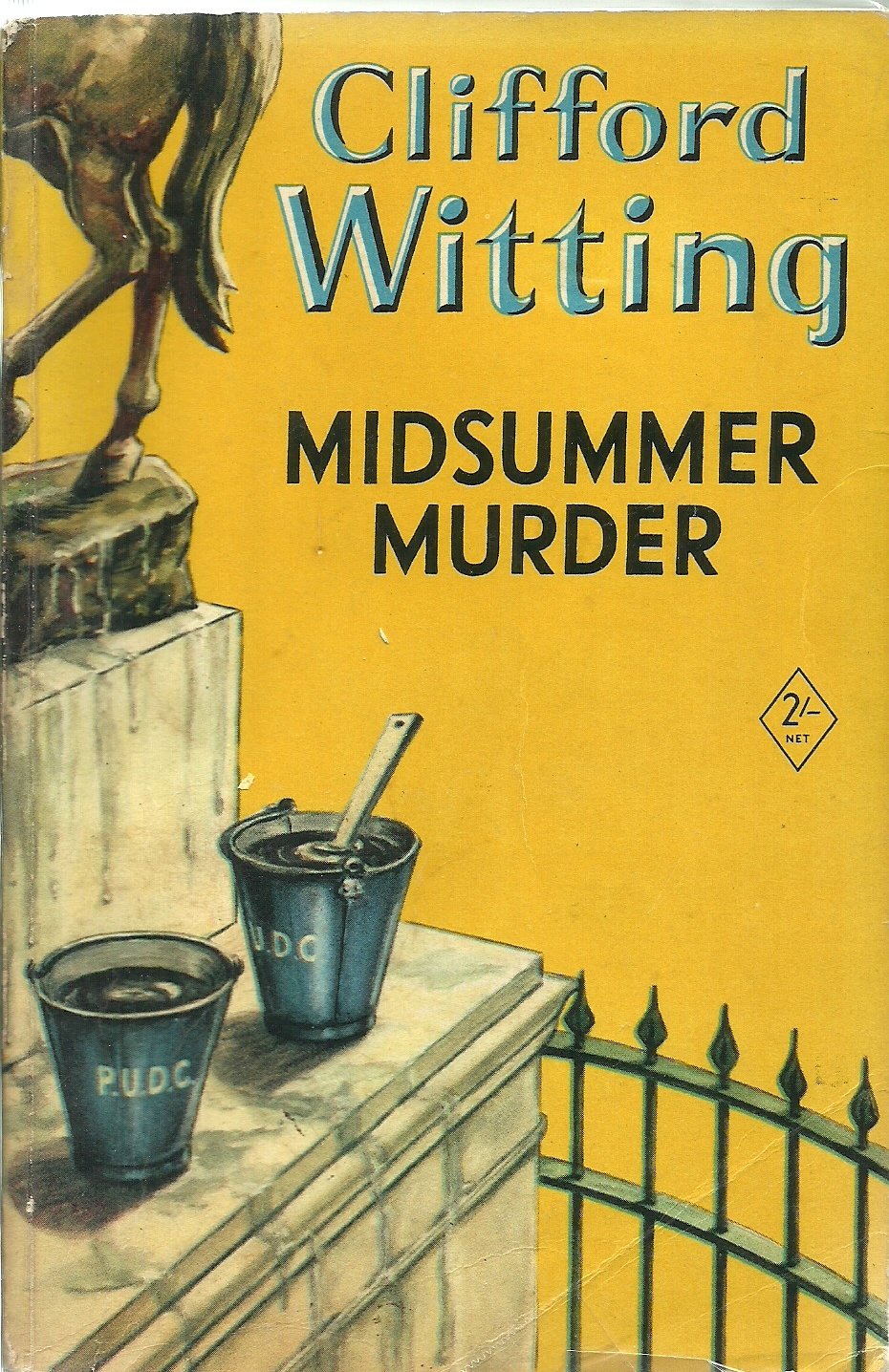
Forgotten Book - Midsummer Murder


Image result for clifford witting midsummer murder

I've read a couple of books by Clifford Witting, which I'd rank as very competent Golden Age stories, towards the top end of the second division. And now I've devoured Midsummer Murder, his second novel, which I found extremely enjoyable. It's a story about a series of sniper killings in a small town, and it comes complete with map of the crime scene and an ironic reference to the Detection Club in the very last sentence.

Witting was a witty writer, and occasionally he overdoes the facetiousness. There's also a bit too much authorial  intervention for modern tastes (although that amusing final sentence makes up for it, in my opinion). But I'd say that he is a writer whose work is likely to appeal to anyone who is a fan of George Bellairs. And on the basis of what I've read, I'd add that he's the superior crime novelist. Indeed, twenty years after his jokey reference to the Detection Club, he was elected to become a member.

The story begins, I was pleased to note, on my birthday, in July, in the tranquil setting of Paulsfield, soon to be tranquil  no more. A workman is shot while cleaning a statue in the town square, an extraordinary crime which is apparently motiveless. For a long time I wondered if we were looking at a riff on The ABC Murders. I don't think it's a spoiler to say that this is not a book of that kind, and although (I choose my words with care) some readers will quibble about the slenderness of the connecting link between the deaths that plague Paulsfield, that didn't spoil my enjoyment.

Indeed, a great pleasure of this book is the characterisation, which is consistently amusing and appealing. Among the cast is a widow whose voluminous card index system contains masses of information about the local inhabitants. Inspector Charlton and Sergeant Martin make a likeable investigating duo, and although the book is perhaps a little longer than it needed to be, it held my interest from start to finish. Recommended.

Thursday, 12 March 2009

Day Jobs


Mention of Andrew Garve and Cyril Hare naturally leads me to a subject of great personal interest – crime writers who combine their fiction with a day job. To illustrate my other life, you may be amused to read my legal reminiscences as an employment tribunal advocate on the BBC website, or even to watch my less than George Clooney like performance when they filmed me the other week. Or you may conclude you’d rather not know!

Apart from journalists and lawyers, police officers often turn to fictional crime. Maurice Procter was probably the first noteworthy example in the UK, and he has had many successors. Those whose main source of income was not obviously criminal include the man who wrote as George Bellairs, who was a bank manager. (On second thoughts, perhaps we do think of bankers as criminally inclined these days.)

At the CWA Daggers Dinner last year, I had the pleasure of meeting, and sitting next to, Elizabeth Corley, a successful businesswoman. Janet Neel shuttles between high finance and crime writing. Michelle Spring is an academic, and so is Christine Poulson. For as long as one can juggle two careers, it’s a fascinating thing to do.