Showing posts with label Dean Street Press. Show all posts

Friday, 15 April 2022

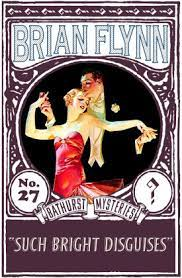
Forgotten Book - Such Bright Disguises


Steve Barge blogs as The Puzzle Doctor and his In Search of the Classic Mystery is one of my favourite crime fiction blogs. His enthusiasm for books he likes is infectious and I am especially impressed by the way he has championed the work of Brian Flynn, an author to whom I must admit to having paid no attention until the past couple of years. Thanks to Steve, the Flynn books have been reissued by Dean Street Press. Flynn was what would now be termed a 'midlist author' - meaning, among other things, that his publishers never bothered much about promoting his work - and it is good that, so many years later, he is now receiving a fair amount of attention.

My eye was caught by discussion of Flynn's 1941 novel Such Bright Disguises and I've just read the book for myself. Steve doesn't discuss the story in his intro, but covered it in a blog post a couple of years back. Two more of my favourite blogs, Mysteries Ahoy! and Pretty Sinister Books have also discussed the story. These three bloggers are good judges (I don't say that merely because I often find myself agreeing with their opinions!) and it's noteworthy that they all have a lot of time for Such Bright Disguises.

This is undoubtedly an interesting and unusual story. The combination of inverted mystery and whodunit is highly intriguing, with several touches of originality. I haven't read much of Flynn, but my strong impression is that he was a very good ideas man. This is an invaluable trait in an author of classic mysteries. There were various highly surprising developments in the narrative which definitely took me aback. Overall, it's an ambitious piece of writing and I find that admirable.

One thing Flynn lacked (like so many authors, past and present) was a high-calibre editor. He was no prose stylist (although I suspect he thought otherwise) and the rapid shifts of viewpoint in some chapters diminish his attempts, praiseworthy as they are, to depict the characters in more depth than is commonly found in many Golden Age mysteries. (there's even a decorous sex scene). We have to digest sentences such as: 'Strange to relate when we recall Hubert, who was their only child, Ralph Grant was a total abstainer.' Some of the clunky writing was surely attributable to Flynn's hurrying too much with his work. He was - like a number of characters in the story - a finance man in local government - and, believe me, I know how difficult it is to combine a busy professional life with writing novels. I just wish he'd considered writing fewer books, and writing them a little more elegantly. 

Having had such an excellent idea, brimming with potential, I feel Flynn could have done more with it. The final section is oddly abrupt after a long and elaborate build-up. Faced with two deaths, the police seem to give up right away and call in the private detective Anthony Bathurst to do their work for them. I understand that including Bathurst may have seemed like a commercial imperative, but the haste of the wrap-up was unconvincing and smacks of a surrender to deadline pressure. As a result, this isn't the book it might have been, a masterpiece in the Ironist tradition, as good as anything written by Bruce Hamilton or Richard Hull. However, I don't want to damn this book with faint praise, because it is a striking and genuinely enjoyable read, which I am more than happy to recommend. Dean Street Press and Steve Barge deserve congratulations for making it available once again.


Friday, 11 September 2020

Forgotten Book - The Edge of Terror


The Edge of Terror (The Anthony Bathurst Mysteries Book 12) - Kindle  edition by Flynn, Brian. Mystery, Thriller & Suspense Kindle eBooks @  Amazon.com.

Not so long ago, the books of Brian Flynn were an unknown quantity to most fans of detective fiction, certainly including me. Now, they are in the course of being reprinted by the estimable Dean Street Press. And this is largely thanks to the enthusiastic advocacy of one person, Steve Barge, who blogs as Puzzle Doctor at In Search of the Classic Mystery, and provides informative intros to the reprints.

Flynn enjoyed a long career in excess of thirty years, and published over fifty novels. Some earned good reviews, and he was published overseas and in translation in the early part of his writing life. But he'd faded from the limelight long before his final book came out in 1958. And probably it's optimistic to suggest that he was ever actually in the limelight. The firms who published him in the UK were respectable but not exactly market leaders. As a crude rule of thumb, it's fair to say that most of the better writers are published by one of the top firms at some point in their career. For instance, Lorac migrated from Sampson Low to Collins, Cecil M. Wills from John Heritage to Hodder, and so on.

One of the key questions about forgotten authors, inevitably, is whether their neglect is understandable. You don't remain a published novelist for thirty years without having some ability as a storyteller (or so I often tell myself) but this doesn't mean that you're an overlooked master of the genre either. I tried a Flynn novel a while ago, but as a result of a number of distractions found myself unable to get into it. When I read Steve's blog post about The Edge of Terror, I felt the moment had come to give Flynn my undivided attention. And so I read the book within a few days of laying my hands on a copy.

I had mixed feelings about the story for a long time, but I felt that the final section worked well enough for me to be very glad I'd read it. The downsides involve Flynn's cluttered prose and often stodgy dialogue. The doctor-narrator has an irritating style, e.g. 'Bathurst had a sudden visualization of activity and, as was his invariable custom, he was shedding the mantle of meditation for the cloak of clash.' As for the Great Detective, Anthony Bathurst: 'Well, Inspector, you haven't come to the Rowfants to tell us about the status quo ante. I'm confident of that. What is it that's haunting your tortured soul. Open the can.' There's a touch of the wannabe Dorothy L. Sayers about this type of writing, and it didn't work for me. Nor did the middle section of the story, which lacked tension. The book introduces a woman whom Bathurst once loved, but I felt more could have been made of her contribution to the story.

And yet. Just when I was lamenting the lack of excitement and suspense in comparison to that conjured up in the serial killer novels Francis Beeding and Philip Macdonald were writing at around the same time, the story seemed to spring to life. I very much enjoyed the fact that Flynn utilised a version of an idea that I happen to be researching right now, but quite apart from that, I felt that the later chapters had a verve that had earlier been lacking. There's also a clue in a name that I didn't spot, and which is nicely done. All in all, there was enough here to make me see why Steve likes Flynn and to feel that I'd be happy to read more of the books.


Friday, 1 May 2020

Forgotten Book - Death of a Frightened Editor

Dean Street Press have done excellent work in reviving a wide range of vintage detective fiction titles and one of their latest rediscoveries is the husband and wife partnership of E. and M.A. Radford. These books benefit from informative introductions by Nigel Moss, and I've just read Death of a Frightened Editor, which was first published in 1959.

This is a novel brimming with Golden Age tropes. We have an apparent "closed circle" of suspects, the seven people who regularly travel in the first class coach of the London to Brighton train, all of whom seem to have a reason to wish the eighth person dead. We have poisoning by strychnine. We have a character leading a double life. We have gossip and mischief-making in country houses. We have a disparity between the victim's legitimate earnings and his evident wealth. We have a scientific puzzle worthy of Austin Freeman. We have...well, you get the picture.

The lead detective is Doctor Manson, who is not only a scientific expert in the Thorndyke class but happens to work for Scotland Yard. The technical trickery at the heart of the plot is rather neat - as with the Cecil M. Wills book I reviewed here last week. Mind you, I was rather baffled as to why this particular group of seven suspects should travel so regularly with the unpleasant victim.

The Radfords only turned to crime writing in their fifties, but they became quite prolific. I enjoyed a passing reference to the then fledgling Crime Writers' Association - my guess is that members of the CWA at that time liked to mention it in their books in order to boost its public profile. In many ways, this book reads as though it was written in the mid-30s - it's very different from the kind of novel that Julian Symons and Margot Bennett were publishing in the late-50s, in terms of plot, characterisation, and prose style. And it's a reminder that, long after the Golden Age, there were still plenty of writers around who were working in the traditional vein. 

Friday, 22 February 2019

Forgotten Book - The Strange Case of Harriet Hall

Dean Street Press have done great work in recent years, making available again a very large number of previously obscure Golden Age mysteries. Although their main market is in ebooks, they also issue print versions which are nicely produced paperbacks and which are well worth seeking out if you prefer that format (as I do). Their approach has enabled them to print long runs of the works of certain authors, such as Punshon and Bush, and this is a valuable service for readers. Not so much because thousands of people will want to read the complete works, but because at long last fans have the chance to pick and choose titles, according to their taste.

The Press's latest ventures have been to reissue books by authors I haven't previously read, Moray Dalton and E. and M. Radford. Another merit of their approach is that they include informative introductions. The Dalton books are introduced by Curtis Evans, and the Radford books by Nigel Moss. And in the case of Dalton's The Strange Case of Harriet Hall, there is also a very useful afterword which deals with a subject that would otherwise be a spoiler.

Moray Dalton was the pen-name of Katherine Dalton Renoir (1881-1963), who wrote a couple of early novels before indulging in criminal fiction from 1924 to 1951. In that time, she produced no fewer than 29 books, but they have long been hard to find; now Dean Street Press has issued five, and there may well be more to come. In her early days, she shared a publisher with E.C.R. Lorac, but never achieved anything approaching Lorac's success.

On the evidence of this book, Dalton was a good writer. She has a nice turn of phrase, and her interest in character is striking. I was impressed. There is also a memorable plot twist before the story is half-way through. On the debit side, there is a certain lack of focus about the story. We begin with one likeable character who has an odd encounter with Harriet Hall before attention switches to tensions within the Dene family, which comprises a mother and three siblings. The Denes clearly fascinated Dalton, and relations within the family become central to the story. I felt that the later plot developments didn't exactly reflect a commitment to fair play plotting, and I sensed that Dalton was less concerned about unravelling the mystery in a satisfactory fashion than most Golden Age writers. This may help to account for her obscurity. But her prose, straightforward and readable, is of a quality to make this novel well worth reading. 

Monday, 23 July 2018

More from Dean Street Press

One of the joys of the revival of interest in Golden Age detective fiction is that quite an avalanche of long-vanished books are now readily available. As in any era, the quality varies. But the range of books that one can now obtain is striking - within the British Library series, for instance, there's a huge difference between the work of, say, Alan Melville, E.C.R. Lorac, Richard Hull, and Raymond Postgate. So readers can discover new writers, and then focus on those they enjoy most.

Various publishing models have been adopted. The British Library focuses on high quality mass market paperbacks, Harper Collins on hardbacks, and others mainly on ebooks and print on demand publications. Dean Street Press fall into the latter camp. They do a really good job, and I'm not just saying that because I've written a few intros for them. Their model makes it possible to reissue a large number of books by the same author. The complete works of Annie Haynes, say, would not be commercially viable if the focus were on mass market paperbacks, because their isn't enough interest in them for the books to be sold in large quantities in paperback format. But thanks to DSP, we can now try out Annie's work in ebook or as a print on demand paperback, and much else besides. One of the DSP authors whom I particularly enjoy is Peter Drax, and I'll be saying more about his books in the future.

At present, DSP are reissuing, in large batches, the Ludovic Travers novels of Christopher Bush. Bush was a writer who wrote so much that sometime quality suffered, but I really enjoyed The Case of the Monday Murders, first published in 1936. The mystery is good, even if I did guess the solution early on, but the satiric touches are even better. This book contains plenty of swipes at Bush's fellow practitioners, and as Curtis Evans says in his intro, the character of crime writer Ferdinand Pole, founder of the Murder League, is surely based on Anthony Berkeley. One chapter title is borrowed from Philip Macdonald: "Murder Gone Mad". There's also a hint of self-mockery in the killer's taunting letters, signed "Justice", which might make one recall the comparable correspondence in Bush's own The Perfect Murder Case.

The funniest moment in the book is when Bush mocks Dorothy L. Sayers and E.R. Punshon in the same breath, parodying Sayers' famous review lauding E.R. Punshon (in the guise of "Petrie Cubbe"), but attributing it to Pole. It does make you wonder how on earth Bush managed to earn election to the Detection Club the year after this book came out, especially since Berkeley was famously thin-skinned. It would be good to think that those who are guyed took it in good part. Or perhaps they just didn't read it! (Though given how many of them were prolific reviewers, that would be surprising). Whatever the truth, the great thing is that readers today have the chance to enjoy this one, and I suspect that it is one of Bush's best. 

Friday, 14 July 2017

Forgotten Book- Death By Two Hands

My Forgotten Book for today is another by Peter Drax. Death By Two Hands was first published in 1937, and until Dean Street Press reprinted six Drax books, it was the only one I'd ever found in a first edition. Like Murder on the High Seas, it's unusual for a crime story of the 30s, because it centres exclusively on working class people, with not a country mansion or secret passage in sight.

A young woman called Alma Robinson leaves her home town to live with her disreputable uncle, and becomes a pawn in a criminal game. A dodgy dealer called Rivers hires the ruthless Spike Morgan to steal a consignment of fox furs. Spike and his sidekicks carry out the plan, but things go wrong, and a man is killed. Soon there is another death...

Drax describes the crime with a realism that we tend to associate more with post-war novels than those of the 30s. He's also pretty convincing when it comes to police procedure. Chance plays a part in the investigation, but the story unfolds in a believable way, and there's a small twist right at the end. The treatment of criminals and their activities is much more convincing than was often the case during the Golden Age.

I'd also like to mention the quality of Drax's writing. He has a very good turn of phrase, and his observations are perceptive and convincing. His evocation of character is excellent, and the book is also good on urban settings. Drax's world is very far removed from Mayhem Parva. I'm surprised these novels weren't better known in the 30s, and I'm delighted that Dean Street Press have reprintged them.

Friday, 26 May 2017

Forgotten Book - High Seas Murder

Years ago, I came across a brief mention in a reference book of Peter Drax as one of those writers who followed in the footsteps of Francis Iles, Bruce Hamilton, and C.E. Vulliamy as an author of realistic, ironic crime novels. Intrigued, I strove to find Drax's books, but they were hard to find. Eventually I was pleased to come across one, but they have remained elusive. Until now, that is. Dean Street Press have just reissued the six books that Drax published during his short life, and Rupert Heath of DSP recommended me to have a look at High Seas Murder, which I'd not encountered before.

Rupert was right - it's a really good book. It was first published in 1939, and was the last novel Drax (whose real name was Eric Elrington Addis - I can see why he opted for a pen-name) produced in his lifetime. His crime writing career began in 1936, so he flourished only briefly. A senior naval officer, he was killed in a German air raid on Alexandria in 1941. After his death, a seventh book was completed by his novelist wife Hazel.

Drax spent much of his adult life as a sailor, though he retired from the Royal Navy in 1929, and practised as a barrister until the war broke out. His knowledge of the sea informs this book, and the authentic feel of the story adds to its quality. But what I find very interesting is the fact that the story focuses almost exclusively on working class people in the fishing port of Gilsboro. The lawyers and the cops play only a minor role.

Although (rather oddly) he is not the first character to whom we are introduced, the central protagonist is Carl Swanson, captain of a local fishing ship. His personality is key to the story - and it's a sign of Drax's skill that the final paragraph contains a clever twist that casts fresh light on Carl's psychological profile. There's a doom-laden feel to the story that today would undoubtedly be described as "noir". The writing is crisp and gripping, and Gilsboro is well-evoked: Curtis Evans' informative introduction doesn't suggest any real life model for the town, and though I have two or three candidates in mind, it may be an amalgam of several towns Drax knew. This is an enjoyable example of the ironic Thirties crime novel, different from Iles', Hull's, and Vulliamy's work yet certainly worthy of being associated with it.

Wednesday, 16 March 2016

The Annie Haynes Mystery

"Continuation novels", where a writer adopts another writer's character - such as Sophie Hannah's The Monogram Murders -have long interested me. But even more fascinating, though less common,are books which are begun by one author and completed by another, and it was this fascination that led me to finish the late Bill Knox's The Lazarus Widow. Recently, a Golden Age example of this type of novel has come my way, thanks to the valiant efforts of Dean Street Press,who have reprinted the complete crime fiction of Annie Haynes, who until recently was a very obscure writer indeed..

She was in very poor health when she started writing her last book, The Crystal Beads Murder, and she died with it still unfinished. Another author took over - but here is the really interesting thing: we don't know who it was. The original introduction, by Ada Heather-Bigg (with whom Haynes lived for many years) simply describes her as one of Haynes' friends, and adds that she "also a writer of this type of popular fiction...it says much for her skill that she has independently arrived at Miss Haynes' own solution of the mystery, which was known only to myself."

In an interesting new intro to the book, Curtis Evans speculates about who completed the book, listing prominent women crime writers of the time as Agatha Christie, Dorothy L. Sayers, Anthony Gilbert (Lucy Malleson), A.Fielding, Molly Thynne and Margaret Cole. I feel sure that Christie, Sayers, and Cole can be ruled out, and I don't know anything about Thynne, and little about Fielding. Curt suggests Anthony Gilbert is the likeliest candidate, though I think that if that were so, she would be likely to have discussed the book, and Haynes,in her memoir, and she didn't. It's also perhaps doubtful that they moved in the same social circles. One name that occurred to me is Jessie Rickard, who was a minor crime writer who became a somewhat peripheral member of the Detection Club, but I don't know enough to say whether there's any similarity between her writing and Haynes', or any other connection.

Curt says, and I agree, that the completion is professionally accomplished. It's quite hard to see the join. The main problem with the story is that it's a tired effort, no doubt because of Haynes' poor health. I couldn't interest myself in the fate of the dastardly Robert Saunderson; the detective puzzle is very much secondary in appeal to the authorship mystery. But Inspector Stoddart is quite an appealing cop,and I look forward to reading some of his earlier cases. Dean Street Press have also reprinted Haynes' non-series mysteries,and I hope to review The Bungalow Mystery in due course..

Friday, 11 March 2016

Forgotten Book - Mystery of Mr Jessop


E.R. Punshon was a strangely variable author. I find his very inconsistency rather intriguing, and that's partly why I've featured him several times in this blog, as well as in The Golden Age of Murder. He could, and often did, write well, although he was also apt to be wordy, and pace wasn't his strongest point. His books display a sharp sense of humour as well as providing quite a few worthwhile insights into different aspects of British society of the time. He could plot with a degree of ingenuity, and - on occasion - his characterisation could be incisive.

Dorothy L. Sayers was a fan, and she was not easily pleased. Today's Forgotten Book, Mystery of Mr Jessop, first published in 1937 and now reissued in Dean Street Press's welcome series of classic reprints, was enjoyed by P.G. Wodehouse, who was a keen reader of detective stories and friendly with Christie and Anthony Berkeley, Given all Punshon's virtues, then, it's not surprising that he was elected to the Detection Club, of which he proved to be an affable and popular member.

Mystery of Mr Jessop begins well, but slows after the first hundred pages. A partner in a jewellery firm has been murdered, a diamond necklace has gone missing, and a duke and duchess and the dodgy Cut and Come Again Club are mixed up in it all. At one point, Sergeant Bobby Owen makes a list of questions and observations about the case. There are more than forty questions, which illustrates Punshon's fondness for complication, and, perhaps, over-complication..

Dean Street Press are republishing a great many of the Bobby Owen books - some of which have long been scarce - and this initiative gives readers the opportunity to see just what an interesting writer he was. I would not, myself, rate this one too highly, but Bobby is on good form in books such as Information Received, Death of a Beauty Queen, and Diabolic Candelabra . And there's another title, recently published by Dean Street Press, which has some fascinating features and which I'll be covering here before long.  

Monday, 25 January 2016

Murder at the Manor - and other classic mysteries


I've just received my author copy of Murder at the Manor, another anthology that I've compiled for the British Library. It will be available in early February. Compiling this book has given me the opportunity to bring together another selection of vintage mysteries. I've adopted the same general approach as for Resorting to Murder, Capital Crimes, and Silent Nights. The theme this time is the country house mystery. There are a few (relatively) familiar authors and stories, and a number of less obvious choices, including a little known, but in my view excellent story by Anthony Berkeley.

Over the Christmas break, The Times published a detailed article about the British Library series, after interviewing John Bude's daughter and me, and listed the top ten bestsellers in the series. Even then, a few weeks after its publication, Silent Nights had reached number seven in the list, and the other two anthologies have also sold many more copies than any of the other twenty-odd story collections I've edited. We're very encouraged by this, and several more anthologies are in the works.

The success of the British Library series is being emulated, and sometimes quoted in the publicity material of, other publishers who are, understandably, keen to take part in the current revival of interest in Golden Age fiction. I'm sure there are many people like me who feel that having so many of these old, and previously hard-to-find, books available again at affordable prices, is very good news.

A particular shout-out for Harper Collins, who - even before the BL series took off - have been doing great work in terms of bringing back books like The Floating Admiral and Ask a Policeman. They have more recently been reprinting Francis Durbridge's Paul Temple books, and have launched the very attractively presented Detective Story Club reprints. I hope to cover one of their titles, The Mystery at Stowe by Vernon Loder, before long. Loder is a writer I've heard good things about for years, not least from my friend Nigel Moss, who has written the introduction. Yet I've never come across one of Loder's books, so I was delighted to read it; the book will be on the shelves in the shops in March. Another book in the series, Freeman Wills Crofts' The Ponson Case, with an intro by crime novelist Dolores Gordon-Smith, will also feature here before too long.

Among the estimable smaller presses active in this field are Dean Street Press, whom I've mentioned several times before on this blog. In the coming months, I'll be talking about quite a few of their titles in more detail, The authors they are publishing include Ianthe Jerrold and E.R. Punshon, and I've just received a copy of a book by the highly obscure Robin Forsythe. It's called "Missing or Murdered".

Friday, 11 September 2015

Forgotten Book - Knock,Murderer, Knock!

When John Norris reviewed Harriet Rutland's debut mystery, Knock, Murdererr, Knock! back in March, I commented that I'd just bagged a copy of the book, and hoped to review it myself. It's taken me six months to get round to so doing, but then, I have a lot of books that have waited for me to attend to them for much longer than that. The TBR pile continues to grow remorselessly. Never mind, plenty to look forward to! And Rutland's novel, my Forgotten Book for today,should not be forgotten for much longer.

The first thing to say is that this is a witty and well-constructed book, an accomplished piece of work which I enjoyed from start to finish. The setting is a Hydro in a resort on the south coast that caters for a variety of invalids. The main activity of the residents is gossiping, a habit which is integral to the plot, as well as providing plenty of comic moments.

When an attractive, and rather mysterious, young woman called Miss Blake arrives at the Hydro, she soon becomes very popular with the men, and correspondingly unpopular with the victim. Seasoned whodunit readers will suspect she is a victim in the making, and they will be right. Inspector Palk,a cop with very definite but often mistaken ideas, soon makes an arrest, but then a second murder occurs...

This is a fair play, closed circle mystery with a sizeable cast of characters. Because Rutland is very generous with her clues, I identified both culprit and motive about half way through the story (and as regards one of the murders, there really wasn't any other likely culprit or motive.) This element of guessability didn't spoil my pleasure, however. John mentioned in his blog that the book is very rare, and I was lucky to get hold of a copy. But happily, Dean Street Press will be republishing Rutland's books soon - an example of the good news for Golden Age fans which is coming thick and fast at present. And I expect to be bringing further good news before long!.

Sunday, 24 May 2015

Azma Dar - guest blog about The Secret Arts

Azma Dar is a playwright who has turned to crime fiction with a book called  The Secret Arts, published by Dean Street Press, whose eclectic list includes numerous classic crime reprints. I've not yet read her novel, but I'm always pleased to learn of newcomers to the crime writing scene, and here's a guest blog post from her which explains the background:

"Although crime is my favourite genre, I’d always been a bit scared to try my hand at it myself, worried that I wasn’t clever enough to write an ingenious plot. My plays are mostly set in London and explore contemporary themes and issues, serious subjects looked at with, I hope, a bit of humour. I’d wanted to write something about black magic, superstitions and “religious” old men who sold charms and cures for some time. I’d heard of these beliefs whilst growing up. 

Unfortunate events were often attributed to evil eyes and curses, and I was fascinated and angered by how easily these theories, rooted in tradition and culture, were accepted by otherwise intelligent and rational minds. Then, on a trip to Pakistan, I heard even more outlandish but supposedly true anecdotes, involving protective chillis, mystical glasses of water, wicked in-laws, jinns, spirits and the odd boiled egg. The idea for a sinister, murderous novel began to take shape.

During that trip we visited the small town of Murree, a pretty, old fashioned place in the hills, full of forests and precarious winding roads. Most strikingly, it was enveloped in a creeping mist. It would seem like a clear day, then suddenly within minutes you could see no further than a couple of metres. It was all that lovely fog which inspired me to set the novel in Murree. It felt like a really atmospheric backdrop for a spooky story.

The novel became The Secret Arts, the story of Saika, a young woman who marries an older man, a respectable Colonel, but her bliss is short lived when she starts hearing rumours about the suspicious death of his first wife. Meanwhile the rest of the family members are entangled in lies and secrets, meddling in black magic and placing curses on each other. When one of her cousins is murdered, and her husband starts behaving strangely, Saika becomes determined to unravel the truth...."


Monday, 6 April 2015

Dean Street Press

Last year, I was contacted by Rupert Heath, who is a well-known literary agent. His clients include such bright stars in the firmament as A.K. Benedict, a guest blogger here a while back. Rupert explained that he was setting up Dean Street Press - a new publishing company that aimed to revive a host of worthy books from the past, including some recent titles -and we have kept in touch since then. Now, I'm glad to say, Rupert's plans have come to fruition..

I'm especially pleased that DSP is making available once again the books of Tim Heald. They will be in ebook format, and this is good news for those of us who enjoyed Tim's novels about Simon Bognor when they first appeared, as well as for those yet to encounter them. It's easy to forget now, but the books were such a success that they reached the TV screens, with David Horovitch in the title role. In all, 21 episodes were screened.


By a happy coincidence, I was with Tim and his wife just over a week ago, at the CWA conference in Lincoln. The last time we met was at the most bizarre book event either he or I have ever attended - the unforgettable Kidwelly Festival - the photo was taken as we recovered over a drink, back at the hotel. Tim has not enjoyed the best of health in recent times, but I'm sure that the return of Bognor will give him a real boost. And DSP will at a later date be reissuing his Tudor Cornwall novels, and also his cricket books.

In the meantime, DSP have already brought out Stella Bingham's book Charters and Caldicott. These were the wonderful characters created for Hitchcock's The Lady Vanishes. Oddly, they didn't appear in the source novel for the film, Ethel Lina White's The Wheel Spins. The Bingham book dates back thirty years, to the time of the TV spin-off series featuring the two men.

Going further back in time, DSP have also published ebook versions of two crime novels which were put out originally under the name of George Sanders, although I understand that the ghost writers were Craig Rice and Leigh Brackett respectively.The titles are Crime on My Hands and Stranger at Home,and I'm looking forward to reading them.

The good news doesn't end there. I'm delighted to see that DSP are planning to issue several Golden Age mysteries, and although the majority of these are likely to be in ebook only format, there will also be print editions of two early novels by Ianthe Jerrold; these titles will also include intros by Curtis Evans. Jerrold, a founder member of the Detection Club, only published books sporadically throughout her long career, occasionally under the pen-name Geraldine Bridgeman, and she faded from view long, long ago. .

And there's more to come from DSP at a later date. There will be a number of books by E.R. Punshon, featuring Bobby Owen, and it will be splendid to see more of his work readily available again (Ramble House in the US have done sterling work in producing paperback editions of a few Punshon titles, but he was much more prolific than Jerrold.) Two other authors to be featured by DSP, Annie Haynes and Harriet Rutland, are even less well known than Jerrold - they weren't even particularly renowned in their day. I know little about Haynes, but Rutland was a writer who impressed Dorothy L. Sayers..

All this is a reminder that new publishing methods are unlocking a host of long-neglected crime novels. Yes, we are overwhelmed with choice, and no, we can't read every book. But it's wonderful to have the opportunity to pick out titles we like the look of - a luxury denied to previous generations where the books in question were out of print. I'll be blogging about some of the other publishing newcomers before long, but in the meantime, I am delighted by Rupert's initiative.