Showing posts with label The Blackmailers. Show all posts

Friday, 1 September 2017

Forgotten Book - Inspector French's Greatest Case


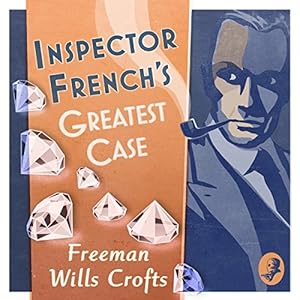
Freeman Wills Crofts published Inspector French's Greatest Case in 1924. It was his fifth book in five years. Already he'd enjoyed considerable success, especially with his best-selling debut, The Cask, and he hadn't troubled to create a series character. The title of this novel suggests that he didn't contemplate that Inspector French would be anything other than a one-trick pony. But things often don't work out as authors expect. In fact, French became a popular detective and Crofts continued to write about him to the end of his life, more than 30 years later.

The opening of the story is relatively conventional - it even reminded me, very distantly, of Gaboriau's The Blackmailers. A firm of diamond merchants is robbed, and a man named Gething is killed by whoever was responsible. Inspector Joseph French of the Yard is called in, but at first his determined inquiries get nowhere.

French, however, is made of stern stuff. He's known as "Soapy Joe" at the Yard, in reference to his habit of charming witnesses and suspect into telling him what he needs to know. We get a few insights into his domestic life - in moments of difficulty, he confides in his wife  Emily, who comes up with suggestions about how to tackle some of the puzzles he confronts. We also learn, in a gruff moment, that he lost his eldest son in the war. This is a book, like many others of the Golden Age, in which the shadow of the conflict looms, even though years had passed since the Armistice.

The plot is convoluted, and the planning of the crime turns out to have been as meticulous as French's investigation of it. French manages to pack in quite a lot of overseas travel, and Crofts' handling of the travelogue-type scenes suggest he was a seasoned and enthusiastic traveller. I very much enjoyed this book, and I'm glad that its recent reissue in paperback makes it widely available once again.

Friday, 28 July 2017

Forgotten Book - The Blackmailers

Harper Collins' Detective Story Club imprint is by no means confined to Golden Age detective fiction. Hugh Conway and Anna K. Greene are among the significant Victorian crime writers represented in the series. Another is Emile Gaboriau, creator of Monsieur Lecoq, a prototype of the Great Detective, and a master of disguise.

Richard Dalby's introduction contains useful background .The book was first published as Dossier No. 113 in 1867, and has also appeared in English translation as File No. 113. Apparently this original version ran to a massive 145,000 words. Collins commissioned a new translation by Ernest Tristan, which cut the word cut roughly by half while retaining the essentials of the storyline intact. The abbreviated version was called The Blackmailers, and this is the version of the story that has been reissued.

The story gets off to a very good start. A bank is robbed, and only two men appear to have access to the safe that the criminal(s) broke into. Which of them is guilty? Or has something else happened? The official police detective, nicknamed "the Squirrel", is keen but inclined to follow false scents. Before long, the rather enigmatic Lecoq becomes involved, sometimes in disguise.

After a suspenseful build-up, we then move into an extended flashback which charts events of the past which led up to the crime .Despite the (very wise) decision to cut the story in half, this melodramatic storytelling seems to go on forever, and my interest began to wane. This, the third case for Lecoq, is historically significant, but the structural weaknesses show that authors were still trying to figure out how best to tell a mystery story. Conan Doyle experienced similar difficulties with his own longer stories about Sherlock Holmes, but Holmes is an inherently more fascinating character than Lecoq. But, just possibly, without Lecoq there might not have been a Sherlock Holmes.