Fireside Gothic, recently published by Harper Collins, is a hardback collection of three novellas by Andrew Taylor. Andrew is one of those writers of my generation (Ann Cleeves and Peter Robinson among the others) whose books originally attracted my attention when I was hoping to get a novel published. I wanted to see what newish authors of roughly my vintage were up to. Like Ann and Peter, and indeed before them, Andrew was writing books that I not only admired, but more importantly enjoyed. And like them, he's gone on to become one of our leading crime novelists.
He's also someone who writes excellent short stories (do please check out his contribution to Motives for Murder, the brilliantly titled and very entertaining "The False Inspector Lovesey"). The three longish stories in Fireside Gothic originally appeared as Kindle Singles. It interests me that a leading writer should try this different, and enterprising, way of publishing material that's some way removed from his current novels, and it strikes me as a very good idea. But I'm glad it's now possible to read these stories in a single, elegantly produced volume.
The book offers a reminder of Andrew's versatility. He's probably best known for his historical crime fiction, and for his willingness to tackle a wide range of different historical periods, but his contemporary work is also very varied, and that is a real strength, My favourites of his books are The Roth Trilogy aka Fallen Angel, The Barred Window, and Bleeding Heart Square, but there are plenty of other good ones to try if you are new to his work not least the Lydmouth series set in a post-war market town. He even wrote five Bergerac tie-ins under a pen-name.
In Fireside Gothic he ventures into what I'd call Robert Aickman territory (and I've written several times here of my enthusiasm for Aickman; I've even produced one story of that type myself, "Through the Mist", which appeared in Starlings). Andrew's strange stories have some linking themes, but are quite distinct from each other. "Broken Voices", a Christmas story with a historical background, is closest to the classic type of supernatural story told by M. R. James. "The Leper House" benefits from an evocative setting in East Anglia, while "The Scratch" is perhaps my favourite of the three,given the number of levels on which you can interpret it. All in all, first-rate fireside reading.
Showing posts with label Bleeding Heart Square. Show all posts
Showing posts with label Bleeding Heart Square. Show all posts
Wednesday, 23 November 2016

Monday, 18 April 2016
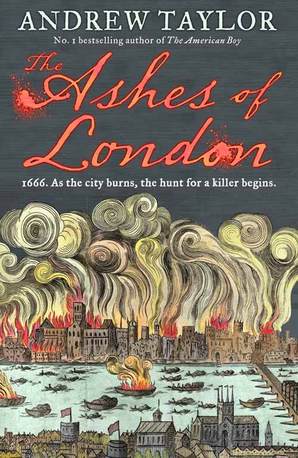
The Ashes of London by Andrew Taylor - review
Like many people, I enjoy historical fiction, and the past twenty years or so has seen a massive increase in the number of historical mysteries being written. There are various reasons for this, including the challenges inherent these days in writing contemporary fiction - over-familiarity is a problem, and so is the reach of new technology. But writing a good historical mystery is by no means a doddle.
I doubt it any crime writer, in Britain or elsewhere, has shown such consistent mastery of historical mystery writing in the past couple of decades than Andrew Taylor. Possibly the most impressive feature of his work is his ability to write in compelling fashion about different places and periods of the past. He's equally at home in the rural England of his post-war Lydmouth series and with much more distant times, as in The American Boy. And his Thirties novel Bleeding Heart Square is quite superb.
Now he's turned his attention to seventeenth century London. The Great Fire of 1666 provides a dramatic backdrop to the opening pages of The Ashes of London, a meaty tale in which James Marwood, the son of a supporter of Cromwell, tries to make his way in a world where Charles II has been restored to the throne. A strange encounter with a young woman dressed as a boy introduces him fleetingly to Cat Lovett, who will play a crucial part in the events that follow.
Cat seems destined for a loveless marriage before Fate, in the shape of her odious cousin Edward, intervenes. Soon she is on the run, and we follow her story, and James', as the two young people fight against the legacy of the past, and in so doing become enmeshed in murderous intrigue. This is an intensely readable novel; Taylor has done his research, but wears it lightly. The result is an enjoyable mystery that is intended as the first of a series.
Wednesday, 8 May 2013
The Scent of Death by Andrew Taylor - review
Andrew Taylor has written a good many books over the years, but he has been slightly less prolific in recent times, which made me all the more eager to read his latest, The Scent of Death. And that's because I think it's fair to say that the appearance of a new Andrew Taylor novel has become an Event, rather in the way that the arrival of a new book by that exceptionally entertaining writer Reginald Hill used to be an Event. Yes, Andrew is that good. The over-riding question, inevitably, is whether the new book matches the high standards of its predecessors such as The American Boy and Bleeding Heart Square. The answer is an emphatic yes. This is a marvellous book.
The story is set in the late eighteenth century, in New York. Edward Savill, a clerk, has been sent on government business at a time when war is raging as many (but not all) Americans press for independence. His arrival sets in motion an elaborate seqeunce of events whose significance does not become clear for a long time. This is a long book, and a masterly example of how to pace a story. A series of small incidents keep the plot moving along while the characters and their environment are developed with unobtrusive skill.
Savill is staying with Judge Wintour and his family, the most intirguing of whom is Wintour's daughter-in-law, Arabella. A man called Pickett who had visited the Wintours in rather mysterious circumstances, is found murdered, and other deaths occur. Time passes, and Arabella's husband, a soldier, returns home. Strange tensions in the Wintours' marriage become evident,although their cause is unclear. Meanwhile, Savill's own marriage runs into trouble.
There are many incidental pleasures in this book. As usual, there are one or two sly references to Taylor's other work - he once used the pen-name Saville, for instance, and an HMS Lydmouth, named after his excellent series set in post-war Britain, makes an appearance. Whilst it's fun to try to detect these little snippets, I really hope that one day he can be persuaded to set out the various cross-references in his books, which I suspect some readers may not have noticed.
I knew very little about this period of American history, but Taylor achieves the distinction of imparting a great deal of information without making his research obvious - and he makes it all extremely interesting. The story-line is gripping from start to finish, even though I was unsure for a long time where it was leading, while the writing is of the highest quality throughout. I figured out one aspect of the plot, but others had me on tenterhooks. This is quite possibly the best book so far from one of our most distinguished crime novelists. Strongly recommended.
The story is set in the late eighteenth century, in New York. Edward Savill, a clerk, has been sent on government business at a time when war is raging as many (but not all) Americans press for independence. His arrival sets in motion an elaborate seqeunce of events whose significance does not become clear for a long time. This is a long book, and a masterly example of how to pace a story. A series of small incidents keep the plot moving along while the characters and their environment are developed with unobtrusive skill.
Savill is staying with Judge Wintour and his family, the most intirguing of whom is Wintour's daughter-in-law, Arabella. A man called Pickett who had visited the Wintours in rather mysterious circumstances, is found murdered, and other deaths occur. Time passes, and Arabella's husband, a soldier, returns home. Strange tensions in the Wintours' marriage become evident,although their cause is unclear. Meanwhile, Savill's own marriage runs into trouble.
There are many incidental pleasures in this book. As usual, there are one or two sly references to Taylor's other work - he once used the pen-name Saville, for instance, and an HMS Lydmouth, named after his excellent series set in post-war Britain, makes an appearance. Whilst it's fun to try to detect these little snippets, I really hope that one day he can be persuaded to set out the various cross-references in his books, which I suspect some readers may not have noticed.
I knew very little about this period of American history, but Taylor achieves the distinction of imparting a great deal of information without making his research obvious - and he makes it all extremely interesting. The story-line is gripping from start to finish, even though I was unsure for a long time where it was leading, while the writing is of the highest quality throughout. I figured out one aspect of the plot, but others had me on tenterhooks. This is quite possibly the best book so far from one of our most distinguished crime novelists. Strongly recommended.
Tuesday, 19 July 2011
Andrew Taylor
I’ve mentioned Andrew Taylor and his books several times in this blog. I was reading his crime novels long before I met him – he started his career young, and began with a series featuring the amoral William Dougal that is often described as ‘quirky’. It’s almost a cliché, but it’s still a fair description, because the Dougal books are definitely unusual and different. One of my favourites is The Sleeping Policeman.
As a full-time writer, Andrew has turned his hand to many kinds of projects. He even produced five novels based on the Bergerac TV series, under a pen-name, Andrew Saville. Every now and then he has turned out a stand-alone psychological suspense novel, and my favourite of these is The Barred Window – really good.
His next series was set in the 50s in the fictional Border town of Lydmouth. It features the relationship between a married cop and a female journalist – one book, cleverly, focuses on the story of the cop’s wife. This series began quietly, but the later books are exceptional. I’ve written an article about Thornhill, the cop, which Andrew included on his website, and I mean to update it some day.
The Roth Trilogy is, arguably, his masterpiece. I’ve written about it before on this blog. Suffice to say that it’s one of the most impressive trilogies I’ve come across in crime fiction – a study, going back through time, of the making of a sociopathic killer.
Then there are his historical novels. The American Boy is the best-known, and I reviewed The Anatomy of Ghosts recently. It's shortlisted for the Harrogate Festival award this week and I'm keeping my fingers crossed for him.
I’d particularly mention Bleeding Heart Square, which is superbly done. He always conveys the atmosphere of the period, and the setting, splendidly, and Bleeding Heart Square has a very good plot and also some resonances with present day Britain. A very good writer, whose work is varied and highly literate. If you don’t know his work, do give it a try.
Wednesday, 20 October 2010
The Anatomy of Ghosts
I've written before about my enthusiasm for the work of Andrew Taylor. The appearance of another historical mystery from Andrew, The Anatomy of Ghosts, is therefore a real treat. Bleeding Heart Square was one of my favourite crime novels of 2008, and while that book was set in the 1930s, here he writes with equal assurance about murky events in a Cambridge college in the late 18th century.
Taylor's fictional Jerusalem College is splendidly and atmospherically evoked. A map is provided at the start of the book, and it turns out that the layout of the college buildings and grounds is relevant to the unravelling of the mystery. I do like maps in books, and I'm actively thinking of trying to draw one for my next book. Only snag is, I'm not at all artistic...
The book opens in dramatic fashion, with the proceedings of the Holy Ghost Club, a secretive and sinister group based at Jerusalem, and a shocking initiation ritual ends in tragedy and death. Attention then switches to the misadventures of John Holdsworth, who suffers terrible double bereavement when first his young son drowns and then his wife commits suicide. Angered by the fact that his wife had been exploited due to her belief that her son's ghost was seeking to make contact with her, Holdsworth writes The Anatomy of Ghosts, debunking ideas about the spirit world, and comes to the attention of a wealthy woman who dispatches him to Jerusalem College to assess the state of mind of a student who was traumatised by events at the last meeting of the Holy Ghost Club.
The first half of the book is sedate, far removed from the quickfire style of many modern serial killer thriller, but is none the worse for that. Taylor establishes character and setting with equal care, and the period detail is very well done. In the latter stages of the story, the pace quickens and a number of plot threads are pulled together with the dexterity that we have come to expect of this highly accomplished author.
Saturday, 31 January 2009
Saturday Selection - Taylor, Cleeves, Kelly and co.
I’ve mentioned Andrew Taylor’s marvellous Bleeding Heart Square more than once in this blog, and on Thursday the Penguin paperback edition appeared. The story is set in the 1930s, and is a really good read. The paperback includes an afterword by Andrew which I found very interesting – to my mind, the trend for including supplementary material in books is certainly a Good Thing.
I’ve just received from Macmillan a proof copy of Ann Cleeves’ Red Bones, the third entry in her Shetland series – it’s been described as the Shetland Quartet, but who knows? Maybe the success of the books will prompt Ann to keep the series going, along with her novels featuring Vera Stanhope.
To be published this week, again by Penguin (and I think as a paperback original) is the latest novel by Jim Kelly. It’s called Death Wore White, and represents a departure from his previous books; I haven’t read him previously, but a number of friends whose judgement I respect enjoy his work. This is an ‘impossible crime’ story – according to the publicity, the killer ‘struck without being seen, and without leaving a single footprint in the snow’. I look forward very much to sampling this one.
A couple of weeks ago, Bantam brought out Breaking Point by John Macken. This one features a forensic scientist who was once fired by the CID. Here he is involved in a case where the GeneCrime police unit ‘is frantically trying to stop a seemingly invisible killer who strikes in the middle of the day on busy Tube lines.’ I was on a panel with John Macken (the name’s a pseudonym) at Crimefest in Bristol last year, and his books are developing a following.
Soon to appear in paperback is the intriguingly titled The Risk of Infidelity Index by Christopher Moore, published by Atlantic. Moore is a Canadian who has published nine novels, but this is the first to appear in the UK. It’s set in Bangkok and features a private eye called Vincent Calvino.
The end of February sees the appearance of The Fifth Floor by Michael Harvey (Quercus). Harvey (no relation to John) is an American television writer, and his novel features ‘a tough-talking Irish cop turned private investigator’, Michael Kelly. Kelly investigates ‘a web of corruption and intrigue’ in Chicago. A very good critic, Marcel Berlins, has applauded Harvey’s writing, so I shall be interested to have a look at it.
Finally, a book from the writer and director of the film ‘I’ve Loved You So Long’ – Brodeck’s Report by Philippe Claudel. It’s translated from the French by John Cullen, who has himself been short-listed for several awards, and is published by Maclehose Press (a division of Quercus.) It’s described as ‘an immensely powerful chronicle of a community’s fear and loathing of what is strange, unknown, and from the Outside’.
Wednesday, 14 January 2009
Andrew Taylor's Diamond Dagger
The public announcement that Andrew Taylor has been awarded the CWA Cartier Diamond Dagger came after I'd written my post yesterday about the televised version of his extraordinary Roth Trilogy, but it was the happiest of coincidences.
The Diamond Dagger is awarded for a crime writing career of 'sustained excellence', and nobody can doubt that Andrew's track record demonstrates just that. I've followed his career since its beginnings, with the fascinating and quirky series about William Dougal, and when I became editor of the CWA's anthology, I was delighted when Andrew came up with the first short story featuring Dougal. 'The Cost of Living' appeared in Perfectly Criminal in 1996, and I said in introducing it that the story 'has all the strengths of the Dougal novels: a neat yet unusual story-line, convincing characterisation and that poignancy which is so characteristic of Taylor's writing'.
The same features were evident in his excellent Lydmouth series, and again Andrew honoured me with the first Lydmouth short story, 'The Woman who Loved Elizabeth David', which appeared in Past Crimes in 1998. Several of Andrew's stand-alone novels are quite outstanding. The American Boy won massive sales after it became a Richard and Judy selection, but one of my favourites is the less well-known, but brilliant The Barred Window. And I've mentioned before in this blog that I'm a huge fan of Bleeding Heart Square.
I read Andrew Taylor for pleasure, but in reading the books, I also learn more about the craft of crime fiction from a writer who is not only a consummate professional (a bit of trivia is that, years ago, he wrote a number of tv novelisations under a pseudonym), but whose literary gifts are subtle and original. A star of the genre, who will be a very popular Diamond Dagger winner indeed.
Subscribe to:
Posts (Atom)