Motive for Murder is a title close to my heart. It was an alternative title for my true crime book Urge to Kill,and the almost-identical Motives for Murder was the title of the Detection Club anthology which I edited, and which yielded four stories on the CWA Dagger longlist, three on the shortlist (including my "Murder and its Motives"!) and the ultimate winner. But today I'm talking about something completely different - the novel published in 1963 by Charles Barling.
Actually, Charles Barling was the name of the author's husband. Her principal writing name was Pamela Barrington and she lived from 1904-1986. Her first novel, White Pierrot, was published in the early Thirties, but it was a romance rather than crime, and her career only really developed after the Second World War. She was never a big name, although Account Rendered (1953) was filmed, with a very young Honor Blackman in a leading role.
Motive for Murder concerns the doomed marriage of Paul Hooper, a young estate agent, to Edith Maitland, an attractive and enigmatic older woman, who moves to Rye and decides to buy the house Paul grew up in, and with which he is obsessed. She seduces him, and they marry - though his eye is on the house rather than Edith. Before long, Edith starts an affair with another man, and behaves so unpleasantly to all and sundry that it's foreseeable she will wind up dead.
And so she does. The question is - who killed her, and why? The publishers described this as "an offbeat crime story with an ingenious twist", and I found it very readable indeed. In fact, I found the build-up very entertaining. But the later part of the story struck me as disappointing. A certain carelessness with the writing perhaps explains my disappointment, as does the fact that I didn't find the twist ingenious. This is nearly a very good mystery, and I'm glad I read it, but the excellence that I'd anticipated wasn't sustained. A shame, because there's something distinctive about this writer's storytelling.
Showing posts with label Motives for Murder. Show all posts
Showing posts with label Motives for Murder. Show all posts
Friday, 2 February 2018

Monday, 30 October 2017
The CWA Dagger Awards 2017

The CWA Dagger Awards Gala Dinner is one of the major occasions, perhaps the major occasion, in the crime writing world, in Britain at least. I've attended quite a number of Dagger award ceremonies (for a while they were lunches rather than dinners) over the past twenty years, but last Thursday's Gala Dinner at the Grange City Hotel in London was a very different experience, because in my capacity of Chair of the CWA, I was hosting the event. To say that this took me way outside my comfort zone would be an under-statement, but as things turned out, it was a marvellous evening, and Hayley and the organising team deserve huge credit for making sure that everything went so well. Thanks also to Gary Stratmann, our photographer for the evening.


Huge credit also goes to our Master of Ceremonies, the inimitable Barry Forshaw, whom I presented with a CWA Red Herring award. Barry, the consummate professional, made sure that the ceremony went with a swing. And our guest speaker was absolutely excellent. He was Robert Thorogood, creator and writer of Death in Paradise, who proved to be both witty and charming. We had a very enjoyable chat about Golden Age fiction, of which (as those who have watched the show can guess) he is a huge fan. Robert had a tough act to follow, because last year James Runcie was a splendid guest speaker, but we were lucky to have someone equally impressive this time around.

I've attended quite a lot of awards ceremonies over the years, in the legal world as well as in the writing world, and the one thing I've learned is that, if you aren't careful, they can drag on, and the audience becomes bored. I vividly remember legal dinners where sweepstakes were run to guess the length of the seemingly interminable speeches. We were determined to make sure this didn't happen on Thursday.. Whilst it's obviously essential not to rush through awards in such a way that they make no real impression, the pace of the evening's events was an important element in creating the feelgood factor that prevailed from start to finish. An added bonus for me was that a story from a book I'd edited, Motives for Murder, won the CWA Short Story Dagger., though I hasten to emphasise that the judging process is completely independent!

It was a glittering occasion, and the audience of 250 people included such stars as Peter Capaldi and Brenda Blethyn. I talked briefly about the progress the CWA has made this year, and had the great pleasure of presenting Ann Cleeves with the CWA Diamond Dagger. All in all, a memorable occasion, a career highlight, and one that (now it's over!) I shall look back on with enormous and lasting pleasure.

Thursday, 27 July 2017
The CWA Dagger Shortlists
I've returned home after a brief and hectic trip to London that involved a variety of meetings (one of them in the historic Reform Club, which I've never been inside before), a pleasant book-signing session in Hatchards, and finally the CWA Daggers shortlist announcements reception at Waterstone's in Piccadilly.
To deal with the personal stuff first, I'm thrilled to say that my story "Murder and its Motives" has been shortlisted for the CWA Short Story Dagger. This is my fifth appearance on a Dagger list, and it's the third short story of mine to reach this particular shortlist. "Test Drive" did so twelve years ago, and three years later, "The Bookbinder's Apprentice" earned me the Dagger. So I'm naturally very happy.
Happy, too, to see that two other stories from the Detection Club anthology Motives for Murder appeared on the list - those by Michael Ridpath and Len Tyler. What a happy book that has proved to be. I'd also like to say how pleased I am to see Leye Adenie on the shortlist; I've been following his career with keen interest ever since we got to know each other last year. The shortlist also features the legendary James Sallis and Ovidia Yu.
Overall, the event went extremely well, and the attendance was very good. I was especially pleased to meet that fine writer Louise Penny for the first time. The success of the event was due to good work on the part of several people, but I'd like to pay special tribute to Mike Stotter, the CWA Daggers Liaison Officer, an unsung hero of the CWA, who does great work year after year in ensuring that all goes smoothly with the independent judging process. It's that process that ensures the high reputation of the Daggers the world over.
Monday, 22 May 2017
Crimefest and the CWA Short Story Dagger


In case you're wondering, as Chair of the CWA, I keep a distance from the Daggers process, which is in the hands of a large number of capable and independent judges and Dagger Liaison Officer Mike Stotter. The independence of the Daggers judging process is part of the reason why the awards are held in such high esteem around the world. One publisher expressed dismay to me that a particular novel by a talented author hadn't made one of the longlists. But whilst I can always empathise with disappointment, publishers simply can't influence the judges, and that's the way it should be. We may not always share the judges' taste, but such is life.
The convention kicked off for me, as usual, with the Authors Remembered session. I moderated a panel comprising Sarah Ward, John Lawton, Andrew Wilson and Jane Corry, and they did a great job of interesting the audience in a range of writers from Patricia Highsmith to Elizabeth Daly. There was time for a quick bite to eat before the traditional pub quiz, run by the admirable Peter Guttridge (photo above). My team managed to win, and we had a very convivial time of it.

On Sunday, I moderated another panel, this time on the short story. Given that my panellists were Len Tyler, Janet Laurence, Peter Lovesey and Ann Cleeves, it was a great pleasure and a great way to end a fantastic few days.
Saturday, 31 December 2016
2016 - Publications


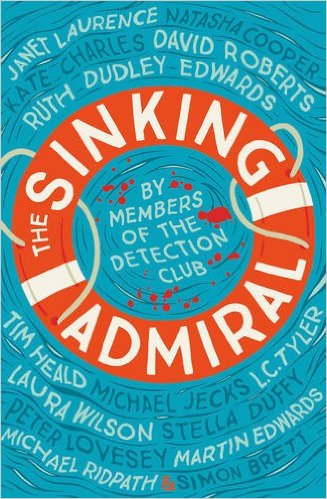
Another memory to treasure concerned the Detection Club's annual dinner at the Dorchester in November, the first over which I'd presided. We presented the US and UK editions of Motives for Murder, a collection of new stories that I'd edited in honour of Peter Lovesey's 80th birthday to the man himself. In the summer the Club had also published The Sinking Admiral, masterminded by Simon Brett, to which I'd contributed a chapter.




Friday, 23 December 2016
Forgotten Book - Another Little Christmas Murder
I thought that for today's Forgotten Book I'd adopt a seasonal approach. A Christmas crime story, and one that is easy to buy as a present, or for yourself. (I'm assuming, of course, that you're already stocked up with The Golden Age of Murder, Crimson Snow, Silent Nights, and the other Brtish Library Crime Classics,and...well, you get the picture!) So I was rather pleased to receive a new paperback with an appropriately snow-covered cover from Sphere -also the excellent publishers, I should say, of Motives for Murder, another book you really ought to treat yourself to!
The book in question is called Another Little Christmas Murder, and the author is Lorna NIcholl Morgan. She is, like Francis Duncan, author of a republished vintage Yuletide mystery that came out a year ago, someone whose work has long been forgotten. There's a difference between Morgan and Duncan on the one hand, and J.Jefferson Farjeon, author of Mystery in White, on the other: Farjeon was highly regarded in his day, whereas Duncan and Morgan never made much impression even when they were publishing new books.
In Morgan's case, that's partly because she only published four books - in a concentrated burst between 1944 and 1947. This was the last of them to appear - under the title Another Little Murder. There's no information about Morgan's life or other books in this edition, and I do think that's a pity. I'm sure I'm not alone in feeling like that: countless people have contacted me from all around the world saying they've loved learning more about the likes of John Bude and company in the BL Crime Classics.
The massive success of Mystery in White created a bandwagon effect, and this year there are lots of books in the shops with Christmassy titles and cover artwork ,quite apart from the BL titles. Yet despite the change to the title of this book, the story does not actually take place at Christmas, which hasn't even arrived by the time the story comes to an end! This was a disappointment.
So what of the story itself? Well, I liked Dilys, the feisty young commercial traveller whose car gets stuck in the snow in a remote bit of Yorkshire, and who is offered refuge in a country house where there are plenty of mysterious goings-on. The book starts well, but the plot is weak, and my enthusiasm began to fade after fifty pages or so. In particular the criminal conspiracy at the heart of the plot is one that the author seems not to have really believed in herself, and I certainly didn't. I'm afraid I may be able to guess why this was her last published book. But never mind, this is the season of goodwill, and I want to end on a positive note. Morgan could write well, and she had a good sense of humour. I particularly liked the character who is an odious health fanatic. And Dilys is so engaging that it's a shame that she never had any more recorded adventures.
Wednesday, 23 November 2016
Fireside Gothic by Andrew Taylor - review
Fireside Gothic, recently published by Harper Collins, is a hardback collection of three novellas by Andrew Taylor. Andrew is one of those writers of my generation (Ann Cleeves and Peter Robinson among the others) whose books originally attracted my attention when I was hoping to get a novel published. I wanted to see what newish authors of roughly my vintage were up to. Like Ann and Peter, and indeed before them, Andrew was writing books that I not only admired, but more importantly enjoyed. And like them, he's gone on to become one of our leading crime novelists.
He's also someone who writes excellent short stories (do please check out his contribution to Motives for Murder, the brilliantly titled and very entertaining "The False Inspector Lovesey"). The three longish stories in Fireside Gothic originally appeared as Kindle Singles. It interests me that a leading writer should try this different, and enterprising, way of publishing material that's some way removed from his current novels, and it strikes me as a very good idea. But I'm glad it's now possible to read these stories in a single, elegantly produced volume.
The book offers a reminder of Andrew's versatility. He's probably best known for his historical crime fiction, and for his willingness to tackle a wide range of different historical periods, but his contemporary work is also very varied, and that is a real strength, My favourites of his books are The Roth Trilogy aka Fallen Angel, The Barred Window, and Bleeding Heart Square, but there are plenty of other good ones to try if you are new to his work not least the Lydmouth series set in a post-war market town. He even wrote five Bergerac tie-ins under a pen-name.
In Fireside Gothic he ventures into what I'd call Robert Aickman territory (and I've written several times here of my enthusiasm for Aickman; I've even produced one story of that type myself, "Through the Mist", which appeared in Starlings). Andrew's strange stories have some linking themes, but are quite distinct from each other. "Broken Voices", a Christmas story with a historical background, is closest to the classic type of supernatural story told by M. R. James. "The Leper House" benefits from an evocative setting in East Anglia, while "The Scratch" is perhaps my favourite of the three,given the number of levels on which you can interpret it. All in all, first-rate fireside reading.
Monday, 14 November 2016
Motives for Murder

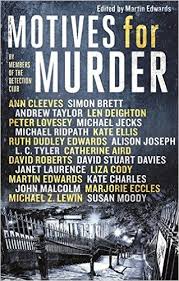
We also celebrated the recent 80th birthday of that wonderful writer Peter Lovesey, who has been a member of the Club for over 40 years. I admired Peter's books long before I met him, more than a quarter of a century ago, and when I suggested to Club members that we celebrate him in a practical way by producing a book in his honour, the response was overwhelmingly positive. And the result has just been published - a book called Motives for Murder.
The UK edition, published by Sphere (front cover above), was presented to Peter by David Shelley, once my own editor (and now J K Rowling's!) and the man who first commissioned my Lake District series. The US edition, published by Crippen and Landru (front cover below), was presented to Peter by Doug Greene whose own contribution to the genre includes a splendid biography of John Dickson Carr.
Len Deighton has written a foreword to the book, and Peter himself has supplied a fascinating afterword, detailing his memories of his early years in the Detection Club. Ann Cleeves, Len Tyler, Kate Charles, Ruth Dudley Edwards, Susan Moody, Andrew Taylor and Liza Cody are among the galaxy of talented writers who have written brand new stories for the book - while Simon Brett contributed a sonnet. An added twist is that the stories (and the sonnet) are connected to Peter's life and work in one way or another. The result is one of the most satisfying anthologies I've been concerned with, and a fitting tribute to one of life's good guys (who treated us on Thursday night to a wonderful rendition of his witty poem about autopsies...) It was a truly memorable occasion.

Wednesday, 7 September 2016
Another One Goes Tonight by Peter Lovesey
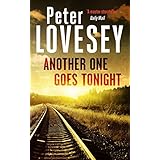 Another One Goes Tonight, published by Little,Brown, is the latest entry in Peter Lovesey's long-running series featuring Bath cop Peter Diamond. And the first thing to say about it is that it's a hugely enjoyable read with a discursive but ingenious plot, in which a whole bunch of inter-related strands are brought together quite splendidly at the end. .
The story begins with a brief extract from a mysterious journal which begins "Another one goes tonight." Clearly, we are reading the words of a serial killer, but although this device is familiar enough, it's put to very good use here, as Lovesey shows a Christie-like mastery of the art of misdirection. After this opening, we move swiftly into a strange encounter involving an apparent traffic offence, followed by a police car crash with tragic consequences.
That crash brings Peter Diamond into the story, and when he finds an elderly man on the point of death at the scene, to whom he gives the kiss of life, he is plunged into perhaps the most baffling enquiry of his career - a case whose disparate elements include a group of railway enthusiasts, an imaginary cat, a debt owed to a gangster, and an ever-lengthening list of apparent murders.
This novel is an example of Peter Lovesey at his best, and I recommend it highly. This week, incredibly, he will be celebrating his 80th birthday while on a trip to the US. His friends and colleagues in the Detection Club will also be marking this milestone with the publication in November of Motives for Murder, a gathering of brand new stories with an intro by Len Deighton and an afterword by Peter himself, in which he tells the story of his early days in the Club. The collection will be published in the UK by Little, Brown, and in the US by Crippen & Landru. I like to think that, as with his latest novel, this is a book not to be missed.
Wednesday, 20 July 2016
Motives for Murder - a new Detection Club book

I'm delighted to announce that the Detection Club will publish in November a brand new collection of short stories, Motives for Murder. The idea is to celebrate the 80th birthday this year of one of the Club's most distinguished members, Peter Lovesey. The book will be published in Britain as a paperback original by Little, Brown, Peter's publishers, and in the US (with a limited hardback edition as well) by Crippen & Landru, a small press run by Peter's good friend Doug Greene.
Setting the wheels in motion for this book was my first act as President of the Detection Club. I wanted to honour Peter, who has given so much to the Club over many years (and has, incidentally, been a great source of information about its past) and I also wanted to showcase the short story writing talents of our wonderful members. The Club's membership is relatively small, and the deadline was exceptionally tight, but more than a third of those members offered to contribute to the book, which delighted me. The result is a very substantial anthology indeed;.
The book benefits from a foreword by the legendary Len Deighton. Len has published very little over the past twenty years, so I was thrilled when he agreed to get things rolling, and there is also a fascinating afterword by Peter himself, which includes many stories about his early days in the Detection Club back in the 70s.
Each of the twenty stories (well, nineteen stories and one sonnet!) was written specially for the book, and each is prefaced by a few words from the author about Peter's contribution to the genre. There are some wonderful things in this book, written by leading crime writers such as Ann Cleeves, Andrew Taylor, Len Tyler, Michael Ridpath, Liza Cody and...well, the list goes on. I'm thrlled that we've put together such a special book in a very short space of time and hope that crime fans everywhere will find something in it to delight and entertain
Subscribe to:
Posts (Atom)