Monday, 14 November 2016
Motives for Murder
We also celebrated the recent 80th birthday of that wonderful writer Peter Lovesey, who has been a member of the Club for over 40 years. I admired Peter's books long before I met him, more than a quarter of a century ago, and when I suggested to Club members that we celebrate him in a practical way by producing a book in his honour, the response was overwhelmingly positive. And the result has just been published - a book called Motives for Murder.
The UK edition, published by Sphere (front cover above), was presented to Peter by David Shelley, once my own editor (and now J K Rowling's!) and the man who first commissioned my Lake District series. The US edition, published by Crippen and Landru (front cover below), was presented to Peter by Doug Greene whose own contribution to the genre includes a splendid biography of John Dickson Carr.
Len Deighton has written a foreword to the book, and Peter himself has supplied a fascinating afterword, detailing his memories of his early years in the Detection Club. Ann Cleeves, Len Tyler, Kate Charles, Ruth Dudley Edwards, Susan Moody, Andrew Taylor and Liza Cody are among the galaxy of talented writers who have written brand new stories for the book - while Simon Brett contributed a sonnet. An added twist is that the stories (and the sonnet) are connected to Peter's life and work in one way or another. The result is one of the most satisfying anthologies I've been concerned with, and a fitting tribute to one of life's good guys (who treated us on Thursday night to a wonderful rendition of his witty poem about autopsies...) It was a truly memorable occasion.
Monday, 13 June 2016
Bodies from the Library

I'm back home - briefly -after an exhilarating trip to London for the second Bodies from the Library conference at the British Library. This was a highly successful event, one in which I was delighted to take part, and during the afternoon coffee break one of the attendees made things even more memorable by kindly telling me that she'd just heard that The Golden Age of Murder has been shortlisted for the Macavity award from Mystery Readers International. Not so long ago, if you'd told me that a book of mine would win three awards and be listed for three more, I'd have thought you were pulling my leg in a rather cruel way. But yes, it has actually happened...
Less of a surprise were two announcements about personal projects of mine which I'm very excited about. For one day only, copies of the new edition of Anthony Berkeley's The Poisoned Chocolates Case, a title in the British Library's Crime Classics series, were on sale - official publication is in October. And this edition contains not only an intro that I've written, but more importantly, a seventh solution (in addition to the six solutions Berkeley came up with) by Christianna Brand, first published in the US in the 70s. And there is a brand new solution written by me. This is a project that was, for me, enormous fun, and a large number of copies of the book were sold on the day. More about this one in October...
During my conversation with Rob Davies of the British Library, we also announced that next year will see the publication of my new non-fiction book The Story of Classic Crime in 100 Books. This book has occupied a good deal of my time over the past 18 months, and I recently finished work on the manuscript. It's very different from The Golden Age of Murder, even though there is an element of overlap in terms of the period covered, and I hope that crime fans will find it full of interesting - and often unexpected - material.
The first session of the day featured another book with which I'm very happy to be associated. This is The Sinking Admiral, by the Detection Club. Simon Brett, who masterminded the book, discussed it with me, and two other contributors, Janet Laurence and Stella Duffy. It was also announced that Stella has been awarded an OBE, and that she has been engaged to write a completion of an unfinished Ngaio Marsh novel: something to look forward to. As for The Sinking Admiral, it sold out by mid-morning.
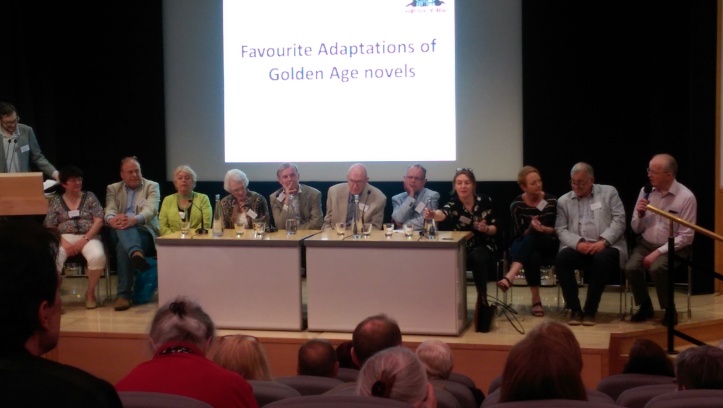
Tony Medawar talked about Anthony Berkeley, while Len Tyler and Susan Moody championed Philip MacDonald and Georgette Heyer, and Barry Pike discussed the work of H.C. Bailey. Dolores Gordon-Smith focused on G.K. Chesterton, while Jennifer Henderson, biographer of Josephiine Tey, talked about Tey as a Scottish writer. John Curran discussed the Collins Crime Club - and his book on the subject is another that will be eagerly anticipated. Finally there was a group panel in which we picked favourite screen adaptations of Golden Age novels.
Dinners on the Friday and Saturday evenings provided plenty of opportunities for socialising, and I was delighted to meet Taku Ashibe, from the Honkaku Mystery Writers' Club of Japan, (modelled on the Detection Club) who presented me with several books, including one of his own. Saturday itself was extremely hectic, and although I had the chance to chat to a number of attendees, there simply wasn't time for as many conversations as I'd have liked. But you can't have everything, and overall this was a wonderful day, full of good things, and pleasant people. What more could you want?
The photo at the top of this post appears on an account of the day on Puzzle Doctor's splendid blog, In Search of the Classic Mystery Novel. Further perspectives on the day may be found on the similaly enjoyable Past Offences blog and Cross Examining Crime.
.
Tuesday, 3 February 2015
Deal Noir
Monday, 2 September 2013
The Oxford Literary Tour
Some months ago, Janet Laurence told me that she was organising a conference for AIEP, the international crime writers' association, to take place in Oxford, and asked if I'd be willing to conduct a guided literary tour of Oxford. Now I have no experience whatsoever as a tour guide, so I felt I was a rather unlikely choice. But Janet is a very persuasive person, so I said yes.
I didn't know what to expect. Not just whether the weather would be kind, which of course was impossible to predict, but how many people would want to go on such a tour, how good their English would be, how energetic they would feel - or anything, really. So preparing was a bit tricky. I realised that I'd have to be flexible and see how things went on the day.
The AIEP conference went on throughout last week, but because of work commitments, I was only able to turn up for the latter stages. However, I found everyone very welcoming and it was fascinating to meet the international contingent, as well as locals such as Susan Moody, Bob Cornwell, Christine Poulson, and Barry Forshaw.I also had an enjoyable evening after dinner in a pub with Michael Ridpath and a number of foreign writers.
To my relief, the tour proved to be great fun. About 35 people came along, and I took them around the city, talking about some of the books set there as we went along. We toured the quadrangles of Balliol, and had a drink in the Eagle and Child, where once the Inklings met, drank and talked. Myfanwy Cook kindly acted as tour photographer!
The last major event of the conference was an after dinner speech by a former top cop, Dame Elizabeth Neville. Janet was given a standing ovations, which she richly deserved. A sign of the esteem in which she is held by the international crime writing community, and a sign too of how much they appreciated their time in Britain. I made a number of delightful new friends, and despite my initial misgivings, in the end I was very glad that Janet asked me to be a tour guide - at least for one afternoon in my life!
Wednesday, 26 June 2013
Edmund Crispin's Classic
There are a couple of reasons why I returned to The Moving Toyshop. First, I've been asked to talk to visiting crime writers from overseas about Oxford detectives at a conference in a couple of months' time and I felt I'd better do some homework. Second, I attended a talk given by Susan Moody at Crimefest on the subject of Oxford detective stories. Susan's enthusiasm made me think it was time to go back to Crispin.
I'm glad I did. The Moving Toyshop is tremendous fun, light-hearted and with an unusual, if occasionally eccentric plot that makes use of a very interesting legal device, the secret trust. The early chapters are quite dazzling and there are some memorable characters, including a very dodgy solicitor, and lots of witty lines. Gervase Fen, the amiable English don, leads the chase for the person who killed Miss Tardy in the toyshop..
Of course, in a high-spirited book like this, it is not easy to maintain tension throughout, and there are moments when farce predominates. The mystery is nicely constructed, but not as striking as the wonderful premise of the toyshop that appears to be in two different parts of Oxford. Crispin is very good at capturing the city's essential atmosphere, and it is a genuine tragedy that his great talent burned out so soon. After a flurry of novels, he was in effect burned out at the age of thirty and he spent the rest of his life drinking himself slowly to death. We had a long wait for his last book,The Glimpses of the Moon, but it proved to be a disappointment. Far better to remember this witty entertainer by books like The Moving Toyshop.
(Incidentally, are other Blogger users finding, as I have done lately, that the previous torrent of spam comments has reduced to a trickle at most? Long may this continue...)
Tuesday, 4 June 2013
Crimefest 2013 - part two
I also attended a talk given by Susan Moody on Oxford Detectives. Susan is a long time member of an international group of crime writers who are coming to Oxford this August. As they have invited me to conduct a literary walking tour, I thought I'd better get some research in early, and Susan's enthusiasm for Edmund Crispin and Michael Innes in particular reminded me I ought to read more of their books. I've never been a great Innes fan, I must confess .I suspect I just read the wrong books long ago - a few of the later ones, which maybe don't fully represent his talent.
Other highlights included a chat with Lindsey Davis, and a meal with James Wills, whom I'd never met before. My literary agent, Mandy Little has represented me from the start of my career, but has recently announced that she will be retiring as an agent before long, while remaining with the business as a consultant. James is her successor and is now managing director of the business, so we were keen to meet each other at long last. And a very good companion he proved to be.
I also attended a panel moderated by Nev Fountain, which dealt with writing for other media. I'm not especially interested in (for example) graphic novels, but I do find the idea of writing for radio quite appealing In fact it's something I did at university, before moving back to the idea of writing novels. Various interesting points were made by a good panel which included Alison Joseph, the recently installed chair of the CWA. And it was especially interesting to me that I met Nev for the first time at the Crimefest gala dinner the following evening. More of that tomorrow.
Thursday, 2 May 2013
Susan Moody and Stephen Murray
I first came across Susan Moody as a writer when I bought a paperback copy of her first book, Penny Black in the mid 80s. At that time, I was casting around for ideas for a crime series of my own, and assessing what else was happening in the market. Suffice to say that I was impressed with the witty and zestful writing. Fast forward a few years, and I met Susan in person, at about the time when she was starting a new series, featuring Cassie Swann, a bridge expert. I can't play bridge (I'm afraid that I once went to evening classes to learn, and found the tutor incomprehensible), but even so the books struck me as successful.
I was impressed by the versatility Susan displayed in a number of short stories which appeared in high profile anthologies edited by the likes of Tim Heald, and Liza Cody and Michael Z. Lewin. She even turned the long-running 'Gold Blend' TV commercials into a novel, and literary versatility doesn't get much more striking than that! With this in mind, when I was asked to put together an anthology for the CWA, Susan Moody was one of the first people I approached to contribute. The resulting story, 'Moving On', with its viewpoint shifts, certainly lived up to expectations, and helped to make Perfectly Criminal a book I was proud to have edited. In recent years, Susan has been less prolific, but she came up with another notable story for Guilty Consciences, my most recent anthology, 'Deck the Halls with Poison, Ivy'.
Stephen Murrary is a contemporary of mine, but he achieved publication as a novelist rather more quickly, and was already well-established by the time I met him. His series of books featuring Alec Stainton, a quiet but likeable cop, achieved considerable distinction, and Stephen too contributed to a couple of early Northern Blood anthologies. The Stainton series came to an end, but when he supplied another good short story, 'Landfall', to Crime on the Move, I thought it was a sign that Stephen's crime novels would be hitting the bookshelves again before long. It hasn't happened yet, but I live in hope.
Friday, 4 June 2010
Forgotten Book - Julian Symons Remembered
My choice for today’s Forgotten Book is a labour of love conceived by John Walsdorf as a tribute to Julian Symons, the crime novelist and critic whom he admired so much. I wrote about Walsdorf’s epic bibliography of Symons’ work a while ago, and thanks to the wonders of the internet, I was contacted via Facebook by John Walsdorf’s son, who promptly put me in touch with his father – who has proved a very interesting correspondent. Making these connections wouldn’t have been possible (or at least, not without great difficulty) a few years ago
John and Kathleen Symons, Julian’s widow, gathered tributes from a wide range of notable writers who knew and admired Julian. Julian Symons Remembered contains some great stories – for instance, I liked Susan Moody’s piece, recording that he hated to be described as a ‘doyen’. The respect in which the man was held shines through the pages.
Reg Hill says: ‘I wish I’d read Playing Happy Families before Julian died so that I could have added my voice to the many telling him how marvellous it was.’ A verdict on a fine book with which I fully agree. Michael Gilbert’s essay concludes: ‘He was, quite simply, a great man. Poet, historian, novelist, critic and Father of the British crime story. When shall we see his like again?’
High praise, but well merited. This is a splendid book, sadly little known and very hard to find, but it does not deserve to be forgotten, just as Julian Symons should never be forgotten by those who love the genre.

