Showing posts with label Stella Duffy. Show all posts

Monday, 12 June 2017

Alibis in the Archive


I'm back from an exhilarating week-end at one of my favourite places, Gladstone's Library in Hawarden. We had the Alibis in the Archive weekend event to celebrate the official launch of the British Crime Writing Archives - that is, the archives of both the Crime Writers' Association and the Detection Club.

We organised a packed programme, and the aim was to give delegates plenty of value for money Even so, we were delighted when the week-end sold out back in March -  only a few weeks after being announced. Capacity is limited, and delegates who couldn't be accommodated in the lovely rooms at the Library were able to stay at a nearby hotel.

After dinner on Friday, the first event was an interactive murder mystery evening hosted by Ann Cleeves. This proved enormously popular. On Saturday, we kicked off with David Stuart Davies (who had acted in the murder mystery) giving a rousing talk about Sherlock Holmes. David Brawn of Harper Collins then talked about working with Agatha Christie's estate. I talked about the CWA and the Detection Club, and also their archives. And then Ann talked about Vera and Shetland. TV scripts that she has donated will in due course form part of the archives.

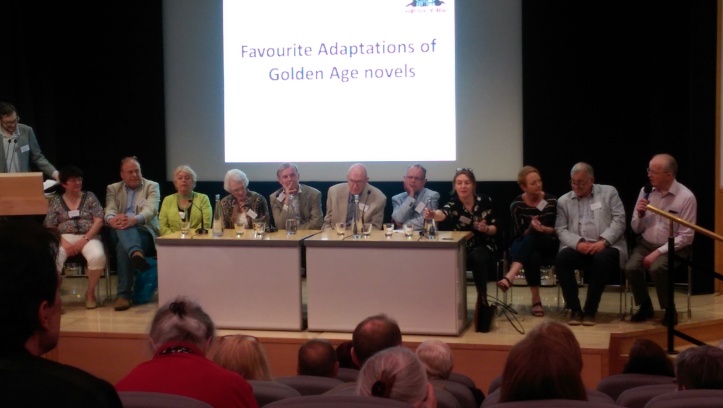
On Saturday afternoon, Rob Davies talked about the British Library, Linda Stratmann about poison, Kate Charles about clerical crime, and Kate Ellis about digging up the past. After dinner we had - yes! - a second murder mystery evening, this time hosted by Kate Ellis. Then on Sunday, Stella Duffy talked about Ngaio Marsh, Rob and I about the British Library's Crime Classics, and there was a panel discussion about Golden Age detective fiction.
We were delighted with the convivial atmosphere, and the enthusiasm of the delegates. A new group of people previously unfamiliar with Gladstone's Library fell in love with it. I had the pleasure of meeting many nice people - including John Bude's daughter, Jennifer.- and also of seeing a project that I've been involved with for a long time finally achieve a very significant milestone. The Archives will develop in the years to come, and I am optimistic that they will become an increasingly important resource for people who are interested in the heritage of crime fiction. The photos illustrating this post were taken by CWA Secretary Dea Parkin, to whom many thanks.

Friday, 24 June 2016

Forgotten Book - Vintage Murder

Ngaio Marsh's Vintage Murder, first published in 1937, is a good example of the well-crafted Golden Age whodunit. It gains strength from being rooted in two worlds with which Marsh was very familiar - New Zealand, her native country, and the world of the theatre. Inspector Roderick Alleyn is travelling on North Island for the good of his health, but of course, wherever a Great Detective goes, murder is bound to follow.

Alleyn finds himself mixed up with a company of actors - the Carolyn Dacres Comedy Company. The company is run by two partners, Alfred Meyer and George Mason, and the leading lady is the lovely Carolyn, who just happens to be married to Meyer, and is an object of admiration for one of her fellow actors. An incident on board a train seems to suggest that Meyer's life may be at risk, and before long, at a celebration of Carolyn's birthday, he is killed in a very original fashion. A jeroboam of champagne was due to descend from the ceiling as part of the festivities. But someone has tinkered with it, and it duly crashes down, killing Meyer.

So -whodunit? Alleyn is only a bystander, but he soon finds himself drawn into the investigation. The local police come very close to tugging their forelocks when confronted by the great man from Scotland Yard. "We've all been trained on your book," they tell him. "It's - it's a great honour to meet the author." Ah yes, a footnote reminds us that Alleyn is responsible for a little tome called Principles and Practice of Criminal Investigation.

Marsh switches the focus of suspicion from one character to another with considerable ease. I felt that the psychology of the culprit wasn't exactly clear (or am I just miffed because I didn't figure out who was responsible?) but the writing style is easy and pleasant, and Marsh conveys her love of theatrical life very well. All in all,a good read. It will be fascinating to see what Stella Duffy, who shares a good deal in common with Marsh, will make of her forthcoming "continuation novel" based on an incomplete manuscript.

Monday, 13 June 2016

Bodies from the Library

IMAG0882_BURST002_COVER.jpg

I'm back home - briefly -after an exhilarating trip to London for the second Bodies from the Library conference at the British Library. This was a highly successful event, one in which I was delighted to take part, and during the afternoon coffee break one of the attendees made things even more memorable by kindly telling me that she'd just heard that The Golden Age of Murder has been shortlisted for the Macavity award from Mystery Readers International. Not so long ago, if you'd told me that a book of mine would win three awards and be listed for three more, I'd have thought you were pulling my leg in a rather cruel way. But yes, it has actually happened...

Less of a surprise were two announcements about personal projects of mine which I'm very excited about. For one day only, copies of the new edition of Anthony Berkeley's The Poisoned Chocolates Case, a title in the British Library's Crime Classics series, were on sale - official publication is in October. And this edition contains not only an intro that I've written, but more importantly, a seventh solution (in addition to the six solutions Berkeley came up with) by Christianna Brand, first published in the US in the 70s. And there is a brand new solution written by me. This is a project that was, for me, enormous fun, and a large number of copies of the book were sold on the day. More about this one in October...

During my conversation with Rob Davies of the British Library, we also announced that next year will see the publication of my new non-fiction book The Story of Classic Crime in 100 Books. This book has occupied a good deal of my time over the past 18 months, and I recently finished work on the manuscript. It's very different from The Golden Age of Murder, even though there is an element of overlap in terms of the period covered, and I hope that crime fans will find it full of interesting - and often unexpected - material.

The first session of the day featured another book with which I'm very happy to be associated. This is The Sinking Admiral, by the Detection Club. Simon Brett, who masterminded the book, discussed it with me, and two other contributors, Janet Laurence and Stella Duffy. It was also announced that Stella has been awarded an OBE, and that she has been engaged to write a completion of an unfinished Ngaio Marsh novel: something to look forward to. As for The Sinking Admiral, it sold out by mid-morning.

Tony Medawar talked about Anthony Berkeley, while Len Tyler and Susan Moody championed Philip MacDonald and Georgette Heyer, and Barry Pike discussed the work of H.C. Bailey. Dolores Gordon-Smith focused on G.K. Chesterton, while Jennifer Henderson, biographer of Josephiine Tey, talked about Tey as a Scottish writer. John Curran discussed the Collins Crime Club - and his book on the subject is another that will be eagerly anticipated. Finally there was a group panel in which we picked favourite screen adaptations of Golden Age novels.

Dinners on the Friday and Saturday evenings provided plenty of opportunities for socialising, and I was delighted to meet Taku Ashibe, from the Honkaku Mystery Writers' Club of Japan, (modelled on the Detection Club) who presented me with several books, including one of his own. Saturday itself was extremely hectic, and although I had the chance to chat to a number of attendees, there simply wasn't time for as many conversations as I'd have liked. But you can't have everything, and overall this was a wonderful day, full of good things, and pleasant people. What more could you want?

The photo at the top of this post appears on an account of the day on Puzzle Doctor's splendid blog, In Search of the Classic Mystery Novel. Further perspectives on the day may be found on the similaly enjoyable Past Offences blog and Cross Examining Crime.
.


Monday, 9 September 2013

Gladfest 2013


Gladfest 2013 is the first literary festival to be staged at Gladstone's Library, and it was so enjoyable that I'm hoping it will become a fixture in the calendar from now on. I was only present for part of the week-end, but it was clear from talking to the delegates that everyone was having a good time. And why wouldn't they, in such an atmospheric and historic setting?

When I was first invited to take part, I was delighted to accept. This was so even though I'm well aware that inaugurating a literary festival can be fraught with difficulties. A great deal of hard work on the part of a lot of people is required, and even then, things may not go to plan. The now legendary Kidwelly ebook festival last year (not an event repeated in 2014) was an example of how things can take an unexpected and unfortunate turn, and although on a personal level I had a very good time there, that was due to the chance to bond with fellow authors, rather than readers, since the latter were conspicuous by their absence. It was all rather a shame. No such problems at Gladfest.

I staged my Victorian murder mystery on Saturday evening, and the audience participated with tremendous enthusiasm. I loved the gasps when the solution was revealed! Those present included a couple of fellow crime writers, Stella Duffy and Martine Bailey; Stella took the photo from the gallery on the first floor of the library room, while Martine and her husband Martin were dinner companions recently at St Hilda's. The volunteers who acted the parts of the suspects did a fnatastic job, and all in all it was a great occasion. The programme for the week-end as a whole was eclectic, and as well as Stella and her partner Shelley Silas, the roster of writers who took part included the acclaimed poet Wendy Cope and a number of those who have been writers in residence at the Library. Stella told me about her month as a writer in residence there, and it sounded like a marvellous experience.

There's a feelgood factor about Gladstone's Library which isn't solely due to the history and the presence of so many old, rare and wonderful books (Jamie, one of the interns, made my day on Sunday by showing me an original edition of The Strand featuring the first appearance of "A Scandal in Bohemia" and the other early Holmes short stories). The commitment and enthusiasm of the staff, including the Festival Director, Louisa Yates, really is a joy to behold. Some people at Gladstone's have had a very long and happy association with it, but I was impressed too by the very obvious love of the place on the part of the group of young people who are learning librarianship and other skills there.

The way the Library is contributing to the development of their careers came over very clearly when I talked to them, and equally I felt (as I often do) that those who argue that young people generally do not have the same passion for books and tradition as previous generations obviously don't meet the same young people that I do.  I wouldn't mind betting that the staff felt like collapsing in a heap once the festival came to an end, but they must be hugely cheered by the fact that all their efforts had such a successful outcome.

Thursday, 25 December 2008

12 Days


On this special day, I feature 12 Days, a book of seasonal short stories that I bought this time last year - an anthology edited by Shelley Silas, including contributions by such luminaries as Val McDermid and Stella Duffy. Well worth a look if you're a fan of the short form.