Showing posts with label Barry Forshaw. Show all posts

Monday, 1 August 2022

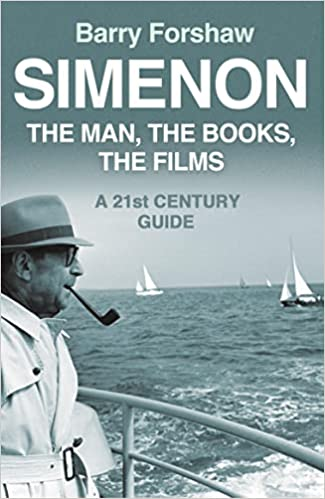
Simenon: The Man, The Books, The Films - by Barry Forshaw


Very few authors of books about the crime genre feature as extensively in the Bibliography of The Life of Crime as Barry Forshaw. Barry is an impressively prolific writer and he has now come up with another snappy book, published by No Exit Press about the Belgian maestro of crime. No, not Poirot, but Georges Simenon. The title is Simenon: The Man, The Books, The Films, and it represents a crisp and user-friendly introduction to the subject.

I noticed that I'm quoted in the endorsements of one of Barry's previous books, saying that Barry's constructive approach comes as a welcome breath of fresh air. I'm glad I said that, because it sums up a key merit of his writing - the positive tone. In addition, he is concise, and that too is a bonus because verbose lit.crit., however well-informed, can become tedious.

From start to finish, Barry's experience as a journalist informs his approach as well as his straightforward and readable writing style. To take just one example, the section 'Adapting Maigret' is essentially an extended quotation from an interview with Alison Joseph, who is at home with radio writing as she is with penning detective novels. Barry has also built upon a bibliography developed by the late David Carter almost twenty years ago.

One of Barry's strengths is his knowledge of films and he itemises many films based on Simenon novels that I'm unfamiliar with. Of the British TV series, it's clear that he prefers the portrayals of Maigret by Rupert Davies and Michael Gambon to Rowan Atkinson's recent interpretation. I don't know if there's ever been a Simenon encyclopaedia, but if not, this little book is an excellent, scaled-down alternative.

Wednesday, 4 December 2019

Crime Fiction: a Reader's Guide, by Barry Forshaw


Image result for barry forshaw crime fiction


Christmas is coming and for those of you looking for a present for the crime fan in your life, Barry Forshaw's Crime Fiction: a Reader's Guide, published by Oldcastle Books in paperback at the price of £12.99 is definitely an attractive solution. This is a book that is concise yet wide-ranging, and is particularly well-suited for crime fans who are looking for fresh titles to add to their to-be-read list. For good measure, there is a short intro from Ian Rankin.

I don't claim to be wholly impartial about this book. Barry is someone who has done a great deal of good for many, many crime writers over the years, and I'm in that long list of beneficiaries; specifically, this book includes a nice piece about Gallows Court. Two of the things I've always liked about Barry's writing about the genre are his enthusiasm and his positivity. He is, like me, a fan of crime fiction as well as someone who writes about it, and at a time when critical negativity often seems depressingly fashionable, his constructive approach comes as a breath of fresh air.

Right at the start, Barry acknowledges that in a book like this, there are bound to be many omissions. Of course, that is absolutely unavoidable, and would still be unavoidable if the book was even longer. The publishers (almost inevitably) claim that this is 'a truly comprehensive survey with definitive coverage', and I wouldn't go that far. What is beyond doubt is that, in the space available, few writers could have covered so much ground, particularly as regards books written in the twenty-first century.

The kernel of this book was the earlier (and much shorter) Rough Guide to Crime Fiction, a point which Barry acknowledges. So if you're familiar with that book and/or Barry's newspaper reviews, you shouldn't expect something totally original, but you will find a great deal of material here that wasn't in the book's earlier incarnation. Even if you have the original volume, therefore, you will find that this one is a worthwhile purchase.

The emphasis of the book is on relatively recent titles, and Barry's expertise in the field of translated crime means that books originally written in languages other than English receive excellent coverage. One of the charms of the layout is the juxtaposition of titles. So in the section about 'Cops', you get in quick succession books by the following slightly unlikely bedfellows: Martyn Waites; Martin Walker; Joseph Wambaugh; and Sarah Ward. There are many other examples of Barry's flair for spotting the common threads in superficially different works of fiction. I've really enjoyed dipping into this volume randomly to discover new-to-me titles, and I am sure many other crime fans will take equal pleasure from it. 

Monday, 4 June 2018

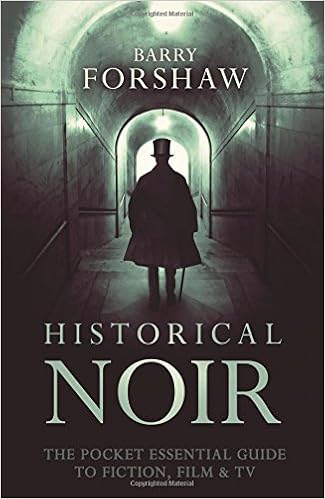
Historical Noir by Barry Forshaw


Barry Forshaw's latest book, Historical Noir, published by Pocket Essentials, is a pleasingly concise, chronological survey of historical crime fiction which ranges from Lindsey Davis, chronicler of Ancient Rome, to authors whose chosen time period is rather more recent, such as James Runcie, Laura Lippman, and William Shaw. I should declare that there's an entry about myself, so I won't pretend to be wholly unbiased, but that said, I can assure you that I'd have enjoyed, and would have learned from, this book even if my work been completely overlooked. If you like history blended with mystery, you'll find here innumerable tips about what to read next, as well as pithy discussion of a sub-genre that is much more diverse than is often acknowledged.

One of the great merits of Barry Forshaw's writing is its readability; another is his lively enthusiasm for the genre. If you want lengthy academic disquisitions about crime writing, there are plenty of those around nowadays (though most will set you back a lot of money), but the "noir" series of genre studies that Barry has produced in recent years is packed with information and insight at a bargain price.

Some of those insights stem from Barry's past experience as a judge of the CWA Historical Dagger; others come from the authors themselves. There are many interviews with crime writers, again including myself, so the book contains a valuable range of viewpoints on this fascinating sub-genre. A word about the title, by the way: the introduction explains that "noir" is used here simply as a synonym for crime; it is, in effect, a brand for the series, and does not imply that the books discussed are invariably dark and disturbing - far from it.

It's customary, when reviewing a book such as this, to pick up on alleged omissions, and to challenge some of the author's judgements. Customary, and sometimes an excuse for the reviewer to show how well-read he or she is. On this occasion, I won't be tempted down that path. I'll simply say that I appreciate Barry's observation that Dancing for the Hangman is "a book to make readers wish that the versatile Edwards might tackle the historical crime genre more often." I'm pleased to say that those readers won't have much longer to wait for my next foray into the past - more news about this soon!


Monday, 30 October 2017

The CWA Dagger Awards 2017


The CWA Dagger Awards Gala Dinner is one of the major occasions, perhaps the major occasion, in the crime writing world, in Britain at least. I've attended quite a number of Dagger award ceremonies (for a while they were lunches rather than dinners) over the past twenty years, but last Thursday's Gala Dinner at the Grange City Hotel in London was a very different experience, because in my capacity of Chair of the CWA, I was hosting the event. To say that this took me way outside my comfort zone would be an under-statement, but as things turned out, it was a marvellous evening, and Hayley and the organising team deserve huge credit for making sure that everything went so well. Thanks also to Gary Stratmann, our photographer for the evening.


Huge credit also goes to our Master of Ceremonies, the inimitable Barry Forshaw, whom I presented with a CWA Red Herring award. Barry, the consummate professional,  made sure that the ceremony went with a swing. And our guest speaker was absolutely excellent. He was Robert Thorogood, creator and writer of Death in Paradise, who proved to be both witty and charming. We had a very enjoyable chat about Golden Age fiction, of which (as those who have watched the show can guess) he is a huge fan. Robert had a tough act to follow, because last year James Runcie was a splendid guest speaker, but we were lucky to have someone equally impressive this time around.


I've attended quite a lot of awards ceremonies over the years, in the legal world as well as in the writing world, and the one thing I've learned is that, if you aren't careful, they can drag on, and the audience becomes bored. I vividly remember legal dinners where sweepstakes were run to guess the length of the seemingly interminable speeches. We were determined to make sure this didn't happen on Thursday.. Whilst it's obviously essential not to rush through awards in such a way that they make no real impression, the pace of the evening's events was an important element in creating the feelgood factor that prevailed from start to finish. An added bonus for me was that a story from a book I'd edited, Motives for Murder, won the CWA Short Story Dagger., though I hasten to emphasise that the judging process is completely independent!


It was a glittering occasion, and the audience of 250 people included such stars as Peter Capaldi and Brenda Blethyn. I talked briefly about the progress the CWA has made this year, and had the great pleasure of presenting Ann Cleeves with the CWA Diamond Dagger. All in all, a memorable occasion, a career highlight, and one that (now it's over!) I shall look back on with enormous and lasting pleasure. 


Monday, 25 July 2016

Festival Time


It's a sign of just how good a time I had at the Harrogate Crime Festival this past week-end that on Friday I completely forgot to post the Forgotten Book piece that I'd written in advance of my trip. Ooops. It will now appear this coming Friday instead! But I really did have a good time at Harrogate, which was looking at its best in the sun. It's a lovely setting for a festival.

I very much enjoyed catching up at length with James, my agent, and discussing with him a wide variety of projects that are in the pipeline for the next twelve months. We also had the chance to reflect on all that has happened in my writing career over the past year - it's been the most exciting time of my writing life. I was also able to give him an update on my latest novel-in-progress. My fiction writing has inevitably taken a back seat lately, but I'm totally committed to it, and although the new novel won't be ready for publication in 2017, it is at least moving forward. Next year will, though, see the publication of The Story of Classic Crime in 100 Books and several anthologies that I've edited.

I had the pleasure of meeting Karen Robinson of the Sunday Times Crime Club for the first time, and of attending parties held by Harper Collins and Bonnier. For the annual quiz masterminded by Val McDermid and Mark Billingham, I was invited to join the Little, Brown team, which also included Stav Sherez, and we came second - not quite top of the pile, but still a good result and a very enjoyable evening.

There was also the chance to have dinner with the likes of Barry Forshaw and David Stuart Davies, as well as catching up with a whole host of old friends, such as Ali Karim Alison Joseph and Leigh Russell, all of whom are pictured above outside the Old Swan Hotel, Ricki Thomas, Felix Francis, and many more. The fact the hotel was the place to which Agatha Christie retreated during her notorious disappearance does give the festival an added piquancy. Harrogate's a different sort of event from those wonderful week-ends Crimefest and St Hilda's (I'm very much looking forward to the latter, in mid-August) but has a distinctive atmosphere.  And the fantastic weather was a bonus..

Wednesday, 6 April 2016

Brit Noir by Barry Forshaw

Brit Noir is another contribution by Barry Forshaw to the Pocket Essentials imprint of Oldcastle Books; his previous titles in the series are Nordic Noir and Euro Noir. The sub-title is "The Pocket Essential Guide to the Crime Fiction, Film and TV of the British Isles". All this in just over 200 pages! Naturally, it's a selective overview, but I've found it not only readable but also informative. Barry Forshaw has already directed me to one or two books and authors I knew very little or nothing about, and that is always one of the great benefits, in my opinion, of a decent book about the genre, whatever angle the author takes.

Barry's angle is wider than the word "Noir" might imply; I'm one of the many authors featured, yet my novels (unlike some of my darker short stories) don't fall within a conventional view of noir fiction. The same is true of Kate Ellis' work and that of many other authors included - such as, to take Barry's own example, Alexander McCall Smith. So just because you're not a noir fan, don't disregard this very wide-ranging guide.

Barry explains his approach more fully in a useful introduction. He also makes the point that, although authors are listed by geographical location, the best way to find them is by looking at the index. I didn't expect to find Kate n the North East section, to be honest, but the explanation derives from the fictionalised York in which her Joe Plantagenet books are set. So the index is the place to go when trying to see if your favourite author is featured.

There are, at least, three main ways in which reviewers tend to criticise books about the genre. The first is to argue about the author's opinions. The second is to complain about omissions, and the third is to quibble about errors. (A cynic might add that a fourth method is to ignore the book and simply promote the reviewer's own opinions!) All of us who write about the genre understand that none of our books is ever definitive, and Barry would be the first to acknowledge that this is true of Brit Noir. But as I say, despite the fact that I've soaked myself in fictional crime over the years, he's highlighted plenty that was unfamiliar to me, above all, various interesting films, some of which I intend to check out as soon as I can. And that makes me very glad indeed to have a copy of this short and snappy book on my shelves.


Tuesday, 4 March 2014

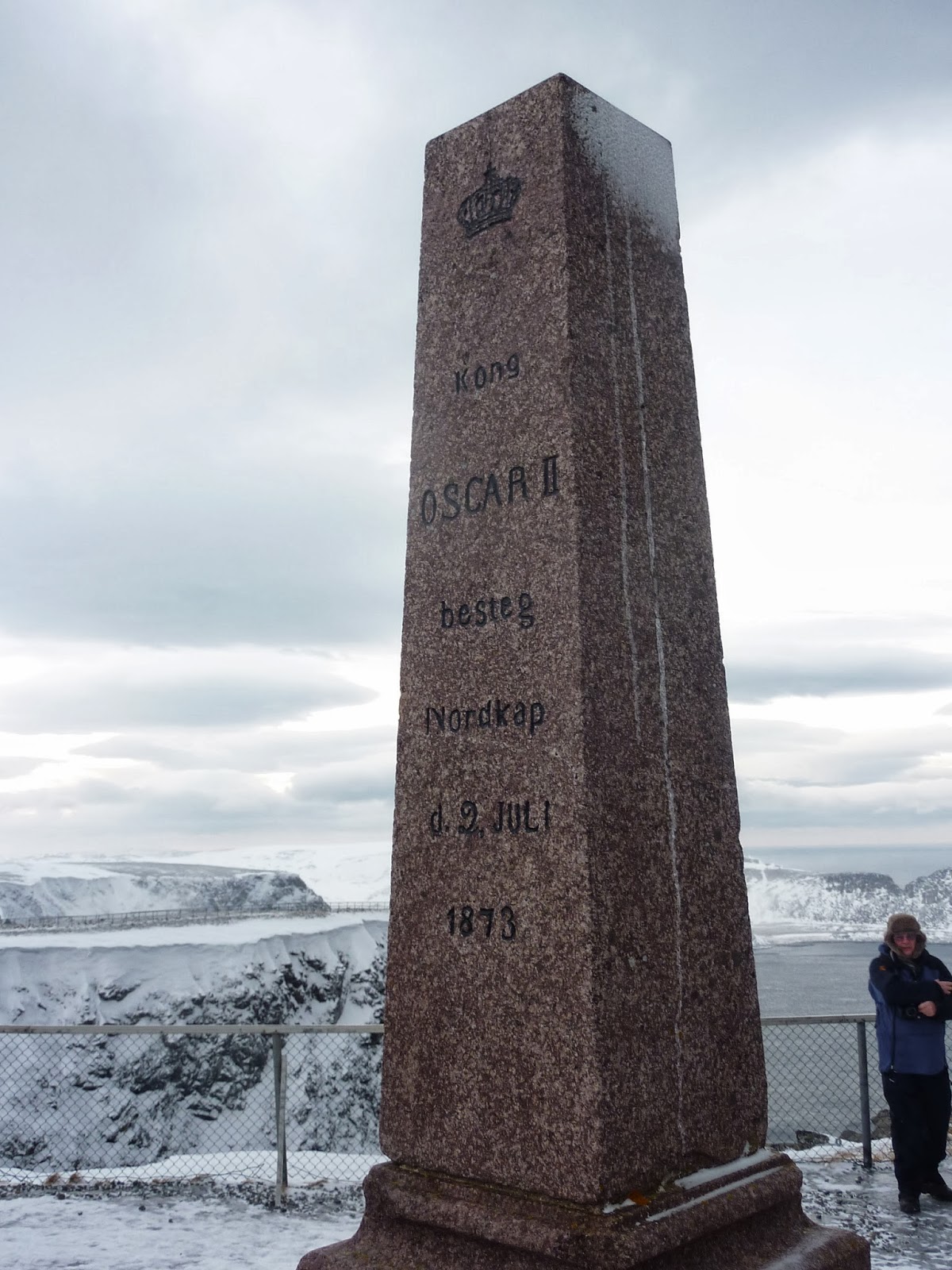
The End of the World


My trip to Norway took me to the end of the world, more or less, as the ship docked on an island a forty minute coach ride away from the stunning landscape of the North Cape. This was certainly the coldest place I have ever experienced, and the journey was memorable,not least because the convoy of buses was led by a snow plough. Even the reindeer had deserted the area in search of (relatively) warmer climes.

I've read and enjoyed a number of books by Norwegian writers in recent years. Jo Nesbo and Karin Fossum are immensely successful, but I particularly like Gunnar Staalesen's books about the private eye Varg Veum. He's a quietly accomplished author, and books like Yours Until Death are well worth seeking out. I can't, without checking, recall reading any books set in the most northerly parts of the country, but I'm sure there must be a number, and the Norwegian landscape does play an important part in creating the bleak atmosphere of books like Fossum's He Who Fears the Wolf. I'll have to consult Barry Forshaw, whose expertise on Scandinavian crime fiction is unmatched (his books, such as Nordic Noir, are a mine of information.)

Norway is an affluent country, with very low unemployment levels, yet the population density, especially in the large northern province of Finnmark is very low - the total coastline of Finnmark is almost 7000 km in length, and the province is bigger than Denmark, but it's home to a mere 75,000 people. There is something eerie, as well as compelling, about Finnmark's lonely mountains, lakes and tiny villages. Lots of scope here for closed communities and dark deeds in isolated settings.


The seas around the North Cape look daunting, but saw a good deal of action during the Second World War and stories with their roots in war-time do crop up from time to time in "Nordic Noir" - a Swedish example that sticks in my mind is Henning Mankell's Return of the Dancing Master . And a trip to the border with Russia the following day provided a reminder of Norway's intriguing geographical position, right next to a country which (as the current alarming news from Ukraine reminds us) is not always the cosiest of neighbours.


Recent years have seen a thawing (sorry, couldn't resist that!) of relations between the two countries, and one can only hope that events in the Ukraine don't lead to increased tension elsewhere. Again, I've not read any "Nordic noir" books set in the borderland, but I'm sure there must be some. Borderlands, as Ellis Peters among others has demonstrated, often provide excellent backgrounds for fiction because of the potential for conflict between cultures. And this particular border country is as fascinating as any I've ever visited.

Monday, 2 September 2013

The Oxford Literary Tour


Some months ago, Janet Laurence told me that she was organising a conference for AIEP, the international crime writers' association, to take place in Oxford, and asked if I'd be willing to conduct a guided literary tour of Oxford. Now I have no experience whatsoever as a tour guide, so I felt I was a rather unlikely choice. But Janet is a very persuasive person, so I said yes.

I didn't know what to expect. Not just whether the weather would be kind, which of course was impossible to predict, but how many people would want to go on such a tour, how good their English would be, how energetic they would feel - or anything, really. So preparing was a bit tricky. I realised that I'd have to be flexible and see how things went on the day.

The AIEP conference went on throughout last week, but because of work commitments, I was only able to turn up for the latter stages. However, I found everyone very welcoming and it was fascinating to meet the international contingent, as well as locals such as Susan Moody, Bob Cornwell, Christine Poulson, and Barry Forshaw.I also had an enjoyable evening after dinner in a pub with Michael Ridpath and a number of foreign writers.

To my relief, the tour proved to be great fun. About 35 people came along, and I took them around the city, talking about some of the books set there as we went along. We toured the quadrangles of Balliol, and had a drink in the Eagle and Child, where once the Inklings met, drank and talked. Myfanwy Cook kindly acted as tour photographer!

The last major event of the conference was an after dinner speech by a former top cop, Dame Elizabeth Neville. Janet was given a standing ovations, which she richly deserved. A sign of the esteem in which she is held by the international crime writing community, and a sign too of how much they appreciated their time in Britain. I made a number of delightful new friends, and despite my initial misgivings, in the end I was very glad that Janet asked me to be a tour guide - at least for one afternoon in my life!


Wednesday, 5 June 2013

Crimefest 2013 - part three

One of the highlights of my Saturday at Crimefest was the chance to appear on a panel moderated, with his customary wit, by Len Tyler. We were talking about detective duos, and fellow panellists were Helen Smith, whom I'd never had the pleasure of meeting before, Dorothy Cannell, who had been a member of our pub quiz team, and fellow Northern lawyer Neil White. Neil and I have a favourite shared trivia question: which character in his books used to work for me? The answer is Laura McGarritty/ The real life Laura's husband Duncan is a great friend of Neil's and was for many years a work colleague of mine, as was Laura. Neil used Laura's name for the female lead character in his first series of books.

Dorothy came up with an intriguing idea during the panel - she said she regarded characters in her books as employees who had to interview well to be included, and were subject to being dismissed every now and then if they didn't perform. There has to be an article worth writing to examine that metaphor. The panel was very enjoyable, and also rather relaxing, since I must say I find it easier being a panel member rather than a moderator.

Nev Fountain hosted an excellent session on Sherlock with Mark Gatiss, Steven Moffat, and Sue Vertue, and I enjoyed Nev's company when I found myself sitting with him and his partner Nicola, a very successful actor and also a songwriter, at the gala dinner. Among the award winners were the admirable Ruth Dudley Edwards and Barry Forshaw. Barry won the H.R.F. Keating award for best crime reference book of the past five years,which was presented by Sheila Mitchell, Harry's widow.

I had a hand in setting up the award, though since I'd contributed essays to two of the books on a fabulous shortlist which also included fine books by P.D. James, John Curran and others, I decided it wasn't right for me to vote. Anyway, it was so hard to choose. But Barry's encyclopaedia on British Crime Writing was a worthy winner, I must say. The quality of the shortlist shows how strong writing about the genre has become in the UK in recent years, a development which is enormously pleasing.

Sunday saw an enjoyable interview with Robert Goddard, and then the annual Mastermind quiz, which was won by Peter Guttridge. One of the questions for Peter was about the legal subject in which I specialise. His answer was corporate law, and although this is not now the case, he was closer than he realised. I did start out my legal career combining employment law with corporate work. In fact my first published book was Understanding Computer Contracts. There has to be another quiz question there...

All in all, a marvellous four days. Adrian Muller and his fellow organisers did a great job as usual, and I feel that Crimefest is getting better each year. As ever it was good to see old friends, and meet a host of delightful people for the first time, including Helen, Dorothy. Nev, Nicola, Jeff Siger, James Wills, Alexandra Benedict, Xavier-Marie Bonnot, Quentin Bates, as well as a good many others. I've already booked for next year.


Sunday, 19 February 2012

Death in a Cold Climate -review

Death in a Cold Climate is a new guide to Scandinavian crime fiction published by Barry Forshaw, a highly experienced journalist who is one of our most prolific commentators on contemporary crime fiction. Barry’s various publications include a massive two volume encyclopaedia about British crime fiction, to which I contributed several essays, and he was kind enough to write a foreword to the recent Murder Squad anthology Best Eaten Cold. He also produced The Rough Guide to Crime Fiction.

Barry has been an enthusiast for crime fiction in translation for years, and when I heard that he was publishing a book on this subject, I was keen to get my hands on it. It is published by Palgrave Macmillan, who have produced a number of learned tomes about the genre over the years, and Barry’s style of writing here is, therefore, a little more academic than in, say, The Rough Guide. But it’s still perfectly accessible.

He makes a number of interesting points – for instance that “the rendering of Scandinavian literature into English offers problems to their translators that are subtly different to those encountered in other languages”. This is something I hadn’t thought about previously, and there are fascinating comments about the nature of translation from the wonderfully named Sarah Death, a senior literary figure in Sweden as well as a translator, that I’d like to explore further one of these days.

The emphasis is very much on books written in the last twenty years or so, and as a result there’s no mention of writers such as Jan Ekstrom, Ella Griffiths and Poul Orum, who may be in danger of being overlooked by present day fans (though this is where bloggers can come in: I recall, for instance, that Maxine, aka Petrona, has highlighted Griffiths’ work on her terrific blog.) But any writer of a book such as this needs to be selective - there is really no alternative. Barry Forshaw has produced a valuable guide to a branch of the genre that has become deservedly popular andI wish him every success with it.

Thursday, 30 June 2011

Best Eaten Cold


I’m delighted to announce that the History Press will be publishing the second Murder Squad anthology of short stories which I have edited in the summer – probably around August. The collection takes its title, Best Eaten Cold, from a story by Stuart Pawson, and many of the stories have some form of revenge or payback at their heart. They also, by and large, have settings in the North of England.

The well-known critic Barry Forshaw has been kind enough to contribute a foreword, and apart from myself and Stuart, there are stories from three of the other five original members of Murder Squad. I'm particularly glad to say that one of the stories written by Ann Cleeves features DI Vera Stanhope, fresh from her recent television series.

Here is a list of the stories (not in the order in which they will appear in the book) - as always, it's been great fun to work on an anthology project with a group of friends of long-standing who also happen to be terrific writers.

Ann Cleeves The Habit of Silence
Ann Cleeves Basic Skills
Ann Cleeves Mud
Martin Edwards The People Outside
Martin Edwards InDex
Martin Edwards The Case of the Musical Butler
Margaret Murphy The Message
Margaret Murphy Act of Contrition
Stuart Pawson Sprouts
Stuart Pawson Best Eaten Cold
Cath Staincliffe Boom
Cath Staincliffe Laptop
Cath Staincliffe Riviera

Monday, 10 January 2011

Italian Noir and Surviving Midsome


Having recorded the BBC4 programme on Italian Noir crime fiction just before Christmas, I’ve finally watched it, and I did find it interesting, even though I was much less familiar with the authors discussed than with the Scandinavian writers who featured in Nordic Noir, which I talked about recently. The talking heads included Maxim Jakubowski and Barry Forshaw, who are both articulate commentators and very knowledgeable about Eurocrime.

Predictably, the major contemporary writers Camilleri and Lucarelli were considered, and interviewed, and I found myself tempted to try their work – perhaps Camilleri’s in particular. But I was especially interested in mention of a writer from the inter-war years, Carlo Gaddo, whose book That Awful Mess on the Via Merulana sounded quite fascinating. I do think that crime novels of the past often cast a very significant light on crime novels of the present, and Gaddo’s book sounded well worth acquiring. I’d be interested to hear from anyone who has read it.

I’ve also watched Surviving Midsomer, an entertaining account of mayhem in the long-running Midsomer Murders series. The TV version derives from books written by Caroline Graham, a very amiable author whom I met a number of times in the 90s, but who (I think) is not at present writing any more crime fiction, no doubt in part because the massive success she has achieved has removed any financial need to do so.

I enjoyed Caroline’s early books very much, and although I gave up on the TV series after a year or two, I do think that the formula that was devised, with witty methods of murder, attractive locations and the very agreeable performances of John Nettles as Barnaby, made the shows effective light entertainment. And this spin-off programme encouraged me to watch a bit more of the Midsomer saga.

Wednesday, 22 December 2010

Nordic Noir


Nordic Noir was an interesting BBC 4 documentary about Scandinavian crime fiction. As regular readers will know, I have quite a long-standing enthusiasm for a number of Scandinavian crime writers – as well as for their countries, which I’ve visited occasionally, and this was a worthwhile assessment with the added bonus of shots of fascinating towns, cities and landscapes (the photo is Stockholm, a city I really liked on my first visit this year.)

Inevitably, the main focus was on Stieg Larsson, but there was also discussion of a range of other writers, including Karin Fossum, Jo Nesbo, Henning Mankell, Sjowall and Wahloo – and Arnaldur Indridason, whose native Iceland is one country I haven’t visited and which is high on my to-be-travelled-to list.

And there was mention, too, of Miss Smilla’s Feeling for Snow, by Peter Hoeg, which some might call a ‘literary’ crime novel, and certainly a book which is memorable, especially perhaps for its early scenes. No mention,though, of Gunnar Staalesen, whom I discussed here a little while back.

The talking heads included the crime fiction commentator Barry Forshaw, and novelists Val McDermid and Hakan Nesser. The witty and amiable Nesser made the point that there are fashions in crime fiction as in other areas of life, and that one of these days, attention will shift elsewhere. Another interesting comment was that younger writers may be more interested in global issues than in exploring localised societies – I’m not sure whether I agree with this broad generalisation, but it certainly got me thinking.

Saturday, 13 March 2010

Following the Detectives


I've had the pleasure of contributing short stories to a number of anthologies edited by the prolific (and hugely knowledgable) Maxim Jakubowski, but the first piece I ever wrote for one of his books was a little essay for a non-fiction volume he edited. This compilation was called 100 Great Detectives (my piece featured Cyril Hare's Francis Pettigrew).

More recently, I've written a couple of essays to feature in one of his latest projects, another factual book about locations associated with great detectives. The book is due to appear in the autumn and I'm very much looking forward to reading the entries from a range of very well-informed commentators. The book will be called Following the Detectives and the full list of places and authors is:


• Boston: Michael Carlson
• Brighton: Barry Forshaw
• Chicago: Dick Adler and Maxim Jakubowski
• Dublin: Declan Burke
• Edinburgh: Barry Forshaw
• Florida: Oline Cogdill
• Iceland: Peter Rozovsky
• London: David Stuart Davies
• Los Angeles: Maxim Jakubowski
• New Orleans: Maxim Jakubowski
• New York City: Sarah Weinman
• Nottingham: John Harvey
• Oxford: Martin Edwards
• Paris: Barry Forshaw
• San Francisco: J. Kingston Pierce
• Shropshire: Martin Edwards
• Sicily: Peter Rozovsky
• Southern California: Michael Carlson
• Sweden: Barry Forshaw
• Venice: Barry Forshaw
• Washington, D.C.: Sarah Weinman

Saturday, 20 June 2009

Editing the Editor


Geoff Bradley has written an article in the latest issue of CADS which I find interesting on a number of levels. He calls it ‘Editing the Editor, or “I Can’t Have Written That Can I?”’ and it deals with an essay he contributed to Barry Forshaw’s monumental British Crime Writing: an Encyclopaedia.

Geoff’s subject was Freeman Wills Crofts, a prolific and highly successful writer of the Golden Age whose Many a Slip I covered in a recent entry for Friday’s Forgotten Books. Geoff explains how, when he received his copy of the book, he checked his entry and found that various unsatisfactory changes had been made to what he had written. It seems that the changes weren’t made by Barry, but rather by a sub-editor at the publishers. Geoff was dismayed at the mauling his piece had received. Over the years, he has written a good deal of non-fiction for CADS and is a sound judge of writing quality, as well as being a first-rate editor (as is Barry) so I’m sure he was right to be concerned.

A number of things struck me about this article – quite apart from the natural sympathy that any author feels for a colleague who is dissatisfied by the way he or she is treated. I thought about the issues it raised in a more general sense and realised that, although I had contributed quite a number of essays to the same book, I had never checked whether my work had suffered a similar editorial fate. And I started to wonder whether this was down to laziness, lack of time - or simply a kind of authorial fatalism…

On a happier note, Geoff, like me, was impressed by the scope and readability of the encyclopaedia as a whole. It's one of the best reference works on the genre, in my opinion (and leaving aside my own contributions) to have appeared in recent years.

Tuesday, 19 May 2009

Forgotten Authors


For me, the Crimefest convention kicked off with a panel that I moderated on Thursday afternoon. The topic was ‘Forgotten Authors’, and the panel comprised Barry Forshaw, Declan Hughes, Sarah Rayne and Mary Andrea Clarke. It was good to have the benefit of Barry’s expertise (he wrote The Rough Guide to Crime Fiction and edited the massive, two volume encyclopaedia about the genre in Britain, published by Harcourt at the turn of the year) and Declan, Sarah and Mary displayed real passion for their chosen writers – factors which contributed to a lively and, I think, hugely entertaining debate.

Declan focused on that great husband and wife team, Ross Macdonald and Margaret Millar, while Mary’s choices were two writers of a very different type, Georgette Heyer and Ethel Lina White. White’s name is not widely known these days, but she wrote the books on which three very successful films were based – The Lady Vanishes, The Spiral Staircase and Wax – and was a specialist in the ‘Had I But Known’ school of crime fiction.

Sarah spoke with much enthusiasm about Francis Iles and that mistress of ingenuity, Christianna Brand, two writers I’m very fond of myself. Barry ranged over writers such as Eric Ambler, the neglected Alan Williams, the thriller writer Francis Clifford, and Peter O’Donnell, who created Modesty Blaise. My own choices were Michael Gilbert and Julian Symons.

The audience became very enthusiastic and involved, and I’m sure it wasn’t simply because there was a goody bag of books to be awarded to whoever asked the best question (Jennifer Palmer got the vote.) All in all, it really was one of the most enjoyable panels I’ve ever been involved with.

Sunday, 10 May 2009

Crimefest 2009


I’m looking forward to attending Crimefest in Bristol next week (blog posts will continue to appear while I’m away) and I hope to have the chance to chat to some of those who read this blog while I’m there. Please do come and say hello if you spot me wandering around the convention.

I’m involved in three events on the programme. At 4.30 pm on Thursday 14 May, I’m participating moderator in a panel reflecting on bygone authors. Panel members are: Mary Andrea Clarke, Barry Forshaw, Declan Hughes and Sarah Rayne.

At 11 am on the Sunday, I’m again participating moderator on a panel titled ‘Edge of Doom’. My colleagues will be Steven Hague, M.R.Hall, Brian McGillowray and Caro Ramsay.

And an hour later, I’ll be involved in the Mastermind quiz, presided over by Maxim Jakubowski. Also participating are Simon Brett, David Stuart Davies and Meg Gardiner.

It should all be very enjoyable and it will be good to meet old friends and make new ones – always the twin highlights of conventions such as this.

Monday, 9 March 2009

Open Book etc.


Barry Forshaw rang to tip me off that he’d talked about my work on the BBC Radio 4 programme ‘Open Book’ yesterday, while warning me that there was always the chance that any mention of my name might be edited out of the final interview! The theme of that part of the programme was lawyers who write crime fiction and the starting point was Mariella Frostrup’s interview of P.D.James about Cyril Hare. I’ve talked about my admiration for Hare on this blog, and James is clearly a huge fan, especially of Tragedy at Law.

Barry was then interviewed by Mariella (lucky chap) about lawyers who write crime and gave me a name check, along with Frances Fyfield, when talking about British lawyer-writers. The Americans, he mentioned were Scott Turow, John Grisham and Mark Gimenez, so I felt I was in very select company.

By coincidence, Steve Steinbock has just blogged about my very first novel, All the Lonely People, which introduced the Liverpool lawyer Harry Devlin, on Criminal Brief. Steve recently gave my latest novel with a legal background, Waterloo Sunset, a terrific review in The Strand Magazine, and this time I am quite unable to resist linking to his generous remarks.


Finally, three more entries on the blogroll: Bookwitch, Paul Brazill, and Deighton Dossier. Do also check out Rob Mallows’ impressive website about Len Deighton.

Tuesday, 20 January 2009

British Crime Writing

Barry Forshaw is a well-known crime fiction critic, and editor of the excellent ‘Crime Time’. His publications include The Rough Guide to Crime Fiction, but he has now produced a much larger and more ambitious two volume encyclopaedia, published by Greenwood. I should declare an interest, in that I contributed several of the essays, and I am one of the many writers whose work is subjected to critical assessment (in my case, by Michael Jecks, a former chairman of the CWA, who is more than generous with his comments.) But, leaving that aside, I am a keen fan crime fiction reference books, and most of those that have appeared over the years weigh down my bookshelves. Barry’s compendium is a very welcome addition.

There are so many interesting, and to me unexpected, features of the encyclopaedia that it’s difficult to know where to start in describing them. Barry has described that his emphasis has been on inclusivity, and the authors covered include not only the usual suspects, but also the likes of Peter Ackroyd and Iain Sinclair, who are not conventionally regarded as crime writers. The emphasis is on contemporary writers, but due attention is paid to names from the past such as the excellent Patrick Hamilton (sometimes oddly ignored in books about the genre) and the less stylish but under-rated E.C.R. Lorac.

There are a number of longish essays about particular subjects, such as Conventions, Noir, and Police Procedurals. I haven’t read all of them yet, but those I’ve sampled are extremely interesting. Of course, having a large number of contributors means that the approach is not entirely consistent, but that is part of the fun of the book, and besides, the diversity of subject matter and focus offers ample compensation.

The price of £90 means that this will not be an impulse buy. But it would make a great present for a crime fan. Otherwise, if you can beg, borrow or steal a copy, or persuade your local library to stock it, you will find much to entertain you. Of course, not all the opinions expressed by the contributors will find universal agreement. Of course, there will be debate about omissions (the choice of crime films which are discussed is highly selective, for instance.) But overall, the only reason why I have wanted to put the books down so far is that, after while, they become rather heavy!