Tuesday, 4 March 2014
The End of the World
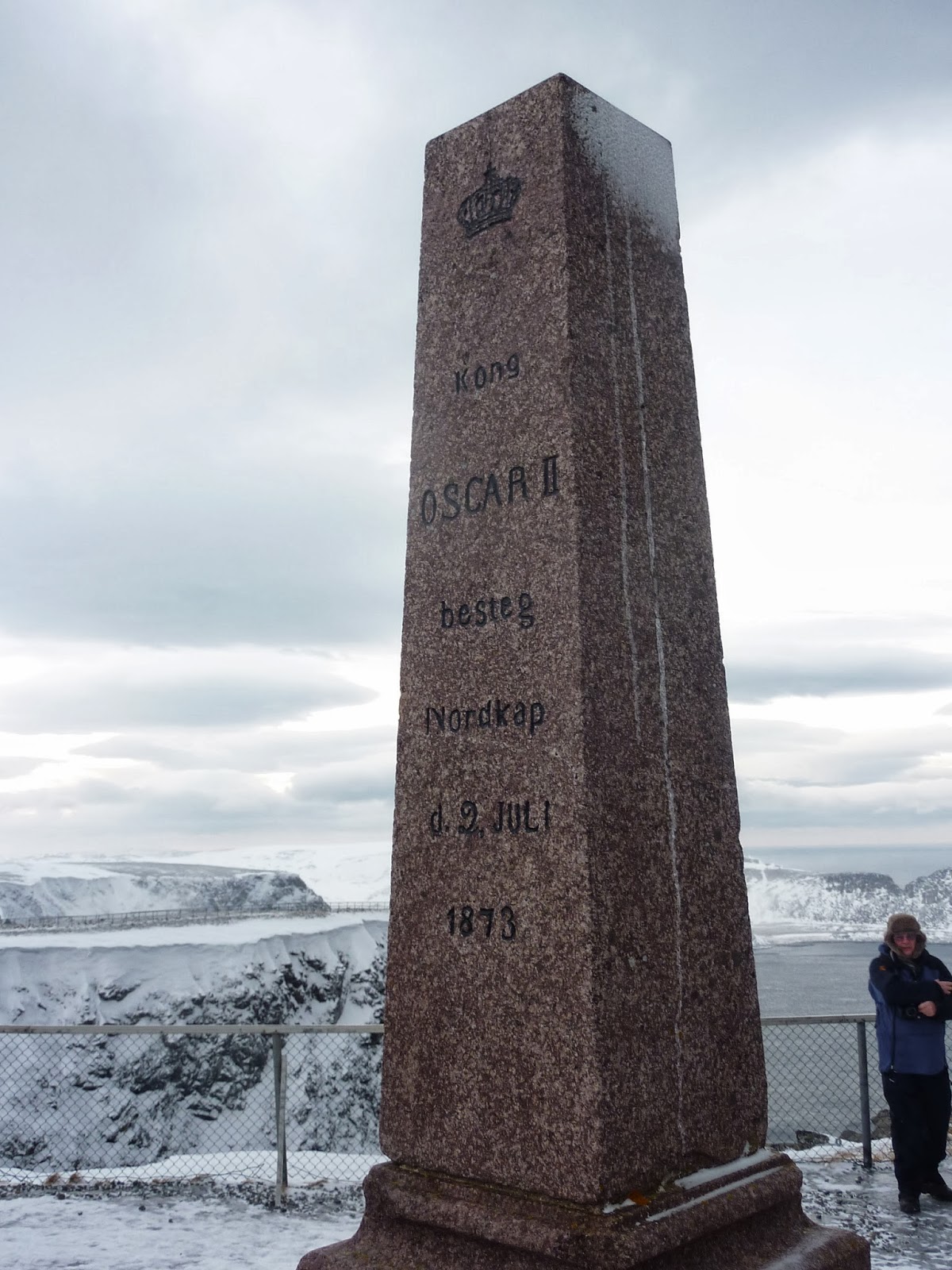
My trip to Norway took me to the end of the world, more or less, as the ship docked on an island a forty minute coach ride away from the stunning landscape of the North Cape. This was certainly the coldest place I have ever experienced, and the journey was memorable,not least because the convoy of buses was led by a snow plough. Even the reindeer had deserted the area in search of (relatively) warmer climes.
I've read and enjoyed a number of books by Norwegian writers in recent years. Jo Nesbo and Karin Fossum are immensely successful, but I particularly like Gunnar Staalesen's books about the private eye Varg Veum. He's a quietly accomplished author, and books like Yours Until Death are well worth seeking out. I can't, without checking, recall reading any books set in the most northerly parts of the country, but I'm sure there must be a number, and the Norwegian landscape does play an important part in creating the bleak atmosphere of books like Fossum's He Who Fears the Wolf. I'll have to consult Barry Forshaw, whose expertise on Scandinavian crime fiction is unmatched (his books, such as Nordic Noir, are a mine of information.)
Norway is an affluent country, with very low unemployment levels, yet the population density, especially in the large northern province of Finnmark is very low - the total coastline of Finnmark is almost 7000 km in length, and the province is bigger than Denmark, but it's home to a mere 75,000 people. There is something eerie, as well as compelling, about Finnmark's lonely mountains, lakes and tiny villages. Lots of scope here for closed communities and dark deeds in isolated settings.
The seas around the North Cape look daunting, but saw a good deal of action during the Second World War and stories with their roots in war-time do crop up from time to time in "Nordic Noir" - a Swedish example that sticks in my mind is Henning Mankell's Return of the Dancing Master . And a trip to the border with Russia the following day provided a reminder of Norway's intriguing geographical position, right next to a country which (as the current alarming news from Ukraine reminds us) is not always the cosiest of neighbours.
Recent years have seen a thawing (sorry, couldn't resist that!) of relations between the two countries, and one can only hope that events in the Ukraine don't lead to increased tension elsewhere. Again, I've not read any "Nordic noir" books set in the borderland, but I'm sure there must be some. Borderlands, as Ellis Peters among others has demonstrated, often provide excellent backgrounds for fiction because of the potential for conflict between cultures. And this particular border country is as fascinating as any I've ever visited.
Wednesday, 22 December 2010
Nordic Noir
Nordic Noir was an interesting BBC 4 documentary about Scandinavian crime fiction. As regular readers will know, I have quite a long-standing enthusiasm for a number of Scandinavian crime writers – as well as for their countries, which I’ve visited occasionally, and this was a worthwhile assessment with the added bonus of shots of fascinating towns, cities and landscapes (the photo is Stockholm, a city I really liked on my first visit this year.)
Inevitably, the main focus was on Stieg Larsson, but there was also discussion of a range of other writers, including Karin Fossum, Jo Nesbo, Henning Mankell, Sjowall and Wahloo – and Arnaldur Indridason, whose native Iceland is one country I haven’t visited and which is high on my to-be-travelled-to list.
And there was mention, too, of Miss Smilla’s Feeling for Snow, by Peter Hoeg, which some might call a ‘literary’ crime novel, and certainly a book which is memorable, especially perhaps for its early scenes. No mention,though, of Gunnar Staalesen, whom I discussed here a little while back.
The talking heads included the crime fiction commentator Barry Forshaw, and novelists Val McDermid and Hakan Nesser. The witty and amiable Nesser made the point that there are fashions in crime fiction as in other areas of life, and that one of these days, attention will shift elsewhere. Another interesting comment was that younger writers may be more interested in global issues than in exploring localised societies – I’m not sure whether I agree with this broad generalisation, but it certainly got me thinking.
Saturday, 16 January 2010
The Water's Edge
Quite a while ago, I was sent a review copy of the latest Karin Fossum title by Mike Stotter, editor of that excellent online crimezine Shots. I’ve read Fossum in the past – He Who Fears the Wolf, a book I thought pretty good – but it took me a long time to read The Water’s Edge.
This was, in part, due to pressure of work and other commitments, but it was also due in part to the subject matter, which is the mistreatment and murder of young boys. I find books which deal with the harming of children difficult to read, although I recognise that this is not only an entirely legitimate subject for crime fiction, but an important one. Well-written fiction can sometimes help to give us an insight into cruel or sociopathic behaviour that otherwise one finds inexplicable, as well as deeply offensive.
Fossum certainly is a skilled writer, and The Water’s Edge is a sensitively composed book. It begins, after a short italicised preamble, with a man walking through a wood, carrying a ‘burden’ which, it becomes plain, is the body of a child. But he is spotted by a couple who are taking a walk. Kristine and Reinhardt react in very different ways to their experience of seeing a child-killer, and the story of their disintegrating relationship is one of the most compelling strands of the whole book.
Once the body is found, the detective work is done, as usual, by Inspector Sejer, but soon he has another missing boy to contend with. The story is as dark as the heart of a Swedish forest. I can’t say that I found this one fun to read, but I did admire Fossum’s literary accomplishment and insights into human behaviour..