Showing posts with label CADS. Show all posts

Monday, 7 March 2022

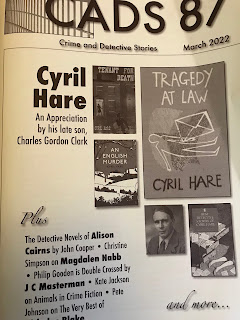
CADS 87


One of the beauties of Geoff Bradley's magazine (or fanzine) CADS is that you never quite know what each new issue will bring. There are contributors who feature regularly, such as Marv Lachman, Liz Gilbey, Mike Ripley,  Philip Scowcroft, Barry Pike, and Jamie Sturgeon, as well as others who cover an extraordinarily wide range of subjects. As a result, I always come away from reading each new issue with something else to look out for.

This is certainly true of the latest issue, CADS 87. For instance, I was unaware of the two detective novels of Alison Cairns, which John Cooper (a sound judge) writes about with considerable enthusiasm. I was familiar with Philip Levene, the radio and TV writer whom Melvyn Barnes discusses in a fascinating piece, but I wasn't aware of the full extent of his work. As a result, I've had a chance, thanks to YouTube, to listen to a couple of his entertaining radio plays. And this in turn has led me to other radio discoveries.

One piece I was glad to see again was a long appreciation of Cyril Hare by his son Charles. Many years ago, Charles sent it to me, along with the initial pages of his father's final novel, which he wondered if I might be interested in completing. Unfortunately there wasn't enough material to build on, but it was fascinating to read. Charles died a few years ago, but his article is full of interesting observations.

My own contribution covered some material which I wasn't able to accommodate in The Life of Crime - a piece dealing with correspondence from Fergus Hume, the American writer Elizabeth Fenwick, and W.J. Burley. But there's much more to enjoy in CADS 87, including a piece by Philip Gooden on J.C. Masterman and an article by Pete Johnson about Nicholas Blake's best books. For fans of crime fiction of any vintage, CADS is a great read and a wonderful resource - strongly recommended.  

Wednesday, 22 July 2020

Bodies from the Library 3 - edited by Tony Medawar


Bodies from the Library 3 eBook: Medawar, Tony: Amazon.co.uk ...

I've mentioned Tony Medawar before on this blog as the leading researcher of obscure crime fiction. He's a great fan of Golden Age mysteries who has uncovered some fascinating material over the years. An example was the Agatha Christie competition story "Manx Gold", which fascinates me. Tony is currently developing a niche as an editor of story collections, including the Bodies from the Library series, which has now reached its third installment. In addition, he's become the supremo of the Agatha Christie International Festival in Torquay, an event I was eagerly anticipating until the pandemic intervened.

I have a vivid memory of my first encounter with Tony. It was at the London Bouchercon, way back in 1990, before I'd published a single piece of crime fiction. We happened to be contestants in a Mastermind quiz. The quizmaster was Maxim Jakubowski, himself a supremely prolific and versatile anthologist. The score was kept by Geoff Bradley, the editor of CADS. On that pleasant afternoon I never imagined that, thirty years on, Geoff, Tony, Maxim, and I would still be in regular contact, having all sorts of criminal conversations. These are three people from whom, in different ways, I've learned a lot.

The other contestants in the quiz, by the way, were Jim Huang, an American crime fan, and the writer Sarah J. Mason, who also took part with me in a re-run of the quiz at the 1995 Nottingham Bouchercon, along with two very knowledgeable Americans, Marvin Lachman and Edward D. Hoch. There is discussion about the quizzes in Marvin's admirable book The Heirs of Anthony Boucher.

Turning to Bodies from the Library 3, like its predecessors it is a mixed bag, with the main connecting link that most of the stories are unknown or little-known efforts by Golden Age writers. (Six stories are also linked by a theme: an orange that saves someone's life, of all things. Of these little tales, Ethel Lina White makes the best attempt to come up with a strong story.) I'd already come across a handful of the entries in the book, including an extremely good Agatha Christie, "The Incident of the Dog's Ball". There are extensive notes about the contributors, and I was especially pleased to learn more about the enigmatic Lynn Brock.

One of the best stories, I felt, came from that talented but rather inconsistent writer Christopher Bush. "The Hampstead Murder" is pleasingly different, and I really liked it. Bush wrote far too much, but this story shows just what he could do on a good day. There's also a story by Christopher St John Sprigg, which makes use of his interest in aeronautics, although this particular mystery is not in the same league as his novel with a similar background, Death of an Airman.

There are a couple of stories by American writers, and two plays, including one by Ngaio Marsh that was previously unknown to me. Although most of the stories have been published before, this was often in obscure magazines (as with the Bush story) and some have never previously seen the light of day.

It is interesting to speculate why this might be. For example, John Curran, who was the first to reprint the Christie story, theorised that she opted to use key elements of the plot for the novel Dumb Witness, and that seems highly plausible. Whatever the reason, it's a story that Poirot fans are sure to enjoy. The best discovery in the book is "The House of the Poplars" by Dorothy L. Sayers, and I'd be fascinated to know why it's never been printed before. While it's no masterpiece, it's certainly good enough to have been published. Did Sayers have reservations about it, possibly because the ending is slightly anti-climactic? Perhaps, but I'm really not sure. At least now, thanks to Tony, we have a chance to read for ourselves a lost story by one of the giants of the Golden Age. 


Friday, 8 December 2017

Forgotten Book - The File on Lester

The name of Andrew Garve isn't as well-known today as it might be, despite the fact that Bello have made much of his work available again. I think that he, like his contemporary (and CWA and Detection Club colleague) Michael Gilbert suffered because of his refusal to be typecast, and his reluctance to write about series characters. He was a prolific and capable writer, who at his best was very, very good.

I've read a number of Garve's books, and I was tempted to try The File on Lester by an article that John Cooper contributed to the latest issue of CADS. John is an excellent judge, and he expressed great admiration for this book. Having read it, I can see why. It's extremely readable (smoothness of writing was something else Garve had in common with Gilbert) and the storyline is highly intriguing.

The eponymous Lester is a fast-rising star in the political firmament. He's just become leader of the Opposition, at a time when the government is unpopular, and facing a general election. Within a short time, Lester could be walking into 10 Downing Street. Then disaster strikes. An attractive young woman lets slip the information that, more than six months earlier, she and Lester had a brief affair. Lester is a widower, and there's nothing terribly scandalous about what happened. But Lester denies that he ever met the young woman, and his apparent deceit creates a furore.

The story is told in a series of documents, including reports from people working on a newspaper sympathetic to Lester. This method of story-telling can work very well, and Garve does a really good job of building the tension. There's an obvious explanation for what has happened to Lester, but it's not the right explanation. I enjoyed finding out the truth, and I now share John Cooper's enthusiasm for this highly entertaining novel.

Monday, 2 October 2017

CADS 76

The arrival of a new issue of CADS is always a cause for celebration. Geoff Bradley's "irregular magazine of comment and criticism about crime and detective fiction" has now reached issue 76. That very irregularity is one of the pleasures of CADS - one never quite knows when the next issue will arrive, a touch of quirkiness that I find very attractive.

It comes as quite a shock to me to realise that I've known Geoff for 27 years. We first met at a memorable Bouchercon in London in 1990. I'd read that there was to be a quiz about crime fiction, so I expressed an interest. What I hadn't realised was that it was to be closely modelled on BBC TV's Mastermind, and when I said that my special interest was "detectives", that meant the questions in the special round ranged far and wide. Geoff kept score, and Maxim Jakubowski set the questions. I'd never met Maxim until then either - now he is one of the CWA's two Vice Chairs and I am the Chair. Who would have predicted that? Not me.

One oft the other three contestants (the others were Sarah J. Mason, a writer with whom I'm still in touch, and Jim Huang from the States) was Tony Medawar. Tony is someone else I'd never met before that day. Since then, I think I've learned more from his researches than from the research of any other Golden Age fan, with the possible exceptions of John Curran and Barry Pike. In CADS 76, Tony is at it again, with a terrific article about "the lost cases of Lord Peter Wimsey". For any Sayers fan, that is a must-read.

As usual, there is plenty of other good stuff. Pete Johnson writes about Andrew Garve, and Barry Pike about Reggie Fortune, while Kate Jackson, who has emerged in recent times as a prolific and interesting blogger, contributes a thoughtful article about mystery fiction and individualism. Liz Gilbey and John Cooper are among a range of other knowledgeable contributors, and I was especially pleased to read John's discussion of the books of Kay Mitchell. Kay's an old friend of mine who has not published a book, sadly, for a very long time, but her work is definitely worth seeking out. I have to confess that three books of mine are reviewed in this issue, but I can promise you that isn't why I recommend this magazine. Over the years, CADS has made a contribution to research about the genre that is both unique and invaluable.

Friday, 12 May 2017

Forgotten Book - No Murder

I've been looking for a copy of H.C. Bailey's No Murder (1942) for a long time. My interest in this book dates back to the time when I read a letter in that great magazine CADS, in which John Jeffries claimed that it's the best detective novel ever written. The quest was given further impetus nine years ago, when Barry Pike, a very good judge, discussed the novel in CADS, and concluded that, if not superior to the greatest Golden Age books, this outing for Reggie Fortune was right up there alongside And Then There Were None, etc.

Barry's short but incisive essay pointed out that the book "is densely packed, with many strands to the narrative, including three violent deaths and three attempts to murder which Bailey handles "with great panache, leading the reader steadily up the garden. He demonstrates continually...the ability to tell one story while appearing to tell another". I agree that's a very significant gift for any detective novelist, and I also agree with him that Agatha Christie was the supreme exponent of this technique.

Barry adds: ""The particular cleverness of No Murder lies in its continuous misdirection, maintained with great skill to the end." The book's American title was The Apprehensive Dog, and as Barry rightly says, "the significance of the dog's activities emerges only in the last few lines of the text." The snag is that this is a rare book, much harder to find than all the other classics to which Barry compares it. So why is it that such a gem has been hidden from view for so long?

Now that I've read No Murder, I think I can guess the answer. The fact that it appeared during the war probably didn't help, but really the density which Barry mentions is reflected in the prose style, and this means that it's nothing like as smooth and slick as the best of Christie. Characters tend not to see things, for instance, they "descry" them. What is more, although the story is intricate and unusual, I didn't find it exciting. This is despite the fact that Bailey was, at his best, a genuinely powerful writer. But his techniques work best in short stories. One of the problems here is that the finger of suspicion points at too few people, and this frustrated me. There's also something anti-climactic about the story, a problem reflected by the title. That said, I was intrigued by the book and I'm glad I've read it. It's certainly original, and I do prize originality. But do I regard it as a masterpiece? I'm afraid not.

Friday, 23 January 2015

Forgotten Book - The Heirs of Anthony Boucher

As I did last week, I've chosen as my Forgotten Book for today a book about the genre, rather than a novel, as a small tribute to the memory of the late Bob Adey. The Heirs of Anthony Boucher, by Marv Lachman,is, to be honest, really too recent to be called a "forgotten book" (it was published by Poisoned Pen Press ten years ago), but it is a unique book that is little known in the UK, and Bob is mentioned a number of times in the text, so I think it deserves to be highlighted.

The sub-text is "A History of Mystery Fandom", and that's exactly what the book is. There's an introduction by Edward D. Hoch, a wonderful and prolific short story writer, sadly no longer with us, who describes himself proudly as a mystery fan. As he says, Marv is ideally qualified to write such a book, given the breadth of his reading over many years. Ed also makes the point that many readers and writers are unaware of what has gone before in the genre, and that it's valuable to be reminded of, for instance, the history of that great convention Bouchercon.

The book gives a pithy account of the early days of fandom, including such little-known organisations as Patricia Wentworth Fan Club and the Praed Street Irregulars. There is a lot of information about Bouchercon, which began in 1970 and marked the beginning of a new era for mystery enthusiasts, as well as the formation of many long-lasting friendships, a happy tradition that continues to this day. A wide range of mytery magazines are discussed, including CADS and Mystery Scene, which are still flourishing.

I've met Marv a few times at conventions, and he's one of the most knowledgeable of all crime fiction enthusiasts. I've read segments of his latest book, about mystery plays, in Give Me That Old-Time Detection,and he also wrote an excellent book about regional American mysteries. But because of its quirky subject matter, this one is a special favourite of mine, and I commend it to anyone who is curious about the evolution of fan interest in the genre. Marv's love of the genre shines through.

Marv also makes special and gracious, mention of one of our encounters, at the 1995 Nottingham Bouchercon. On that occasion, he, Ed Hoch, Sarah J. Mason and I competed in "Mastermind", and had a great deal of fun in the process. There's even a photo of the occasion in the book. It's slightly surreal to see myself looking twenty years younger. Where did the time go? Well, some of it went in reading good books in and about the genre, and this one is definitely among my favourites.  .

Wednesday, 19 March 2014

CADS and the CADS dinner


Anyone who enjoys classic crime fiction - and probably anybody who enjoys crime fiction generally - is likely to find CADS, a fanzine edited by Geoff Bradley, a mine of information and entertainment. I missed its first issue, more than 20 years ago,but I contributed an article to issue 6 and have been a devotee of this irregular magazine for crime fans ever since. It really is a terrific read. It doesn't have a website,but I'll be happy to give Geoff's contact details to anyone who gets in touch with me.

The latest issue of CADS, number 67, is as usual full of good things. An example is Curt Evans' article about the novels of Emma Lou Fetta. If you've never heard of Emma Lou, well, neither had I. That's the beauty of CADS - you discover things that you would really never find elsewhere. The list of the contributors is a roll-call of the leading experts, not just in Britain but elsewhere, of crime fiction's most knowledgable people. To take a few names at random from this issue - Bob Adey, the world's greatest expert on the locked room mystery, Arthur Vidro, editor of Give Me That Old-Time Detection, John Cooper and Barry Pike, authors of Collecting Detective Fiction, John Curran, the leading expert on Dame Agatha, Liz Gilbey and Philip L. Scowcroft, plus many more. Fascinating.

A tradition has grown up of crime fans meeting once a year for dinner in London - it's organised by Tony Medawar, and is known as the CADS dinner. I managed to attend this year,and took these photos. As usual the evening was great fun. The only snag was that there wasn't time to have a long conversation with everyone present, but the company was certainly excellent. And among those attending were Geoff, Barry Pike - and Doug Greene, well-known as the man behind that wonderful publisher Crippen and Landru, and biographer of John Dickson Carr.

Doug's contribution to crime fiction scholarship is to be honoured later this year by way of a festschrift compiled by Curt Evans. The list of contributors is very impressive, and the range of crime fiction subjects eclectic. I'm really looking forward to reading what they have to say. In the meantime, there is enough in CADS 67 to keep me happily occupied for quite a while.

Friday, 4 October 2013

Forgotten Book - Cicely Disappears


Today's Forgotten Book is one that I'm fairly confident few readers of this blog will have encountered. What's more, it was written by one of the finest novelists of the Golden Age. It's a fabulous rarity,conceivably the most sought-after of all Golden Age mysteries, and I was lucky enough to be loaned a dust jacketed copy in superb condition. I've no idea how much it was worth, but quite a bit, and you can be sure I took good care of it before returning it to its owner.And for good measure, it is a novel with a curious history. What's not to like? Well.....

The book is Cicely Disappears, and the author is A.Monmouth Platts. Now, if that name is unfamiliar to you, I should add that it's a pseudonym, composed of the names of two houses owned by Anthony Berkeley Cox, whose much better known pen-names were Anthony Berkeley and Francis Iles. Regular readers of this blog will be well aware that I'm a fan of Berkeley-Iles. He really was an interesting writer.

This particular story began life as a serialisation published by The Daily Mirror, of all newspapers,under the by-line of A.B. Cox. The Mirror ran a competition with prizes for those who guessed the solution correctly.The story was at that stage called The Wintringham Mystery, and Tony Medawar, a great researcher into the Golden Age, published a piece in CADS some time ago explaining that Agatha Christie's husband Archie was one of the runners-up. Did Agatha enter the competition under Archie's name, I wonder?

Berkeley made some changes to the story, and published it as a novel under his new pen-name a year later. So, what of the story? It's a book of legendary rarity, but I am afraid I think this is a case where obscurity is deserved. Really, the changes to the story are largely padding, and the mystery of Cicely's fate is dragged out in a way that tempts one to skip to the end. I'm so glad I have had the chance to satisfy my curiosity by reading this particular forgotten novel, but I'm afraid the final verdict is that those who are less fortunate are not really missing out. The books that appeared under the Berkeley and Iles names are infiinitely better.


Monday, 19 November 2012

Margaret Yorke R.I.P.


I was very sorry to learn earlier today, via our mutual friend Kate Charles, that Margaret Yorke, one of Britain's most distinguished crime novelists, has died at the age of 88. I'd learned a short time ago from Margaret's family that she was very unwell, news that came as a great shock, given that she was sending me cheery emails as recently as a couple of months ago. I shall miss her greatly.

I've mentioned Margaret numerous times on this blog, and regular readers will therefore know that I was a great fan of her work. I started reading her in the late 1970s, and among my favourites of her books were Devil's Work and No Medals for the Major. The latter marked a change of direction in her writing. She'd begun with romantic fiction, and then wrote light detective novels with Patrick Grant as her sleuth. But her greatest achievements came with stand-alone novels of psychological suspense. She excelled at studies of domestic tension, spilling over into violence, and her characterisation showed profound insight into human nature.

Much later, after I became a published writer, I met Margaret occasionally, not only at the St Hilda's Crime Week-end, which Kate organises, but also when she received the CWA Cartier Diamond Dagger to mark her outstanding and sustained achievements as a crime writer. This was a memorable occasion, at the House of Lords, and made such an impression on me that it later gave me the opening scene for Take My Breath Away.

Margaret also contributed a couple of stories to anthologies that I edited, but I came to know her much better in the last few years. The catalyst for this was my research into the provenance of a pastiche of Golden Age detective fiction, Gory Knight, by Margaret Rivers Larminie and Jane Langslow. To cut a long story short, both writers were related to Margaret, and she became as fascinated as I was by trying to fathom how they'd come to write the book and by trying to prove Jane Langslow's real identity. The result was an article published in CADS to which Margaret made a massive conribution.

After that, she offered me much help and advice as regards my continuing researches into the history of detective fiction, and one of her last emails, which arrived out of the blue, was a kind note congratulating me on my foreword to the reprint of Ask a Policeman. I was fortunate to be invited to visit her at her lovely cottage in Buckinghamshire a couple of times, when she made excellent lunches, as well as providing stimulating and convivial company. Age had not dimmed her at all, it seemed to me; she was a truly perceptive woman, with a terrific fund of anecdotes. I am sad to think that there will be no more of those conversations.

Margaret was a strong character, with strong opinions, which she was never afraid to express (she recalled, for instance, once coming to "verbal blows" with that talented writer Michael Dibdin in a radio broadcast, when he made some rather ill-judged criticisms of Agatha Christie, of whom Margaret was a big fan). I found her unflinching honesty wholly admirable, whether or not I agreed with her opinions, (in fact, as with the Mike Dibdin debate, generally I did agree). There were many examples of her kindness and generosity, and it's also worth adding that she did all writers a service with the work she put in to the campaign to secure Public Lending Right.

To lose someone, whatever their age, is hard to take, but Margaret's family and friends will all know that she, and her books, will long be remembered, not only with admiration, but with great affection and appreciation. I am so glad I had the chance to get to know her.


Wednesday, 20 June 2012

CADS 63


CADS 63, edited by the tireless Geoff Bradley, has just been published, and once again it’s packed with interesting and often esoteric information about crime fiction past and present, but predominantly past. I can’t remember a single issue – and I’ve read them all – when I haven’t been introduced to a book or author that I’ve enjoyed, yet otherwise might not have bothered with. The joy of CADS is that you have so many encounters with the unexpected.


These include – for instance – two assessments by John Cooper of a selection of books by writers who are today under-rated, Francis Beeding and Clifford Witting; this highlighted a number of books I’m keen to seek out. Tony Medawar contributes a nice little article about Jacques Futrelle, who died on the Titanic, and there are good pieces by a range of the usual suspects, including Bob Adey, Barry Pike and Liz Gilbey.


Curt Evans’ latest piece of mystery scholarship, an attempt to puzzle out which of the ‘joint’ books by G.D.H. Cole and his wife Margaret were written as solo efforts by one or other them inevitably depends on a mixture of logical deduction and guesswork,  but the arguments are well presented, and may be as close as we come to finding out the truth about this slightly odd collaboration. I'm looking forward eagerly to reading Curt's new book about three relatively neglected Golden Age mysteries - more about this in due course.


On a personal note, I was grateful for Chris Simpson’s review of Waterloo Sunset, and also to Geoff and to Bob Cornwell, for including me in their long running feature, the CADS Questionnaire. By their kind permission, the Questionnaire will also appear on the ‘interviews’ page of my website. But really, if you’re keen on the genre and its history, there is no substitute for buying the magazine. An absolute bargain, unreservedly recommended.    


Wednesday, 15 February 2012

CADS 62

I hesitate to say this, because the general standard is always so high, but the latest issue of CADS, edited by Geoff Bradley, is possibly as good as the best of any of its 61 predecessors. It’s absolutely full of great things (I admit these include Angela Youngman’s very kind review of The Hanging Wood) and if you like traditional fiction, you really will enjoy this magazine.

One of the glories of CADS is the sheer unpredictability of the content. There are things here you simply won’t find anywhere else. Contributors aren’t afraid to buck trends. For instance, B.J. Rahn ( a distinguished academic and expert on crime fiction) writes a thoughtful but severely critical piece about the highly popular Camilla Lackberg. Meanwhile Philip Scowcroft not only praises The Five Red Herrings (I don’t share Philip’s enthusiasm, suffice to say) in one article but also contributes another with the memorable title “Visits to Doncaster by Crime Authors” (in which I get a kind mention, and I must say how much I did enjoy my visit to Doncaster!)

Liz Gilbey, a wise and witty writer, contributes “the best of the blurbs” (e.g “A really thrilling thriller which deals cunningly with murder, death and hocus-pocus”, of a Ngaio Marsh title) and a fascinating article about Ian Mackintosh, of whom I’d never heard. Curtis Evans, that splendid researcher, has a nice article about T.S. Eliot as a crime critic, pointing out that Eliot was a pioneer in terms of setting out "rules of the game", while Mike Ripley covers C.S. Forester. My very first contribution to CADS, many years ago, was about Forester, but that was before the rediscovery of that marvellous book The Pursued. I was interested to see that Ripley’s views and mine on Forester’s excellence are pretty much identical.

There are countless other gems, including a short article by Arthur Robinson on Anthony Berkeley’s stage plays, and one by John Cooper on Michael Gilbert’s radio plays. Bruce Shaw casts fresh light on E.C. Bentley, while Bob Adey has unearthed rare articles by Henry Wade and others. Cooper’s article about Clifford Witting, a writer I’ve never read, made me want to read his books. Other expert contributors include Marv Lachman and Barry Pike. The TBR pile will mount! All in all, Geoff Bradley really has excelled himself. I can't wait for the next issue.

Sunday, 24 April 2011

CADS and Curt Evans


That wonderful "irregular magazine of comments and criticism about crime and detective fiction", CADS, has just landed on my doorstep again. This is the 60th issue, a testament to the hard work of editor and publisher Geoff Bradley. As usual, it is an excellent and fascinating read. The emphasis is always on books of the past, but if you are interested in any aspect of the genre, I think you'll find something of interest in each issue.

There are many good things in this issue, including three typically enjoyable contributions by Liz Gilbey, but perhaps the highlight is a lengthy article about the "deposed crime kings" of the Golden Age, written by Curt Evans. Curt, incidentally, often contributes very well-informed comments on my posts, for which I am extremely grateful. He goes by the name of "Vegetable Duck", which is also the unlikely title of a novel by John Rhode, who is one of the authors featured in his article.

I've done quite a bit of research on the same authors, but Curt has come up with some points I wasn't aware of. For instance, he says that TS Eliot was a great fan of Freeman Wills Crofts and R. Austin Freeman, and he has discovered that Margaret Cole apparently wrote 10 of the mysteries which appeared under the names of her husband Douglas and herself on her own, while Douglas wrote 18 by himself. He also refers to one book by John Rhode which "manages to credibly employ a purple hedgehog as an instrument of death". Wow! Now that is one neglected classic that I really must track down one of these days!

He also makes the point that Crofts' work was influenced by his "religious value system", and Douglas Cole liked to bring to his work "a satirical touch, often influenced by a leftist world view". These writers, and the others whom he discusses, had some failings as prose stylists, but Curt is doing a great job at highlighting some of their under-estimated virtues.

Wednesday, 17 November 2010

The Long Memory revisited


After I posted about the film of The Long Memory, I was contacted by Liz Gilbey, a long-time contributor to CADS, who had written about the book previously. A very enjoyable correspondence has followed, and Liz has kindly supplied both the images above from the original book (the photo depicts the talented but now forgotten author Howard Clewes) and the following guest post about this very interesting story:

'Philip Davidson has served seventeen years in prison for a murder he did not commit. Released on parole, he hunts down the two people who lied and condemned him.

So far, so standard fare. But Howard Clewes wrote a crime masterpiece with this book, still fresh and exciting when read 59 years on. Little wonder it was compared to early Graham Greene when first reviewed.

There is a complication to what starts as a tale of revenge. One of the perjurors is married to a policeman who investigated the case. He has always had his suspicions.....and he is also the narrator of the book.

Inspector Lowther is not a hero nor is he an admirable man. He had his suspicions at the time of the murder, but quashed them; because he fell in love with Fay - Davidson's girlfriend - when investigating the case, and love made him blind.

But now Davidson is out seeking revenge, and the marriage has faded into inertia. Lowther fears for his wife, and his conscience is needling him about the miscarriage of justice, even though he had tampered with evidence to put Fay in a good light, and his career will be destroyed if this comes to light.

The book is psychologically rich and complex, dealing with love, marriage, injustice, people smuggling, displaced persons, poverty, social and industrial decay. The characters are strong, from the over conscientious reporter on the case to the harrassed wives. Even the dead man who turns out not to be dead at all. And the setting - the Thames estuary - has it's own grim identity.

Coming to the book from the film (increasingly being accalimed as a great British film noir) it is remarkable how faithful one is the the other - sometimes you have to check to make sure the book was indeed written first, for action and descriptions replicate wholesale, as if the author is directing and even casting the film. The only odd man out is John Mills as Davidson. Davidson is written as a hulk of a man, not the physically slight Mills (whose confidence building participation was part of a brave rush of films seen at the time as mere quota quickies to keep the British film industry alive.) But his characterisation is true and strong.

Story changes for the film strengthen and simplify some themes and accomodate the narrator's inner musings without detracting from the book.

Track down and enjoy the book, see the film. Both are true masterpieces, spare and strong.'

I've not yet read the book, but I certainly endorse Liz's views about the film. Thanks, Liz!


Sunday, 27 June 2010

Helen Simpson


One of the articles in the new issue of CADS, from regular contributor Liz Gilbey, provides a very interesting account of the Australian born Golden Age crime writer Helen Simpson, whose first detective story appeared in 1925, when she was just 28.

I learned a lot about Simpson from this article that I didn’t know before. She was an early, and youthful, member of the Detection Club, and contributed to The Floating Admiral, Ask a Policeman and Anatomy of Murder. But she did a good deal more. In 1926 she contributed dialogue to the Hitchcock film Sabotage, and a book she co-authored, Enter Sir John, was filmed by Hitchcock as Murder! After her death, Hitchcock also made a movie from her book Under Capricorn.

Enter Sir John was the firs of three novels she co-wrote with Clemence Dane (who, I was startled to learn, ‘was Britain’s most successful writer’between the wars. A year after the novel was published, Dorothy L. Sayers published Strong Poison, which had some similarities. Sayers was, in fact, one of her closest friends.

Sadly, Simpson died of cancer in 1940, at the age of 43. As Liz Gilbey says, she was ‘on the brink of greater writing success and a new political career’ – she was a Liberal parliamentary candidate from 1938. Her premature death no doubt helps explain why she is now seldom mentioned by crime fans, but this first class article made me want to read more of her work.

Wednesday, 2 June 2010

25 Great Years


CADS 58 has just been published and this marks 25 years of publication of a wonderful magazine. This milestone represents a triumph for editor Geoff Bradley, who has produced every single issue over a quarter of a century and established CADS as a truly unmissable publication for crime fans, especially for those fascinated by obscure and less well remembered books.

As usual, there are many, many good things in this issue (and also, I should declare, an article by me about Gory Knight, and a review of The Serpent Pool). I shall write on another occasion about Liz Gilbey’s informative article about Helen Simpson. An old article by George Bellairs about Sherlock Holmes and the Bankers has been unearthed, Nick Kimber writes about Hilda Lawrence (a writer whose Death of a Doll I much enjoyed) and other notable contributions come from Philp Scowcroft, Mike Ripley, Christine R. Simpson, Bob Adey and Marv Lachman.

Really, though, it verges on the invidious to single out particular items, because the contributors are both knowledgeable and enthusiastic. The letters column of CADS is always interesting, and so is The Questionnaire, in which Bob Cornwell puts questions to a leading writer – this time, Frances Fyfield.

Producing CADS is a labour of love. A great deal of hard work must be involved, but I can only hope that Geoff will keep the magazine going for many years to come. CADS is indispensable for the crime buff and I recommend it unreservedly to readers of this blog.

Friday, 7 May 2010

Forgotten Book - Released for Death


My choice this week for Patti Abbott's series of Forgotten Books is Released for Death, a novel by Henry Wade which I've seldom seen discussed. It's a period piece, but of considerable interest, both historically and in its own right. I reviewed it for Geoff Bradley's marvellous magazine CADS a few years back. Here is an amended version of that review.

The rich variety of Wade’s work is illustrated by this book, which traces the misadventures of a cat burglar, Toddy Shaw. The early pages of the novel are set in Hadestone Prison, where Shaw is serving a sentence for a crime committed in collaboration with a cleverer and infinitely more dangerous villain, Jacko Carson. He is released earlier than Carson, who by that point is nursing a grudge that threatens, eventually, to cost Toddy Shaw his life. Wade shifts viewpoint regularly, both in the prison scenes and later, and this technique adds depth to the novel, although it is a little frustrating that, having interested the reader in the prison doctor and his wife in the space of a few pages, he never allows either character to return and play any part in subsequent events.

Following his release, Shaw contrives to stay on the straight and narrow – until family misfortunes and renewed acquaintance with Carson push him into resuming his criminal career with disastrous results. When he is charged with a murder he did not commit, he realises too late that he has been set up. The question then is: will he be able to free himself from the noose that Carson has so neatly arranged to fit his neck? As usual, Wade charts the police investigation – and the differing approaches of the members of the team – with calm authority.

An important part is played in the later stages of the novel by the ambitious young PC John Bragg, who appeared in the short story collection Here Comes a Copper, published in the same year as this novel:1938. Wade includes a scene in which Bragg admits to his wife that as part of his duties he is trying to win the affections of a woman who has given Carson an alibi. Arguably, it is a scene superfluous to the story, and it certainly slows the book as it approaches a climax. Yet Wade’s willingness to address the personal implications for a young policeman of his work is striking: he was a writer much more interested in character than most of the ‘humdrum’ school of novelists with which he is sometimes – misleadingly, I tend to think – associated by the critics.

It is a pity that Bragg did not appear in other books, but Wade (like the late lamented Michael Gilbert, of whom he was a forerunner) liked to ring the changes with his detectives as well as with types of story. Wade’s novels tend not to move at lightning speed and that is undeniably the case here - apart from a final scene that feels rushed after the stately pace of what has gone before. But he was much more than a mere plodder. This book may not be a masterpiece, but it presents an interesting and credible picture of a slice of British society in the bleak period immediately before the Second World War. Wade manages to hold the reader’s interest despite largely dispensing with puzzle and mystery. No mean achievement for a writer in the Golden Age.

Tuesday, 22 December 2009

CADS 57


There are many, many good things in the latest issue of CADS – issue number 57, in fact, of this ‘irregular magazine of comment and criticism about crime and detective stories’ edited by Geoff Bradley, whom I first met at a Bouchercon held in London almost two decades ago.

Liz Gilbey writes about Adam Diment, a trendy and very successful writer of the Swinging Sixties, who literally disappeared from sight. What on earth happened to him? Marvin Lachman contributes a long list of obituaries concerning crime writers or those otherwise connected with the genre. There are articles on a range of tiopicesby seasoned commentators such as Philip Scowcroft, Mike Ripley and Bob Adey. B.A. Pike, who knows a great deal about Golden Age mysteries, contributes a piece about an Irish writer unknown to me, Sheila Pim, who published four novels between 1945 and 1952 – he makes them sound well worth searching for.

Pim apparently included ‘erudite footnotes’ in her work, and ‘Footnotes in Crime and Detective Stories’ is the title of a fascinating article by David Ellis. He covers footnotes in the work of Poe, and the pseudonymous early crime novelist Charles Felix, in Golden Age stories, and in modern books by the likes of Somoza and Mark Haddon.

I find articles on quirky subjects, such as Ellis’s, thoroughly enjoyable as well as informative. Geoff Bradley, the editor of CADS, does a great job in bringing these pieces together in a form where they can be widely appreciated. For anyone interested in the genre, especially in mysteries of the past, I can recommend this magazine without any reservations whatsoever.

Saturday, 12 September 2009

Disappearing Magazines


We’ve become sadly familiar with the experience of first-rate print magazines vanishing from the shelves, because of declining circulation. The biggest loss in recent years was probably that of Sherlock, a splendid magazine, which under the editorship of David Stuart Davies covered the whole world of crime fiction, not just Sherlockiana. But after several successful years, the owner lost heart. Unfortunately, the trend of disappearance isn’t confined to print publications. A couple of worthwhile ezine projects have faltered in the last year or so.

One was Cobwebby Bottles, produced by fellow author and blogger Rafe McGregor. This had a Sherlockian emphasis, and was really very promising. Now comes the news that Crime Fiction Gazette, the brainchild of rare book specialist and new novelist Paul Moy is also coming to an end after only two issues. A pity.

The snag is that producing print magazines takes a considerable financial investment, and even with ezines, there has to be a significant input of time and effort if the publication is to be sustained. It’s hard work, and I can well understand why those involved give up.

On a happier note, there are still various magazines available which do a terrific job of discussing the genre, and they deserve the support of crime fans everywhere. In the US, I can think of Mystery Scene, Deadly Pleasures, Give Me That Old-Time Detection and The Strand. In the UK, we have CADS, which I think is quite brilliant, and also excellent online resources such as Shots and Crime Time. I like all of them, and admire all the editors who do such a good job with them – but I’m sure there is room for fresh publications too.

Saturday, 20 June 2009

Editing the Editor


Geoff Bradley has written an article in the latest issue of CADS which I find interesting on a number of levels. He calls it ‘Editing the Editor, or “I Can’t Have Written That Can I?”’ and it deals with an essay he contributed to Barry Forshaw’s monumental British Crime Writing: an Encyclopaedia.

Geoff’s subject was Freeman Wills Crofts, a prolific and highly successful writer of the Golden Age whose Many a Slip I covered in a recent entry for Friday’s Forgotten Books. Geoff explains how, when he received his copy of the book, he checked his entry and found that various unsatisfactory changes had been made to what he had written. It seems that the changes weren’t made by Barry, but rather by a sub-editor at the publishers. Geoff was dismayed at the mauling his piece had received. Over the years, he has written a good deal of non-fiction for CADS and is a sound judge of writing quality, as well as being a first-rate editor (as is Barry) so I’m sure he was right to be concerned.

A number of things struck me about this article – quite apart from the natural sympathy that any author feels for a colleague who is dissatisfied by the way he or she is treated. I thought about the issues it raised in a more general sense and realised that, although I had contributed quite a number of essays to the same book, I had never checked whether my work had suffered a similar editorial fate. And I started to wonder whether this was down to laziness, lack of time - or simply a kind of authorial fatalism…

On a happier note, Geoff, like me, was impressed by the scope and readability of the encyclopaedia as a whole. It's one of the best reference works on the genre, in my opinion (and leaving aside my own contributions) to have appeared in recent years.

Tuesday, 16 June 2009

CADS 56


I mentioned the latest issue of that terrific magazine CADS the other day and I’ve been dipping into it, as usual, with great pleasure. The range of articles is as wide as ever. Examples include an excellent piece by Dick Stewart on Little Dorrit, a book which I have to own up to never having read. There’s a history of the spy story, an examination of the crime novels of Macdonald Hastings by the indefatigable Philip Scowcroft, and an account of the first Dennis Wheatley Convention. I’m not really a fan of Wheatley, but his Murder Dossiers were a fascinating idea, and there is an article about them on my website.

A number of current crime novelists read and contribute to CADS. Among them is Harry Keating, who has written an entertaining piece about the return of Inspector Ghote, his most popular character, in A Small Case for Inspector Ghote? Marvin Lachman continues his features about mystery series characters who have made the transition from printed page to television, and includes a long list of recent genre-related obituaries. There’s an intriguing article by John Herrington called ‘The Case of the Novel that Never Was’, about a banned detective story of the 30s, and a range of short reviews by the phenomenally knowledgeable Bob Adey.

Bob Cornwell contributes an assessment of reviews of crime novels published in 2008, and does an extremely interesting Q&A with Len Deighton, but the emphasis of the magazine is on books and short stories of the past. There’s a continuation of Nick Kimber’s article about S.S. Van Dine and Philo Vance, while an academic with a great interest in crime fiction, B.J. Rahn, writes about ‘The Mystery of Ernest Bramah’.

Bramah, by the way, created the blind detective Max Carrados – but his first book was English Farming and Why I Turned It Up. Later, he published A Guide to the Varieties and Rarity of English Royal Copper Coins. Who says crime writers can’t be versatile?