Showing posts with label Celia Fremlin. Show all posts

Friday, 24 November 2023

Forgotten Book - The Echoing Stones


The Echoing Stones was Celia Fremlin's penultimate book, written when she was in her late 70s and published (by Severn House) in 1993. I don't think it's unfair to say that it is in some respect an older writer's novel and that may be why it seems to have been turned down by Gollancz, who had published her up to that point in her career. It's not a story that has a lot of pace or drama. But Fremlin was a very good writer and the novel is still extremely readable.

Arnold, a conventional man of sixty-one has just done something unconventional. He's given up his comfortable existence, deciding to sell up his house and take a job as caretaker and guide at a Tudor mansion. He loves history and he wants to live the dream. Unfortunately he neglects to persuade his wife Mildred of the merits of his decision. She leaves him, and as a result he's finding it difficult to look after the place by himself.

Things start to look up when his wayward daughter, Flora, arrives unexpectedly. She is willing to help serve teas to visitors, but her wilfulness is a problem, especially when she befriends the senile former curator, whose daughter is struggling to look after him. Meanwhile Mildred finds herself a new man, only to discover that he has a strong interest in the very mansion from which she fled...

The great strength of this book lies in Fremlin's flair for social comedy, a feature of some of her best novels. The scenes involving Mildred and her feminist friend Val are amusing and Fremlin's caustic observations on social mores are entertaining. The 'crime' element of the book is present, but rather perfunctory. Read it to enjoy the writing rather than to be dazzled by the mystery.

Friday, 5 August 2022

Forgotten Book - With No Crying


Abortion, kidnapping, squatters, under-age sex. The ingredients of a cutting-edge novel of today? Well, perhaps, but they also form the core elements of a novel published way back in 1980. With No Crying is another of Celia Fremlin's remarkable novels of suspense and, as usual, almost all the main characters are women. Strong women, weak women, jealous and malicious women (she was especially good at chronicling vindictiveness between so-called female friends). It is perhaps hard for a male reader to judge some of these characterisations fairly, but for me Fremlin was one of the finest suspense novelists of her era.

In this story, Miranda Field is a dreamy fifteen year old who, along with her pal Susan, fantasises about boys she doesn't know. When a 'chance encounter' with the object of her affections is contrived, the result is a brief sexual encounter which results in her becoming pregnant. Her parents are left-wing progressives, but although, on the surface, they seem supportive, in fact their attitude is selfish. Fremlin was herself a left-wing progressive by instinct, and her portrayal of the Fields is all the more convincing because one suspects that she knew many people like them in real life.

Miranda agrees, very reluctantly, to have an abortion, but she is embittered by her parents' treatment of her. Before long, she runs off and ends up in a squat with a number of idealistic young people. But she pretends that she is still pregnant, and this deception has alarming consequences.

This is a short book, but it is unpredictable and it packs a punch. There's a good twist, which as the blurb says, is carefully foreshadowed. The story is a good one but really it's the presentation of the characters that makes it stick in the mind .Definitely worth reading.

Friday, 29 April 2022

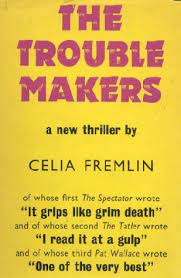
Forgotten Book - The Trouble Makers


I've spoken before on this blog about my admiration for the work of Celia Fremlin. She's one of the authors to whom I've given quite a bit of attention in The Life of Crime. Inevitably, it's only been possible for me to talk at length in that book about a selected number of authors whose work I love, but I do see her as influential and important in terms of the development of domestic suspense. 

Francis Iles, a very shrewd critic and excellent judge of writing quality, heaped praise on Fremlin's first two books. She didn't need to focus on violence and murder in her stories. Skilful characterisation allowing for the creation of tense situations was her forte. The Trouble Makers, her fourth book, first published by Gollancz in 1963, is a case in point. It presents a picture of suburban life which is as disturbing as it is compelling.

The lead character is Katharine, a harassed mother of three girls whose marriage to Stephen is far from blissful. She takes solace and indeed pleasure from the fact that her friend and neighbour Mary seems to be having a worse time in her own marriage, to an older man called Alan. A number of other women in the neighbourhood who are friendly with Mary also enjoy feeling superior to her.

This is a subtle, slow-burning novel which presents a rather horrifying picture of the interactions between a number of women. Their husbands have considerable failings, but they remain in the background. Fremlin's focus is on the shortcomings of her own sex. To what extent her views were influenced by her own experiences, I don't know, but the outcome is truly chilling. Fremlin describes a way of life which in some respects now belongs to the distant past, but there is something timeless about her portrayal of the casual cruelties of which seemingly decent people are sometimes capable.   

Monday, 10 August 2020

Vintage Crime


Vintage Crime: from the Crime Writers' Association (Fiction Without Frontiers) by [Crime Writers' Association, Martin Edwards]

Vintage Crime is published tomorrow. It's my latest anthology to be edited on behalf of the Crime Writers' Association, and it differs from its predecessors in a couple of respects. First, we have a new publisher, Flame Tree Press, with whom I've worked in the past. They are lovely people to work with, and the care they devote to their publications is admirable. The production values on Vintage Crime are terrific.

Second, this is not a collection of newly written stories, but rather a book that is designed to showcase the evolution of the crime short story throughout the existence of the CWA. The CWA was founded back in 1953, and its first anthology appeared in 1956. Since then the CWA has been a major supporter of crime short stories, and many award-winning stories made their first appearance in a CWA collection.

In essence, I've mined the CWA archives to put together a book of stories which have appeared in previous CWA anthologies but which seem to me to deserve a new life. I've chosen stories dating back to the 1950s, written by a range of writers whose names are mostly well-known, including the brilliant Mick Herron and the equally gifted Andrew Taylor, two of the finest authors working in the genre today.

There are some terrific names here, including Robert Barnard (whose "Sins of Scarlet" won a Dagger), Frances Fyfield, Celia Fremlin, Peter Lovesey, Liza Cody - and John Dickson Carr. Yes, the king of the locked room mystery was a CWA member. The contributors have, between them, won enough awards to fill a locked room, and I'm hopeful that many readers will enjoy devouring these mysteries from the (sometimes quite recent) past.

Friday, 12 June 2020

Forgotten Book - Possession

Celia Fremlin was by no means a prolific novelist, but I've never read a book of hers that failed to impress me. When I spotted a paperback copy of Possession in a second hand shop, therefore, I snapped it up. The novel was published in 1969, and although it's not her best-known book, I found myself gripped as soon as I started reading.

The story is narrated by Clare Erskine, a married woman with two daughters who lives in London and enjoys nothing better than a gossip and scoring points off her friends. Fremlin portrays Clare cleverly, making clear her shallowness, and the gulf between her perceptions and reality, yet in a way that creates genuine sympathy for her.

Clare is thrilled when her older daughter, nineteen year old Sarah, breaks the news that after worrying her mother with a string of unsuitable boyfriends, she plans to get married to Mervyn Redmayne, an accountant. But when Clare boasts to her friends, she starts to learn things about Mervyn and in particular his mother which give her some cause for concern. Clare being Clare, she brushes off any worries, but it soon becomes evident that there is something deeply unhealthy about Mrs Redmayne's personality.

The title of the book is also its theme. Fremlin is very good at conveying the nature of possessiveness of various kinds, and the harm it can do. Her skill at social observation is outstanding and we get a splendid insight into middle-class London life at the end of the Swinging Sixties. There is much brilliance in this novel, although I must say that I felt the final part of the story did not make the most of the set-up she created. Had it done so, I would have classed this book as a masterpiece of psychological suspense. It's not quite outstanding, but it's very enjoyable, and in its quiet way very dark.

Monday, 9 March 2020

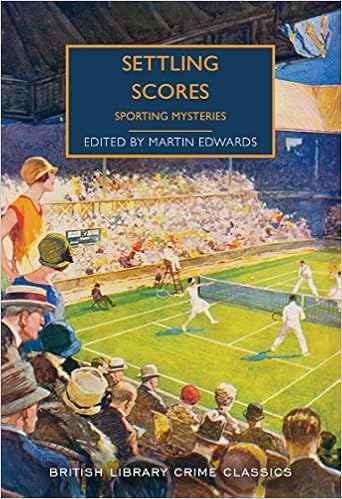
Settling Scores


Tomorrow sees the publication in the UK of my latest anthology in the British Library's series of Crime Classics. The unifying theme of Settling Scores is not revenge, but sport. Each story is not only by a different author, but it features a different sport. I'm not aware of any other crime anthology which is quite the same; there was a splendid book edited almost 80 years ago by Ellery Queen, Sporting Blood, but that one included poker, chess, and butterfly collecting.

I'm often asked what my favourites are among my own books - assuming that I do have favourites. Well, I never release a book on an unsuspecting world unless I'm happy with it, and it seems worthy of publication. And naturally it's a matter of personal and professional pride to try to make sure that each book is as good as it possibly can be. That said, inevitably there are books which give rise to different feelings - especially after a lapse of time. And different levels of satisfaction too.

Among my British Library anthologies, I'm especially proud of Foreign Bodies, because of its ambition, and several others, such as The Measure of Malice, strike me as interestingly different from the general run of anthologies. And Settling Scores is right up there, partly because there are some fascinating stories, and partly because I find it intriguing to see how different authors have set about integrating a sporting background into their narrative. I'm hopeful the book will do well.

So what of the specific contents? There's a long story by Julian Symons, set around Wimbledon, and a characteristically accomplished one by Celia Fremlin which is a bit different because it concerns a school sports day. And then there are stories by little-known figures such as F.A.M. Webster, David Winser, and Gerald Verner. Each of these three men, by the way, had a very interesting life, and I recently read a biography of Verner by his son Chris which I'm hoping will be published fairly soon. In the meantime, if you like sport, or if you hate sport but love crime fiction, do consider giving Settling Scores a try...


Friday, 13 December 2019

Forgotten Book - Appointment with Yesterday

Celia Fremlin was a remarkable woman, and a remarkable writer. I had the pleasure to meet her briefly in the early 1990s, at a CWA conference, although I didn't have the chance to talk to her at great length. I've admired her writing for a long time, though I haven't read all her books by any means, and I've only recently caught up with her 1972 mystery Appointment with Yesterday.

This is a really terrific novel. It's a story of domestic suspense, but it's the wittiest example of that sub-genre that I can recall having read. There are many acute insights and touches of humour, which relieve a rather dark storyline, and make the whole book entertaining as well as perceptive. It's at least as good as her excellent debut, The Hours Before Dawn, which won an Edgar.

This is the story of a woman who calls herself Milly Barnes. We know that isn't her real name, and we also know that she is on the run, fleeing from something terrible. What has she done, why is she so afraid? Milly can be exasperating, and can seem weak and rather stupid, but gradually Fremlin reveals the circumstances that have shaped her personality, and our sympathy for her grows.

Milly runs off to a seaside town where she takes a number of part-time jobs as a cleaner. Fremlin herself had worked in domestic service, and her presentation of the relations between employer and employed is as enjoyable as it is plausible. Meanwhile, the tension mounts, since someone is trying to find Milly. Who can it be, and what do they want? I can strongly recommend this excellent novel. It deserves to be much better-known.

Monday, 8 July 2019

The birthday trip


Even when I was working full-time, I got into the habit of taking the day off for my birthday, and I've had a good many fun experiences as a result. Going up Snowdon, sailing round Puffin Island, and taking the steam train from Llangollen in north Wales, for instance, as well as journeys to the Lakes, a river cruise on the  Dee, and so on. This year, with the weather forecast looking promising, I decided to fulfil a long-held ambition and travel on the Settle to Carlisle railway line.


It made sense to turn it into a weekend trip, staying overnight in High Bentham, not far from the very attractive tourist centre of Ingleton. Wandering round the Yorkshire Dales is a pleasant way to pass the time, and we stopped in Sedbergh and Hawes before reaching Ingleton. Sedbergh is England's book town, and although it doesn't compare to Hay-on-Wye in terms of the number of shops, I managed to pick up several paperbacks that appealed to me. And Celia Fremlin's short suspense novel Possession made such a good impression on me that I could hardly put it down.


Then to Settle yesterday morning to pick up the train. This is a regular Northern Line service, though I believe that steam trains also run on the line from time to time. Settle's a nice town (though its two bookshops are closed on Sundays; perhaps just as well) and the journey lived up to expectations. The countryside along the route is gorgeous, and unspoilt. The train travels over the famous Ribblehead Viaduct. The viaduct isn't unusually long - what makes it more noteworthy than, say, the "Arches" in Northwich which I used to walk past on my way to school is the glorious setting.


There was time to mooch around Carlisle in the sunshine. It's a pleasant city with (yes!) an open bookshop, and a good one at that, to say nothing of a castle, a citadel, and a cathedral. Then it was back on the return journey, in time for a trip to Dent, a quaint cobbled village, and the only one in Dentdale, apparently because in the days of Norse invaders, they favoured individual homesteads rather than larger settlements. The Yorkshire Dales (and the neighbouring bits of Cumbria) are a lovely part of the world, and the birthday trip was a resounding success, suitably rounded off by a meal in a canalside pub back at Lymm. 


Monday, 2 April 2018

The Couple Next Door by Shari Lapena - book review


Image result for shari lapena

The Couple Next Door is a bestselling novel of psychological suspense by Shari Lapena, whom I had the pleasure of meeting in the whirl of the Toronto Bouchercon last year. Shari, who is herself based in Toronto, is a former lawyer, and I've always particularly enjoyed reading the crime fiction of legal eagles who have managed to fly away from the desk, the computer, and the clients for long enough to write a novel.

As regular readers of this blog will know, I'm a long-term fan of novels of psychological suspense, and when I read them, I find myself not only enjoying the story (assuming it's a good one) but also of studying the approach taken by the writer - whether it's Patricia Highsmith or Celia Fremlin in days gone by, or Paula Hawkins or Gillian Flynn today. For instance, a key decision is whether to opt for a first person narrative, or a third person single viewpoint narrative. Shari Lapena has chosen the third person multiple viewpoint method, and it's a choice well-suited to her plot. A key reason why it works so well is that it enables her to shift suspicion around a small cast of characters in a very effective way.

In a nutshell, this is a "baby in jeopardy" thriller.  Anne and Marco have been invited round to dinner by Graham and Cynthia, the couple next door, and have unwisely succumbed to pressure from Cynthia to leave their tiny daughter Cora at home, checking on her regularly. You can guess what's coming, can't you?

It's a long time since my own children were as small as Cora, but anyone who's been a parent can, I think, empathise with the terror of Anne and Marco as their life together rapidly falls apart, with Cora missing, and the police deeply suspicious that one or both of them may be implicated in the kidnap. Losing your child is really a parent's worst nightmare. At least Anne's own parents are rich enough to be able to afford to pay a ransom demand, but is that really such a good idea? The moral dilemmas come thick and fast, and so do the plot twists. This is a pacy, action-packed thriller, brimming with suspense. No wonder it's achieved such success.

Friday, 18 July 2014

Forgotten Book - The Hours Before Dawn

Celia Fremlin's Edgar-winning debut novel, The Hours Before Dawn, earned great acclaim on its first publication in 1958, and it only qualifies as a Forgotten Book by virtue of its age. Many readers are well aware of Fremlin as a gifted novelist of suspense, and this book, along with a few others such as The Spider Orchid, retains its appeal to this day. It certainly should never be forgotten.

My edition, which dates back to the 80s, is a paperback which benefits from an interesting introductory note by Fremlin herself. I always find such pieces interesting. She describes how the idea of the story came from having her second baby, who used to scream through the night. A similar problem is encountered by Louise, the central figure in her book, whose third child, a little boy who can't get to sleep at night, causes increasing difficulties which are exacerbated by the arrival in their suburban London home of a female lodger, who seems to be something of a woman of mystery.

Louise isn't helped by the selfishness of her husband, and before long she starts to fear for her marriage. The husband doesn't seem to be very sympathetically portrayed, but Fremlin denied that she regarded him as some sort of monster. I'm not sure that her intentions with regard to his characterisation were perfectly implemented, but his behaviour contributes to Louise's sense of isolation and fear, and helps to build the tension.

This is a short book, with a relatively straightforward plot, and the device Fremlin uses for revealing what is happening to Louise strikes me as a little clumsy. This was, after all, a beginner's book. But it has a raw power which I find impressive, and well deserved its success. Today's experts in psychological suspense often write long, complex book, but this relatively slender and early work in the field stands comparison with the best of them.

Friday, 25 October 2013

Troubled Daughters, Twisted Wives - review

Troubled Daughters, Twisted Wives, is the rather brilliant title of one of the most interesting anthologies of crime fiction that I've read in a long time. Edited by Sarah Weinman, and published by Penguin, the book collects some fine stories by a number of the finest female writers of suspense fiction in the twentieth century. Weinman's introduction is interesting and incisive, but of course, the meat of the book is in her story selection. And what a good selection it is.

Here we find some famous names, and some forgotten ones too. I was particularly pleased to see a story by Nedra Tyre, an author whose name, I suspect, will be unfamiliar to many. "A Nice Place to Stay" made a great impression on me when I first came across it many years ago - in, as far as I can recall, one of the many fine anthologies edited by Ellery Queen. It inspired me to write a story called "A Job for Life", which eventually appeared in print, and is possibly the earliest of my stories to have done so.

Elisabeth Sanxay Holding is represented by a long and very clever story, almost a novella, called "The Stranger in the Car". I liked the twists in this one, as well as the insightful characterisation. Holding was a gifted writer, but even more talented was Margaret Millar, one of whose all too rare short stories is also included here. And we also have some very fine writers, ranging from the superb Shirley Jackson and the often creepy Patricia Highsmith to the subtle Celia Fremlin and the author of fhat very good story "The Purple Shroud", Joyce Harrington (and no, it was not the inspiration for The Frozen Shroud!)

Reviewers have been quick to heap praise on this book, and I'm with them. Among the most interesting assessments, as you might expect, is one from Jon L. Breen, arguably the finest living crime critic in the US. He notes Weinman's suggestion that the writers she has chosen lacked an editorial champion, but points out that their success (and they were highly regarded in their day, even if most have now faded from view) indicates that the feminist crime writers of the 70s and 80s were not breaking as much fresh ground as is sometimes argued. But what matters most is that the stories in this book represent really good entertainment. I look forward to more anthologies from Sarah Weinman.

Sunday, 30 August 2009

Celia Fremlin


I was sorry to learn that Celia Fremlin, a British suspense novelist of genuine distinction, died earlier this summer. I only found out because I read an obituary notice by Rebecca Tope in the CWA’s private members’ newsletter. If her passing has been discussed in the newspapers, or online (and surely it must have been?) then I have missed it.

One thing is for sure – Fremlin’s work is not talked about too much these days. But it deserves to be, because she was a class act. To my regret, I only met her once, very briefly, at a CWA conference in the early nineties. Her sixteenth and last novel appeared not long after, in 1994, when she was 78.

The lack of attention paid to Fremlin’s work is all the more sobering when one reflects on the immediate impact she made when her first novel, The Hours Before Dawn, appeared in 1958. It’s a good title and an even better book – it went on to win an Edgar. My copy is a 1988 reprint, which benefits from a pithy preface by Fremlin. The story involves a harassed mother, Louise Henderson, who lives in suburbia and who takes in a lodger with unexpected consequences. The domestic milieu is very well drawn, and Fremlin was one of those who led the way in developing the psychological suspense set in recognisable everyday surroundings.

It’s a long time since I read Fremlin, but although I can’t remember much about them, I do know that The Spider-Orchid and Appointment with Yesterday were good books, written by a novelist both sensitive and intelligent. Are any readers of this blog Fremlin fans? I hope so, for she should not be forgotten.