Showing posts with label Dorothy B. Hughes. Show all posts

Friday, 13 May 2022

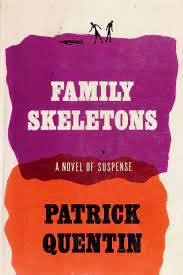
Forgotten Book - Family Skeletons


Patrick Quentin, in various incarnations, is an American crime author I've enjoyed reading for many years. The name (and the names Q. Patrick and Jonathan Stagge) conceals a complex set of collaborations, but in the 1950s the brand adorned a final run of books by Hugh Wheeler, writing solo. The last of the books, Family Skeletons, has eluded me until now, but when I had the chance to acquire Dorothy B. Hughes' review copy, I snapped it up.

Hughes was, like me, a Patrick Quentin fan, but I think she probably enjoyed the book rather more than I did. I sense that, by the time this title appeared in 1965, Wheeler was tiring of the game. He'd become established in the world of musical theatre, where great success still awaited him. This story has, as Hughes said, the touch of a professional - especially in the way that suspicion shifts around a pool of possible suspects. But there is something perfunctory about the whole exercise, as if Wheeler's heart wasn't really in it.

The problem is that Lewis Denham, the protagonist, is a rather irritating figure. He's a member of a rich (and even more irritating) family and when he marries in secret, he pretends, for no reason that I could find credible or remotely sensible, that he is not married. Then, when he and his new wife come across a body and realise that she might be a prime suspect, they make matters much worse for themselves by stupidly taking away the corpse and pretending that nothing has happened. 

Overall, I felt that this was a story where the characters behaved in the way that they did mainly in order to build the suspense. Yes, contrivance is permissible in a crime story, but it needs to have a touch of believability and we usually need to empathise with at least one of the characters. Wheeler was a talented writer, and he could characterise rather more effectively than he does here. He was also adept at plotting, but I'm sorry to say that, some time before the end, I lost interest in the whodunit twists. This isn't a bad book, but there are certainly a good many better Quentin books than this one. Why was it the last? Probably because Wheeler was smart enough to realise that he'd lost his touch.

Friday, 24 January 2020

Forgotten Book - Dread Journey

Dorothy B. Hughes was a first-rate writer, and my admiration for In a Lonely Place is unbounded. So when, in the splendid second hand bookshop at Carnforth, I spotted a copy of her 1945 novel Dread Journey, I couldn't resist. It's a book in which the action takes place during a long train journey, and really it blends elements from women-in-jeopardy novels and Murder on the Orient Express (but there's no snowdrift...)

I should say at the start that, although it's a well-written book, I struggled with the basic premise. Kitten Agnew, a shallow actress is terrified (and with good reason) that the wealthy Hollywood mogul Viv Spender intends to kill her during the course of the journey. Spender is a sociopath with a long track record of mistreating women, and his previous interest in Kitten has cooled - he's now turned his attention to someone else. But despite knowing that her life is at risk, Kitten wants to marry him, and persists in provoking him. Why? I wanted to scream. For all Hughes' skill, I unable to suspend my disbelief in the fundamental set-up of the story, and that was a drawback.

There are, however, some very strong elements in the story. The portrayal of Spender is interesting in the #MeToo era; one might conclude that Hughes, who knew about Hollywood men, was making a point that is not only powerful but unfortunately of enduring relevance. Her writing still resonates today. And her presentation of a black character who plays a significant part in the storyline is equally interesting and ahead of its time.

So there is much to enjoy in this book, recently reprinted by Otto Penzler in the US and thus readily obtainable, even if I don't rate it as highly as some critics do. But I'm certainly glad I read it. Hughes was not only a talented writer but a thought-provoking one.

Monday, 7 October 2019

In a Lonely Place - DVD review

The film of In a Lonely Place (1950), directed by Nicholas Ray, is rather better known than Dorothy B. Hughes' novel (1947) from which it was adapted. Both are quite excellent, but very different. I read the book first, and now I've caught up with the DVD of the movie, which stars Humphrey Bogart and Gloria Grahame. Bogart plays Dix Steele, a Hollywood screenwriter whose career is in decline.

In the novel, Dix is a war veteran who hankers after becoming a writer, but doesn't achieve his dream. He becomes obsessed with picking up women and murdering them, and the book charts his mental decline. In the film, a young woman in whom Dix has shown an interest is murdered, but it's not clear until the end whether or not he is guilty of the crime.

Even though I knew in advance that the film script bears only a limited resemblance to the source material, I was still surprised that Andrew P. Solt, the writer, jettisoned so much of Hughes' book. Given the excellence of the novel, this was a high-risk gamble, but in fairness to Solt, he does create a mood of menace, and the actors do a superb job. I'm slightly surprised that nobody has attempted to re-make the film in a manner more faithful to the book; perhaps the success of Ray's version remains a deterrent.

In the bonus extras, the comment is made that in the movie, Dix is a man whom women watch, whereas in the book, he's a man who watches women. This distinction between the approach of the male and female writers struck me when I was watching; there's something very modern about Hughes' writing, and the same can't quite be said about Solt's script, despite its considerable merits. But I enjoyed watching the film almost as much as I enjoyed reading the novel. Not least because of the soundtrack by George Antheil, known to locked room mystery fans as Stacey Bishop, author of Death in the Dark.

Friday, 22 March 2019

Forgotten Book - The Killer Inside Me


Image result for killer inside me jim thompson


Jim Thompson's 1952 novel The Killer Inside Me has been filmed a couple of times, though I haven't seen either movie. In fact, I've only just got round to reading the book. I was very taken with Thompson's The Getaway, but did wonder if The Killer Inside Me would suffer by comparison with an earlier novel, which also presents the world from the perspective of a psychopathic serial killer, Dorothy B. Hughes' In a Lonely Place. In fact, it's very different, and also very powerful.

The premise is gripping. Lou Ford is a 29 year old deputy sheriff in a small town in Texas. Everyone likes him, he helps people out when the chance arises, and he's very attractive to women. The local newspapers extol his virtues. The only snag is that he's afflicted by "the sickness" - an urge to kill. He's kept things under control for a long time, but when he meets Joyce Lakeland, the old demons re-emerge.

Whereas Hughes wrote her novel in elegant prose, there's something visceral about Thompson's style that suits the material. Lou's habit of talking in endless cliches is an intriguing way of characterising an apparently easy-going guy who begins to lose control of his behaviour. As the body count rises, so suspicion starts to swirl around him. Can he get away with multiple murder?

There's a fascinating chapter towards the end of the story where Lou converses with a man named Walker. I don't want to give any spoilers, but it rather sums up why I admire this book - in a deceptively simple style, Thompson makes points that pack a punch. It took me a long time to get round to reading much Thompson, and I gather that his work is uneven, but at his best, he was very, very good.


Friday, 7 September 2018

Forgotten Book - In a Lonely Place

In a Lonely Place is a justly admired film noir starring Humphrey Bogart, but until this year I'd never come across the novel on which it is based, written by Dorothy B. Hughes, and first published in 1947. The book is quite different from the film in some crucial respects, but I must say that I really, really enjoyed it. It's compelling, very well-written, and just the right length for the material.

The story is told in the third person, but everything is seen through the eyes of Dickson (Dix) Steele, a former pilot who has not found the adjustment to peacetime easy. Hughes describes something that hadn't really struck me very powerfully before - how for some men, war service offered excitement, and a sense of achievement that was unavailable elsewhere. And she describes it so well that I was convinced by Dix and by his often irrational behaviour. He is a memorable character.

The setting is Los Angeles, and very well-evoked that city is too, with fogs worthy of Bleak House, and a strange mix of urban glitz and leisurely beach life. Dix is staying in the home of an absent rich friend, and renews a friendship with a former colleague in the military, only to find that Brub Nicolai has married, and become a policeman.

Given that it soon becomes clear that Dix is a serial strangler, this relationship offers both insight into the police investigation and huge risks. Matters are further complicated when Dix falls for a neighbour, a glamorous but erratic actress called Laurel. Hughes describes Dix's increasingly wild mood swings credibly and with occasional touches of cool wit. This is a very, very good book, and although similar ground has been covered many times since, the quality of Hughes' prose makes it memorable in its own right, and not just as a precursor to later books by Patricia Highsmith, Jim Thompson, and countless others.