Showing posts with label Georges Simenon. Show all posts

Monday, 1 August 2022

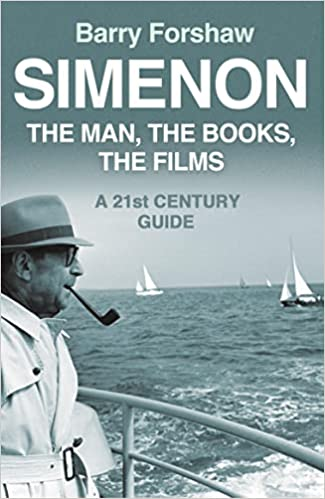
Simenon: The Man, The Books, The Films - by Barry Forshaw


Very few authors of books about the crime genre feature as extensively in the Bibliography of The Life of Crime as Barry Forshaw. Barry is an impressively prolific writer and he has now come up with another snappy book, published by No Exit Press about the Belgian maestro of crime. No, not Poirot, but Georges Simenon. The title is Simenon: The Man, The Books, The Films, and it represents a crisp and user-friendly introduction to the subject.

I noticed that I'm quoted in the endorsements of one of Barry's previous books, saying that Barry's constructive approach comes as a welcome breath of fresh air. I'm glad I said that, because it sums up a key merit of his writing - the positive tone. In addition, he is concise, and that too is a bonus because verbose lit.crit., however well-informed, can become tedious.

From start to finish, Barry's experience as a journalist informs his approach as well as his straightforward and readable writing style. To take just one example, the section 'Adapting Maigret' is essentially an extended quotation from an interview with Alison Joseph, who is at home with radio writing as she is with penning detective novels. Barry has also built upon a bibliography developed by the late David Carter almost twenty years ago.

One of Barry's strengths is his knowledge of films and he itemises many films based on Simenon novels that I'm unfamiliar with. Of the British TV series, it's clear that he prefers the portrayals of Maigret by Rupert Davies and Michael Gambon to Rowan Atkinson's recent interpretation. I don't know if there's ever been a Simenon encyclopaedia, but if not, this little book is an excellent, scaled-down alternative.

Friday, 6 December 2019

Forgotten Book - A Tangled Web

A Tangled Web could be the title for any number of crime novels, but my Forgotten Book today was written by Nicholas Blake (aka C. Day Lewis) and published in 1956. It's one of only four Blake books not to feature Nigel Strangeways, and it's none the worse for that. I found it extremely readable, written in a smooth and entertaining style with several polished touches worthy of a future Poet Laureate.

The essentials of the plot were drawn from Sir Patrick Hastings K.C.'s account of a real-life criminal trial. In a prefatory note, however, the author emphasises that "the colour, detail and interpretation...are largely my own, and the characters are wholly imagined." The story is, in essence, about a post-war version of Raffles, a charming amoral character called Hugo Chesterman.

Hugo makes a living as a burglar, but his life changes when he meets the dazzlingly attractive Daisy Bland. They start a relationship, and she gives up the life she's known to be with him. But Hugo can't resist temptation, and when the opportunity to steal an old woman's jewels comes along, he can't resist. But, as we know from the outset, he then finds himself suspected of murder. The police investigators take a tough line, and I'm pretty sure that Blake's account of their approach was influenced by John Bingham; he acknowledges Bingham's influence (and that of Simenon and others) in a foreword to an omnibus volume containing this novel.

The book's strength lies in its account of the relationship between Daisy and Hugo, and in particular in the depiction of Hugo's deeply sinister friend Jacko, a character who clearly fascinated Blake. Where the story fails is in Blake's unwillingness to build on the basic plot - we are told too much in the first chapter for the web to be adequately tangled, given the failure to add plot twists at the end of the book. Indeed, Blake might have done better to abandon the first chapter altogether. So there's no great mystery about this particular crime novel, but that readability is a major compensation.


Friday, 11 January 2019

Forgotten Book - Cul De Sac


Image result for john wainwright cul de sac

It's safe to say that John Wainwright is a forgotten author, even though he died not much more than twenty years ago, and was publishing until near the end. In fact, he published more than 80 novels, almost all of which benefited in some way from his years of experience as a police officer in Yorkshire prior to become a busy full-time novelist.

I once met John Wainwright in the late 1980s. This was at a Liverpool library event. I was asked to take part on the basis of my work as a reviewer - I hadn't published a novel at that time. The other authors involved were Eileen Dewhurst, who became (and still is) a very dear friend of mine, and the late Roger Ormerod.

I was pleased to meet Wainwright, whose books I'd read and admired, but I found him taciturn in the extreme, as if keen to play up to the stereotype of the cantankerous Yorkshireman. He didn't seem interested in either the event or the questions asked by the audience, but this may well have been due to shyness. Roger Ormerod, also rather reserved by nature, I think, was much more gracious. Having read his memoirs recently, I don't doubt that Wainwright was a nice chap if you really got to know him, I just think he was utterly out of his comfort zone, as someone who seldom attended author events. The contrast with the exceptionally pleasant Peter N. Walker, also a former Yorkshire cop, and a highly convivial man, was striking.

Wainwright's books use to crowd the library shelves, but after his death, his reputation faded. He wrote too quickly, as so many authors do, and the quality of his work was variable, but I think that at his best he was a fascinating writer. Cul De Sac, published in 1984, earned high praise from Georges Simenon, no less. I found it an intriguing study of character and of police work.

It begins with a diary extract - shades of Gone Girl! In some ways, Wainwright was ahead of his time. The diary-maker's wife meets an untimely end, falling over a cliff. Accident, suicide, or murder? An obsessive detective, Harry Harker, sets  out to find the truth. It's a highly readable story. My only quibble is that the excellent final twists did not seem to me to be adequately foreshadowed, a flaw that could easily have been remedied. It's a book of its time. But I liked it a lot.


Friday, 24 August 2018

Forgotten Book - The Hanged Man of Saint-Pholien

Georges Simenon's early (1931) Maigret novel The Hanged Man of Saint-Pholien, has also had several other titles. These include The Crime of Inspector Maigret (sacre bleu!) and Maigret and the Hundred Gibbets. Personally, I'd have been inclined to call it simply The Hanged Man, as the new title is a bit of a mouthful, but perhaps the shorter version didn't seem distinctive enough.

The version I read was the translation from 2014 by Linda Coverdale, published by Penguin. The translation struck me as exceptionally readable and gripping, and credit must go to Coverdale as well as to Simenon. In my youth, I found some of the translations of Simenon that I read rather drab, but the more recent ones that I've come across are more appealing. Perhaps, also, I've become more interested in Simenon as I've got older. Despite his huge popularity, he is, for some, an acquired taste.

In this book, Maigret is working in Belgium when he sees a poorly dressed man posting a large number of banknotes to an address in Paris. Intrigued, the detective follows the man and - extraordinarily but somehow characteristically - switches the suitcase the man is carrying for another. This crucial plot development, unlikely yet arresting, seems to me to typify Simenon.

The man discovers the switch and promptly commits suicide. Even Maigret's customary calm is slightly ruffled by this shocking development. So what was in the man's suitcase - a fortune in banknotes? No, an old, bloodstained suit. What on earth is going on?

As Maigret follows a strange trail, and risks his life on more than one occasion, he comes across an odd group of individuals linked together by past events. Like all the other Maigret novels I've read, this is a short, snappy book, and it's probably the Maigret that I've most enjoyed reading. Maigret's actions are sometimes improbable, but Simenon's gift is to make them seem psychologically plausible. The same goes for the behaviour of the other characters in this entertaining story. 

Friday, 21 April 2017

Forgotten Book - Bird in a Cage

Frederic Dard was a successful and exceptionally prolific French crime writer whose work is little known in Britain despite the fact that he's often been compared to his friend Georges Simenon. That should change now, since Pushkin Vertigo have begun to publish some of his books.in English translation. I decided to have a look at Bird in a Cage, first published in 1961, and now translated by David Bellos.

This is a mystery set at Christmas, but if you're expecting a Parisian equivalent of The Santa Klaus Murder, you are in for a shock. It's really a noir story, with a melancholic mood, and a whiff of Boileau-Narcejac (when will more of their mysteries be translated into English, I wonder? Vertigo was far from being their only masterpiece).

The protagonist is Albert, who has come back home after years of absence. His mother is dead, and he becomes entranced by an attractive woman he chances to meet. The woman has a child (although it has to be said that the narrative does not show her parenting skills in a particularly good light) but she seems as drawn to Albert as he is to him.

Before long, however, we are confronted with a corpse, and in due course, in classic mystery fashion, the body vanishes. What is going on? I enjoyed this story, and felt that Bellos' translation worked well. It's a very short book, not much more than a novella, but none the worse for that brevity. I enjoyed reading it, and will look forward to reading more Frederic Dard.

Monday, 26 December 2016

Maigret's Dead Man - ITV and book review


Image result for maigret's dead man
Maigret's Dead Man was ITV's big Christmas Day production, marking a return to the screen for Rowan Atkinson as Jules Maigret. The screenplay by Stewart Harcourt was based on Georges Simenon's novel, a new edition of which I've just received for review from Penguin, who are steadily bringing back all the Maigret novels into print. (A big project - there are more than seventy of them...)

Atkinson's first outing as Maigret, Maigret Sets a Trap was screened at Easter. I rather enjoyed it, as I wrote on this blog, but overall, reaction was rather mixed. There will be some who feel that Maigret's Dead Man was not obvious seasonal fare, but I thought it was well done, and rather more compelling than the earlier adaptation. This is partly because Atkinson is growing into the role, partly because the storyline was more compelling.

A number of very violent robberies and murders are taking place at farms in Picardie. Maigret's assistance is sought, but he is distracted by the mysterious beating and murder of a man who has been trying to contact him by phone. The dead man said that Maigret knew his wife Nina, but the name rings no bells with the detective. We see some of the events of the dead man's last day - he is being pursued by two toughs, but we don't know why. Maigret is told not to waste his time on a gangland killing, but of course he is too persistent to let the matter slide.

When I first read Simenon as a teenager, I was disappointed that the Maigret stories weren't classic twisty whodunits. Nowadays I appreciate their virtues - in particular their glances at character, and their humanity. At the end of the TV programme, the adoption of a young child is proposed, and I was curious to see whether this was something just tacked on for the benefit of telly audiences (I wasn't sure the adoption was such a great idea, I must admit; to say why would be a spoiler). It turns out that that this strand of the finale is replicated, more or less, in the novel. Interesting. Overall, a good programme (although 90 minutes would have been a better length than 2 hours), and a good book.

Tuesday, 16 August 2016

Following in Simenon's Footsteps


I'm just back from a short but highly enjoyable trip to Belgium, where my itinerary included a trip to Liege, birthplace of Georges Simenon, the prolific creator of Maigret and, in addition, the author of a great many notable non-series novels. There is a Simenon audio-visual tour, and the great man's statue is to be found in a square named after...Maigret. My travelling companion, Mr Edwards junior, and I enjoyed a drink in the square on a truly lovely Sunday. Sunday's also the day when the great market along the banks of the Meuse takes place in Liege, and this was well worth a visit. Other sights include an epic climb up the Mountain of Bueren, a rather steep flight of nearly 400 steps. I did get to the top, but at a stately pace...


Another great trip was to Antwerp, famous for Rubens, and a port with a huge amount of character. There was plenty going on, not least the Antwerp Pride festival, and a particular highlight was a trip to the top of the MAS Museum, close to the river Scheldt, where on a sunny day the views all around are quite fantastic.


Our base was Brussels, a city I last visited a long time ago The Grand Place is as grand as ever, but this time around, there was something very special about it - the Flower Carpet, a bi-annual display of begonia petals that attracts huge crowds. It was good to be part of those crowds, as one of the locals told me that tourism in the city had been blighted by the recent terrorist attacks. Not surprisingly, there were plenty of armed police in evidence, but the mood of the city was very positive, and that was great to see.


Belgium's a great country. It didn't only give us crime fans Simenon, but S.A. Steeman and Poirot as well, among others. The landscape's flattish (except for those steps in Liege!) , but the places I've mentioned, as well as Ghent and Bruges, are truly delightful. Absolutely worth a visit.

Friday, 18 March 2016

Forgotten Book - The House that Kills

The House that Kills was the first detective novel published by Noel Vindry, a major French writer of the Golden Age who was unknown to almost all English-speaking fans until recently, simply because nobody translated his work. Now, John Pugmire of Locked Room International, has repaired the omission,and published a nice paperback edition with an intro and appendices.

As John says in the intro, at one time Vindry (1896-1954) had a reputation to match those of two Belgians, Georges Simenon, and Stanislas-Andre Steeman (whom I've discussed previously on this blog). I was fascinated to learn that Boileau-Narcejac were huge fans of Vndry, speaking of his "unequalled virtuosity". Narcejac even went so far as to suggest that Vindry surpassed Ellery Queen and John Dickson Carr. I have to say that - on the evidence of Vindry's debut - this seems over the top, but Narcejac studied the genre in depth, and his opinions on it certainly command respect. So I look forward to reading Vindry's later work.

Vindry trained as an examining magistrate,and put his professional know-how to work by giving the same occupation to his Great Detective, Monsieur Allou. Vindry's focus was on puzzle rather than character,and Allou is not drawn in great depth (but then, you might say the same of Hercule Poirot). His speciality is solving impossible crimes, and here he is confronted by a bunch of them.

This is a clever book, if dry in style when compared to John Dickson Carr's atmospheric writing. Vindry was certainly ingenious, and Locked Room International have done a great job in making his debut available at long last. They also publish Paul Halter, a present day exponent of the impossible crime story who has attracted many admirers. Halter's work is also worth seeking out, and if you liked miraculous murders, I think you'll enjoy The House that Kills. Will you be able to solve the various puzzles before Allou? They aren't easy to crack believe me..  .

Monday, 7 March 2016

The Essex Book Festival


I've just returned from the Essex Book Festival. A long way to go - I set off from snowy Lymm on Friday morning and finished up admiring a rather magical sunset over the water at Southend-on-Sea. But it was a good trip, and I was glad to play a small part in a huge county-wide event that is a credit to those in charge: Seona Ford, Camilla Shestopal, Ros Green, and their various colleagues.

I had the great pleasure of meeting John Simenon, son of the legendary Georges, at a dinner on Friday evening. John has co-produced the imminent new version of Maigret, and was full of admiration for the performance of Rowan Atkinson. Definitely one to look out for. The following morning, I made the short journey to Westcliff to admire the truly fantastic book collection of John Cooper, who co-wrote two of my favourite books about the genre with Barry Pike. One or two items - inscribed books by Georgette Heyer and Henry Wade - stand out in my memory; the former is among the most interesting Golden Age items I've ever seen.

Then it was back to Southend, in time for lunch and then a session moderated by journalist Jake Kerridge in which John Simenon and I enjoyed talking about Golden Age fiction from our different perspectives. An hour and a half sped by. After that, I moderated a panel about international crime fiction. Prior to the Festival, I'd worried about whether I'd be able to do a satisfactory job, given that,the focus of the panellists' books are very different from mine. But one of the great things about crime fiction, I believe, is that the connections between crime novelists, however diverse their writing, are highly positive,and so it proved.

So special thanks to the four people who made up a really excellent panel - see Lucy Dauman's phot above - from which I learned a lot. Leye Adenie is a first time novelist from Nigeria, the grandson of a Nigerian king and -  I discovered over a glass or two of his favourite red wine that evening - also an IT expert and creator of patented inventions. We had a fascinating discussion. Robert Karjel is Swedish, and was until recently a Lieutenant Colonel in the Swedish air force. He's written four novels over the past fifteen years or so, and the success of My Name Is N, a thriller with a memorable protagonist, Ernst Grip, has enabled him to concentrate on writing full-time. Robert and I had a chip supper together on the seafront late on Saturday evening in weather conditions that can best be described as "bracing". Zgymunt Miloszeweski is a Polish writer whose books about another interesting central character, called Szacki, have made a big hit. And last but certainly not least was Anya Lipska, a Brit married to Pole whose books about an East End Polish fixer who teams up with a female cop have already won a substantial and enthusiastic following.  It was a real pleasure to get to know this quartet of writers, and to be part of a terrific Festival.