Showing posts with label John Pugmire. Show all posts
Wednesday, 15 January 2020
Locked Room Murders Supplement by Brian Skupin
I've talked on this blog, and also at many library events over the years, about my love of the late Bob Adey's wonderful reference book Locked Room Murders. (The photo of Bob above was taken by Jamie Sturgeon a few years back.) I acquired the first edition from a London bookdealer many moons ago, and then the second expanded edition when it came out. After I got to know Bob, he kindly inscribed them for me. These are not easy books to find nowadays and so Brian Skupin and John Pugmire did fans a great service when they produced a new and affordable revised version of the second edition via John's Locked Room International imprint.
And now, they have gone the extra mile and done something that many of us had hoped Bob might live to do, producing an update of the second edition that is wide-ranging and highly informative. Brian is the author and Locked Room International again the publisher. They call it a "Supplement" but perhaps that description doesn't fully convey the scale of the endeavour. This is a very substantial book in its own right, running to 326 pages. On Amazon UK, it's for sale at about £15, and if you're a locked room fan, that makes it an unmissable bargain.
Brian and John are eminently qualified to undertake this project. They are experts in the field, yes, but even more importantly they are enthusiasts, people whose love of the genre informs their judgements. Their anthology The Realm of the Impossible is fascinating and I can't believe that I've not reviewed it at length on this blog as yet - one of these days, I'm sure I will get round to it.
In the meantime, let me say how much I've enjoyed dipping into the Supplement. It ranges very widely, paying due attention to the work of Paul Halter and the Japanese writers who have worked such ingenious variations on the locked room form as well as to TV shows such as Jonathan Creek. Various contemporary British writers feature in at least one entry - examples include Simon Brett, Chris Fowler, Jim Kelly, Ann Cleeves, and Kate Ellis. I am sure that Bob would be delighted to see this book in print. Brian and John have carried on the baton in admirable manner.
Four of my own stories are included - they are all short stories, since I've never contemplated taking on a full-length locked room novel. At least not yet. Another story, "The Locked Cabin", is due to be included in a forthcoming anthology of locked room mysteries, edited by Maxim Jakubowski although I should say that this isn't itself a locked room mystery in the accepted sense, but rather a story about the idea of creating a locked room mystery - on board the first Queen Mary.
Friday, 23 November 2018
Forgotten Book - The Tokyo Zodiac Murders
Today's Forgotten Book, The Tokyo Zodiac Murders by Soji Shimada, dates back to 1981, but more than thirty years elapsed before the novel was published in English by those splendid publishers Pushkin Vertigo. The translation was undertaken by the equally splendid John Pugmire, whose own imprint, Locked Room International, has been responsible for bringing to to English language readers some truly fascinating locked room mysteries.
Shimada's book caused quite a sensation in Japan on its original release, in that it represented a striking move away from a focus on gritty realism. The story has many elements (such as floor plans and footprints in the snow) that are pure Golden Age, and Shimada is a long-time admirer of classic detective fiction from Britain and America, but it is also modern, dealing with some subjects in a degree of gruesome detail that you would never find in, say, the work of John Dickson Carr or Anthony Wynne.
The story deals with a sequence of murders (and dismemberments) that took place in 1936, and their reinvestigation in 1979. The new inquiry is undertaken by a sort of Holmes-Watson duo, the brilliant young astrologer Kyoshi Mitarai and his friend, the narrator (of most but not all of the book), an illustrator called Takeshi Yoshiki. So it's a cold case mystery, and a very complicated one too. But there are some nice touches of humour, as in Kyoshi's witty debunking of some of the most famous Sherlock Holmes stories - rather as Holmes affected to disdain Gaboriau's stories about Lecoq.
I've never visited Japan, but in recent years I've become increasingly interested in the country's detective fiction, and it was a great thrill for me when The Golden Age of Murder was bought by a Japanese publisher. The Tokyo Zodiac Murders paved the way for a new generation of writers such as Alice Arisugawa who have made intriguing use of classic tropes in their fiction, combining elements familiar from Carr and company with a Japanese sensibility that I find intriguing. I gather that Pushkin Vertigo are planning to publish more crime fiction from Japan, and I look forward to reading it.
Shimada's book caused quite a sensation in Japan on its original release, in that it represented a striking move away from a focus on gritty realism. The story has many elements (such as floor plans and footprints in the snow) that are pure Golden Age, and Shimada is a long-time admirer of classic detective fiction from Britain and America, but it is also modern, dealing with some subjects in a degree of gruesome detail that you would never find in, say, the work of John Dickson Carr or Anthony Wynne.
The story deals with a sequence of murders (and dismemberments) that took place in 1936, and their reinvestigation in 1979. The new inquiry is undertaken by a sort of Holmes-Watson duo, the brilliant young astrologer Kyoshi Mitarai and his friend, the narrator (of most but not all of the book), an illustrator called Takeshi Yoshiki. So it's a cold case mystery, and a very complicated one too. But there are some nice touches of humour, as in Kyoshi's witty debunking of some of the most famous Sherlock Holmes stories - rather as Holmes affected to disdain Gaboriau's stories about Lecoq.
I've never visited Japan, but in recent years I've become increasingly interested in the country's detective fiction, and it was a great thrill for me when The Golden Age of Murder was bought by a Japanese publisher. The Tokyo Zodiac Murders paved the way for a new generation of writers such as Alice Arisugawa who have made intriguing use of classic tropes in their fiction, combining elements familiar from Carr and company with a Japanese sensibility that I find intriguing. I gather that Pushkin Vertigo are planning to publish more crime fiction from Japan, and I look forward to reading it.
Wednesday, 29 August 2018
The Publishing Revolution
Technology drives me to distraction when it doesn't work, but in calmer moments, I often reflect on the benefits it has brought, not least to readers and writers. I don't think it's an exaggeration to say that publishing has been revolutionised in recent years by technological advance. Now that it is possible to publish books cheaply, either in print form, or as ebooks, many titles are available that would have been impossible to find in the past.
I'm not just talking about reprints of classic crime novels. Authors of non-fiction are benefiting hugely. Of course, technology has (in a sense) impacted harshly on non-fiction books. So much information is available online at the click of a mouse that traditional publishers may well be wary about taking on new titles unless it's very clear that there's an eager readership for them. But two books landed on my doorstep yesterday that reminded me of those benefits I've mentioned.
The first is a book I've mentioned here previously, the updated version of the late Bob Adey's Locked Room Murders. John Pugmire and Brian Skupin have rendered crime fans a great service by revising this splendid book, which in its original editions is almost impossible to find at a reasonable price. The book appears under John's Locked Room International imprint, and LRI is one of those small presses which have made admirable use of technology to make available books which are fascinating yet which might have a relatively limited readership. Strongly recommended - and I can't wait for the promised further update of Bob's splendid work...
The second is John Goddard's Agatha Christie's Golden Age, a chunky and in-depth study of the Poirot stories, with an intro by John Curran. This book is published by Stylish Eye Press, an imprint set up by John Goddard himself. Again, this is a volume which might not sell in the tens of thousands yet which seems to be a very worthwhile venture. I'm looking forward to reading it, but without that technological progress I've mentioned, I'd never have had the chance. Something to remind myself of the next time my PC breaks down!
I'm not just talking about reprints of classic crime novels. Authors of non-fiction are benefiting hugely. Of course, technology has (in a sense) impacted harshly on non-fiction books. So much information is available online at the click of a mouse that traditional publishers may well be wary about taking on new titles unless it's very clear that there's an eager readership for them. But two books landed on my doorstep yesterday that reminded me of those benefits I've mentioned.
The first is a book I've mentioned here previously, the updated version of the late Bob Adey's Locked Room Murders. John Pugmire and Brian Skupin have rendered crime fans a great service by revising this splendid book, which in its original editions is almost impossible to find at a reasonable price. The book appears under John's Locked Room International imprint, and LRI is one of those small presses which have made admirable use of technology to make available books which are fascinating yet which might have a relatively limited readership. Strongly recommended - and I can't wait for the promised further update of Bob's splendid work...
The second is John Goddard's Agatha Christie's Golden Age, a chunky and in-depth study of the Poirot stories, with an intro by John Curran. This book is published by Stylish Eye Press, an imprint set up by John Goddard himself. Again, this is a volume which might not sell in the tens of thousands yet which seems to be a very worthwhile venture. I'm looking forward to reading it, but without that technological progress I've mentioned, I'd never have had the chance. Something to remind myself of the next time my PC breaks down!
Tuesday, 7 August 2018
Great News for Locked Room Fans
On this blog and elsewhere, I've mentioned many times that one of my absolute favourite books about the crime genre is the late Bob Adey's marvellous and unique Locked Room Murders. Bob was a great guy, to whom I dedicated Miraculous Mysteries, and from whose widow Sue I've been able to acquire a number of gems for my own collection. I'm the proud possessor of copies of the first and second editions which Bob inscribed for me years ago, but for a long time it's been a source of frustration and regret that other fans have been unable to track down copies at affordable prices.
Now that's going to be put right. I'm delighted to hear from John Pugmire that the book is to reappear, under his Locked Room International imprint. And even better news, an update is in the works. Here is the information John has passed on to me:
"Locked Room Murders is a bibliography
containing a description of the problem and, separately, the solution to locked
room and impossible crime novels and short stories.
It has been a classic in the locked room
pantheon for over 40 years, beginning with a 1972 article by Bob Adey in The Armchair Detective. The first
edition of Locked Room Murders,
published by Ferret Fantasy in 1979, covered 1280 titles. The 1991 second edition, published by Crossover Press, covered 2019 titles.
Due to limited print runs, both editions
have become prohibitively expensive. Locked Room International (LRI) is now making
a revised version of the Second Edition available at an affordable price.
Edited by Brian Skupin, LRI consultant and co-publisher of Mystery Scene magazine, this revised version contains the same 2019
titles, but with corrections and additional references which have appeared
since 1991.
Plans are in place to publish a Supplemental
Edition in 2019, to include novels and short stories (including translations from
sources outside the Anglosphere) published since 1991, films, TV series, graphic
novels, and other media. It will not contain any of the titles in the Second
Edition, Revised."
Wednesday, 4 October 2017
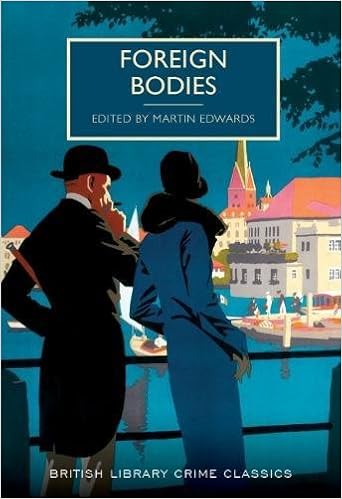
Foreign Bodies - a new British Library anthology
Over the past twenty-plus years, I've had the pleasure of compiling and editing a great many anthologies of crime writing. This year sees the publication of no fewer than five of my anthologies - four from the British Library, and the CWA collection Mystery Tour, due later in the year. But of all the anthologies I've been associated with, Foreign Bodies is one of the most exciting. And after a great deal of work behind the scenes, it finally hits the shelves tomorrow.
Classic crime fiction is usually associated in the public mind with stories written in the English language. Christie, Sayers and company in Britain, of course, and their American counterparts, the likes of Ellery Queen and C. Daly King. Few people realise how many detective stories were written in other languages at much the same time. And not only those by Georges Simenon, either.
The appeal of the detective story is worldwide,and that has long been the case. Sherlock Holmes inspired a host of writers to flatter Conan Doyle by imitation. Maurice Leblanc's stories about Arsene Lupin (which feature "Holmlock Shears",among other characters!) are quite well-known, the tales by the German Paul Rosenhayn about an American sleuth in the Holmes mould are long-forgotten. And even writers in Asia and South America were taking note of what Doyle and his successors were doing in Britain, and seeking to follow their example.
There are a number of reasons why compiling Foreign Bodies has proved quite a challenge. For a start, it's far from easy to track down some of the stories in their original forms. Acquiring the rights has sometimes been far from easy - we missed out on one intriguing "impossible crime" story aa a result of rights problems, for example - and getting the translations sorted out with a satisfying period feel has been another hurdle. Thankfully, I and the British Library have benefited from a great deal of help, in particular from John Pugmire of Locked Room International and American short story writer and translator Josh Pachter. I hope that readers find the result of our labours as fascinating to read as I have found it to put together.
Monday, 17 April 2017
Foreign Bodies

There are some fascinating titles coming up in the British Library's Crime Classics series over the next twelve months. The programme for the second half of this year has recently been made public, and it includes a number of books I'm really pleased about. These include The Long Arm of the Law, a collection of police stories that I've edited, for which I've just finished writing the intros. Several rare stories make an appearance, as well as some by more familiar names.
I suppose, though, that if you forced me to say which of the various anthologies I'm editing this year is likely to excite the most interest, I'd be bound to say Foreign Bodies, which is due out in October. This book gathers together classic crime stories in translation. Some of the translations are brand new, and the friends and colleagues to whom I am especially indebted include John Pugmire and Josh Pachter.
It's often thought that classic crime fiction was the preserve of British and American authors. Georges Simenon is seen as an honourable exception. But the truth is more complicated, and more interesting. In reality, plenty of authors in Europe and elsewhere were writing crime stories, sometimes with a nod to Anglo-Saxon traditions and tropes, sometimes not. The trouble is, very few of these stories were translated at the time.
Foreign Bodies seeks to redress the balance, and tell an interesting story about foreign crime fiction. I'll say more about the detailed contents at a later date, but at this stage let me just add that of all the many anthologies I've edited since the mid-90s, I think this one might prove to be the most striking. We'll see.
Monday, 16 January 2017
Death in the Dark
I'm delighted to bring marvellous news for locked room mystery fans. Locked Room International will, at the start of March, be publishing Death in the Dark by Stacey Bishop. This novel, set in New York City, was originally published in 1930 as one of pair of books issue experimentally by Faber with pictorial boards and no dust jacket. It has subsequently become one of the most sought-after rarities among crime novels.
Prior to this edition, no English language reprint has ever appeared. I'm sure the arrival on the market of a nicely produced and very affordable copy will be greeted by collectors with a good deal of pleasure. John Pugmire of LRI deserves great credit for bringing the book back to life - and he's already been rewarded by a starred review in Publishers' Weekly.
I've written an introduction to this new edition, and there's also a fascinating Afterword written by the author's nephew and executor. Mystery has, suitably enough, long surrounded this book. Julian Symons talked about it in Bloody Murder, and suggested that there was in fact another Stacey Bishop book out there somewhere. Plenty of people, including me, have tried to track it down, but it now seems clear that this novel was a one-off.
And what a one-off! Symons, who revealed that the Bishop pen-name concealed the identity of a controversial composer called George Antheil, called it "an extraordinary performance". Bob Adey said it was "an extraordinarily complex work". As John said when interviewed by Publishers' Weekly, this is "probably the only literary work of any kind in history to have had three Nobel Prize winners involved in its creation." Does that whet your appetite? I thought it might....
Prior to this edition, no English language reprint has ever appeared. I'm sure the arrival on the market of a nicely produced and very affordable copy will be greeted by collectors with a good deal of pleasure. John Pugmire of LRI deserves great credit for bringing the book back to life - and he's already been rewarded by a starred review in Publishers' Weekly.
I've written an introduction to this new edition, and there's also a fascinating Afterword written by the author's nephew and executor. Mystery has, suitably enough, long surrounded this book. Julian Symons talked about it in Bloody Murder, and suggested that there was in fact another Stacey Bishop book out there somewhere. Plenty of people, including me, have tried to track it down, but it now seems clear that this novel was a one-off.
And what a one-off! Symons, who revealed that the Bishop pen-name concealed the identity of a controversial composer called George Antheil, called it "an extraordinary performance". Bob Adey said it was "an extraordinarily complex work". As John said when interviewed by Publishers' Weekly, this is "probably the only literary work of any kind in history to have had three Nobel Prize winners involved in its creation." Does that whet your appetite? I thought it might....
Friday, 18 March 2016
Forgotten Book - The House that Kills
The House that Kills was the first detective novel published by Noel Vindry, a major French writer of the Golden Age who was unknown to almost all English-speaking fans until recently, simply because nobody translated his work. Now, John Pugmire of Locked Room International, has repaired the omission,and published a nice paperback edition with an intro and appendices.
As John says in the intro, at one time Vindry (1896-1954) had a reputation to match those of two Belgians, Georges Simenon, and Stanislas-Andre Steeman (whom I've discussed previously on this blog). I was fascinated to learn that Boileau-Narcejac were huge fans of Vndry, speaking of his "unequalled virtuosity". Narcejac even went so far as to suggest that Vindry surpassed Ellery Queen and John Dickson Carr. I have to say that - on the evidence of Vindry's debut - this seems over the top, but Narcejac studied the genre in depth, and his opinions on it certainly command respect. So I look forward to reading Vindry's later work.
Vindry trained as an examining magistrate,and put his professional know-how to work by giving the same occupation to his Great Detective, Monsieur Allou. Vindry's focus was on puzzle rather than character,and Allou is not drawn in great depth (but then, you might say the same of Hercule Poirot). His speciality is solving impossible crimes, and here he is confronted by a bunch of them.
This is a clever book, if dry in style when compared to John Dickson Carr's atmospheric writing. Vindry was certainly ingenious, and Locked Room International have done a great job in making his debut available at long last. They also publish Paul Halter, a present day exponent of the impossible crime story who has attracted many admirers. Halter's work is also worth seeking out, and if you liked miraculous murders, I think you'll enjoy The House that Kills. Will you be able to solve the various puzzles before Allou? They aren't easy to crack believe me.. .
As John says in the intro, at one time Vindry (1896-1954) had a reputation to match those of two Belgians, Georges Simenon, and Stanislas-Andre Steeman (whom I've discussed previously on this blog). I was fascinated to learn that Boileau-Narcejac were huge fans of Vndry, speaking of his "unequalled virtuosity". Narcejac even went so far as to suggest that Vindry surpassed Ellery Queen and John Dickson Carr. I have to say that - on the evidence of Vindry's debut - this seems over the top, but Narcejac studied the genre in depth, and his opinions on it certainly command respect. So I look forward to reading Vindry's later work.
Vindry trained as an examining magistrate,and put his professional know-how to work by giving the same occupation to his Great Detective, Monsieur Allou. Vindry's focus was on puzzle rather than character,and Allou is not drawn in great depth (but then, you might say the same of Hercule Poirot). His speciality is solving impossible crimes, and here he is confronted by a bunch of them.
This is a clever book, if dry in style when compared to John Dickson Carr's atmospheric writing. Vindry was certainly ingenious, and Locked Room International have done a great job in making his debut available at long last. They also publish Paul Halter, a present day exponent of the impossible crime story who has attracted many admirers. Halter's work is also worth seeking out, and if you liked miraculous murders, I think you'll enjoy The House that Kills. Will you be able to solve the various puzzles before Allou? They aren't easy to crack believe me.. .
Subscribe to:
Posts (Atom)