Showing posts with label James Ellroy. Show all posts

Wednesday, 22 March 2023

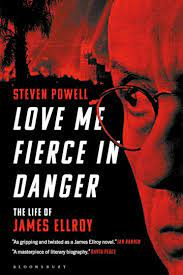
Love Me Fierce in Danger by Steven Powell - review


James Ellroy is an extraordinary writer and also a remarkable individual. I met him once, briefly, at an event and had a chat with him as he inscribed some books to me. He likes to present himself as 'The Demon Dog of Crime' and it's not always easy to separate the publicity-generating headlines about him, and his sometimes outrageous behaviour, and the real man. I have mixed feelings about his work - some of it I really like, some of it leaves me cold. But, as anyone who has read The Life of Crime will know, I do think he is a significant and interesting figure in the development of modern American crime fiction.

Love Me Fierce in Danger: The Life of James Ellroy is the first biography of him, and I'm sure it won't be the last. Ellroy is, at 74, still writing and has a novel due out soon. There's a lot to unpick in his life story, including of course the consequences of the terrible murder of Ellroy's mother on her son when he was just ten years old. Ellroy has written extensively on this subject himself, and any psychologist would have a field day exploring his complex thought processes.

Steven Powell is one of a number of British academics - Mike Wilson, Jamie Bernthal, and Mark Aldridge are among the others - who are doing good work in writing about crime fiction without an excess of academic jargon. Powell is a specialist in Ellroy and his sympathy for the man is, I would argue, a strength of the book. Importantly, he writes in a clear and accessible way.

Powell highlights, among much else, the influence that the distinguished American editor Otto Penzler had on Ellroy's career. All writers benefit greatly from an editor who believes in their work and Otto definitely has an eye for talent. Inevitably there are a few points one might quibble with. For instance, is it really credible that the CWA gave Ellroy a 'briefing' asking him not to cause offence at the 1995 Bouchercon (which I attended), given that the CWA didn't organise the convention and would have had no standing in the matter? The CWA Chair in those days was the ex-cop Peter Walker and it hardly sounds like his doing.

Overall, though, there is much to relish here, not least the quote from Joyce Carol Oates that Ellroy is 'the American Dostoyevsky'. As Steven Powell points out, for all the troubled nature of aspects of Ellroy's life, it also has an inspiring quality in a number of respects. This book makes a worthwhile and welcome contribution to Ellroy scholarship. 

Monday, 15 October 2018

The Big Somewhere by Steven Powell

The growth of academic interest in crime fiction over the past few decades has been quite stunning. When Julian Symons published the first edition of Bloody Murder in 1972, very few scholarly studies of the genre were available. Since then, hundreds have been published, and some of them have been extremely interesting. Crime has become a "respectable" subject for academic study,, something I think is really rather wonderful and indeed overdue. Yet it's striking that not one of these academic books has had as much impact as Symons' book.

Why is this? Certainly, there are many insightful and scholarly studies of the genre which have taught me a good deal. But there is also a sense that some academic books represent the work of a small group of people talking to themselves, rather than to the wider community of crime fans or crime writers. Too often they don't seem designed to be read. It's not uncommon, for example, to find endless pages devoted to turgid footnotes which seem designed mainly to prove that the authors have done their homework and which, I suspect, hardly anyone finds useful. In my opinion, that's a real pity.

Happily, there are signs that things are changing for the better. Not long after The Golden Age of Murder was published, I was invited to take part in a symposium focusing on the work of James Ellroy at the University of Liverpool. The event was organised by a lecturer at the university, Steven Powell, who has specialised in writing about American crime fiction, and in particular about Ellroy. I really enjoyed taking part (and meeting, amongst others, Woody Haut, whose excellent books about hardboiled crime fiction, and its links with Hollywood, have long appealed to me).

I also found that I enjoyed reading Steven's own writings, which seemed punchier and more accessible than much other academic work about the genre. An excellent example of this approach is to be found in a collection of essays that he edited, 100 American Crime Writers.

Now Steven has a new book out; The Big Somewhere is published by Bloomsbury, and comprises a range of essays by various authors (including Woody Haut) on the subject of Ellroy's fiction.  My interest in Ellroy dates back to the late 80s, and although I've not read much of his work of late, I attended a talk he gave in Manchester some years ago (making sure that he inscribed some of his books to me!) and found him as remarkable in person as he is in print. There is nobody quite like "the Demon Dog".

His unique qualities as a crime writer are well captured, and cogently analysed, in The Big Somewhere. In addition to a general introduction, Steven Powell contributes the first essay in the book, and co-authors the tenth and concluding essay, which deals with Ellroy's influence on the British writer David Peace. It's always the case with a book of this kind (as it is with an anthology of short stories) that one will not rate every contribution equally highly, but I found something of interest in all of them. Diana Powell's study of Ellroy's influence on Megan Abbott (in her earlier novels, at least) is particularly thought-provoking.

Because I'm a fan of books about the genre, I'm keen to see a narrowing of the gap between academic studies and more popular accounts of crime fiction, such as Bloody Murder. Novelists like me who are interested in the genre's range and possibilities can learn a great deal from the academics, and I think it's fair to say that there are some academics who could profitably study the art of writing entertainingly. Books like The Big Somewhere, which contain a good deal of valuable information without becoming unduly bogged down by scholar-speak, point the way forward. I enjoyed reading this book, (and not only because of the absence of tedious footnotes in tiny print!) I think that anyone who is a serious Ellroy fan will find The Big Somewhere insightful and interesting.

Wednesday, 13 January 2016

James Ellroy by Steven Powell

Last summer, I was invited to speak at a conference at Liverpool University which focused on the work of the American crime writer, James Ellroy. One of the reasons I accepted was that, in my early days as a crime novelist, I found myself reading Ellroy's novels, and thinking about his approach to story-telling. Not because I wanted to emulate his style, but because I believe it's helpful for a writer to absorb a whole range of influences rather than just a few. He is a controversial character, and some of his novels seem to me to be much better than others, but he and his work are thought-provoking, no question about that.

The conference was organised by Steven Powell, a researcher at Liverpool University, who has now written a book about Ellroy, sub-titled Demon Dog of Crime Fiction, and published by Palgrave Macmillan in their Crime Files series. Steven has previously been responsible for a wide-ranging collection of essays in the same series, 100 American Crime Writers, which I found readable and enjoyable, as well as Conversations with James Ellroy, which I have yet to read.

He makes the valid point that critics have often struggled to distinguish between Ellroy's work and his persona, and notes that Ellroy has managed to establish himself as "a character within the history of the genre". A pretty major character, it's fair to say. And I rather like the quote from Ellroy that ends the book: "I'm just James Ellroy, the self-promoting Demon Dog...You call it swagger. I call it joie de vivre.". Steven Powell's ability to recognise that joie de vivre is one of the key strengths of this book.

The book began life as a thesis, and this is a sign of the times. Not so long ago, few academics were interested in writing about crime fiction. Now there is a flood of academic texts about the genre. Some are excellent, but some of them are not exactly riveting, to put it mildly. One or two authors seem to prefer pedantry to conveying a love of the books, never mind a sense of joie de vivre. One of the things I like about Steven Powell's work is that he doesn't fall into this trap. He writes in a readable way, wears his learning lightly, and puts his discussions with Ellroy to good use. The result is scholarly, but not dull, and for me, the absence of page after page of footnotes was a definite plus (there is an extensive bibliography, which is useful.) I'm not an expert on theses, but the book doesn't seem to me to read like one, and that is a Good Thing. If you are interested in studying Ellroy, this thoughtful if not inexpensive book will prove a valuable and important resource..