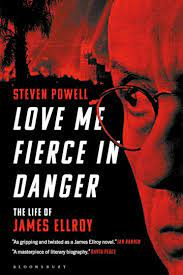
James Ellroy is an extraordinary writer and also a remarkable individual. I met him once, briefly, at an event and had a chat with him as he inscribed some books to me. He likes to present himself as 'The Demon Dog of Crime' and it's not always easy to separate the publicity-generating headlines about him, and his sometimes outrageous behaviour, and the real man. I have mixed feelings about his work - some of it I really like, some of it leaves me cold. But, as anyone who has read The Life of Crime will know, I do think he is a significant and interesting figure in the development of modern American crime fiction.
Love Me Fierce in Danger: The Life of James Ellroy is the first biography of him, and I'm sure it won't be the last. Ellroy is, at 74, still writing and has a novel due out soon. There's a lot to unpick in his life story, including of course the consequences of the terrible murder of Ellroy's mother on her son when he was just ten years old. Ellroy has written extensively on this subject himself, and any psychologist would have a field day exploring his complex thought processes.
Steven Powell is one of a number of British academics - Mike Wilson, Jamie Bernthal, and Mark Aldridge are among the others - who are doing good work in writing about crime fiction without an excess of academic jargon. Powell is a specialist in Ellroy and his sympathy for the man is, I would argue, a strength of the book. Importantly, he writes in a clear and accessible way.
Powell highlights, among much else, the influence that the distinguished American editor Otto Penzler had on Ellroy's career. All writers benefit greatly from an editor who believes in their work and Otto definitely has an eye for talent. Inevitably there are a few points one might quibble with. For instance, is it really credible that the CWA gave Ellroy a 'briefing' asking him not to cause offence at the 1995 Bouchercon (which I attended), given that the CWA didn't organise the convention and would have had no standing in the matter? The CWA Chair in those days was the ex-cop Peter Walker and it hardly sounds like his doing.
Overall, though, there is much to relish here, not least the quote from Joyce Carol Oates that Ellroy is 'the American Dostoyevsky'. As Steven Powell points out, for all the troubled nature of aspects of Ellroy's life, it also has an inspiring quality in a number of respects. This book makes a worthwhile and welcome contribution to Ellroy scholarship.
