Showing posts with label Steven Powell. Show all posts

Wednesday, 22 March 2023

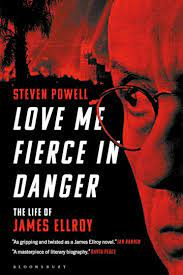
Love Me Fierce in Danger by Steven Powell - review


James Ellroy is an extraordinary writer and also a remarkable individual. I met him once, briefly, at an event and had a chat with him as he inscribed some books to me. He likes to present himself as 'The Demon Dog of Crime' and it's not always easy to separate the publicity-generating headlines about him, and his sometimes outrageous behaviour, and the real man. I have mixed feelings about his work - some of it I really like, some of it leaves me cold. But, as anyone who has read The Life of Crime will know, I do think he is a significant and interesting figure in the development of modern American crime fiction.

Love Me Fierce in Danger: The Life of James Ellroy is the first biography of him, and I'm sure it won't be the last. Ellroy is, at 74, still writing and has a novel due out soon. There's a lot to unpick in his life story, including of course the consequences of the terrible murder of Ellroy's mother on her son when he was just ten years old. Ellroy has written extensively on this subject himself, and any psychologist would have a field day exploring his complex thought processes.

Steven Powell is one of a number of British academics - Mike Wilson, Jamie Bernthal, and Mark Aldridge are among the others - who are doing good work in writing about crime fiction without an excess of academic jargon. Powell is a specialist in Ellroy and his sympathy for the man is, I would argue, a strength of the book. Importantly, he writes in a clear and accessible way.

Powell highlights, among much else, the influence that the distinguished American editor Otto Penzler had on Ellroy's career. All writers benefit greatly from an editor who believes in their work and Otto definitely has an eye for talent. Inevitably there are a few points one might quibble with. For instance, is it really credible that the CWA gave Ellroy a 'briefing' asking him not to cause offence at the 1995 Bouchercon (which I attended), given that the CWA didn't organise the convention and would have had no standing in the matter? The CWA Chair in those days was the ex-cop Peter Walker and it hardly sounds like his doing.

Overall, though, there is much to relish here, not least the quote from Joyce Carol Oates that Ellroy is 'the American Dostoyevsky'. As Steven Powell points out, for all the troubled nature of aspects of Ellroy's life, it also has an inspiring quality in a number of respects. This book makes a worthwhile and welcome contribution to Ellroy scholarship. 

Thursday, 20 February 2020

Loughborough and the Academic World


Image


I'm just back from a fascinating trip to Loughborough University. Thanks to the good offices of Professor Mike Wilson, I did a couple of events, one a public talk, the other an extensive workshop with Mike's third year students. The students are working on a dramatic version of Farjeon's Thirteen Guests, and I was very interested to hear the take of these young, thoughtful people on Golden Age fiction. Their positivity was refreshing and my visit as a whole very enjoyable. I was also greatly entertained by the poster designed to promote the event...

Nor is this to be my only encounter with the academic world this year. In April I'm taking part in a Golden Age weekend of events organised by the University of Chester. And later in the summer, the Routledge Companion to Crime Fiction will be published; an academic tome, with many contributions from academics - plus me.

My interest in the academic world goes back a long time. In my younger days, I thought seriously about becoming an academic and once I started to train as a solicitor, I wondered if I'd be better suited to lecturing and researching rather than working in a legal office. In either case, I wanted to pursue my dream of becoming a crime novelist, but I thought the academic life might be more conducive to that. So I went for lunch with one of my tutors at Balliol, a wonderful New Zealander called Don Harris, for whose judgement I always had the greatest respect. We talked it over, and he persuaded me that, at that time, the uncertainties of academic life were unappealing. So in the end I stayed in the legal profession, and it worked out well - in the long run.

I continued to write the occasional academic article, as well as more prosaic stuff for newspapers and magazines. And in recent years, as academic interest in crime fiction has risen, so my contacts with the academic world have increased. I very much enjoyed being part of Steven Powell's seminar on James Ellroy at Liverpool University a few years ago and I'm keen to see closer contact between crime novelists and academics interested in the genre.

There is some fascinating research going on, and some very good writing, but at present it seems to me that there's also some surprisingly poor writing in the academic field, stuff that - whatever its intellectual merits - is desperately boring to read, because some authors seem to pay more attention to things (such as bibliographies and other references) which try to show how well they have done their homework, rather than writing accessibly and in a way that others will find inspiring. I understand that part of the thinking is to assist future researchers, but the balance often seems to be tipped against good prose, a strange example for teachers to give to students. Thankfully, the likes of Steven Powell and Mike Wilson recognise the importance of communicating clearly, widely, and well. I'm optimistic that a similar approach will be followed by more and more academics in years to come.

Monday, 15 October 2018

The Big Somewhere by Steven Powell

The growth of academic interest in crime fiction over the past few decades has been quite stunning. When Julian Symons published the first edition of Bloody Murder in 1972, very few scholarly studies of the genre were available. Since then, hundreds have been published, and some of them have been extremely interesting. Crime has become a "respectable" subject for academic study,, something I think is really rather wonderful and indeed overdue. Yet it's striking that not one of these academic books has had as much impact as Symons' book.

Why is this? Certainly, there are many insightful and scholarly studies of the genre which have taught me a good deal. But there is also a sense that some academic books represent the work of a small group of people talking to themselves, rather than to the wider community of crime fans or crime writers. Too often they don't seem designed to be read. It's not uncommon, for example, to find endless pages devoted to turgid footnotes which seem designed mainly to prove that the authors have done their homework and which, I suspect, hardly anyone finds useful. In my opinion, that's a real pity.

Happily, there are signs that things are changing for the better. Not long after The Golden Age of Murder was published, I was invited to take part in a symposium focusing on the work of James Ellroy at the University of Liverpool. The event was organised by a lecturer at the university, Steven Powell, who has specialised in writing about American crime fiction, and in particular about Ellroy. I really enjoyed taking part (and meeting, amongst others, Woody Haut, whose excellent books about hardboiled crime fiction, and its links with Hollywood, have long appealed to me).

I also found that I enjoyed reading Steven's own writings, which seemed punchier and more accessible than much other academic work about the genre. An excellent example of this approach is to be found in a collection of essays that he edited, 100 American Crime Writers.

Now Steven has a new book out; The Big Somewhere is published by Bloomsbury, and comprises a range of essays by various authors (including Woody Haut) on the subject of Ellroy's fiction.  My interest in Ellroy dates back to the late 80s, and although I've not read much of his work of late, I attended a talk he gave in Manchester some years ago (making sure that he inscribed some of his books to me!) and found him as remarkable in person as he is in print. There is nobody quite like "the Demon Dog".

His unique qualities as a crime writer are well captured, and cogently analysed, in The Big Somewhere. In addition to a general introduction, Steven Powell contributes the first essay in the book, and co-authors the tenth and concluding essay, which deals with Ellroy's influence on the British writer David Peace. It's always the case with a book of this kind (as it is with an anthology of short stories) that one will not rate every contribution equally highly, but I found something of interest in all of them. Diana Powell's study of Ellroy's influence on Megan Abbott (in her earlier novels, at least) is particularly thought-provoking.

Because I'm a fan of books about the genre, I'm keen to see a narrowing of the gap between academic studies and more popular accounts of crime fiction, such as Bloody Murder. Novelists like me who are interested in the genre's range and possibilities can learn a great deal from the academics, and I think it's fair to say that there are some academics who could profitably study the art of writing entertainingly. Books like The Big Somewhere, which contain a good deal of valuable information without becoming unduly bogged down by scholar-speak, point the way forward. I enjoyed reading this book, (and not only because of the absence of tedious footnotes in tiny print!) I think that anyone who is a serious Ellroy fan will find The Big Somewhere insightful and interesting.

Wednesday, 13 January 2016

James Ellroy by Steven Powell

Last summer, I was invited to speak at a conference at Liverpool University which focused on the work of the American crime writer, James Ellroy. One of the reasons I accepted was that, in my early days as a crime novelist, I found myself reading Ellroy's novels, and thinking about his approach to story-telling. Not because I wanted to emulate his style, but because I believe it's helpful for a writer to absorb a whole range of influences rather than just a few. He is a controversial character, and some of his novels seem to me to be much better than others, but he and his work are thought-provoking, no question about that.

The conference was organised by Steven Powell, a researcher at Liverpool University, who has now written a book about Ellroy, sub-titled Demon Dog of Crime Fiction, and published by Palgrave Macmillan in their Crime Files series. Steven has previously been responsible for a wide-ranging collection of essays in the same series, 100 American Crime Writers, which I found readable and enjoyable, as well as Conversations with James Ellroy, which I have yet to read.

He makes the valid point that critics have often struggled to distinguish between Ellroy's work and his persona, and notes that Ellroy has managed to establish himself as "a character within the history of the genre". A pretty major character, it's fair to say. And I rather like the quote from Ellroy that ends the book: "I'm just James Ellroy, the self-promoting Demon Dog...You call it swagger. I call it joie de vivre.". Steven Powell's ability to recognise that joie de vivre is one of the key strengths of this book.

The book began life as a thesis, and this is a sign of the times. Not so long ago, few academics were interested in writing about crime fiction. Now there is a flood of academic texts about the genre. Some are excellent, but some of them are not exactly riveting, to put it mildly. One or two authors seem to prefer pedantry to conveying a love of the books, never mind a sense of joie de vivre. One of the things I like about Steven Powell's work is that he doesn't fall into this trap. He writes in a readable way, wears his learning lightly, and puts his discussions with Ellroy to good use. The result is scholarly, but not dull, and for me, the absence of page after page of footnotes was a definite plus (there is an extensive bibliography, which is useful.) I'm not an expert on theses, but the book doesn't seem to me to read like one, and that is a Good Thing. If you are interested in studying Ellroy, this thoughtful if not inexpensive book will prove a valuable and important resource..  

Monday, 23 November 2015

Steven Powell on James Ellroy

Today, I'm pleased to welcome Dr Steven Powell to the blog, with a guest post about his new book concerning that controversial but hugely interesting crime writer James Ellroy. I've just received a copy, and I'll be reviewing it here in due course:

"James Ellroy: Demon Dog of Crime Fiction began life as my thesis at the University of Liverpool. After I graduated, Palgrave Macmillan accepted my proposal for a new monograph on Ellroy, and I began to adapt my years of research on Ellroy into book form. There were two elements of James Ellroy's career that I found particularly fascinating. One is referenced in the title of my study: his self-styled 'Demon Dog of American Crime Fiction' persona. I was determined to find out the full extent that Ellroy's literary persona had played in shaping his works. Was it a major factor in his writing or did Ellroy simply call himself the Demon Dog to give a name to his often unhinged performances at book readings and during interviews?

Another aspect of Ellroy’s work that interested me was the gradual evolution of the text in both plotting and prose from character bio’s to outline to first draft to finished novel. I was able to map out this process when I visited the James Ellroy archive at the University of South Carolina several years ago. It's fascinating to read the outline and drafts of The Black Dahlia, L.A. Confidential and White Jazz against the published novels and see just how different these works could have been.

Ellroy's literary persona, by contrast, was less visible in the text, although he is fond of recurring dog motifs which could be read as subversive clues to its presence. The Demon Dog moniker, however, was frequently invoked during the hundreds of interviews Ellroy has given throughout his career. I created an inventory of Ellroy interviews, partly so that when I came to talk to Ellroy myself I would know which topics he had already discussed at length and which subjects were overlooked. I interviewed Ellroy four times and then edited the anthology Conversations with James Ellroy for University Press of Mississippi.

Ellroy once said to journalist Ron Hogan 'Every interview I give is a chance to puncture the myth I've created about my work and refine it'. It was quotes like these that helped me to understand the purpose of Ellroy's persona, but there were also events in Ellroy's life which I discuss in James Ellroy: Demon Dog of Crime Fiction as being central to the formulation of the Demon Dog role.

One such incident occurred early in his career. After his first two novels were published, Ellroy moved to New York where he underwent a sudden crisis in his career. He was unable to sell his third novel to a publisher and his agent dropped him as a result. His solution was typically bold and theatrical. The story goes (it may be somewhat apocryphal) that Ellroy marched into the office of editor Otto Penzler and brashly introduced himself as 'the Demon Dog of American Crime Fiction.' Penzler was naturally taken aback by this uninvited guest, but he, and legendary agent Nat Sobel, took Ellroy on as a client and essentially rescued his career. If Ellroy hadn’t brandished the Demon Dog name, could his meeting with Penzler have been less successful I wonder?

As I say in the introduction to the book ‘Ellroy is an author at ease with his own sense of celebrity, but, in one of the many contradictory sides of his character, he relishes his self-crafted image as an outsider – too edgy, unpredictable and maverick to ever truly belong to the Hollywood or publishing establishment.’ It is this enigmatic and combative side to Ellroy’s character, I believe, which has complemented some of the most accomplished and controversial crime fiction written over the past thirty years, and why his work will continue to be debated by critics and readers for many years to come. James Ellroy: Demon Dog of Crime Fiction is my offering to this debate."

Monday, 3 August 2015

100 American Crime Writers - Steven Powell

Palgrave Macmillan publish an interesting list of academic books on a variety of crime fiction topics. One gripe - common, alas, to almost all academic publishers - is that the books are very pricey. This means that, for the overwhelming majority of individual readers who don't have the book-buying budget of some institution, they will be out of reach in terms of a personal purchase. But they are often worth tracking down via a library.

I mention this because 100 American Writers is a book that I think will appeal to a significant number of readers. The writers are discussed in short, snappy summaries by a range of writers, and the book doesn't become bogged down by academic jargon, footnotes or endless appendices, although there is a bibliography and a useful list of suggested further reading.

I came across the book a few weeks ago by chance, as it is edited by Steven Powell, who organised Liverpool University's recent conference about James Ellroy. Steven has provided introductory editorial material, and also gathered together a pleasing range of contributors, including among many others J.Kingston Pierce of the Rap Sheet, one of the best crime blogs around. Steven's wife Diana, a fellow Liverpool academic, but originally from the US, is another, and I was glad to find that she was the author of the section on that fascinating Golden Age writer C. Daly King., Another contributor is Chris Routledge, whose guest blog here about a British novelist in the Golden Age tradition, Simon Nash, attracted a good deal of interest.

The authors covered are predominantly more modern than King (for instance, Diana also covers Megan Abbott), but there were several names from the past that I was glad to see featured, including Melville Davisson Post and the brilliant Fredric Brown. For anyone seeking an introduction to American crime fiction, this book will make a very good choice.


Friday, 3 July 2015

James Ellroy and The Golden Age of Murder

Do you find the heading of this post a little...counter-intuitive? I couldn't blame you if you did. I must say that I was surprised a few months ago to receive an invitation to be a guest speaker at an academic conference on the subject of "James Ellroy - Visions of Noir" and even more surprised when I was asked to talk about The Golden Age of Murder. But they were pleasant surprises, and I readily accepted. And I'm really glad I did.

The conference, which was held on Thursday, took place in Liverpool University, in a splendid library in Abercrombie Square. The organiser, Steven Powell, is an academic, and is the author of a book about James Ellroy which will appear later this year. His wife is a fellow academic and she was among the other speakers. And a keynote address came from Woody Haut, author of (among other things, including most recently a novel, with another on the way) Heartbreak and Vine. That's a very good book, by the way, and never having met Woody before, I was delighted to have the chance to chat with him and to ask him to sign my copy.

So - Martin Edwards and James Ellroy? Detection Club archivist meets Demon Dog? Well, my enthusiasm for Golden Age books should not mask the fact that my taste in crime fiction is pretty broad, and in the late 80s and early 90s I read Ellroy's Brown's Requiem and the L.A. Quartet with a great deal of enthusiasm. When he gave a talk in Manchester, I went along,and had a brief and pleasant chat with him while, you guessed it, he signed my copies of his books. After My Dark Places, I'm afraid I lost touch with Ellroy's work, and what I heard about The Cold Six Thousand, for instance, didn't encourage me to read it. But there's no doubt.that he is a significant writer.

When Steven interviewed me about The Golden Age of Murder, I didn't attempt to draw parallels between Ellroy and the likes of Freeman Wills Crofts, but I was pleased with the reaction from the attendees, and enjoyed their questions. I was also encouraged to hear that my book is not regarded with disdain by literary academics. In fact, Steven wrote a very kind blog post about it recently. One of the reasons I'm heartened by such a response is that I'm very conscious that I'm not an academic, and my book isn't an academic text. No footnotes, and endnotes that are at least as much about fun facts as relentless detail about sources. I wasn't aiming at an academic readership at all, but it's good to know that even those whose approach to literature is rather more sophisticated than mine can find plenty to enjoy in the story of the Detection Club's early days.

The day ended splendidly with a meal in one of Liverpool's snazzier restaurants. I was glad to chat with people from distant parts - a German expert on Ellroy who kindly presented me with a copy of her book about his work, and a Brazilian academic who is another Ellroy expert. My warmest congratulations to the Powells for organising it all so well, and I look forward to talking more about Steven's book in the autumn.