Showing posts with label John Thaw. Show all posts

Wednesday, 13 December 2017

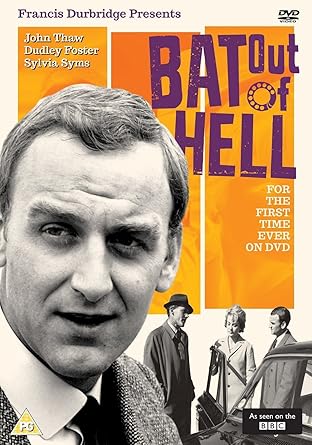
Francis Durbrige Presents: Bat Out of Hell - DVD review -


Image result for francis durbridge bat out of hell

My introduction to Francis Durbridge came when I was a boy. I happened to watch his TV serial Bat Out of Hell when it was screened by the BBC in 1966. Not long before, I'd discovered Sherlock Holmes and Agatha Christie, whom I still admire. And Durbridge, too, is a master of the crime genre, with a particular flair for the cliffhanger. I've watched and listened to many of his serials for TV and radio, and read many of his books. But Bat Out of Hell remains my favourite of his works.
There are several reasons for this. First, it's not formulaic. In fact, the structure is highly original. We are presented, it seems, with a classic "inverted mystery" scenario. Geoffrey Stewart is a wealthy estate agent but his marriage to the much younger Diana is fraying. We soon discover that Diana is having an affair with Mark Paxton, who works for Geoffrey, and that they are conspiring to murder him for his money. The crime is duly committed - but then the fun really starts. For the body vanishes, and Diana receives a telephone call, evidently from Geoffrey. For good measure, a body turns up in the spot where Paxton had intended to bury Geoffrey. But the corpse isn't Geoffrey's.

All this in episode one, lasting a mere half hour. Old TV crime shows often suffer from a lack of pace by modern standards, but not Bat Out of Hell. The twists keep coming, as relentless as they are baffling. I can't think of any inverted mystery with such an ingenious plot, and the investigating detective, Inspector Clay is truly remorseless as Paxton and Diana find themselves living a nightmare. Durbridge's novelisation of the story, by the way, is a good one, and a few years back I encouraged Arcturus to republish it in their Classic Crime series. Copies are still easy to find.

Back to the TV series. Apart from the cleverness of the plot, the impressive pace, and a memorable cop, the five-part show also benefited from a superb cast. Paxton is played by the young John Thaw - yes, Inspector Morse himself. Diana is played by Sylvia Sims, at her most beautiful. The inspector is played by Dudley Foster, a terrific character actor whose career was sadly ended when he committed suicide. The supporting cast, also very good, includes Noel Johnson, Patsy Smart, and June Ellis, best remembered for appearing in the "Waldorf Salad" episode of Fawlty Towers.

And here's another little gem for fellow trivia lovers. Half-way through the first episode, I was startled to hear a piece of background music that seemed very familiar. But I know it as the theme from Callan, a TV series of a later vintage. It was given the title "Girl in the Dark" and was a piece of stock library music. The composer was Jack Trombey, who later wrote the theme for Van Der Valk, which became a number one hit as Eye Level for  the Simon Park Orchestra.

I'm delighted that Bat Out of Hell is now available on DVD, and I loved watching it again, fifty years on. It's worn better than many TV series of that era, in my opinion. And I can see exactly why it made a very big impression on the admittedly impressionable young Martin Edwards.

Saturday, 21 February 2015

Francis Durbridge: A Centenary Appreciation

My enthusiasm for Francis Durbridge dates back to my school days - I was just eleven when I saw Bat Out of Hell on TV, and loved it. That serial starred John Thaw, long before he became Inspector Morse. Later, I enjoyed reading books about the genre written by Melvyn Barnes, and although he and I have never met, I've been delighted to get to know him via cyberspace, and recently to learn about a very worthwhile project of his, Francis Durbridge: A CentenaryAppreciation. So I invited Melvyn to write a guest blog to share the news - and here it is:

"I have never been a full-time writer, having spent my entire career as a chartered librarian until retiring in 2002 after eighteen years as Director of Libraries and Art Galleries for the City of London.  But crime fiction has been a lifetime interest, which led to part-time writing and the publication of my books Best Detective Fiction, Dick Francis, and Murder in Print, together with numerous contributions to magazines and reference books such as Twentieth Century Crime and Mystery Writers, The Oxford Companion to Crime and Mystery Writers and Scribner’s Mystery and Suspense Writers.

As a youngster during the “wireless” years I was captivated by the Francis Durbridge serials featuring Paul Temple, and later by his television serials that in their day attracted record viewing figures.  So much so, that well into retirement I decided it was time to take up the pen again and fill a gap by producing a unique account of Durbridge’s work.

It proved to be an unexpectedly complex and lengthy process, requiring several years’ research including many sessions at the British Library, the (late lamented) Newspaper Library in Colindale and the BBC Written Archives Centre at Caversham.  This provided countless details about Durbridge’s twenty-eight Paul Temple radio serials and plays from 1938 to 1968, his seventeen television serials from 1952 to 1980, his thirty-five novels from 1938 to 1988 and his nine stage plays from 1971 onwards.  Truly surprising, however, was the extent of his other works – nine cinema films were made from his radio and television serials, he wrote three novels as newspaper serials that were never published in book form, two plays long before he was recognised as a stage dramatist, and a Paul Temple comic strip for the London Evening News which ran for over twenty years.  Most surprising of all was the revelation of his prolific output for the radio, which not only included many non-criminous scripts but also non-Temple plays and serials featuring other detectives, using his own name and three pseudonyms.

This long period of slogging research frequently led me from one reference to another, with the final clinching of answers to previously unresolved questions.  It not only informed my introductory survey of Durbridge’s work, but it resulted in a comprehensive annotated listing of his novels and all his other works – including the first full listing of his Paul Temple comic strips.  It also enabled me to provide summaries of his plots (without spoilers, of course), with production and cast details of his radio, television, stage and cinema works.  Another important achievement was to show the links between them, to identify which were original and which were re-writes.  My ultimate satisfaction, however, came from the unearthing of so much new information, and not least in debunking the numerous errors that perpetuate on the Internet.

Francis Durbridge died in 1998, but today he retains a substantial fan base and attracts many new enthusiasts.  His serials are regularly repeated on Radio 4 Extra, re-creations of his “lost” serials have been produced on Radio 4, his novels continue to be reprinted, and there is a thriving trade in audiobooks, e-books and DVDs.

Although my earlier books were commissioned by commercial publishers, this time I decided to go it alone.  A commercial publisher would have required something more elaborate, probably with extensive biographical material and the addition of illustrations (acquired at my own expense), whereas I felt confident that I had already achieved all I set out to do.


So to order a signed copy of this 140 page paperback, post/packing included (UK only), send a cheque for £10.99 (payable to Melvyn Barnes) to 7 Netherhall Close, Old Newton, Stowmarket, Suffolk IP14 4RP.  And for overseas orders, information can be obtained by emailing melvyn.barnes@oldnewton.com "

I can only add that my copy arrived today and I'm enjoying reading it already.

Wednesday, 17 April 2013

Endeavour: Girl - ITV review

If Broadchurch has, as I said in my last post, underlined the continuing appeal of the whodunit, then Endeavour does not only that but also highlights the seemingly endless potential of Inspector Morse spin-offs. I enjoyed the pilot episode when it was screened, and the first episode of the first full series, Girl, was a high quality murder mystery.

A great deal of credit has to go to Russell Lewis, the writer, who has taken the essence of the original series,and the character as played by John Thaw, and given us a very appealing prequel set in the sixties. The plot of Girl was clever and the revelation of the culprit's identity took me completely by surprise. Pleasurable surprise, I must add. As I said yesterday, it is good to be fooled fairly, and I thought Russell Lewis paced the plot twists perfectly. There was even a neat little code which provided a crucial clue to that person's name. Colin Dexter would have been well pleased, I think.

The acting, too, is very good. Shaun Evans catches the young Morse's bolshie but vulnerable personality, and Roger Allam, as DI Thursday, is humane and believable. Some comic relief is offered by Anton Lesser's prissy disdain for the young cop. Sophie Stuckey, playng a suspect with epilepsy whom Morse fancies, handled the tricky role of the girl of the title very well.

Setting counts for a great deal in so many TV crime shows,and of course the Morse franchise has the inestimable advantage of being set in one of the most photogenic of cities. I wonder sometimes if people who are less keen on Oxford than I am may get bored with the endless flow of cop shows set there, but all the signs are that demand for those shows is as strong as ever. Yes, the broadcasters are playing it safe, and that's why a less conventional series like Broadchurch is so welcome. But if subsequent screenplays are as sharp as this one was, there is a good chance that Endeavour will run and run.

Wednesday, 30 September 2009

Colin Dexter


I enjoyed the recently screened ITV3 documentary about Colin Dexter, which featured interviews with plenty of contemporary writers who expressed their enthusiasm for Colin’s work – enthusiasm which I’ve shared since the early days of his career. I remember his first Morse novel coming out while I was a student. If I’d stumped up for a hardback copy, it would have been far better as an investment than my jinxed pension plan.

Colin is an entertaining speaker, and I first heard him at a library event in Liverpool before I was a published writer. I mentioned recently his poignant after dinner speech at St Hilda’s, and he always exudes charm, as well as humour. I cherish a photograph taken outside the Oxford Museum a few years ago, in which a group of writers including Colin, myself and Anne Perry were snapped next to cardboard cut-outs of John Thaw and Kevin Whately – a souvenir of a very enjoyable day.

In the programme, Colin made the point that Morse possesses many of his creator’s characteristics. But the detective’s lack of generosity is something that Colin Dexter does not share. A few years ago, I was working on an anthology to celebrate the CWA’s Golden Jubilee, and I was keen to have a contribution from most of the genre’s luminaries. When I sent a message to Colin, asking if he was willing to come up with a new story, I was truly gratified to receive a phone call at home one Sunday morning, saying that he’d be glad to. And he was as good as his word. The story was called ‘The Double Crossing’ and it appeared in Mysterious Pleasures, which in sales terms is the most successful of the 16 anthologies I've edited.