Showing posts with label The Poisoned Chocolates Case. Show all posts

Wednesday, 13 April 2022

100 British Library Crime Classics


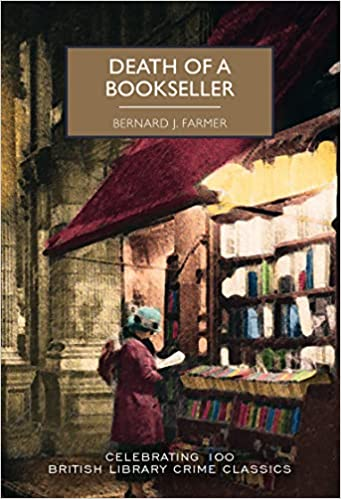
The one hundredth British Library Crime Classic has now been published. The title in question was, appropriately enough, a 'bibliomystery', Bernard J. Farmer's Death of a Bookseller, complete with a message on the inside cover from me to series fans. My association with the series dates back to July 2013, when I first met the then publisher, Rob Davies, who asked me to write intros for a couple of forthcoming titles by John Bude. I'd been writing intros for republished crime novels since the mid-90s, but it's fair to say that none had come close to the bestseller lists. And neither Rob nor I dreamed that the series would become such a runaway success.

It's interesting for me to cast my mind back to that stage in my career. I'd just published my sixth Lake District Mystery, The Frozen Shroud, but I was still a partner in my firm (although by that stage working four days a week). I was hard at work on The Golden Age of Murder, a project which had occupied me for years, and it seemed far from certain that book would even find a publisher. Suffice to say that the intervening years have been kind  and the Crime Classics have certainly played a part in my enjoyment of that time. Many have followed in the British Library's footsteps, sometimes splendidly, sometimes not quite so splendidly. From my point of view, it's marvellous to see so many long-neglected books becoming available again at affordable prices. The series' influence on the wider publishing world has been quite remarkable. Meanwhile my postbag (and the sales figures) indicate little doubt that the Crime Classics remain comfortably ahead of the field.  

There have been many British Library-related highlights for me during the past nine years. I loved being given the chance to write a new solution to Anthony Berkeley's The Poisoned Chocolates Case: short as it is, I've been gratified by the response from reviewers and readers. The same is true of reaction to the eighteen anthologies (with two more on the way) that I've edited for the series. My companion volume to the series, The Story of Classic Crime in 100 Books, was nominated for five awards and won one; among other things, it's now been translated into Korean and Chinese. I designed a murder mystery for a pop-up shop at the Library one Christmas and I've also held a weekend masterclass on classic fiction there and been interviewed in the Library's Conference Centre, with Ann Cleeves, by Mark Lawson. There have been lots of other events, including last year's lovely visit to Ely, with more in the pipeline. I'd like to pay tribute to Rob and his successors at the Library and express my thanks for their encouragement and faith in my suggestions..

Today the Crime Classics are famous enough to merit a mention in Anthony Horowitz's Moonflower Murders. All this demonstrates how much people enjoy a well-made and entertaining story. I certainly don't choose all the titles or authors for the series, but I'm glad to have played a particular part in the rediscovery of interesting novels by such varied writers as E.C.R. Lorac, Mary Kelly, John Dickson Carr, Richard Hull, C.E. Vulliamy, Anne Meredith, Peter Shaffer, Christianna Brand, Nap Lombard, Raymond Postgate, and Margot Bennett. Do I admire every single book in the series equally? Of course not; the range is, quite deliberately, too diverse for that. Do I think that the series has made a wonderful contribution to readers' pleasure across the world? Absolutely.  


Friday, 17 December 2021

Forgotten Book - The Second Shot

Anthony Berkeley's The Second Shot is rare if not unique among detective novels for being more renowned for its preface than for the substance of its story. In what is really an extended dedication to his literary agent, the legendary A.D. Peters (whose former wife Berkeley married not long afterwards), he argued that 'the detective story is already in process of developing into the novel with a detective or crime interest, holding its reader less by mathematical than psychological ties.' This opinion was quoted with approval by Julian Symons in Bloody Murder and I agree that Berkeley was spot on.

Symons pointed out that in fact this particular novel did much less to demonstrate the point Berkeley was making than did his first Francis Iles book, Malice Aforethought. Again, I agree. Nevertheless, it's a distinctive effort, a Roger Sheringham mystery narrated by Cyril Pinkerton, although Pinkerton certainly isn't a Watson-character. In fact, he's the prime suspect for the murder of loathsome Eric Scott-Davies.

Berkeley's ideas about crime, punishment, and justice were invariably as interesting and often as controversial as his opinions (and he was never short of opinions) about the crime genre. This novel was, along with Gladys Mitchell's Speedy Death, one of the first Golden Age puzzle to tackle head-on - explicitly, rather than by implication - the notion of the 'altruistic crime',  which I explored in The Golden Age of Murder. If you can think of an earlier example, do let me know. Christie, Carr, and others tackled the 'altruistic crime' during the Thirties, but Berkeley led the way.

Apart from Sheringham, the writer Morton Harrogate Bradley, who had appeared in The Poisoned Chocolates Case, pops up in the story, albeit without contributing much. There's also passing mention of Alice Dammers, from the same novel. This novel reflects his habit of fictionalising real life places and people. There's a wonderful map on the endpapers of the crime scene, Minton Deeps, which was based on Berkeley's own Devon home, Linton Hills. I suspect that Paul de Revel and his glamorous wife were based on people in Berkeley's circle (E.M. Delafield and her husband Paul, perhaps?). The same may also be true of Armorel Scott-Davies, who plays a central role in the story. 

The main problem with the novel is that, after a sprightly start, the pace drags. Berkeley's prose is never less than readable, but there is endless discussion about who was where and when. There are compensations in the way Berkeley juggles multiple false solutions, while the final revelation of the culprit is highly characteristic of his ironic approach to crime writing: he gives a fresh twist to a narrative technique that had been around for a few years. This novel was published in 1930, a year that in many ways marked a turning point in the genre. Berkeley was one of those who showed the way ahead, and his influence continues to be felt.   

Saturday, 15 October 2016

Murder at Magenta Manor

It's been a crazily busy but hugely enjoyable week. The CWA Daggers Dinner, very glitzy, was a great success, and I had a wonderful time the following evening, after zipping up from London to Yorkshire. I was hosting a Yorkshire supper at the legendary Betty's Tea Room and gave a talk about Gil North, and rural detective fiction for the Ilkley LitFest. And then, on Thursday, it was back to London again. I had a truly fantastic time, as I opened a new Classic Crime pop-up shop at the British Library.

This shop is dedicated to classic detective fiction (and yes, it sells my books too!) and it will be open until the new year. And it has a very special feature, which for all I know is unique in British retailing. The Library offers visitors the chance to participate in a murder mystery competition, with prizes. And guess who was commissioned to write the murder mystery?


When the Library first mooted the project earlier this year, I was intrigued, but slightly daunted by the challenge. The puzzle has to interest customers, but also not be too fiendish, otherwise people will not be able to escape from the shop for hours as they struggle to solve it... But after much thought and trial and error, I came up with the story of Murder at Magenta Manor, the puzzle of who killed Murdo Magenta - and how. Almost inevitably, poisoned chocolates are involved. But what was the poison?


The Library told me they loved the plot. Very encouraging. As a next step, I met the specialist designer from Spain who was tasked with turning my concept into a 3-dimensional shop design. And she and her team did a brilliant job. When, on Thursday, I walked into the shop, I was blown away. The clues are artfully hidden in the shop, and there are all manner of wonderful presents, quite apart from books, to tempt people hunting for Christmas presents. (There are bags bearing the Poisoned Chocolates Case cover artwork, and bags and coasters featuring the artwork for my new winter anthology, Crimson Snow). It really is the most unusual and extraordinary writing
project I've ever worked on.


Thursday was a Press evening, and the Library team were delighted by reaction. The excitement even attracted the interest of two real life police officers who came in for a look around and proved very entertaining visitors, happy to enter into the spirit of the mystery. No photos of them on the blog, for obvious reasons, but they made their own contribution to an unforgettable occasion.


Monday, 10 October 2016

The Poisoned Chocolates are back!


Today sees the publication of the latest title in the British Library's series of Crime Classics, and for me personally, it's the most pleasurable moment so far of my association with the series as consultant. The book is Anthony Berkeley's Golden Age classic The Poisoned Chocolates Case. And this special edition includes not only an introduction in which I set the context of the book, but two special extras.

As many Golden Age fans already know, the novel is famous for the six different solutions to the mystery of who killed Joan Bendix that are proposed by members of the Crimes Circle, presided over by Roger Sheringham. One of those solutions, put forward by Sheringham himself, is the same as that in Berkeley's short story "The Avenging Chance", which features essentially the same plot. In the novel, however, things turn out very differently indeed...

In the 70s, Berkeley's friend Christianna Brand, herself a noted plot-weaver, wrote a seventh solution which featured in an American reprint of the book. That edition only had a relatively limited circulation, however, and most British fans of the genre haven't read it. The British Library edition does, however, include the Brand solution.

And what's more, it includes a completely new solution - written by me. I found writing this new "epilogue" to the story hugely enjoyable - a challenge, yes, to write in Berkeley's style and to find a fresh way of twisting the mystery, but one I loved undertaking. I know that it's high risk to write in the style of the masters of days gone by, but I've enjoyed writing new Sherlock Holmes stories, and this project was great fun. What others will make of it, time will tell..

Wednesday, 30 July 2014

Top 10 Golden Age novels

Here, as promised, is my highly subjective and apt-to-change-in-the-blink-of-an-eye list of top ten favourite Golden Age detective novels. I've imposed some limitations - just one book per author, and I've focused on detection rather than psychological crime (hence, no room for the wonderful Malice Aforethought.) I've tended to choose books that were in some way very original. Mike Linane made a very good suggestion that I should pick novels that are not too difficult to obtain, and I've gone part of the way to doing this. The Hull book, for instance, was an old green Penguin that you often find in second hand bookshops or at book fairs, although I can't claim that it's very easy to find. The King book was republished by Collins Crime Club in the 80s, and again is not terribly rare. So I hope anyone who wants to track them down will be able to do so, even if it takes a bit of perseverance. Next week, however, I shall develop a theme which Mike put in my mind by listing ten Golden Age books that are very obscure, but in my opinion undeservedly so.

Finally, I should say that, to show how difficult this game is, I changed my mind several times during the course of writing this post. And I'll probably change it a few more times as I'm reminded of classics I've overlooked...

10. The Crooked Hinge by John Dickson Carr - I'm a great fan of "impossible crime" mysteries, and Carr wrote several superb examples. Hard to choose just one, but I did admire this mystery.

9. Tragedy at Law by Cyril Hare - several of Hare's books appeared as late as the Fifties,but like Christie's and that of Edmund Crisipin and Christianna Brand, his work belongs in spirit to the Golden Age. This is a classic study of law and crime. Very unusual.

8. Excellent Intentions by Richard Hull - a strangely under-estimated book by a writer who was always trying something different. Very clever twist on the idea of the courtroom drama.

7. Death Walks in Eastrepps by Francis Beeding - a wonderfully original serial killer whodunit, with a great twist and terrific seaside setting.

6. Obelists Fly High by C. Daly King - King wrote barmily implausible books, but this one is written with such gusto, and has such a detailed "clue finder" that I find it impossible not to include it in my list.

5. Trent's Last Case by E.C. Bentley - this is the book that was the catalyst for the Golden Age school of writers, and it's really very well done. Elegant and memorable.

4. Murder Must Advertise by Dorothy L. Sayers - I find it very hard to pick my favourite Sayers book. They all seem flawed to me - but usually because she was so admirably ambitious. The Nine Tailors and The Documents in the Case are really good too. I'm not a member of the Gaudy Night fan club, I'm afraid, even though again I respect what Sayers was trying to achieve.

3. Lonely Magdalen by Henry Wade - a police story, and much darker than most Golden Age books. But very impressive, and a landmark title in terms of police procedure mysteries.

2. The Poisoned Chocolates Case by Anthony Berkeley - witty and clever, this is a masterly example of the multiple solution detective mystery. Both Sayers and Christie loved it, and so do I.

1. And Then There Were None by Agatha Christie - as I said on Monday, this one is simply unbeatable in my opinion...

Monday, 27 January 2014

Lethal Alliance by Kate Clarke - review

At around the turn of the year, I was delighted to receive a copy of Kate Clarke's latest true crime book, Lethal Alliance. Like many a good book these days, it's published by a small press, Carrington Press. There isn't a biographical note, but Kate Clarke is a very experienced true crime specialist, and once co-wrote a book that was short-listed for the CWA's Gold Dagger for non-fiction.

Her subject is two distinct "lethal alliances", though as she emphasises in her introduction, the cases discussed bear no resemblance to modern cases such as Brady and Hindley, and Fred and Rose West. Here we are dealing with two nineteenth century cases. The first, set in Brighton, involved the fatal attraction that a doctor named Beard had for au attractive unmarried woman called Christana Edmunds. The second, set in London, concerned Sarah Gale's attachment to James Greenacre.

I was already familiar with, and very interested by, the Edmunds case. This is because it is referenced by two of the greatest Golden Age writers, Anthony Berkeley and John Dickson Carr. Berkeley's The Poisoned Chocolates Case draws on some material from the Edmunds story, while Carr's The Black Spectacles takes a case similar to that of Edmunds as the starting point for an unusual and intriguing mystery.

Lethal Alliance told me plenty that I didn't know previously about the Edmunds case. Her weird campaign of poisoning resulted in a trial where she was found (controversially, as Kate Clarke explains) to be insane. She spent the rest of her life in Broadmoor. It's a sad tale of delusion. The Gale-Greenacre case, dating from the 1830s, is an extraordinary reminder that there is nothing new about the dismemberment of luckless murder victims. Overall, if you are interested in real life cases with a historical dimension, I think you will find much of interest in  Lethal Alliance

Friday, 26 August 2011

Forgotten Book - The Piccadilly Murder


My choice for today's Forgotten Book is yet another novel by that extraordinarily interesting crime writer Anthony Berkeley. The Piccadilly Murder, first published in 1929, is a good example of a high calibre traditional mystery which still makes an entertaining read today.

The central figure in the book is not Berkeley's regular amateur detective, Roger Sheringham, but rather Ambrose Chitterwick, the timid bachelor whose ability to solve mysteries was demonstrated so vividly in that wonderful novel The Poisoned Chocolates Case. Chitterwick is an appealing character, and his self-effacing demeanour conceals a sharp mind.

There taking afternoon refreshment at the Piccadilly Palace Hotel, Chitterwick witnesses (or believes he witnesses) a man committing a cold-blooded murder. As a result of his evidence, a Major Sinclair is arrested and charged with the murder by poisoning of his wealthy aunt. But a group of well-to-do people, including Major Sinclair's wife, try to persuade Chitterwick that all is not as it seemed.

This is a very well constructed mystery. I have to confess that even though I have read it before (admittedly more than 25 years ago) I had forgotten the solution, and Anthony Berkeley fooled me all over again. He was a clever writer, and any fan of traditional mysteries who seeks this book out will not, I think, be disappointed.

Friday, 25 March 2011

Forgotten Book - The Poisoned Chocolates Case


P.G. Wodehouse wrote a number of stories with a crime element, and admired Agatha Christie. She liked his work, too, and it’s a pity the two of them never collaborated. Had they done so, they might have come up with a book as good as The Poisoned Chocolates Case, by Anthony Berkeley.

This whodunit is a classic of the genre, which I first read many years ago. I decided to take another look at it, and found it was at least as good as I remembered - which is saying something. It’s clever and witty and quite unique.

Its genesis was a short story called ‘The Avenging Chance’. In the novel, written in 1929, Berkeley has the six members of the Crimes Circle (based, no doubt, on the then embryonic Detection Club) come up with different solutions to the puzzle of who killed Joan Bendix. Roger Sheringham’s solution derives from the short story – but here it isn’t the right answer to the puzzle. There are, in fact, two more twists in store.

In 1979 Christianna Brand came up with yet another solution. All this makes Berkeley’s point, that the solutions to a fictional mystery are potentially endless. I love the way he keeps shifting the kaleidoscope in this story. It deserves its status as a masterpiece of the Golden Age.