Showing posts with label Claude Chabrol. Show all posts

Monday, 26 September 2022

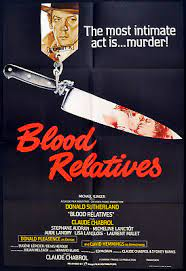
Blood Relatives - 1978 film review


Claude Chabrol was an excellent film director, sometimes compared to Hitchcock but distinctive in his approach. Blood Relatives, a Canadian-French film of his from fairly late in his career is his take on an 87th Precinct police procedural by Ed McBain. The result of this collaboration of talents is suspenseful and interesting movie, with the setting switched to Montreal - apparently for tax reasons - but not to the detriment of the story.

Donald Sutherland plays Steve Carella, McBain's lead character in the series. As ever, he puts in a good performance as he seeks to unravel the truth behind a savage knife attack on two young women who are cousins, one dark night. The older girl is killed, the younger one is wounded but survives and gives conflicting descriptions of their attacker.

The suspects include a dirty old man played by Donald Pleasence and the dead girl's philandering boos, played by David Hemmings. Two impressive actors who are, arguably, under-employed in the story. There is also the handsome brother of the girl who survived; it turns out that he's been having an affair with the girl who died.

Carella spends a lot of the time reading the victim's secret diary, and much of the story is told in flashbacks. This is a clunky device, but Chabrol handles it pretty well. The culprit isn't too difficult to pinpoint, but the film is well-made. Mind you, it's striking to think how much attitudes have changed towards exploitative relationships in the past forty-plus years. The way an under-age girl is interviewed by Carella with nobody else present now seems rather alarming.


Wednesday, 28 August 2019

Merci Pour Le Chocolat - 2000 film review

Claude Chabrol was a gifted film-maker, and as I've become increasingly interested in the work of Charlotte Armstrong, the American suspense novelist, I was intrigued to see his version of her novel The Chocolate Cobweb, a novel published in 1948, which became Merci Pour Le Chocolat just over fifty years later. (Chabrol also adapted an Armstrong novel into La Rupture, which is on my list for the future...)

The DVD version has several special features, and in an interview, Chabrol explains that he'd read the book long ago and was fascinated by the idea of making a film about a woman who was superficially delightful, but instinctively evil. In the movie, this character is Mika, played by Isabelle Huppert. I haven't read the novel, so I don't know how faithful the film is to the source; not very, I imagine. But that's perhaps inevitable.

The setting of the film is Lausanne, a place I'd rather like to visit. Mika owns a chocolate business, and has recently remarried a pianist, Andre Polonski, played by Jacques Dutronc. Their first marriage ended in divorce, and Polonski remarried, only for his second wife to die in a car accident. They had a son, Guillaume, but there was a mix-up when the child was born, resulting in brief confusion as to whether Polonski's child was a girl, born at the same time. Now that girl, Jeanne, learns about the mix-up and decides to trace Polonski. She's also a pianist and Polonski encourages her. So does Mika, but what are her motives?

This is an enigmatic film, but it's not lacking in suspense, and I enjoyed watching it. Huppert is, as always, very good, and although the mystery component of the story isn't very strong, there's enough uncertainty about the characters' fate to keep one engaged. Now I'm tempted to track down the book to compare it with the film...

Friday, 22 December 2017

Forgotten Book - Mischief

One regrettable habit of mine is to get hold of a good book and then to fail to find time to read it, for ages and ages. Today's Forgotten Book is an extreme example. I obtained a copy of Charlotte Armstrong's novel of psychological suspense, Mischief, many years ago, but I only got round to reading it recently. My mistake. It's a very good book, and so short and snappy that lack of time really wasn't much of an excuse.

The book was first published in 1950, early in Armstrong's career. It was filmed two years later, as Don't Bother To Knock, with none other than Marilyn Monroe. As late as 1991, it was adapted for a TV movie called The Sitter, though I haven't seen either screen version of the story. Several of Armstrong's books were filmed over the years, notably by Claude Chabrol, and it's not hard to see why. She's a vivid, atmospheric writer, and adept at creating a sense of menace and suspense. Her portrayal of female characters is also particularly compelling.

The set-up is straightforward. Peter and Ruth Jones come to New York City because Peter has to deliver a speech at a banquet. They have a nine year old daughter, Bunny, and they are let down at a late stage by their baby sitter. Help is at hand. The elevator man has a niece, Nell, who will sit with Bunny. But the elevator man, likeable as he is, is naive. Nell really isn't the sort of young woman to whom you'd want to entrust your child.

Trust is a theme of this book, and all the action takes place during the course of a single evening. The principal setting is the hotel where the Joneses are staying, and this adds to the rather claustrophobic mood of the book. The Joneses feel twinges of unease when they are introduced to Nell, but overcome them. We can tell that Bad Things are likely to happen when Nell is around. And the suspense is built expertly. I was impressed, and not only would I like to read more Armstrong, I'd also be interested in seeing some of the films based on her books.

Monday, 5 December 2011

Cry of the Owl - movie review


John Curran recommended me to give a try to Cry of the Owl, a 2008 movie based on Patricia Highsmith's book, written nearly 50 years ago and previously filmed, in a version I haven't seen, by Claude Chabrol. It's an interestingly different film, and you can never be sure how things are going to develop.

As so often with Highsmith, the characters behave oddly. A man called Forester, played by Paddy Considine, who has suffered depression and is getting a divorce from his gorgeous but rather unpleasant wife becomes obsessed by a couple who live in an isolated house in the woods. He spies on them, but in a curiously innocent way. The couple's relationship is in difficulty, and one night Jenny, the woman, played by Julia Stiles invites in the watcher. This is unexpected enough, but soon she starts stalking him. Her lover takes this amiss, and in a struggle, Forester hits him, but doesn't kill him.

However, the man disappears, and before long Forester is suspected of his murder. His world continues to fall apart. Jenny commits suicide and someone tries to kill Forester. The police react disbelievingly and he is suspended from work. I found a lot of this implausible, to say the least. And yet, strangely, I remained intrigued and wanted to find out what would happen next.

Suffice to say that the story didn't become any more plausible - far from it - but despite its flaws, I was glad I watched it. There was one nice twist and Considine's performance is very watchable. He is an actor with a good line in innocent weirdness.

Monday, 25 April 2011

Que La Bete Meure - review

In recent months, I have posted about a couple of films directed by the legendary Claude Chabrol, and now I have watched a third, Que La Bete Meure, which certainly counts as one of his major achievements. This is the, which opens in chilling fashion. A small boy is walking back to his home in a quiet French village when a car comes careering along, knocks him down and kills him.

His father, played by Michael Duchaussoy, starts to write a diary, which makes it clear that he is determined to track down the driver of the car, and take murderous revenge. The police fail to find the culprit, but a lucky chance puts the father on the right trail. He establishes that the driver was a businessman who owns a garage, and that he was accompanied by a young actress with whom he had had a fling.

The father begins a relationship with the actress, and she introduces him to the garage owner and his family. Almost everyone hates the garage owner, a selfish bully with few redeeming features, but when the father has the chance to kill the man he's pursuing so relentlessly, he does not take it. Nevertheless, in due course, justice is done – but who is responsible? The ending is ambiguous.

I enjoyed the film, and I enjoyed the book on which it is based – The Beast Must Die, by Nicholas Blake – when I read it a couple of years ago. But the two are very different. Blake's novel has a clever twist absent from the movie version, and features his regular series detective, Nigel Strangeways, whereas the film focuses on psychological suspense rather than mystification. Both book and film are, however, highly accomplished and have stood the test of time.

Monday, 14 February 2011

La Femme Infidele


Although I found Claude Chabrol’s famous film Le Boucher interesting, having just seen his 1969 movie La Femme Infidele, I certainly found it more absorbing, and even, dare I say it, more substantial. Again, it stars Chabrol’s then wife, Stephane Audran. This time she is married to a wealthy older man, played by Michel Bousquet. They live in the countryside, in an idyllic house with lovely grounds, along with their ten year old son, to whom they are both devoted.

However, all is not well with the marriage. The spark seems to have gone. The wife , Helene, is becoming bored, and there is a lack of mutual understanding and empathy. The husband, Charles, begins to suspect that Helene is having an affair, and a private detective confirms his worst fears. Charles does not confront his wife. Rather, he pays a visit to her lover, and a calamitous series of events ensues.

This is a film roughly in the Hitchcock tradition, and the attempts to cover up a murder are portrayed vividly. But it is the relationship between Charles and Helene that is the key to the film, and it is conveyed rather subtly, and with a depth that Hitchcock might not have attempted. The final scenes reveal more about the true nature of the relationship than the police work which (by a route which isn’t explained) leads to the identification of the culprit.

The performances of the two lead characters are excellent, yet cleverly under-stated, in keeping with the low-key mood of the film. I enjoyed this one, and – as long as you are not looking for a conventional murder mystery – I think you will too.

Sunday, 19 September 2010

Le Boucher and Chabrol


A week after the death of the eminent film-maker, Claude Chabrol, I’ve watched one of his most famous movies, Le Boucher. It’s not exactly a homage to Hitchcock, but the influence of the master of suspense is evident in a various ways, most notably in the appealing yet repressed blonde heroine, played by Chabrol’s wife, Stephane Audran.

At a wedding in the idyllic village where she is in charge of a small school, she meets a butcher called Popaul, who has returned after 15 years in the army. They strike up a slow-burning friendship, but the community is rocked when a woman is murdered in a nearby wood. A tramp is suspected, but there are no real clues.

Soon, in a very memorable scene, a second woman’s body is discovered, during the course of a school outing. Near the corpse, the teacher discovers a lighter that she gave to the butcher. She hides it, but her trust in him is destroyed and the story develops from there through a doom-laden sequence of events.

Chabrol, who also wrote the screenplay, favoured simple plots and complicated characterisation, and this film demonstrates his approach well. It’s not in any sense a whodunit, but it is a disturbing and noteworthy example of French film. No wonder Hitchcock said he wished he’d made it.

Wednesday, 5 August 2009

One Missed Call


One Missed Call is a 2008 movie with a cast unknown to me, but a screenplay written by that very accomplished thriller merchant Andrew Klavan. The film is, in fact, a re-make of a successful Japanese movie of a few years earlier called Chakushin Ari.

The premise is gripping. A young woman called Beth is terrified by the deaths of a group of friends, all of whom suffer unpleasant fates after receiving phone calls, apparently from themselves in the future, showing the precise times of their demise. Beth’s attempts to convince a senior police woman of the connection between the fatalities get nowhere (bizarrely) but a detective whose sister has died in similar circumstances is more willing to listen.

From that point, it has to be said, the plot descends into horror-hokum. We aren’t talking Alfred Hitchcock or Claude Chabrol here. There’s something slick and superficial about the way the story unfolds – we’ve been here a good many times before. It isn’t a truly sophisticated genre.

Nevertheless, the pace and confidence of the script is a reminder of Klavan's expertise. These qualities carry the viewer along, without the need to delve too deeply into character or motive. I found the movie entertained me satisfactorily on an evening when I was more than ready for a bit of mindless time-passing.