Showing posts with label David Hemmings. Show all posts

Wednesday, 15 February 2023

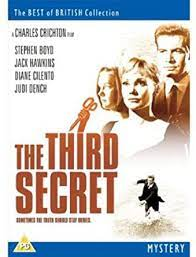
The Third Secret - 1964 film review


The Third Secret is an ambitious film that falls short of excellence but is nevertheless interesting. The basic plot material is quite straightforward; a famous psychiatrist dies, apparently having shot himself, but his daughter believes he was murdered. She persuades one of his patients (Alex Stedman, played by Stephen Boyd) to investigate. And it seems that it is one of the dead man's patients who was responsible for his death.

So far, so conventional. What took me by surprise was the way that Robert L. Joseph, who wrote and directed the film, opted for a storytelling approach that was wordy and at times pretentious. I think he could have achieved the effects he was aiming for in a more economical, less verbose way. That said, the script is unusual enough to keep the viewer interested, if at times irritated.

A real strength of the film is the cast. Whilst I don't think Boyd's performance is exceptional, Pamela Franklin is impressive as the dead man's daughter. The patients who come under suspicious include characters played by such notable actors as Richard Attenborough, Diane Cilento, and Jack Hawkins. The supporting cast, featuring Rachel Kempson, Peter Sallis, Peter Copley, Charles Lloyd Pack and even the young Judi Dench (in her first film role) is equally impressive.

If Joseph had edited his script more ruthlessly, and perhaps chosen another actor instead of Boyd role, this film could have been outstanding. It isn't, alas, but it's certainly worth watching. Joseph was aiming for a rounded psychological drama, I think, and this may account for his lack of concern about pace. But he did manage to produce an intriguing study of mental breakdown. 

Monday, 26 September 2022

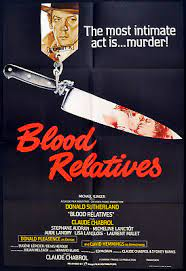
Blood Relatives - 1978 film review


Claude Chabrol was an excellent film director, sometimes compared to Hitchcock but distinctive in his approach. Blood Relatives, a Canadian-French film of his from fairly late in his career is his take on an 87th Precinct police procedural by Ed McBain. The result of this collaboration of talents is suspenseful and interesting movie, with the setting switched to Montreal - apparently for tax reasons - but not to the detriment of the story.

Donald Sutherland plays Steve Carella, McBain's lead character in the series. As ever, he puts in a good performance as he seeks to unravel the truth behind a savage knife attack on two young women who are cousins, one dark night. The older girl is killed, the younger one is wounded but survives and gives conflicting descriptions of their attacker.

The suspects include a dirty old man played by Donald Pleasence and the dead girl's philandering boos, played by David Hemmings. Two impressive actors who are, arguably, under-employed in the story. There is also the handsome brother of the girl who survived; it turns out that he's been having an affair with the girl who died.

Carella spends a lot of the time reading the victim's secret diary, and much of the story is told in flashbacks. This is a clunky device, but Chabrol handles it pretty well. The culprit isn't too difficult to pinpoint, but the film is well-made. Mind you, it's striking to think how much attitudes have changed towards exploitative relationships in the past forty-plus years. The way an under-age girl is interviewed by Carella with nobody else present now seems rather alarming.


Monday, 20 July 2020

Unman, Wittering,and Zigo - 1971 film review


Unman, Wittering and Zigo - UK, 1971 - overview and reviews ...

Over the weekend, I watched two films. In terms of quality they were at opposite ends of the scale. One was London Fields, starring Amber Heard, which barely justifies even its 0% rating on Rotten Tomatoes; it's truly awful, a strong contender for Worst Film I've Ever Seen. Thankfully, the other was Unman, Wittering, and Zigo, directed by John Mackenzie, who was later responsible for the brilliant The Long Good Friday. Unman... made a great impression on me when I first watched it many years ago and it stands the test of time.

Unman... was based on a radio play by Giles Cooper and is set in a public school. The pupils make even the rebels in Lindsay Anderson's If... seem tame. (Incidentally, we were shown If... when we were at school ourselves; pretty enlightened teaching, it seems to me.) Unman... stars David Hemmings, then at the height of his fame, as a John Ebony, a young teacher who has just arrived at Chantry School in mid-term.

Ebony is replacing a Mr. Pelham, who died in mysterious circumstances. He's young and keen, and accompanied by his wife (Carolyn Seymour). The head teacher, played by the splendid Douglas Wilmer, is just as remote and useless as the head in If... When Ebony comes into conflict with the boys in his form, Upper V B, they claim that they murdered Pelham and that he'll suffer the same fate unless he toes the line...

This is a chilling and compelling film which deserves to be much better known. Some people suggest that the title is off-putting, but I think it's memorable and resonant. I do, however, tend to agree with those critics who suggest that the ending isn't entirely satisfactory. Even so the story as a whole is first-rate. If.... is a much more renowned movie, and I enjoyed watching it again recently; even so, I found Unman... somehow more shocking, and also rather more sophisticated in its portrayal of rebellious young men. Watching it was a great way to get over the dismal experience of yawning my way through London Fields.     

Wednesday, 30 May 2018

Fragment of Fear - 1970 film DVD review

I've become increasingly interested in the work of John Bingham, and as a result I sought out the DVD made of his 1965 novel, A Fragment of Fear. I've not read the book as yet (though I hope to do so before long) but I was tempted by reviews of the DVD of the film version made five years after the book's appearance. The film sounded very appealing, not least because of a terrific cast, led by David Hemmings, who was at his peak at around that time. Hemmings was, like the late Hywel Bennett, an immensely charismatic actor whose career faded somewhat, and who died too young.

The screenplay was written by Paul Dehn, who like Bingham was a former spy (he was also a poet and critic, and his other scripts included Goldfinger and Murder on the Orient Express). The film opens in Italy, with Hemmings chatting to his aunt (played by Flora Robson). He's a reformed drug addict who has recently published a successful book. His aunt is found dead in mysterious circumstances, and a strange message left with a wreath which refers to "the Stepping Stones" intrigues our hero. He falls for an attractive woman (Gayle Hunnicutt), and takes her with him to England, where they plan to get married. But his determination to find out what happened to his aunt soon becomes obsessive.

The suspense builds with some splendidly mysterious plot twists, worthy of Francis Durbridge at his best. Hemmings becomes trapped in a Kafkaesque nightmare, as strange, menacing things happen to him which seem inexplicable. When he tries to explain himself to the police, they suggest he is going mad. Then Whitehall (in the person of Arthur Lowe, of all people) gets involved. What on earth is going on?

The ending of the film is perhaps controversial. Suffice to say that things aren't wrapped up in the classic Durbridge style. Really, this is a film which has to be seen as a product of its time - yes, it's enigmatic, but so was Blow Up, a Hemmings film which made a great impression when I saw it in my teens. But even though I like stories with clever and comprehensive solutions, I'm also a big fan of Franz Kafka's The Trial. And there's a touch of Joseph K. about Hemmings' luckless character.

Friday, 28 March 2014

Forgotten Book - The Walking Stick

The Walking Stick is a novel written by Winston Graham at the peak of his powers and it's very good news that Bello have reissued it, along with many other of his books. I'd seen the film based on it and made in 1970, starring Samantha Eggar and David Hemmings, and really enjoyed it. The book, published three years earlier, was just as good, and even though it is to some extent of its time, it seems to me to have worn very well, as so many books written by really good storytellers do.

By the time he wrote this book, Graham was a very experienced crime writer. If you compare it to Take My Life, which I blogged about recently, it's got more depth and more subtlety. It's a mark of his confidence that he felt able to write in the first person, as a young woman suffering from a disability (her leg has been badly damaged by polio, hence her need for the titular walking stick) and to do so in a way that carries conviction .Deborah, one of three daughters in a wealthy family, compensates for a sense of insecurity with a rather brusque approach, and the way she rebuffs an attractive young man, Leigh, who evidently fancies her, may seem unlikely to some readers, but I found it credible. In the end, however, she succumbs to his advances.

Leigh, unfortunately, is a bit of a dodgy character. He's an artist - but how good are his paintings? And how reliable are his accounts of his previous life? From the outset, it's clear that there is more to him than meets the eye. Graham's portrayal of Leigh reminded me of Francis Iles' portrayal of Johnnie in Before the Fact, and I did wonder if the earlier book was a slight influence, even thought the plots are very different, and the build-up here is slower than in the Iles classic. Even so, I gulped the story down..

Graham is interested in the moral choices that people make, and through careful character-building, he makes us believe in the choices - both good and bad, wise and foolish - that his narrator makes. Yet there's nothing preachy about this story - it's a straightforward yarn, yet told so fluently that it also makes you think a bit. Not too much, though - first and foremost, Graham was an entertainer. And a very accomplished one too.

Tuesday, 23 December 2008

Winston Graham


In the 1970s, the hugely popular television series ‘Poldark’ made Winston Graham’s name very well known. I never got into ‘Poldark’, a historical saga set in Cornwall (even though I thought Angharad Rees, one of the stars, was truly lovely) and I was never tempted to read the books. Not until some years later did I discover that, before he turned to swashbucklers, Graham was a highly accomplished writer of crime fiction.

Successful, too. He wrote the book on which Hitchcock based that interesting movie ‘Marnie’, starring Sean Connery, and also the story that sourced ‘The Walking Stick’, a quirky thriller boasting another starry cast that included the late David Hemmings, Samantha Eggar and Francesca Annis. I rather like both films.

And there is more. Winston Graham was the very first winner of the CWA Gold Dagger Award in 1955, for The Little Walls. (In fact, in those days, the award rejoiced in the name of the Crossed Red Herrings Award. It changes name from time to time, having recently been the Duncan Lawrie Dagger an expediency to reflect the short-lived sponsorship of a bank, but the Dagger name changes are irritating; to my mind the Gold Dagger is the right title for the award for best crime novel of the year.)

So I decided it was high time to read a bit of Winston Graham. And thanks to eBay, I now have a decent and modestly priced haul of his paperbacks.