Showing posts with label The Long Good Friday. Show all posts

Wednesday, 27 October 2021

Get Carter - 1971 film review


I've mentioned Get Carter several times in blog posts over the years. As I've said, it is, along with The Long Good Friday, one of my all-time favourite gangster films and many would rate it even higher than that masterpiece. Back in 2010 I was glad to have a chat with the director Mike Hodges at CrimeFest. Mike has achieved a great deal over the years but I'm pretty sure that Get Carter is the film for which he'll be remembered, long into the future. It's a classic of its kind, and since - amazingly - it's 50 years since it was made, here's a review based on my latest viewing.

Just as Bob Hoskins is the key to the brilliance of The Long Good Friday, so Michael Caine is at the heart of everything in Get Carter. His performance as a one-man killing machine is superb, and there's also a rare touch of emotion at one point. But only a touch. There isn't anything quite as chilling as the final scene in The Long Good Friday, but there are lots of shocking moments, not least in the closing stages as Jack Carter's quest comes to a bloody conclusion.

Ted Lewis''s novel on which the film is based (and which really is excellent - the best British gangster thriller by far) was originally called Jack's Return Home. He' goes back to his roots in the north east following the mysterious death of his brother. Jack is a villain, and so, in a smaller way, was his brother, who was mixed up with villains including Cyril Kinnear, played with creepy menace by John Osborne. Ian Hendry, who was originally considered for the Caine role, plays Eric Paice, a nasty piece of work who meets an extraordinary end. The cast as a whole features some terrific performers,stalwarts of British television ranging from George Sewell, Alun Armstrong, Glynn Edwards, Terence Rigby, Bernard Hepton, and Bryan Mosley, as well as Britt Ekland in a minor but not to be overlooked role as Jack's girlfriend.

Fifty years on, this violent movie offers us insight into a past way of life just as interesting as, if very different from, the pictures of vanished lifestyles in vintage crime novels. The attitudes towards women are strikingly dated, needless to say. Jack Carter's world is a man's world, and it's frightening and very grim. But I don't think, taken as a whole, that it's a film in which Mike Hodges glamorised violence. On the contrary, it's really a movie about very bad things happening to very bad people. And it remains compelling.   


Monday, 20 July 2020

Unman, Wittering,and Zigo - 1971 film review


Unman, Wittering and Zigo - UK, 1971 - overview and reviews ...

Over the weekend, I watched two films. In terms of quality they were at opposite ends of the scale. One was London Fields, starring Amber Heard, which barely justifies even its 0% rating on Rotten Tomatoes; it's truly awful, a strong contender for Worst Film I've Ever Seen. Thankfully, the other was Unman, Wittering, and Zigo, directed by John Mackenzie, who was later responsible for the brilliant The Long Good Friday. Unman... made a great impression on me when I first watched it many years ago and it stands the test of time.

Unman... was based on a radio play by Giles Cooper and is set in a public school. The pupils make even the rebels in Lindsay Anderson's If... seem tame. (Incidentally, we were shown If... when we were at school ourselves; pretty enlightened teaching, it seems to me.) Unman... stars David Hemmings, then at the height of his fame, as a John Ebony, a young teacher who has just arrived at Chantry School in mid-term.

Ebony is replacing a Mr. Pelham, who died in mysterious circumstances. He's young and keen, and accompanied by his wife (Carolyn Seymour). The head teacher, played by the splendid Douglas Wilmer, is just as remote and useless as the head in If... When Ebony comes into conflict with the boys in his form, Upper V B, they claim that they murdered Pelham and that he'll suffer the same fate unless he toes the line...

This is a chilling and compelling film which deserves to be much better known. Some people suggest that the title is off-putting, but I think it's memorable and resonant. I do, however, tend to agree with those critics who suggest that the ending isn't entirely satisfactory. Even so the story as a whole is first-rate. If.... is a much more renowned movie, and I enjoyed watching it again recently; even so, I found Unman... somehow more shocking, and also rather more sophisticated in its portrayal of rebellious young men. Watching it was a great way to get over the dismal experience of yawning my way through London Fields.     

Sunday, 27 March 2016

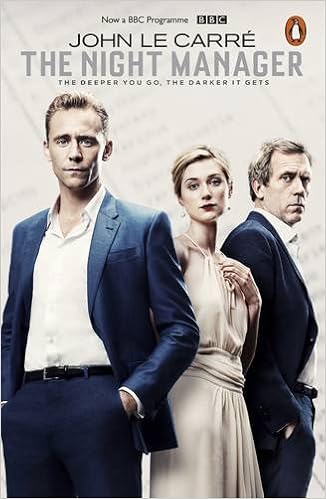
The Night Manager - spoiler-free reflections on a TV classic


The Night Manager, the sixth and final episode of which aired on BBC 1 this evening, is one of the finest British television series I've seen in a long while. In recent years I can only think of Broadchurch (the first series, definitely not the second) and Happy Valley which were similarly compelling. In contrast to those two series, The Night Manager was based on a novel,. It was written by the legendary John Le Carre, and I haven't read it, although evidently the process of updating the story to the present and for the screen has resulted in many changes.

Why has the story hooked me, and millions of others? Well, first of all, it offers a gripping blend of plot and character. Jonathan Pine, the enigmatic hotel manager with a military past, becomes involved with a beautiful woman who falls foul of a fabulously wealthy villain called Roper. When she is murdered, Pine is jolted out of his apparently comfortable lifestyle,and is persuaded by a British secret agent, played by Olivia Colman, to infiltrate Roper's organisation and bring him down.

That' s the basic set-up, but the detail is full of complications that are so skilfully handled. Part of the fascination of the story for TV viewers like me is surely the glimpse into the lifestyles of absurdly rich people such as Roper and his circle. They move from one exotic spot to another, flunkies cater to their every whim. Sounds great, but there's a price to be paid. I was reminded vividly of an exceptionally rich person I once came across. He lived in a fantastic mansion, which I found fascinating to visit, and had a glamorous girlfriend and a private yacht and plane. But the mansion had a panic room where they could hide from kidnappers, and military guards at the gate...

Back to The Night Manager. The relationships, for example between Colman and her colleagues,and between Hiddleston and Roper's lover, are done in enough depth to make us care about the characters,and about what happens to them. I was glad that the final episode matched the quality of the preceding five. One brief but memorable scene did owe something to The Long Good Friday, but without in any way compromising the originality of the storyline.

A script so good deserved great acting, and that's exactly what was supplied by Tom Hiddleston, Tom Hollander, and Elizabeth Debicki. I wasn't quite sure at first about Hugh Laurie as Roper; was he credibly nasty enough to play the part? My misgivings proved needless Laurie presented a character with great superficial charm, a caring father who has people killed for profit; he was at his best in the final episode, when his true nature came to the surface. Hollander was brilliantly creepy as Corky, and Hiddleston has really made a name for himself with this show. I wasn't sure before I started watching The Night Manager whether I'd love it. But I did,- I really did.


Wednesday, 15 April 2015

Ted Lewis, the "Get Carter" man

This blog tends to focus rather more on whodunits and novels of psychological suspense than it does on gritty, violent thrillers, but there are plenty of books in the latter category that I enjoy. And one of the most interesting of all British writers of tough and rather dark thrillers was the late Ted Lewis. I'm therefore very pleased that his work is enjoying a renaissance, thanks to Soho Press.

Lewis is best known for Jack's Return Home, a very good book in itself, which was brilliantly filmed by Mike Hodges as Get Carter. Along with The Long Good Friday, and possibly Layer Cake, it's one of my favourite non-American thriller films of the "gritty" variety (I'm not sure I really like describing books as "gritty", but in a blog post, this rather tired and often misused and overused adjective is at least useful shorthand.) The novel is just being reissued by Soho Press, under the title Get Carter, and I have no hesitation in recommending it.

Lewis dies at the age of 42, after a colourful life which, like so many colourful lives, ended sadly and all too soon as a result of heavy drinking. The publicity material accompanying the Soho Press reissues includes an extract from an as yet unpublished biography of Lewis by Nick Triplow, which I found very interesting. I do hope it finds its way into print before long. Suffice to say that I've been told a bit about Lewis' life by a friend of his whom I know, and his account very much corroborates what Nick Triplow has to say.

Among Lewis' other books is Plender. I haven't read this one, but I did discuss the French film version, Le Serpent in my early days as a blogger. The other Soho Press titles coming out just now are GBH, Jack Carter's Law,and Jack Carter and the Mafia Pigeon. I gather that GBH in particular is a notable book (written towards the end of Lewis's life, when his powers as a novelist had seemed to be in decline) and I look forward to reading it.  

Tuesday, 11 October 2011

Hidden - TV review


A downmarket, dogged criminal lawyer called Harry works in a scruffy city backstreet. Harry has been damaged by the death of someone very close to him and has a troubled love life, as well as an eye for a pretty woman. When he gets dragged into a murky case involving the murder of an attractive woman, he visits a gym as part of his enquiries, and runs into more trouble for his pains.

These were all elements of my first novel, All the Lonely People, so I was intrigued to see them reprised in the new four part BBC TV thriller Hidden, by Ronan Bennett. Hey, I knew my story-line was a good one! Joking apart, I won't be sueing for plagiarism, because in fact what Bennett has written is not a whodunit but a conspiracy thriller, with a political dimension (a bit like Take My Breath Away!) And Bennett's Harry is known to some of his mates as 'H', which reminded me of Harold Shand in The Long Good Friday.

All this shows, of course, is that there's nothing new in the world. Bennett has, however, tried to give the material a fresh feel by interweaving several convoluted plot elements, with copious flashbacks. A great deal of suspension of disbelief is required, especially when a mystery woman claiming improbably to be a lawyer offers Harry a large sum of money to find a man. In the Google era, it takes seconds to discover that she is not who she claims to be. As for the political storyline (is the Prime Minister the victim of a plot orchestrated by his smug colleague?), it struck me as not much more authentic than the portrayal of legal life.

And yet there's something about Hidden that encourages me to watch episode 2. That something is the presence of Philip Glenister, a very enjoyable actor, in the role of Harry. He carries the whole thing along with his usual rugged charm. I'm not sure I care much about the various mysteries, but I'll be interested to see how Bennett weaves all the strands together.

Sunday, 30 May 2010

Butterfly on a Wheel


Butterfly on a Wheel (also known as Shattered, for some reason) is a 2007 movie starring Pierce Brosnan, as a kidnapper who reprises the sinister stare into a driver’s rear view mirror that many of us remember from that great film The Long Good Friday. Since that early appearance, Brosnan has become a superstar, but he still conveys menace better than most.

The set-up of the story is straightforward. An apparently perfect Chicago family comprises a rising corporate executive called Randall (Gerard Butler), his gorgeous wife (Maria Bello) and their adorable daughter. But the mysterious Brosnan is watching Randall, and when he catches up with the couple, he makes it clear that their little girl has been kidnapped, and that they must do his bidding.

His first step is to force them to withdraw their life savings – and he then sets fire to them. Various other humiliations follow. Brosnan is playing mind games with Randall. But what isn’t clear is his motive – is there some hidden connection with Randall’s work that explains the terrifying sequence of events?

This is a taut and pacy thriller, and Robert Duncan’s soundtrack music is in the moody John Barry style. The double twist of the ending took me by surprise, even though it probably shouldn’t have done. Brosnan is a powerful presence on the screen, and although there were (perhaps inevitably) some implausibilities in the plot, on the whole I thought it worked very well. The premise may seem formulaic, but the story-line proves to be out of the ordinary. Good entertainment.

Monday, 8 February 2010

Layer Cake


I like good gangster movies, but mediocre ones can be very tedious – and the really good ones are rather thin on the ground. So I approached the film of J.J. Connolly’s book Layer Cake with some trepidation, drawn as much by the fact that it starred the excellent Daniel Craig as by optimism that I’d enjoy the story.

But enjoy it I did – very much. In fact, Layer Cake now lines up alongside Get Carter, The Long Good Friday and The Italian Job as one of my absolute favourite British gangster films. Craig is predictably cool and classy in the lead role, but he is assisted by a first rate cast which includes, as senior Bad Guys, those fine actors Kenneth Cranham and Michael Gambon, both of whom perform with gusto.

The plot is complex – multi-layered like some cakes, in fact. Briefly, Craig is planning to retire young to enjoy his ill-gotten gains, but a hapless henchman called Duke lands him in the mire by stealing a vast quantity of drugs from some seriously menacing Serbian villains, while Craig finds it impossible to keep both Cranham and Gambon off his back. There are some very violent moments, which are not for the faint-hearted – Cranford this is not! - but also some very funny lines and scenes.

Craig moves smoothly from one messy situation to another, pausing only (though this is entirely understandable, I think) to pick up Sienna Miller, who dumps Duke’s unstable nephew, with consequences that in the end prove very unfortunate. I liked the pace and twists of the story-line, and as long as you don’t mind violence and bad language, this is a film that can definitely be recommended.

Sunday, 3 January 2010

Agatha Christie's Poirot - Appointment with Death: review


Appointment with Death is one of my least favourite Poirot novels, but I’ve just caught up with the David Suchet version screened on Christmas Day and it made enjoyable viewing. This was the result of a number of pleasing ingredients, including good background music and excellent photography – the setting of the screenplay is Syria in 1937, and the programme was visually impressive.

The cast, needless to say, was of high quality. I’ve talked before about my admiration for Suchet’s interpretation of Poirot, but among the other performances I enjoyed was that of Paul Freeman as Colonel Carbury. I always associate Freeman with his role in The Long Good Friday, in which his unwise shady dealings lead to disaster for Harold Shand, played by Bob Hoskins. A very different role here, and he played it with gusto. Other notable cast members included Cheryl Campbell, Mark Gatiss, Tim Curry – and Beth Goddard, who is so attractive that the nun she played was instantly noticeable and therefore highly suspicious.

Guy Andrews’ screenplay took plenty of liberties with the original, but got away with it, because the criminal’s motivation in the book is profoundly unsatisfactory. I still remember being disappointed by it when, as a Christie addict, I first devoured the book as a teenager. In the tv version, the motivation is totally different, and there are two culprits working hand in glove rather than one, as well as new characters and (groan!) that now hoary old stand-by, child abuse.

Purists will say that the screenplay was wildly over the top, and this is certainly true of the climactic scene. But on the whole, this is surely forgivable in the case where the original book is very far from being a classic. Appointment with Death was fun to watch.