Showing posts with label Fell Murder. Show all posts

Wednesday, 3 July 2019

Exploring Lorac Country


Last week I spent a fascinating day exploring the area where Carol Rivett, alias E.C.R. Lorac and Carol Carnac, lived for the last fifteen years or so of her life. This is Lunesdale in north Lancashire, an area that is - in comparison at least to the much-visited hot spots of the Lake District - somewhat off the beaten track, yet a very appealing area of the English countryside. The photo above is of Crook O'Lune - which supplied the title for one of Lorac's novels.


My guide was someone who actually knew Carol Rivett well, and who features as a minor character in one of her books. I learned a great deal from her, not least that Carol was a strong-minded woman with many talents. I had the chance to admire some of her artwork, embroidery, and calligraphy; she was also an accomplished musician, who taught the piano prior to the Second World War. I also learned something I hadn't realised before, that her output included a novel for children called Island Spell.


Carol moved to Lunesdale during the war, in the early 1940s, to be close to her sister Maud and her brother-in-law. The family was very close; there was a third sister, Gladys, and although she lived in London, all three sisters are buried in  the churchyard at Aughton (pronounced "Afton", and not to be confused with Aughton near Ormskirk) where Carol lived. We went on a pilgrimage there, and also to the neighbouring houses where Carol and her in-laws lived.


Whilst walking around the area - some of the narrow and bumpy rural lanes are not ideal for driving! - by chance we bumped into someone who lives in another house nearby which features in one of the Lorac books. She put a lot of her experiences (and people she knew) into her books, and it was a pleasure to be able to see them for myself. It's a lovely part of the world, and I can see why she was happy to live there. And I wondered what she would have made of the enthusiasm which has greeted the British Library's recent reprints of her work - with another title, Fell Murder, which is set in Lunesdale, due out next month.




Wednesday, 6 March 2019

Forthcoming Crime Classics


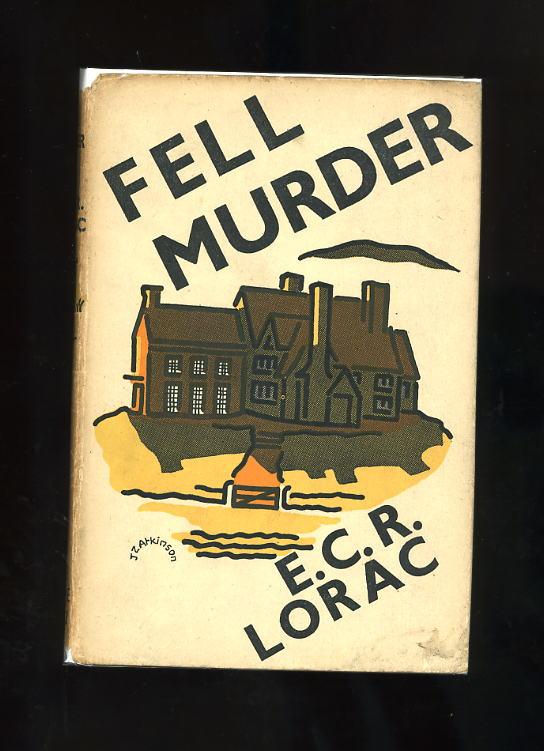
The British Library has just issued its catalogue of publications for the second half of this year, and there are many good things in store. And of course that includes the forthcoming Crime Classics. Among notable features of the list is another novel written by E.C.R. Lorac, whose work has proved extremely popular with fans. This is Fell Murder, set in Lunesdale, where she made her home. It is a lovely part of the world, and this is a book with an exceptionally strong sense of place, and a sense of the intimacy of the rural community.

I'm especially thrilled that the series will, for the first time, include a novel by John Dickson Carr. This is It Walks By Night, which was his very first novel, set in Paris and featuring his first major series detective, Henri Bencolin. I've been hoping for some years that it would be possible to include Carr in the series, but it has proved tricky, because the rights position is extremely complicated. But the Library team has done great work in finally overcoming the obstacles and achieving success. Although Carr was American, his work seems to make a very natural fit with the series; he was an Anglophile who lived in England for many years and was Secretary of the Detection Club and a gifted practitioner of the "fair play" whodunit. This book also includes a Bencolin short story.

Anne Meredith's Portrait of a Murderer was a very successful book the Christmas before last, and Lucy Malleson who wrote under the Meredith name returns to the series with a book written under her best-known pen-name, Anthony Gilbert. This is Death in Fancy Dress, a country house mystery very much in the classic tradition. The book will also include a couple of Gilbert short stories.

Talking of short stories, there will be another anthology, The Measure of Malice, which is a collection of tales of scientific detection that I've put together. I'm delighted that the British Library anthologies have done so well in terms of sales and reviews, and I can also commend their "weird tales" collections, some more of which will be forthcoming (I like the sound of a collection of "killer tales of the botanical Gothic"!)

Other crime titles include another novel by George Bellairs, who is back by popular demand, Mary Kelly's The Christmas Egg, and a second Pocket Detective puzzle book by Kate Jackson. Something for everyone, in other words! And I can assure you that plans for 2020 are already making good progress. At least one more Carr title is on the way... 

Friday, 18 January 2019

Forgotten Book - Fell Murder


Image result for fell murder lorac


In Britain, female Golden Age writers have remained in print more often than their male counterpart. Christie, Sayers, Tey, Allingham, and Mitchell in particular have enjoyed enduring popularity with the general reader, in contrast (at least, until recently) to the fate of Hull, Rolls, Postgate, Bude, and Rhode. But not so long ago, the name of E.C.R. Lorac was only known to enthusiasts, since almost all of her books had been unavailable for many years. Even when you did turn them up, they were sometimes unaffordable. And right now, one of her rarest books, a signed copy of Tryst for a Tragedy, can be bought for a mere £5,250. A snip!

I'm glad that the British Library has played a big part in reviving Lorac. And my researches into her work have led me to a quite a number of books that are definitely worth reading. An excellent example is Fell Murder, first published in 1944. This was the first of a number of books which took Macdonald of the Yard to Lunesdale, a part of the country Lorac loved, and which became her home.

The description of the countryside, and of farming life, is quite lyrical. As so often, Lorac paints the scene with great care before murder intrudes. We're introduced to a tyrannical patriarch, Robert Garth, and the family members and local residents who have motives to wish him ill. But it's typical of Lorac that the portrayal of the victim is quite nuanced. The old man behaves badly, but he also has his good points.

The plot is one of of the best that I've found in Lorac's work so far. She is not in Christie's league when it comes to plotting, perhaps because her love of character prevents her from treating her people as pawns in a game. But the storyline is nicely done. Macdonald comes into the story at the mid-point of the novel. The local superintendent has failed to get anywhere with the tactiturn villages. But he, too, is by no means a cipher, and Macdonald appreciates his strengths. But it's left to the Scotland Yard man to solve the puzzle, and he does so with his customary calm efficiency.