Showing posts with label Sweet Adelaide. Show all posts

Friday, 7 April 2023

Forgotten Book - Sweet Adelaide


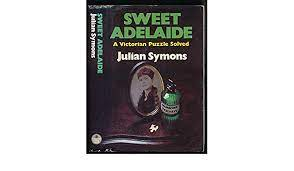
Sweet Adelaide, first published in 1980, was the second of Julian Symons' three Victorian mysteries. He'd deserted the contemporary scene to write The Blackheath Poisonings, which most people agree is the most successful of the trio. The plot of that book drew on elements of a famous real life crime. With Sweet Adelaide, Symons went much further. The eponymous Adelaide is Adelaide Bartlett, who was tried for the murder of her husband in 1886. Symons invents quite a lot of material, but most of the essentials are factual.

In an interesting afterword, he describes this as an 'experimental' novel, trying to cast light on a real life case by filling in the gaps - in this case, most particularly, the precise means by which Edwin Bartlett died. I realise with hindsight that when I wrote Dancing for the Hangman, I was doing something that is perhaps comparable, although in my novel, there was less invented material: I tried to be rigorous in sticking to the established facts, but also to use my imagination so as to try to see things from the point of view of Dr Crippen. For perfectly understandable reasons, Symons felt that he needed to bulk out his own story by introducing a range of elements of his own devising (for instance, an encounter with the Theosophist Madame Blavatsky). Some of these are definitely plausible, some less so.

When I first borrowed this book from a library, shortly after publication, I was very taken with it, partly because I wasn't familiar with the trial and I found his explanation of events interesting. As I've mentioned before, it's a story that casts light not only on the case itself, but on Victorian life. 

On reading the story again, I focused on trying to understand the techniques Symons employed in bringing the story to life. One of his key methods is to juggle timeframes. So we begin with the death of Edwin; then there is a long flashback about Adelaide's early life prior to her marriage. Another method is to juggle point of view. So we have some extracts from Adelaide's journal, but also scenes presented from the perspective of other people in the story, plus third person narrative, mostly but not entirely seen from Adelaide's point of view. 

I suspect that he used these methods to introduce variety and interest and also to help build suspense. After all, anyone who knows the case knows what happens at the trial (though Symons also adds an interesting coda, set in the US many years after the trial). My guess is that he was worried that the story might become a bit mundane if told in an entirely straightforward way. He does his best to solve that problem. 

It's clear that he did a huge amount of research into the case, and on my latest reading of the book, I found myself reflecting that perhaps he packed too much of it into the storyline, resulting in a slackening of tension. His prime concern was to explore Adelaide's psychology and I think this is done fairly well. However, there is quite a lot of medical/technical detail relating to Edwin's health and what precisely happened to him, and although that was crucial to the trial and its outcome, I felt that it slowed down the second half of the book. An interesting novel, certainly, but - for me - not a complete success on a second reading.    


Friday, 4 March 2022

Forgotten Book - The Detling Murders aka The Detling Secret


I first read Julian Symons' The Detling Murders not long after its original publication in 1982. It was the third of his Victorian mysteries, following the highly successful (and televised) The Blackheath Poisonings and the very interesting Sweet Adelaide. Both those novels drew heavily on real life nineteenth century murder cases, although they were very different from each other. The Detling Murders was different again - Symons strove not to repeat himself, hence his distaste for series characters - but I remember feeling rather underwhelmed. 

For one thing, if not for the title(which was changed for the US anyway), I'd have wondered if I really was reading a murder mystery. Murder doesn't occur until we are more than half way through the story, while the second killing takes place very near the end of the book. Symons himself felt dissatisfied with the book and decided to go back to writing contemporary mysteries.

On rereading the book, however, I was more impressed. This is partly because Symons' picture of upper class Victorian society is very entertaining in its own right. The Detlings are a fading branch of the landed gentry and Sir Arthur Detling, the head of the household, is almost a caricature of a crusty old reactionary. But the family dynamics are nicely portrayed. The starting point is the news that Dolly Detling wants to marry an up and coming Liberal MP, Bernard Ross, whose background is rather mysterious. Sir Arthur isn't happy, but the couple get their way.

As usual, Symons moves the story along over a period of time, shifting focus from one character to another, so that it's not clear where events are heading. There are some Fenian dynamiters lurking in the background and shady business dealings aplenty. Roderick Detling is a gambler who has run up debts, while Nelly Detling gets herself involved with a dodgy crowd of artists (allowing Symons to write yet another bohemian party scene - he really did like writing those). The plot is carefully constructed, and stronger than I appreciated on a first reading. And as ever with Symons, the book is extremely readable. It ends up with a Christmas family gathering in rural Kent - the sort of scenario which usually opens detective stories rather than closing them. In this part of the book, as earlier, there are some nice comic touches.

The main reason why this book isn't a complete success is, I think, that Symons didn't pay enough attention to the building of tension and suspense. He sets up a series of intriguing situations but there's not as much excitement as many readers expect and indeed demand. Nor is it clear (and this is a problem in quite a few of his books) which member of his ensemble cast of characters is the central protagonist. For me, Bernard Ross is clearly the central figure and I think the story might have worked better if the focus on him had been clearer and more unrelenting. I guess Symons feared that this would reduce the surprise element of his story, but there could have been ways round that challenge. As it is, the murders and their investigation seem more perfunctory than is desirable in a detective novel. So this is a minor Symons, but it's definitely good enough to justify a read. Or two. 


Friday, 14 May 2010

Forgotten Book - Sweet Adelaide


In discussing Linda Stratmann’s book Chloroform: The Quest for Oblivion, I mentioned that she devotes a chapter to the case of Adelaide Bartlett. This is one of the most fascinating of the classic British murder cases, I think, right up there with Maybrick, Crippen, Wallace, Ruxton and the Croydon Poisonings.

The trial of Adelaide Bartlett took place in 1886, and as Statmann explains, it ‘both scandalized and titillated Victorian society’. Adelaide was accused of using chloroform to murder her husband Edwin, and it emerged that she had been the subject of more than one sexual intrigue. However, in the end she was acquitted, although the consensus view is that she was responsible for Edwin’s death.

The case formed the basis of one of the three novels that Julian Symons wrote about Victorian murder mysteries, Sweet Adelaide. It’s a pretty good novel, with a clever solution (although not one with which Stratmann agrees) and it deserves to be better known, not least because of its entertaining characterisation of the people in and around the Bartlett household and compelling evocation of Victorian social attitudes.

After her perhaps lucky acquittal, Adelaide disappeared from public view. Stratmann describes a couple of accounts of Adelaide’s later activities, but explains that neither stands up to scrutiny. Adelaide’s later story is unknown. Now there, surely, is an opportunity for another interesting novel to be written!

Friday, 18 December 2009

Forgotten Book - The Blackheath Poisonings


Once again, my pick for Patti Abbott’s series of Forgotten Books is a title by the late, great Julian Symons. The Blackheath Poisonings is one of his ventures into Victorian crime – Sweet Adelaide, based on the real-life Adelaide Bartlett case, is another – and it carries a particular memory for me.

During the 1990s, Nottingham was the place for crime fans to visit, during the annual Shots on the Page convention. The convention was, so far as I know, the brainchild of Maxim Jakubowski, who worked closely with film specialist Adrian Wootton. I missed the first of the conventions, but attended all the others and found them most enjoyable. They paved the way for Nottingham to host Bouchercon itself – quite a coup for Maxim and his colleagues, and the last time that Bouchercon crossed the Atlantic.

One year, the convention hosted an advance screening of an adaptation for TV of The Blackheath Poisoinings. The small screen version was excellent, benefiting from a first rate cast that included Zoe Wanamaker, Judy Parfitt and Ronald Fraser, as well as a screenplay that was sympathetic to Symons’ original story.

And a very good story it is, with a sharp eye on the sexual complexities lying just beneath the surface of late Victorian society. A respectable family is torn apart by poison, and poisonous suspicion. One of the characters is tried for murder, but before the story is concluded, there will be another death, and the revelation of an unsuspected criminal.

Julian Symons inscribed my copy of this novel (which is a hardback reprint, published not long before his death from cancer)when we were together at a CWA conference in Brighton. Characteristically, he added a question: ‘A good Victorian crime story?’ The answer is an unequivocal yes.

(P.S. - For unfathomable reasons, at present, I am able to send but not receive emails, so if you've emailed me in the past three days, please don't think the absence of a reply means I'm ignoring you....)