Showing posts with label Thompson-Bywaters case. Show all posts

Friday, 16 February 2018

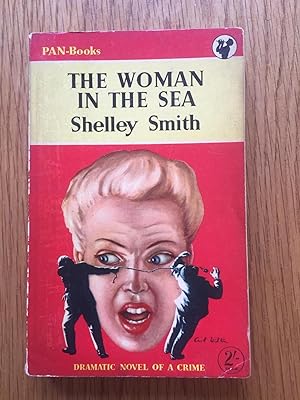
Forgotten Book - The Woman in the Sea


Image result for shelley smith woman in the sea

An older woman called Mrs Robinson seduces a naive young man. Sounds familiar? Well, my subject today is not The Graduate, but a much less familiar story, Shelley Smith's novel of 1948, The Woman in the Sea. It was her sixth book, and it's the work of an accomplished and interesting novelist, much admired by Julian Symons.

There's an Author's Note at the beginning, in which Smith states that "Looking about me for a suitable plot by which to illustrate certain aspects of morality which were much exercising my mind..." she recalled a real life case which seemed "to provide a framework both solid and pliable enough for my purpose". Here she is referring, I have little doubt, to the Rattenbury and Stoner case of 1935 (although that case bears uncanny similarities to the earlier, and even more famous, Thompson and Bywaters case).  She denies that her characters are intended to represent their real life counterparts,and on the whole I think this denial is not disingenuous, but fair enough. Francis Rattenbury, for instance, led a very different life from Zoe Robinson's husband Bertram.

The book has a prologue involving the discovery of the body, and essentially the rest of the story is a flashback, recounting the events in a doom-laden house which led up to that particular death. I suspect that Smith realised that her method of structuring the story reduced the tension, but that she though it a price worth paying. A debatable decision, as far as I'm concerned, but despite being quite sure how it was all going to end, I kept reading.

This is because Smith was a writer of genuine ability and intelligence. She could plot very well when she wanted to, but her main concern here was with those issues of morality. To a modern reader, perhaps these are not quite as compelling as they were in 1948, but the account of Zoe's affair with a really rather stupid lad is handled with some poignancy. I'm glad I read it. Smith's constant determination to try to do something different strikes me as admirable.

Friday, 14 August 2015

Forgotten Book - The Documents in the Case

The Documents in the Case, first published in 1930, is in many ways an unusual book. It's the only novel that Dorothy L. Sayers wrote in collaboration - with Robert Eustace. It's her only novel which does not feature Lord Peter Wimsey. And it's a novel that offers not only an interesting and unorthodox "howdunit" mystery, but also a fictionalised version of the Thompson-Bywaters case that fascinated a good many Golden Age novelists, not least Anthony Berkeley and E. M. Delafield.

Sayers is not by any stretch of the imagination a forgotten writer, but this is the one novel of hers that seems to me to have been generally under-valued. Perhaps it's the absence of Wimsey that accounts for the generally lukewarm critical reaction over the years (though I should add that a number of good judges have also praised the book.) Each time I read it, I find my appreciation of Sayers' skill increasing, even though, in the immediate aftermath of completing the book, she felt that she had failed to do justice to the clever idea at its heart.

In telling the story, she borrowed from Wilkie Collins' The Moonstone. Collins was a writer she greatly admired, and she was at the time she wrote the novel working on a biography of him that she never managed to complete. The events are seen from the point of view of characters in the story, and told in the form of letters. It's a very good device, when used well, and Sayers captures the different voices of the characters splendidly.

It's in the later part of the story, where the scientific material central to the plot is debated, that the narrative flags somewhat. Eustace contributed the scientific ingenuity here, as he did to stories by other writers such as L.T. Meade and Edgar Jepson, but Sayers did the writing. The method she chooses for conveying this material results in a rather abrupt ending, The problem with this section of the book is one of story structure, and I sense that she rushed those final pages, when with a slightly different approach she might have produced a book that would have been more widely acclaimed as an innovative masterpiece. Nevertheless, it's a novel of considerable interest and distinction, and if you aren't familiar with it, then it's definitely worth a read. There's a fascinating chapter about how the book was written, incidentally, in the late Barbara Reynolds' excellent biography of Sayers.