Thursday, 31 December 2015
2015: The Publications
In 2015, I published a non-fiction book, a novel, four anthologies and three short stories, as well as introducing a raft of classic crime novels. Quite a year, then. But of course, the appearance of so many books so quickly is partly due to coincidence. I've been working on one of them in particular for a very long time. In May, The Golden Age of Murder, the product of so many years of reading and research (and indeed writing) finally made an appearance. I'd spent most of those years expecting it would be published by a small press, and reaching a modest readership. It felt like a niche project, not exactly self-indulgent,,perhaps, but not like a book of mass appeal. Yet it has proved, in terms of hardback sales and the number and quality of reviews, to be the most successful book I've ever written. I never anticipated this, but I'm very, very happy about it.
I've tried to analyse why it's happened, and the reviews (nearly one hundred of them now: incredible) do supply a few clues. I suppose the answer is something to do with a revival of interest in classic crime, and something to do with the fact that, whatever else may be said about it, The Golden Age of Murder is an unusual and idiosyncratic book. Yes, it's non-fiction, but there is a lot of me (or rather, what fascinates me) in it, and this has proved to be less of a disadvantage than I might have thought. What I'm really pleased about is the breadth of the book's appeal - not just to died-in-the-wool Golden Age fans, but all sorts of readers and reviewers, and indeed a surprising number of contemporary writers, some of whom have been so kind as to send me personal messages which usually include the phrase "I never knew that..."
The Dungeon House, sixth of the Lake District Mysteries, appeared more recently, and I've been gladdened by two things. First, readers have responded well to the fact that this novel differs in some ways from earlier entries in the series. Second, my fiction seems to be reaching a wider audience than in the past. This was helped the other day by a Kindle Daily Deal on three books in the series, which saw them briefly occupying places in the top 15 Kindle bestsellers list. I'm accustomed to my novels not selling in vast numbers (to put it mildly), but things definitely seem to be moving in the right direction.
For the CWA, I put together an anthology of essays about real life crimes, Truly Criminal, published by the History Press. In comparison to my other books this year, it hasn't received widespread attention, or achieved large sales, but I feel that the quality of the contributions (three of them written by winners of the CWA Diamond Dagger) deserves to ensure its longevity. Nothing very like it has been produced for many years, and I'm hopeful that it's a book whose reputation will keep growing..
As well as introducing classic crime books published by the British Library, I've contributed intros to the welcome reprint of Hugh Conway's Called Back and also to a second Arcturus anthology of Sherlock Holmes stories. For the BL I've also edited three anthologies of short stories. Both Capital Crimes and Resorting to Murder outsold any of the other anthologies I've edited - by a long way - and recently Silent Nights has become one of the most successful titles in the series. It seems already to be one of the bestselling crime anthologies published in Britain in recent decades..Something else my crystal ball never foretold...
On the short story front, I was glad to contribute to Murder Squad's Starlings (a story that was barely criminous, and influenced by my love of the work of Robert Aickman) and Maxim Jakubowski's anthologies of stories about Professor Moriarty and Jack the Ripper respectively.
So what does next year have in store? If you'd like to know, take a look at the blog tomorrow...
Wednesday, 30 December 2015
2015: The Places
This past twelve months, I've visited a wonderful variety of places, near to home, and very remote, and many have had literary associations., For many years, I hardly travelled abroad, but I've more than made up for that in recent times. It remains the case, however, that I love Britain, and exploring places that are relatively close at hand. A prime example came with a trip to Burgh Island in September. It was great fun to follow in Agatha Christie's footsteps: Burgh is not only the place that inspired the setting for Evil under the Sun, and probably also And Then There Were None, but a magical spot in its own right. The fact that my visit coincided with warnings of a tropical storm which cut us off from the mainland only added to the atmosphere...
You could say something similar about Piel Island (above), off the Cumbrian coast. No murder story has yet been set there - but the operational word there is 'yet'...A boat trip out there, courtesy of the King of Piel, was a great experience. Again there was a risk of being stranded on the island, but this time it didn't materialise. I went to Piel as part of my Lake District research for the next book. Other destinations included Silloth, visited on a beautiful afternoon, with great views over the Solway Firth, and that's another location I mean to use in fiction before long.
The journey was so long that the travel agent persuaded me that it made sense to combine it with a look at South America. Good advice - I'd never had such a burning desire to visit Chile or Peru, but they turned out to be marvellous destinations. Not just Machu Picchu, but also places like Cuzco, Valparaiso and the Atacama Desert. Unforgettable. And two of them are likely to feature in my fiction before long. Whilst in Valparaiso, I visited the home of Pablo Neruda, and was delighted to discover in his personal library copies of a stack of Golden Age paperbacks - including Trial and Error by Anthony Berkeley, and titles by the likes of Michael Innes and Q. Patrick.
A week's cruise around islands of the West Indies was a more recent treat. Pick of the bunch was Bequia in the Grenadines, closely followed by St Lucia. but each island has its own distinctive nature and plenty to offer. Dominica is an example. It was the birthplace of the late Jean Rhys, and I've just finished reading The Wide Sargasso Sea, which was a Christmas present (yep, I do sometimes get away from crime fiction, believe it or not!) I'd not read Rhys before, but hers was an extraordinary life, and there is something quite compelling about her prose. This book is regarded as her masterpiece, but I'm certainly tempted to read more of her work.
Somehow this year I managed to spend my birthday sailing on a pirate ship in the harbour of Scarborough, North Yorkshire (last of the above photos), and then, four month later, travel to another port called Scarborough - in Tobago (next to last photo). No prizes for guessing which was slightly warmer, but the Yorkshire resort will always be one of my favourites: it has rather more to offer than endless sunshine..
Back in Europe, I managed to see plenty of new places, including Sintra, Porto, Coimbra, Lamego, and the fabulous River Douro in Portugal, Salamanca, Madrid and Toledo in Spain, and the charming and under-estimated Ghent.
I travelled to Ghent by Eurostar, something made easier by the location of my son's flat within walking distance of St Pancras. I've spent much more time in London (below photo) than before, and this has given me a chance not only to meet up with more people, but also to see some of the never-ending exhibitions, including the Magna Carta exhibition at the British Library, and the intriguing cartoons at the Cartoon Museum, as well as places like Tate Modern and the NPG. The recent Alice in Wonderland exhibition at the BL was definitely worth a look. I'm an Alice fan, and Daresbury, where Lewis Carroll spent much of his early life (hence the 'Cheshire Cat') is just down the road from where I live.
It's impossible to do everything that one would like to do in life. One can't read every book, or visit every resort. All the same, I've been lucky this past twelve months to have had the good health and the time to see at least some of the marvellous places the world has to offer..
Tuesday, 29 December 2015
2015 - The People
A crime writing friend sent me an email the other day in which she said that 2015 had, for me, been something of an annus mirabilis. Shortly afterwards, a second email from another friend said exactly the same thing. Well, each year has its ups and downs, but they are right; I'll be very lucky indeed if any other twelve month period matches this one for pleasurable experiences. Over the next three days I'll reflect on the people, places and publications that have made this year such a special one for me, and it seems right to start with what always matters most - people.
In 2015, I was doubly honoured. Members of the Detection Club elected me as their President, and I owe them a great debt. Above all, I'm grateful to Simon Brett, the outgoing President, who has given me tremendous support. My number one aim is to make sure that the Club continues to flourish, and I have plenty of ideas about how to achieve that. One great pleasure has been taking part in meetings with those Club members who have been co-writing The Sinking Admiral, due to be published next year. Most of the meetings took place in London hostelries, but Simon also organised an unforgettable Whodunit Dinner at the Groucho Club (above photo) when we figured out the solution to our own mystery.
This year I was also elected Vice Chair of the Crime Writers' Association, during an excellent conference in Lincoln. Among those present at Lincoln was Tim Heald, who unfortunately is in very poor health these days. I asked if he thought he'd be able to make it to the Detection Club dinner later in the year, and he said he doubted it - but with a characteristic grin, added: "But I'll be there in spirit." He certainly was. I've enjoyed working with the excellent CWA committee led by Len Tyler - who happens to be one of the contributors to The Sinking Admiral.
Two lunches stand out in my memory because they were spent in the company of two men I admired as a teenager and have continued to admire ever since. The legendary Len Deighton invited me to Koffman's, and treated me to three hours of fascinating anecdotes about his life and career. Incredibly kind and truly unforgettable. The photo above shows Len in the process of inscribing his first four books to me. Peter Gibbs, playwright, novelist, and former Derbyshire cricketer took me to Vincent's Club in Oxford, and we spent the day together, revisiting old haunts. I also had the pleasure of meeting for the first time Simon Curtis, director of My Week with Marilyn, who invited me for coffee at the Ivy Club - my first visit there - and a chat about Golden Age books..
I work with several lovely publishers, and two of my editors, David Brawn of Harper Collins, and Rob Davies of the British Library, took part in the Bodies in the Library conference in June. Jake Kerridge interviewed me about the Golden Age, and Simon and I talked about the Detection Club. The event provided a great opportunity to meet several readers of this blog for the very first time, something I really enjoyed. There are many other readers whom I only know through comments and emails, but I hope that in the coming year, I'll have the chance to get to meet more of you in person.
I took part in panels at Crimefest and the Harrogate Festival alongside such luminaries as Andrew Taylor, John Harvey, Peter James, and Peter Swanson, and got to hang out with some delightful folk, including James Runcie, whose Grantchester novels have been such a hit. The photo above is of a memorable dinner with Catherine Aird, who won this year's CWA Diamond Dagger.
Malice Domestic in Washington DC was terrific. I interviewed Ann Cleeves, the international guest of honour, appeared on a Golden Age panel moderated by Doug Greene, and generally had a great time. All being well, I'll be back there in 2016. I also took part in crime festivals closer to home, in Liverpool, Northwich, and Knutsford, as well as those in Carlisle and Torquay, the latter for the Agatha Christie Festival. I appeared on Sunday Brunch, Radio 4's Open Book and (believe it or not) a Japanese documentary about Agatha Christie, as well as having the pleasure of watching my Harry Devlin books feature on BBC's Mastermind.
Murder Squad continues to thrive, and we got together at Carlisle in the early summer (above photo) before launching our collection of stories, Starlings, which is edited by Ann, in Wrexham. Mrs Edwards contributed a story to that book and I hope she can be tempted to do more writing next year. The fact that I'm now only a part-time lawyer also gave me the chance to catch up with some mates from university and school days as well as some much newer friends.
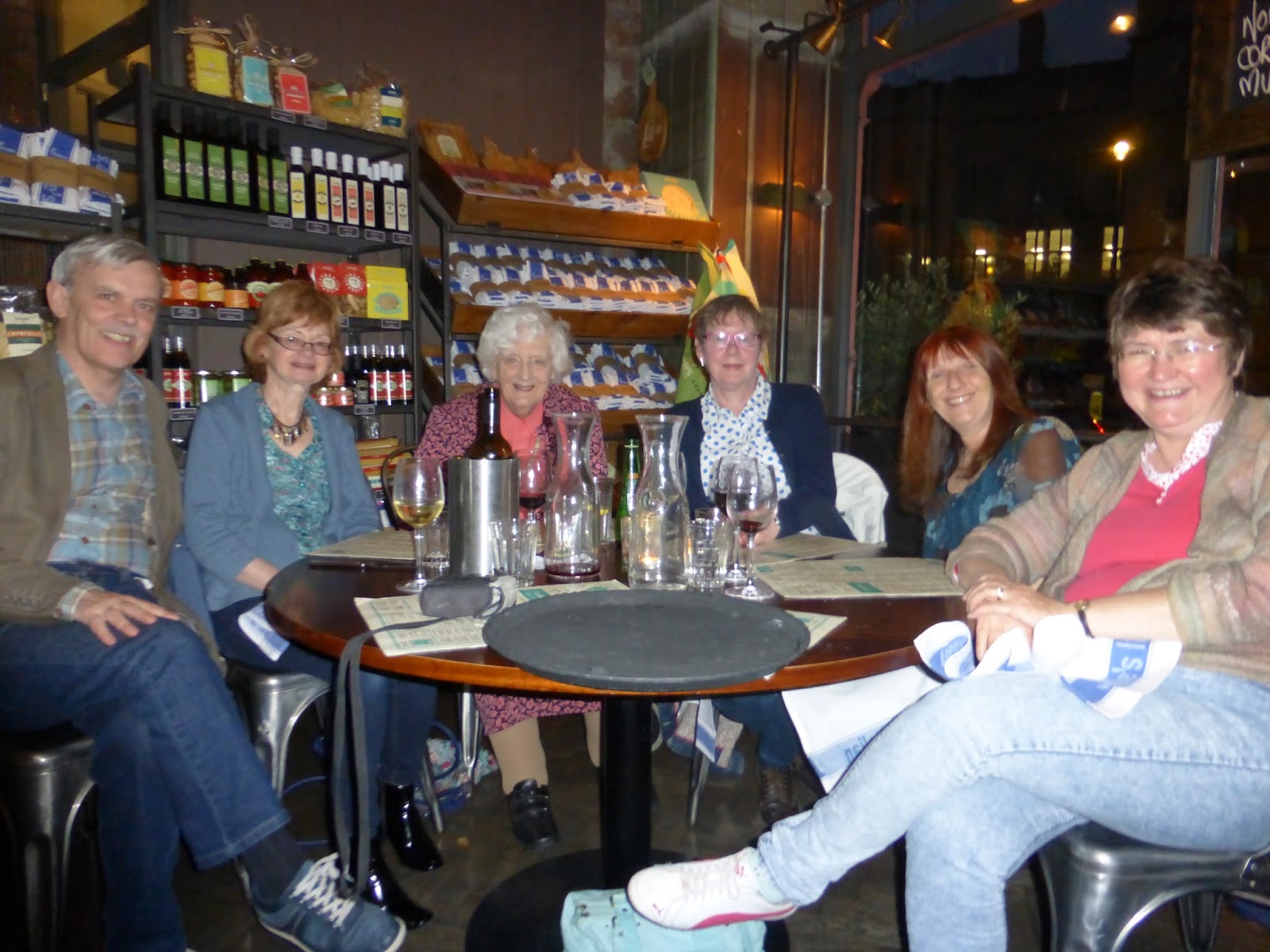
I met - at long last - Roberto and Davide, two Italians with whom I've been in touch for many years, at the Burt Bacharach concert at the Royal Festival Hall in summer (photos below), found that the former owners of my son's London flat, Elaine and English Showalter, are not only distinguished academics but charming dinner companions, and over a pint in a London bar I learned a bit about Austrian academe from a professor I'd first met on a trip around Easter Island, It's always easy to put this kind of socialising with civilised companions off to some unspecified date in the future - but it's so much more enjoyable if you don't. None of us know what is round the corner. Might as well make the most of life right now.
Saturday, 26 December 2015
And Then There Were None - BBC 1 TV review
And Then There Were None is the finest of all Golden Age detective stories in my opinion- never mind that it lacks a great detective in the mould of Poirot or Marple. Agatha Christie wrote plenty of fine crime stories, but this has been my favourite since I first read it at a tender age. So the question I asked myself when anticipating this evening's first episode of the BBC TV three-part adaptation by Sarah Phelps was - would the TV version do the book justice?
There's been a lot of cunningly contrived publicity in the run-up to this showing which has been designed to generate interest. It has been suggested that Phelps was modernising the story in an inappropriate way, by introducing drug-taking, bad language, and other terribly topical features. Phelps, we were told, had never read any Christie before taking on the task of writing the script. I was rather sceptical about whether the script would prove as shocking as was implied. If you've ever read much Agatha Christie, you will know, for instance, that drug-taking crops up in a good many of her stories. And I devoted a good slice of The Golden Age of Murder to explaining why the perception that Christie's work is "cosy" is feebly inadequate.
The early scenes, which set up the complex mystery, were well done, I thought. This was probably where a less accomplished screenwriter would have found it easiest to mess up. The book supplies plot, dialogue and characters aplenty, but the challenge of creating the right mood at the outset was an important test, and I felt Phelps passed it with flying colours.From then on, the excellent cast, did the work of keeping me glued to the screen. The filming hasn't been done, as far as I can tell, on Christie's beloved Burgh Island, but I kept thinking back to my own trip to Burgh in September, and my brief experience of being cut off from the mainland for a while, due to the heavy seas....
Phelps has quite an interesting approach to pacing the plot developments, and as I'm starting to study the art of scriptwriting myself, it's helpful to see how an expert does it. Charles Dance, Miranda Richardson, Aidan Turner and Maeve Dermody (who was excellent in the key role of Vera) were all particularly good, while Noah Taylor and Anna Maxwell Martin made splendidly creepy servants. Two members of the cast have met untimely ends so far. The body count will continue to mount tomorrow night. And I will definitely be watching.
Thursday, 24 December 2015
Forgotten Book - Mr Bowling Buys a Newspaper
In my last post before Christmas, I'd like to wish all readers of this blog a very happy and peaceful time over the festive season. Thanks for all your feedback; it's always good to hear from you, and I've learned a lot from people who have taken the trouble to get in touch. Today's blog is a case in point, as a correspondent has greatly increased my knowledge and understanding of a writer who has long intrigued me.
Donald Henderson died young in 1947, just three years after the publication of Mr Bowling Buys a Newspaper. It's his most famous book, thanks to words of admiration from Raymond Chandler, which prompted me to search it out many moons ago. I re-read it recently, and for me, it has much the same darkness as Patrick Hamilton's better-known Hangover Square, but it's nevertheless distinctive. Sensibly, Henderson kept the book short - a greater contrast from Georgette Heyer's over-long Penhallow, discussed here yesterday, would be hard to imagine.
We know from the outset that William Bowling, public school educated and superficially charming, is a murderer. Henderson conveys with economy and skill a rather complex psychological profile, and we follow Bowling as he moves from one more or less motiveless crime to another. It makes for chilling and compelling reading. Very different from Chandler's style, but you can see why the great man was taken with it.
The title, seemingly innocuous, is rather creepy. Mr Bowling buys the newspapers only to find out what the latest is on the murder he's committed. He is skilled in getting away with murder without really trying. This is a dark and ironic book, and there are echoes of Francis Iles as well as of Hamilton. I don't claim that Henderson was as good a writer as that pair, but perhaps had he lived longer, he would have achieved a great deal more.
Henderson was an interesting chap, and I'm indebted to Paul T. Harding, who has researched his life over a good many years, and presented his archive to the University of Reading, for giving me fresh information about him, as well as the chance to read autobiographical material that has aided my understanding of him as a writer. Henderson's other major book is Goodbye to Murder, which was published in a Pan paperback edition, but his earlier crime novels, such as Murderer at Large, are very obscure. Both Paul and I hope to have more to say about Henderson in the future.
Donald Henderson died young in 1947, just three years after the publication of Mr Bowling Buys a Newspaper. It's his most famous book, thanks to words of admiration from Raymond Chandler, which prompted me to search it out many moons ago. I re-read it recently, and for me, it has much the same darkness as Patrick Hamilton's better-known Hangover Square, but it's nevertheless distinctive. Sensibly, Henderson kept the book short - a greater contrast from Georgette Heyer's over-long Penhallow, discussed here yesterday, would be hard to imagine.
We know from the outset that William Bowling, public school educated and superficially charming, is a murderer. Henderson conveys with economy and skill a rather complex psychological profile, and we follow Bowling as he moves from one more or less motiveless crime to another. It makes for chilling and compelling reading. Very different from Chandler's style, but you can see why the great man was taken with it.
The title, seemingly innocuous, is rather creepy. Mr Bowling buys the newspapers only to find out what the latest is on the murder he's committed. He is skilled in getting away with murder without really trying. This is a dark and ironic book, and there are echoes of Francis Iles as well as of Hamilton. I don't claim that Henderson was as good a writer as that pair, but perhaps had he lived longer, he would have achieved a great deal more.
Henderson was an interesting chap, and I'm indebted to Paul T. Harding, who has researched his life over a good many years, and presented his archive to the University of Reading, for giving me fresh information about him, as well as the chance to read autobiographical material that has aided my understanding of him as a writer. Henderson's other major book is Goodbye to Murder, which was published in a Pan paperback edition, but his earlier crime novels, such as Murderer at Large, are very obscure. Both Paul and I hope to have more to say about Henderson in the future.
Wednesday, 23 December 2015
Forgotten Book - Penhallow
There are two writers, long popular with many readers, for whose mystery novels I have always had a blind spot. One is Patricia Wentworth, the other is Georgette Heyer. I can't summon up much enthusiasm for Wentworth's Miss Silver, I'm sorry to say,, and I've stared Heyer novels more than once, only to give up at an early stage. But several people whose judgement I respect rate both these writers highly. I therefore resolved to try again, and so I read Heyer's Penhallow from start to finish.
It's a country house story. Old man Penhallow rules his family with a rod of iron, and what is worse,his extravagance means that the estate risks running out of money. He's a nasty piece of work, the old chap, someone who takes pleasure in hurting people, not least his much younger wife. He likes having staff and family members at his beck and call. A character who rejoices in the name of Jimmy the Bastard is both a servant and an illegitimate child; and it turns out that Jimmy is not the only person in the family whose lack of legitimacy means he has no claim on the estate when the old tyrant's life finally (and very belatedly) comes to an end.
Heyer was a very competent writer, who retains a following, mostly for her historical romances, but also for her forays into crime. She was never much interested in the plotting of a mystery - a task generally delegated to her husband, it seems. On this occasion, he did not bother to come up with any sort of puzzle - this is one of the least mysterious of books, and the detective work is perfunctory in the extreme. .
Every now and then, a member of the family tells the others how loathsome they all are, and each time I found myself agreeing. The awfulness of Penhallow and his tribe is established early on, but this doesn't stop Heyer spending another 400 pages or so ramming home the message. To me, it felt like a wearisome, never-ending soap opera, going on and on and on and on. There's an explanation for this, according to some sources, who suggest that Heyer wrote the book with a view to escaping from her contract with her then publishers. Yet her biographer, Jennifer Kloester, provides a rather more nuanced account of the writing of the book,which indicates that Heyer was actually pretty happy with it. For the time being at least, however, she remains one of my crime fiction blind spots..
It's a country house story. Old man Penhallow rules his family with a rod of iron, and what is worse,his extravagance means that the estate risks running out of money. He's a nasty piece of work, the old chap, someone who takes pleasure in hurting people, not least his much younger wife. He likes having staff and family members at his beck and call. A character who rejoices in the name of Jimmy the Bastard is both a servant and an illegitimate child; and it turns out that Jimmy is not the only person in the family whose lack of legitimacy means he has no claim on the estate when the old tyrant's life finally (and very belatedly) comes to an end.
Heyer was a very competent writer, who retains a following, mostly for her historical romances, but also for her forays into crime. She was never much interested in the plotting of a mystery - a task generally delegated to her husband, it seems. On this occasion, he did not bother to come up with any sort of puzzle - this is one of the least mysterious of books, and the detective work is perfunctory in the extreme. .
Every now and then, a member of the family tells the others how loathsome they all are, and each time I found myself agreeing. The awfulness of Penhallow and his tribe is established early on, but this doesn't stop Heyer spending another 400 pages or so ramming home the message. To me, it felt like a wearisome, never-ending soap opera, going on and on and on and on. There's an explanation for this, according to some sources, who suggest that Heyer wrote the book with a view to escaping from her contract with her then publishers. Yet her biographer, Jennifer Kloester, provides a rather more nuanced account of the writing of the book,which indicates that Heyer was actually pretty happy with it. For the time being at least, however, she remains one of my crime fiction blind spots..
Tuesday, 22 December 2015
Forgotten Book - Paul Temple and The Front Page Men
Paul Temple and the Front Page Men is an early thriller in the famous series by Francis Durbridge. The story began life as a radio serial which was then novelised by Durbridge It's an apprentice work, and although Durbridge never became a rival to Graham Greene as a prose stylist, his later stories naturally tend to display greater craftsmanship. But the tale is a very lively one, and it's easy to understand why pre-war audiences lapped up such unpretentious entertainment. Having heard the BBC audio version, I was delighted to come across a new reprint, part of a series being produced by Harper Collins.
A crime novel called The Front Page Men has become a great success, but there is a mystery about its pseudonymous author - who has somehow managed to keep his or her real identity secret. Something very strange happens when a crime wave - initially a series of robberies, but then kidnapping, and eventually murder - takes place. The culprits leave a calling card marked 'The Front Page Men'.
There are several plot devices of the kind that became Dubridge's hallmark. For instance, a seemingly innocuous piano tuner keeps turning up in circumstances which suggest he may be connected to the gang's activities. Might he, just possibly, be the mastermind behind the crimes? Paul Temple and his devoted wife Steve are, needless to say, the people to find out.
One of the attractions of this series of reprints is that it is allowing readers an opportunity to see how Durbridge developed as a writer. Here, there are several of his customary cliffhangers, but the connection between the calling cards and the novel was, to my mind, pretty thin. Later, with the benefit of experience, he became more adept at making the interconnections between his numerous and essentially unlikely plot strands seem substantial, as well as plausible. But this is a fun book, great escapist reading for the Christmas season.
.
A crime novel called The Front Page Men has become a great success, but there is a mystery about its pseudonymous author - who has somehow managed to keep his or her real identity secret. Something very strange happens when a crime wave - initially a series of robberies, but then kidnapping, and eventually murder - takes place. The culprits leave a calling card marked 'The Front Page Men'.
There are several plot devices of the kind that became Dubridge's hallmark. For instance, a seemingly innocuous piano tuner keeps turning up in circumstances which suggest he may be connected to the gang's activities. Might he, just possibly, be the mastermind behind the crimes? Paul Temple and his devoted wife Steve are, needless to say, the people to find out.
One of the attractions of this series of reprints is that it is allowing readers an opportunity to see how Durbridge developed as a writer. Here, there are several of his customary cliffhangers, but the connection between the calling cards and the novel was, to my mind, pretty thin. Later, with the benefit of experience, he became more adept at making the interconnections between his numerous and essentially unlikely plot strands seem substantial, as well as plausible. But this is a fun book, great escapist reading for the Christmas season.
.
Monday, 21 December 2015
Forgotten Book - We Shot an Arrow
This has been a fantastic year for lovers of Forgotten Books; so many long-lost titles are now readily available, and I'm sure next year will see the return of many more. To celebrate, this week I'm going to highlight a Forgotten Book on each of the next four days in the run-up to Christmas, starting with one that's very obscure, but certainly of interest.
We Shot an Arrow, first published in 1939, is the work of writing duo George Goodchild and Carl Bechhofer Roberts. I have covered a couple of their books here previously, The Jury Disagree and Tidings of Joy,but I was particularly interested in this one, as it boasts one feature that is, as far as I know, unique. It's a book by two writers who play the detective - under their own names - in the story.
The story begins with Goodchild and Roberts debating the subject matter of their next novel, and taking a trip to a small town where a by-election is taking place. Roberts knows the Conservative candidate slightly, and is aware that he's a rather unpleasant character. His Labour rival seems little better. When the Tory is found dead in his bath, the death is determined to have been an accident, and the Labour man, Vansittart, becomes the town's M.P. But his success is short-lived. Soon he, too, dies in his bath....
This is an unusual novel with an odd confection of ingredients: archery, golf, politics and the by-play between the writer-protagonists. The events coincide with Neville Chamberlain's "peace pact" at Munich, and this provokes a lot of discussion. Rather too much to enable tension to be maintained, I'd say. The political background is certainly of interest,but the plot is relatively slight.
I was hoping to learn more about the authors from their self-portraits, and one poignant element of the story is that Carl Roberts talks about a near-fatal car accident in which he'd been involved in France, which provided plot material for Tidings of Joy. A scene involving a car plays an important part in the unravelling of the mystery - and these passages take on a very melancholy character once one learns that Roberts was killed in a car crash, at the age of 55 in 1949. A tragic end to a busy and fascinating life.
We Shot an Arrow, first published in 1939, is the work of writing duo George Goodchild and Carl Bechhofer Roberts. I have covered a couple of their books here previously, The Jury Disagree and Tidings of Joy,but I was particularly interested in this one, as it boasts one feature that is, as far as I know, unique. It's a book by two writers who play the detective - under their own names - in the story.
The story begins with Goodchild and Roberts debating the subject matter of their next novel, and taking a trip to a small town where a by-election is taking place. Roberts knows the Conservative candidate slightly, and is aware that he's a rather unpleasant character. His Labour rival seems little better. When the Tory is found dead in his bath, the death is determined to have been an accident, and the Labour man, Vansittart, becomes the town's M.P. But his success is short-lived. Soon he, too, dies in his bath....
This is an unusual novel with an odd confection of ingredients: archery, golf, politics and the by-play between the writer-protagonists. The events coincide with Neville Chamberlain's "peace pact" at Munich, and this provokes a lot of discussion. Rather too much to enable tension to be maintained, I'd say. The political background is certainly of interest,but the plot is relatively slight.
I was hoping to learn more about the authors from their self-portraits, and one poignant element of the story is that Carl Roberts talks about a near-fatal car accident in which he'd been involved in France, which provided plot material for Tidings of Joy. A scene involving a car plays an important part in the unravelling of the mystery - and these passages take on a very melancholy character once one learns that Roberts was killed in a car crash, at the age of 55 in 1949. A tragic end to a busy and fascinating life.
Saturday, 19 December 2015
Blue Serge
"Blue Serge" is a new short story of mine, which has just appeared in an anthology compiled by the tireless Maxim Jakubowski. The title of the collection, published by Robinson, is The Mammoth Book of Jack the Ripper Stories, and the numerous other contributors include Barbara Nadel, Peter Guttridge, and Michael Gregoriou.
My story has a connection with a real life case other than the Ripper murders - the almost equally famous case of Hawley Harvey Crippen, and features one of the leading characters from the Crippen case. I've long been intrigued by both cases, and I really enjoyed writing this particular story.
I tried to stick to the facts of the Ripper case so far as they are known, but in an afterword to the story, I explain that the part of it which pins villainy on a particular person is very much the product of my imagination. That individual is long gone, and I don't think anyone would have a moment's doubt that this is a work of fiction, solely intended to entertain. I'm conscious, however, that stories often represent long-dead people as misbehaving in all sorts of ways which have in fact been invented. To my mind, it's important to spell out the fact that they have been invented. Otherwise - especially in film screenplays which claim to be faithful to the facts, but which actually take liberties with them - reputations can be posthumously damaged without cause.
My thanks go to Maxim Jakubowski, who has edited a great many anthologies and included stories written by me in quite a number of them. Unless you've edited an anthology yourself, you tend to under-estimate how much hard work is involved. I take my hat off to the likes of Maxim and Mike Ashley, and in the US Otto Penzler, who have produced so many anthologies of such high calibre. Long may they continue to do so.
My story has a connection with a real life case other than the Ripper murders - the almost equally famous case of Hawley Harvey Crippen, and features one of the leading characters from the Crippen case. I've long been intrigued by both cases, and I really enjoyed writing this particular story.
I tried to stick to the facts of the Ripper case so far as they are known, but in an afterword to the story, I explain that the part of it which pins villainy on a particular person is very much the product of my imagination. That individual is long gone, and I don't think anyone would have a moment's doubt that this is a work of fiction, solely intended to entertain. I'm conscious, however, that stories often represent long-dead people as misbehaving in all sorts of ways which have in fact been invented. To my mind, it's important to spell out the fact that they have been invented. Otherwise - especially in film screenplays which claim to be faithful to the facts, but which actually take liberties with them - reputations can be posthumously damaged without cause.
My thanks go to Maxim Jakubowski, who has edited a great many anthologies and included stories written by me in quite a number of them. Unless you've edited an anthology yourself, you tend to under-estimate how much hard work is involved. I take my hat off to the likes of Maxim and Mike Ashley, and in the US Otto Penzler, who have produced so many anthologies of such high calibre. Long may they continue to do so.
Friday, 18 December 2015
Forgotten Book - Something Like a Love Affair
Something Like a Love Affair was published in 1992, and not long after it came out, I seized the chance to ask its author, Julian Symons, to inscribe my copy. Under the inscription, in his tiny, immaculate handwriting, he wrote "A good title?" and then, under that, "A good book??" The title is not, I think, anything special, but the book is certainly a good one. It does, however, qualify for the description "forgotten". I've seen very little discussion of it anywhere.
In fact, I enjoyed re-reading Something Like a Love Affair even more than I enjoyed the story the first time around. One of the reasons is that now I can see more clearly than I saw then what he was aiming for, a fresh spin on a device introduced (unless there's an earlier example of which I'm unaware) by an author whom Julian and I both admired - Anthony Berkeley. It's a form of "whowasdunin" story. There are a few poorish reviews of this book online, but I take a different view: it offers a nice example of storytelling technique from a very talented novelist.
We know from the outset that the police have discovered a body, but we don't know whose body it is. The action then goes back a short distance in time, and we are introduced to Judith Lassiter. On the surface she has a lot to be thankful for: she is attractive, well-off,and has a doting husband. But she isn't happy, and as the story unfolds, we begin to understand why.
As in a number of his books, Symons combines a portrayal of mental disintegration with a cunningly plotted mystery. Nowadays, his fiction is much less renowned than that of his friend Patricia Highsmith, but I see quite a few similarities between what they were trying to do with the post-war crime novel. Highsmith was the superior literary stylist, but Symons' plots were cleverer. I've always thought it a paradox that it was she and not he who wrote a book about plotting suspense fiction. But much as I relished Something Like a Love Affair, I was struck by a passage which quotes from the day's newspaper headlines: trouble in the Middle East and global warming were major concerns then, just as they are today. As for the question marks.after "A good book", they indicate the modesty of the man. He judged his own work by exacting standards, but I think he was pleased with this one and I'd be pleased to have written it too.
In fact, I enjoyed re-reading Something Like a Love Affair even more than I enjoyed the story the first time around. One of the reasons is that now I can see more clearly than I saw then what he was aiming for, a fresh spin on a device introduced (unless there's an earlier example of which I'm unaware) by an author whom Julian and I both admired - Anthony Berkeley. It's a form of "whowasdunin" story. There are a few poorish reviews of this book online, but I take a different view: it offers a nice example of storytelling technique from a very talented novelist.
We know from the outset that the police have discovered a body, but we don't know whose body it is. The action then goes back a short distance in time, and we are introduced to Judith Lassiter. On the surface she has a lot to be thankful for: she is attractive, well-off,and has a doting husband. But she isn't happy, and as the story unfolds, we begin to understand why.
As in a number of his books, Symons combines a portrayal of mental disintegration with a cunningly plotted mystery. Nowadays, his fiction is much less renowned than that of his friend Patricia Highsmith, but I see quite a few similarities between what they were trying to do with the post-war crime novel. Highsmith was the superior literary stylist, but Symons' plots were cleverer. I've always thought it a paradox that it was she and not he who wrote a book about plotting suspense fiction. But much as I relished Something Like a Love Affair, I was struck by a passage which quotes from the day's newspaper headlines: trouble in the Middle East and global warming were major concerns then, just as they are today. As for the question marks.after "A good book", they indicate the modesty of the man. He judged his own work by exacting standards, but I think he was pleased with this one and I'd be pleased to have written it too.
Subscribe to:
Posts (Atom)