Showing posts with label Ruth Rendell. Show all posts

Monday, 4 April 2022

Reader, I Buried Them by Peter Lovesey - review


I had an advantage when coming to review Peter Lovesey's new collection of short stories, Reader, I Buried Them. A number of the stories included appeared previously in anthologies that I've edited over the years. It's always a great joy to receive a submission from Peter. The quality is high - that's a given - but what I love particularly is the sheer variety and the consistent enjoyability of his writing. There are plenty of fine examples in this book.

Peter is a brilliant ideas man. Fresh concepts spring to his fertile imagination with astonishing consistency. In a pleasing introduction to the book, he tells a good story about his first published short story, 'The Bathroom', which earned the admiration of Ruth Rendell and her encouragement to continue with the short form as well as his novels. The story is included, and so is a splendid companion piece of non-fiction, 'The Tale of Three Tubs', which I featured in my CWA collection of essays about real life crimes, Truly Criminal. 

Some of the clever ideas may, I suspect, have sprung from a great idea for a title - such as 'A Three-Pie Problem', featuring Peter Diamond, and also the title story of the book. There are nods to Patrick Hamilton in 'Gaslighting' and to Edgar Allan Poe and Agatha Christie in other stories. The stories vary in length as well in style and one of the very shortest, 'Agony Column' is appealingly jokey. There's an amusing monologue at the end of the book and a comprehensive checklist that will be invaluable for Peter's many fans.

Need I add that I found this book highly entertaining from start to finish? And there was a little bonus when I looked at the back cover. There were three well-deserved encomia. One from Ruth Rendell herself. One from Val McDermid. And one from me. Great company to be in - a company of long-term Peter Lovesey fans.  

Wednesday, 13 May 2020

A Spot of Folly by Ruth Rendell

Ruth Rendell was as talented a short story writer as she was a crime novelist, and that's saying something, because so many of her novels were so good. I've devoured her various collections over the years, and now I've had a chance to read her final, posthumously published (in 2017) collection, A Spot of Folly, and to remind myself of her remarkable talent.

The hardback's dust jacket proclaims that it is a book of "New and Uncollected Short Stories." New? Well, they haven't previously been collected together in book form under Rendell's name, although one appeared in Winter's Crimes. But it simply is not correct to imply that these are "new" stories. Most of them were first published in the 1970s, and one of them, the splendid "The Irony of Hate", is discussed in some detail in Harry Keating's equally splendid book about the craft of crime writing. The most recent story was published more than a decade before this book.

Anyway, what of the book itself? It benefits from an intro by Sophie Hannah, who is like me a long-time Rendell fan, and the copyright page reveals that the selection was made by the very knowledgeable Tony Medawar. The contents are billed (more accurately this time) as "ten and a quarter stories" - the quarter story is just a few lines long, but it's neatly done. The story from Winter's Crimes, "A Drop Too Much", shows Rendell, unusually, in comic mode, and it's an entertaining biter-bit tale.

As for the others, they are a mixed bag. There are ghost stories, and also an interesting dystopian story, "Trebuchet", which deserves to be read more than once. It dates from the Eighties, and again it's best read if one remembers that it was written during the Cold War; even so, it has resonance today. There is also an intriguing and unusual story, "In the Time of his Prosperity" which I'm sure will stay in my mind. The novella "The Thief", alas, is a later work, and it rather illustrates Rendell's decline. Plenty of authors would be glad to have written it, but for such a superstar, it's pretty unconvincing. So, overall, this book is a mixed bag, but that is the nature of such things. I'm glad to have caught up with it.

Wednesday, 19 June 2019

Slaughter in Southwold - and Suffolk


I've just returned from my first proper visit to Suffolk - a county I've only passed through briefly in the past, en route to somewhere else. What a lovely place I've missed... Suffolk was beloved of Ruth Rendell and P.D. James, and features in some of their books, as well as in plenty of other good crime novels. Rendell even published a glossy illustrated guide to the county. Suffice to say that when I was invited to take part in the Slaughter in Southwold Crime Fiction Festival, I accepted very quickly indeed.


And what a successful festival it was - a huge credit to Charlotte Clark and her willing team, and to Suffolk Libraries, for whom Charlotte works as an executive library manager. She told me that the festival originally began in conjunction with the CWA, a great example of collaboration. Everything was very well-organised, and I bumped into old friends such as Val McDermid, Kate Ellis, Felix Francis, and Mick Herron, as well as having the pleasure of meeting Nicci French (that is, the husband and wife team of Nicci Gerrard and Sean French) for the first time. The attendance was excellent and Beccles Books also did a grand job of selling Gallows Court among other titles.


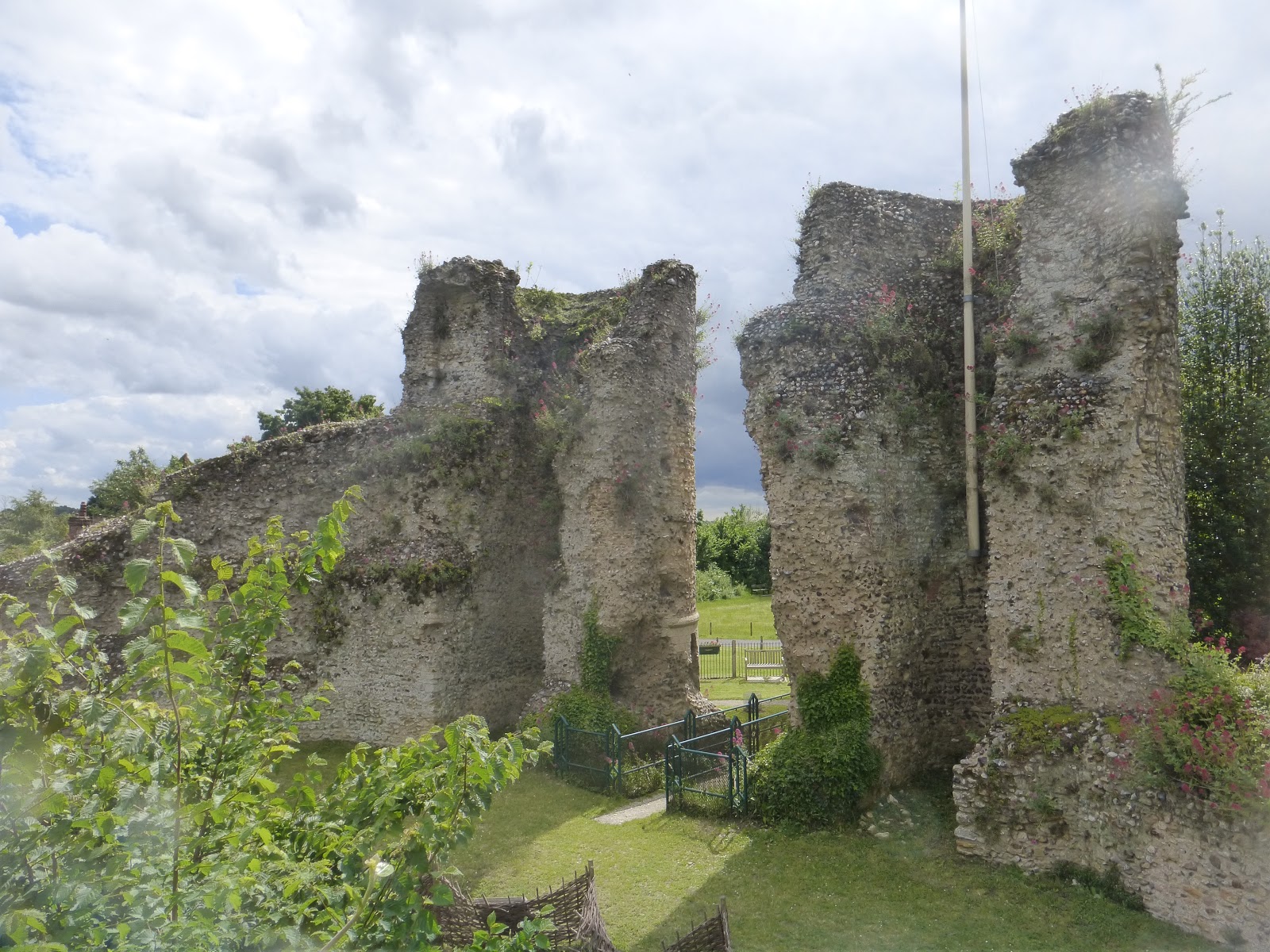
Southwold is a very long way from where I live - roughly a 500 mile return trip that involves some of the most depressingly clogged motorway routes in Europe, so I was determined to make the most of my trip. Suffolk boasts some delightful market towns, several of them with second hand bookshops, and on the way down I stopped off at Bungay, and wandered round the old castle ruins (above) as well as just about resisting the temptation to add to my book collection.


I really enjoyed my first visit to Southwold, a very upmarket little resort, with an inland lighthouse and pretty little beach huts - you can buy one too, if you have £75,000 to spare! I travelled to the equally smart Aldeburgh (above photos of Moot Hall, Martello Tower and marina), just down the coast. Both towns are home to lovely, high calibre independent bookshops which I enjoyed visiting very much. I also made a point of going to Dunwich (above photos of boat on beach and priory gateway), site of a once great port, now lost to the waves; a ruined priory still remains inland. The notion of a lost village, let alone a lost port, has always fascinated me. There was also a chance to take a look at Leiston Abbey (above, lower photos), a very impressive ruin.





Making my way up the coast, I spent one night at a hotel on the edge of Oulton Broad - I hadn't realised that the Norfolk Broads actually extend into Suffolk. As I was very lucky with the weather, I couldn't resist the lure of a boat trip along the broad, Oulton Dyke, and the River Waveney - a truly delightful experience. I also continued to explore the towns and villages of the area - the likes of Thorpeness (rather close to the nuclear reactor at Sizewell, but very attractive), Burgh St Peter, and Beccles, where I finally succumbed to temptation, having managed to find a couple of inscribed crime novels at yet another second hand bookshop.


And then it was on to Sutton Hoo, legendary as the site of Anglo-Saxon burials, and pleasantly situated above the River Deben. After that, on to Bury St Edmunds, a cathedral city as charming as Wells which I visited the other week, and dinner with Kate and her husband Roger, who were also doing the tourist thing, having had a similarly long journey.


 On my last day in Suffolk, I explored the lovely village of Long Melford and then the gorgeous town of Lavenham. They say that Lavenham is England's best-preserved medieval town, and I don't doubt it. The Guildhall in the market place is a National Trust property, well worth visiting. And I decided to fit in one more National Trust visit before returning home. This was to Ickworth, a hugely impressive property. To my astonishment, as I was looking round the rooms, one of the guides addressed me by name. It turned out she's read all my Lake District and Liverpool novels. Believe me, that's not an everyday occurrence! It's hard for me to put into word how gratifying such encounters are. What a marvellous time I had. I'm so grateful to those who helped to make it possible, and to make it so special.


Monday, 15 April 2019

The New Girlfriend - 2014 film review

Ruth Rendell was an exceptionally gifted writer of short stories as well as novels, and I read her story "The New Girlfriend" a long time ago and enjoyed it. Only recently did I discover that it was filmed five years ago by the talented French director Francois Ozon. Turning a short story into a film is often problematic, because of the need to stretch out a rather slender storyline. Ozon wrote the screenplay himself, and solved the problem by creating an erotic drama that borrows from the genre of crime and suspense but does not really belong to it.

Anais Demoustier plays Claire, who forms an intense friendship with another young girl, Laura (Isild Le Besco). The two girls meet handsome young men whom they marry, but they remain close. Laura gives birth to a daughter, but falls ill and dies. Claire vows to take care of Laura's husband David (Romain Duris) and the little girl, but is startled when she calls at their home and finds David dressed as a woman.

Once she has overcome her initial shock and distaste Claire becomes increasingly drawn to David, or at least to his alter ego Virginia. The plot thickens, and so do the sexual complications. As a reviewer on rogerebert.com says, Ozon "transforms what might have been a tonal nightmare in other hands into a wildly entertaining work, one that manages to be simultaneously funny, touching, slightly unnerving and undeniably sexy to behold, regardless of where your predilections may lie."

Some reviewers have termed the film "Hitchcockian", but although I can see why they say this, given the tricky way in which the story develops, it's a misleading description. I was expecting a crime film, and it took me a while to realise that Ozon (although he's worked in the crime genre, and is clearly fascinated by it) was here going in a different direction. But once I'd understood what he was trying to do, I was impressed.


Thursday, 28 February 2019

Tigerlily's Orchids by Ruth Rendell

Ruth Rendell published Tigerlily's Orchids in 2010. It's a stand-alone novel, and it's clear that she was trying to do something a bit different with it. I always find it admirable when an established author breaks away from their accepted patterns, or attempts to do so. In this case, the attempt is only partly successful, but it's still an intriguing and readable book.

What's different is that that this book is an ensemble piece. The main focus isn't on a single protagonist, or even on a single crime. Instead, we're presented with Lichfield House, in a dreary London suburb, a place which has been divided into flats. Rendell examines the lives of the occupants, and their numerous misadventures, and also gives a compelling picture of the transience of London life. By the time the story comes to an end, much has changed in Lichfield House. Some lives have ended, some have been changed forever. And as the final lines indicate, one of Rendell's concerns here is the gap between imagination and reality.

This is a good idea for a story, but it carries risks. In particular, there is a danger of a lack of focus, and I'm not sure that Rendell avoids falling into the trap. At first, the key storyline concerns Stuart, one of her superficially attractive young male protagonists, but really a stupid and unlikeable character. His affair with a solicitor's wife causes ructions when the solicitor finds out the truth. The solicitor and his wife are well matched; both are deeply unpleasant.  Murder is eventually done, but the crime (and its solution) is dealt with very casually by Rendell, almost as if having set up a teasing mystery, she could no longer be bothered with it.

Attention shifts from one character to another in a way that is, at times, irritating. And several of the characters are all-too-recognisable Rendell types. But there are compensations, including a sub-plot about a loathsome caretaker that raises interesting questions about society, and the behaviour of paedophiles. I found the story interesting and readable, but it's certainly not vintage Rendell. It felt rushed, and in need of a vigorous editor. This impression of a lack of editing was, unfortunately, a recurrent failing in Rendell's later books. I sense that she was writing too much, too quickly. But that said, even a minor Rendell novel still offers enough interest to deserve attention.

Wednesday, 30 January 2019

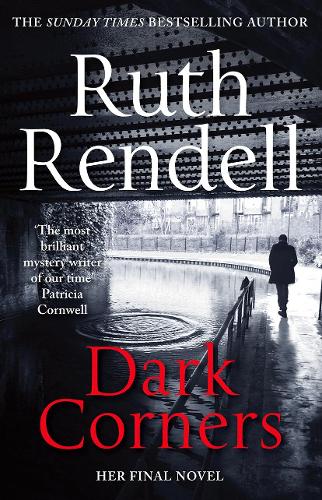
Dark Corners by Ruth Rendell


Image result for ruth rendell dark corners

Ruth Rendell was, in crime writing terms, a genius. For decades, her remarkable books set a new standard in excellence. I discovered her work in my early twenties, and promptly devoured every story of hers that I could lay my hands on. In the books she published from the late 1990s onwards, however, I sensed a touch of repetition and perhaps even fatigue creeping in, as regards character types, settings, and plot developments. Given how prolific she was, that was hardly surprising, and her books continued to be highly readable. Unfortunately, I found myself struggling to finish The Saint Zita Society, and I felt it better to take a break from her books. More recently, though, I've wanted to give her later books a go, and see how I felt about them.

Dark Corners was her final novel, published posthumously in 2015 following her death earlier that year. The last words of the books are truly poignant. They are: "'now it's all over'". And so it was. In the story, this phrase refers to an act of redemption which concludes a typically involved narrative with several plot strands.

The lead character is Carl, who unwisely gives some pills to a female friend and accepts money for them. The friend dies, and Carl is distraught. He feels guilty, although actually he has committed no crime. When he is blackmailed by someone who is aware of what happened, he submits meekly until eventually he can tolerate things no longer.

Carl is in some ways typical of Rendell's young male protagonists, but I found his behaviour less than convincing. Part of her genius (and the same is true of Patricia Highsmith at her best) lay in making extraordinary courses of conduct seem almost inevitable. For me, though, Carl didn't really work as  a lead character. Similarly, there is a truly Rendellesque sub-plot, but it's rather half-hearted and unsatisfactory. On the plus side, the story is very readable. I raced through it, and thought it much more gripping than The Saint Zita Society (I'll have to battle to the end of that one eventually and see if I've judged it too harshly). Dark Corners certainly is infinitely superior to Agatha Christie's sad finale, Postern of Fate. It's not, however, in the same league as her twentieth century stand-alones. 

Wednesday, 6 May 2015

Ruth Rendell R.I.P.

I learned of the sad news of the death of Ruth Rendell a few minutes before joining Katherine Hall Page for our "Malice Remembers" conversation about Patricia Moyes. We both felt that it was right to pay a brief tribute to Rendell before turning to Moyes, though breaking the news to audience members who were unaware of the loss of this great writer was bound to be a shock.

I've been a huge admirer of Ruth Rendell for many years, and I've often referred to her as my favourite living crime writer. I recall meeting Sophie Hannah for the first time when we were on a panel together in Runcorn, and an audience member asked me to name my favourite crime writers. I named Agatha Christie among those who were dead, and Rendell from among the living. Sophie - who had just published her first novel - exclaimed: "I was going to say that!" A shared enthusiasm is a good way to bond with a fellow author..

I'm sure that Rendell, along with her friend P.D. James, will be ranked as one of the great writers of popular fiction of the second half of the twentieth century. I enjoyed her Wexford novels, such as A Sleeping Life, but I enjoyed the non-Wexfords even more. A Judgement in Stone is a masterpiece, a crime genre cornerstone, and books like A Demon in My View and The Lake of Darkness almost equally brilliant. As if this wasn't enough, she proceeded to write stunning novels as Barbara Vine. My favourite is A Fatal Inversion, but the quality was invariably high. She wrote of particular,worlds - much bleaker and more restricted than, for instance, those of the great Reg Hill, who once gently teased her at an event I attended; Her books, unlike Reg's, seldom attempted humour, but she explored her favoured landscapes in utterly compelling fashion.

That wasn't all. She was an equally gifted short story writer, and when she tried her hand at a novella, the result, Heartstones, was characteristically excellent. For decades, she maintained an astonishingly high standard, despite being very productive. I cannot think of any prolific crime writer, with the possible exception of Reg himself, who has kept writing at anything like such a consistently high level for so long. Inevitably, as the twenty-first century dawned, she found it more difficult to avoid repeating herself and books such as The Saint Zita Society seemed to me to fall well short of her earlier, stellar achievements. Nevertheless, few crime novelists of the past fifty years have left such a wonderful legacy.

In my own writing, I like to pay occasional tributes to writers and other people whom I admire - Conan Doyle, Christie and so on. When I was planning The Arsenic Labyrinth, I conceived my version of a "Ruth Rendell type of sociopath" in the character of Guy. I loved writing about Guy, and I may return to that type of character one day. But of course, nobody could match Rendell..

One more thing. I never chatted to Ruth Rendell in person, but I corresponded with her, and on several occasions I invited her to contribute short stories to CWA anthologies that I was editing. Each and every time, she agreed readily, and authorised her agent to accept exactly the same - extremely modest - fee offered to other contributors. She did not attend CWA events, as far as I know, but she remained a member right to the end. I found her willingness to help truly admirable. and it's yet another reason why I respected her so much.


Monday, 29 September 2014

Susan Hill - Who cares if a book is by a male or female author?

Saturday saw the publication in The Times of an exceptionally interesting article by Susan Hill on the subject of whether an author's gender is relevant. I'm linking to the article, but as it's behind a paywall, perhaps I should summarise some of her argument. She contends that gender is essentially irrelevant to the appreciation of literature, and points out that, although she has often written in the first person from a male perspective, doubts are sometimes expressed about men writing as women, and vice versa. As she puts it, "A novel is the work of the imagination. Where is the gender there?"

This is a topic that I've often mused over. When I started writing, I wrote exclusively from a male point of view, but as my confidence grew, I started to branch out. I've written various short stories from female (and in one case, gay male) perspectives, as well as many scenes in the Lake District Mysteries. In the novel I'm writing at the moment, many key scenes are presented from the perspective of a rather enigmatic woman, and I'm finding these very satisfying to write, although they aren't easy (to say why would be too much of a spoiler...) As Hill suggests, part of the pleasure of writing about this woman is the challenge to my imagination - to try to think myself into her life, which is so very different from mine. Equally, I loved writing Dancing for the Hangman, when I had to think myself into the mindset of Dr Crippen.

In essence, I agree with Susan Hill. That said, she and I may not be in a majority. Plenty of people evidently take a different view - and I did find some of the comments on her article rather depressing (often true with online comments on press articles, admittedly.) One male commenter said he didn't believe, in general, that a woman writer could empathise with him. He felt that women's outlook, experiences, and sympathies were generally not the same as his. I suppose my response would be - that may be so, but why does it preclude a woman from trying to think herself into a man's mindset, different as it may be in very many respects? Isn't that element of imagination integral to the novelist's craft?

One positive comment cited the great Ruth Rendell as a good example of someone who often writes beautifully from a male point of view. I very much agree, though I'd add that many of her male characters are highly unusual people, and their masculinity is sometimes not a key feature of their personalities. Just possibly, Ruth Rendell may not know much about, or have much empathy for, 'ordinary blokes' who go to the pub and follow the football avidly, but it doesn't matter, because she is not writing about them, but about strange and troubled young men who sometimes slip into a murderous madness. It's certainly never bothered me in the least that she is a woman writing about men. There's something eerily credible about her characters, however bizarre their behaviour. The same was true of Patricia Highsmith, creator of Tom Ripley, and there are many other examples.

Anyway, I continue to mull over the arguments - and I'd be extremely interested to learn your views.


Monday, 15 July 2013

How many characters in a novel?

When starting a new book, a vital question is: how many main characters will take part in the story? This is closely linked with the question of how many murder suspects to include, although the two issues are not quite identical. I often give this a lot of thought, because it is vital that readers care about the characters, even if they don't like some of them. My latest reflections on this topic have coincided with reading a book by Ruth Rendell which highlights the dilemmas that an author can face.
I mentioned the other day that I pay attention to and try to learn from critical, as well as positive, comments in reviews, as long as they seem sensible, and supportively meant. In relation to a couple of books I've written in the past, a question has arisen about whether the early part of the book was challenging because of the introduction of a significant number of people and plot strands. (On this topic, Kate Ellis and I agreed at Blackpool last week that our tendency in this direction had been influenced by those wonderful early series of Taggart by Glenn Chandler.)

In The Frozen Shroud, I tried to address this by reducing the number of potential suspects. This made me worry that the solution to the mystery might be too obvious, but I'm reassured by the reviews that are in to date. With my new book, though, I'm going to tackle the issue in a different way.

Ruth Rendell's The Saint Zita Society boasts an unusual way of helping the reader disentangle what was going on. Rather than have a 'cast of characters' in the manner familiar from some trarditional mysteries (those fine writers Ngaio Marsh and Christianna Brand were keen on this device), the publisher included a diagram of Hexam Place on the endpapers of the book. This showed the houses and listed their occupants. A neat concept though I have to say that, even so, I  found myself overwhelmed with the number of people who cropped up in the first fifty pages, not something I've ever experienced when reading with this gifted writer. Clearly, she too is continuing to experiment with her approach, and that is what keeps authors fresh..

Friday, 1 February 2013

Forgotten Book - Snap

My Forgotten Book for today is another from that very fine writer Jacqueline Wilson, one more of that sadly all too short sequence of crime novels she wrote in the 70s.Snap was published in 1974, when she was just 29 years old. In some ways, it reminds me of the books that Margaret Yorke started writing at around the same time - stories about very ordinary people who find themselves caught up in events that lead to murder.

There are three connected storylines in Snap. Katy is a 14 year old girl (and Wilson excels at depicting teenage girls) who has a crush on her schoolteacher. Unfortunately, it's a relationship that he encourages. It's easy to foresee that it will end badly - but how, exactly?

Meanwhile, Katy's mother, Frances (a very likeable woman) is a widow who writes romantic stories for magazines. She comes to the attention of George, a literary agent who is recently bereaved. His wife was someone he never loved, and who made his life a misery. When he meets Frances for lunch, the attraction is mutual.

Unknown to George, his secretary, Ellen,is secretly infatuated with him. When George invites her out for a drink, she seizes her chance to develop the relationship, with disastrous consequences. Wilson manages the different narratives with considerable expertise,and springs one particularly good surprise close to the end. When I looked back at the earlier chapters, I found myself admiring the skilful and subtle way she had planted the clues to that particular twist.

This is a good example of how a very short novel can be intensely gripping. One can only guess at how prominent Wilson would have become as a crime writer, had she not changed course and become a stellar children's writer instead. I think she might have given even the great Ruth Rendell a run for her money.

Wednesday, 3 October 2012

Tideline - review

Tideline is a first novel, by Penny Hancock, that has quickly achieved a great reputation. I met Penny at Crimefest in May, when we were on the same panel, moderated by Peter Guttridge. What she had to say about her debut sounded interesting, and at last I've caught up with it. Suffice to say that the accolades are well-earned - this is going to be the rave review I promised yesterday!

The story-line interweaves two connected narratives. Sonia tells her story in the first person, and it soon becomes clear that she is rather disturbed, possibly as a result of a tragic incident in her past involving somone called Seb. A 15 year old boy comes to visit her in her intriguing home on the banks of the River Thames - and Sonia decides that she doesn't want to let him leave.

An alternative perspective is provided by a third person narrative featuring Helen, the aunt of the missing boy. Helen has her own problems, compounded by a taste for alcohol, and her life disintegrates as the police investigate the boy's disappearance, and suspicion grows that she may have had a hand in it.

Years ago, I talked to a literary agent about the success of Minette Walters; she attributed it to a combination of excellent plotting and excellent writing. The same can be said of Ruth Rendell/Barbara Vne, and with Penny Hancock's debut, the blend of story and style is again very impressive. The setting is superbly evoked, and though the plot has some echoes of The Collector and Misery, this is not a weakness, for the author has a very different approach from that of John Fowles and  Stephen King, and the result is a very different book. I really enjoyed this one - it's the best recent debut I've read since Belinda Bauer's Blacklands.

Monday, 13 August 2012

Ruth Rendell's Thriteen Steps Down - ITV review


Thirteen Steps Down, by Ruth Rendell, is one of her more striking books of the last ten years, and so I looked forward to tonight’s first part (of two) of an ITV adaptation with much relish. At one time, Rendell mysteries were impossible to avoid, even in the unlikely event that you wanted to avoid them. They were a staple of the television schedules (apparently ITV produced more than 80 Rendell stories, many based on her short stories, and there were BBC adaptations as well). Many of the old episodes keep cropping up on the repeat channels, but this is the first new Rendell on ITV for twelve years. The press pack spoke of Rendell being “rediscovered for television” – blimey, how soon they forget!


Mix Cellini (played by Luke Treadaway) is a mechanic who lives in a London flat and is fascinated by the John Reginald Christie murder case – and also by a glamorous model. Geraldine James, superb in a challenging role as a crotchety octogenariian with an equally strange obsession about a past romance, plays his landlady, Gwendolen, while Elarica Gallagher is the model. 


Mix is a good example of a typical Rendell protagonist – a superficially attractive, but deeply troubled youngish man whose obsessions and warped moral values lead to calamitous consequences. Treadaway veered more towards unpleasant than appealing in his portrayal of Mix, and I felt this was a mistake; it's the apparent charm of Rendell's sociopaths that makes them so memorable.

When I started planning The Arsenic Labyrinth, I decided to experiment by introducing a key character, Guy, who was in the mould of a Rendellesque sociopath, and I enjoyed enormously writing those scenes in which Guy appeared. That was my small tribute to a genius of the genre, even though the book itself was rather different from anything Rendell has produced (not least because it is very rare for her to venture north of the London that she knows, and conveys, so well!)


I’ve often said in interviews that Rendell is the living crime writer whom I most admire; her work has given me enormous pleasure ever since I first read the brilliant The Lake of Darkness. That is still the case, although I do worry that there has been (by her exceptional standards) a bit of a falling-off in her work over the past fifteen years. Themes, and plot elements, have tended to recur, but not with quite the flair of the past, and since she was elevated to the House of Lords, she has made some attempts at political and social comment  in her novels, which have seldom worked well. Perhaps some decline is inevitable, especially with a writer who has been so prolific. But this creepy, if at times unsubtle, TV adaptation is a reminder of what a gripping story-teller she is. It's not as good as the book, but I shall certainly be tuning into part two.


Wednesday, 7 December 2011

End In Tears


I have written before in this blog of my huge admiration for Ruth Rendell. At one time, I had read every novel and short story she'd published, both under her own name and as Barbara Vine. In the past 10 years or so, however, I've missed a few titles, and I've rather felt that (with a few notable exceptions) her most recent books have not quite reached the remarkable standards of excellence that she set in the past. But she remains a gifted writer, and I'm keen to fill in the gaps.

I decided that I'd try an audio book version of one of her Wexford stories, and was tempted by End in Tears, especially as it was read by Christopher Ravenscroft, who was so good on television in the role of Detective Inspector Mike Burden. I really like the Wexford series, and I also admired the performance of the late George Baker as a very believable television Wexford.

Again, however, I have felt that there has been something of a falling-off in the more recent Wexford books. For my taste, Rendell became a little too anxious to shove some social comment into the stories, and in such a long-established series, this occasionally seems a bit awkward and unconvincing. But I make this observation simply because I think Ruth Rendell is such a fine writer that she ought to be judged by the most demanding standards (most of the rest of us need justice to be tempered with a liberal dose of mercy!)

End in Tears is a well-constructed mystery, although not ideally suited to audio book abridgement, which led to a slightly fragmentary narrative and perhaps too many characters. The social comment element here is about surrogacy, and I found this fairly interesting. But the actual murder motive was, to my mind, genuinely fascinating, and neatly concealed. This book may not rank with the best of Wexford, but it is still enjoyable and I'm glad I've caught up with it at last.


Monday, 14 November 2011

Betty Fisher movie review


When I visited John Curran in Dublin, I had not only the chance to admire his book collection, but also his very wide-ranging collection of DVDs, and he recommended a number of films to me that I'd never even heard of before. Among them was a French film, directed by Claude Miller with the frankly unpromising title Betty Fisher and Other Stories.

I was startled to find that the film is based on a novel by Ruth Rendell. The source book is Tree of Hands, a suspense story I enjoyed reading when it first came out. But that was a long time ago, and I must admit I've forgotten how the story goes. That was probably an advantage, given that Betty Fisher focuses on the core themes, but with many changes of detail.

To some extent, it's a story about maternal instincts, as well as about grief and guilt. Betty is a successful novelist with a crazy mother. When her son dies in an accident, her mum kidnaps another child, whose mother is an occasional prostitute, and who doesn't seem to miss him much. The strands of the two women's lives intertwine time and again, ultimately with bloody results. The use of coincidence is very typical of Rendell, but the treatment somehow seems very Gallic, and the effect is rather stylish.

It's one of those films where you really can't be sure what is going to happen. I found I just about believed in the story, despite various implausibilities, and it certainly kept me gripped from start to finish. An odd movie, perhaps, but a good one. John is a sound judge!

Saturday, 8 October 2011

R.I.P. George Baker aka Inspector Wexford


I was sorry to read of the death of George Baker, at the age of 80, today. Many people assume he made his name playing Inspector Reg Wexford in the long-running adaptations for TV of those very enjoyable Ruth Rendell novels set in fictional Kingsmarkham, and I'm sure that's the role he will remain best known for. But there was much more to him than that.

Baker was a staple of film and TV during my youth. Apparently he was one of those considered for the role of James Bond, but he wasn't always a good guy. I remember him playing a criminal, Stanley Bowler, in The Fenn Street Gang, a sitcom spin-off from Please, Sir! And so good was he that a further spin-off series, Bowler, came into being, although it didn't last long. But Baker did the menacing yet pretentious villain (his door chime was Beethoven's Fifth) very well.

When I was a student, and visited the BBC, he was there in his toga, recording an episode of I, Claudius, in which he had a leading role. But the Ruth Rendell Mysteries enabled him to bring his greatest strength as an actor, his essential warm humanity to the part of a shrewd and likeable cop.

Ruth Rendell has already indicated she has no plans for any more Wexford novels, probably a good decision as the character has, I think, reached his sell-by date. But the series includes some great titles, and on television, Baker brought the stories, and the character, splendidly to life.

Friday, 15 July 2011

Forgotten Book - Portrait of a Murderer


Anne Meredith is not a name to conjure with in the history of crime fiction, yet this pseudonym does not deserve to have sunk into oblivion. It is one of a number of pen names used by Lucy Malleson, who is far better known as the prolific detective novelist, and creator of Arthur Crook, Anthony Gilbert.

My choice for today's Forgotten Book is the first novel she produced under the Meredith pseudonym, back in 1934. Portrait of a Murderer is, considering its date, arguably a pioneering work. There are some hints of the irony deployed by Francis Iles, but the novel has a bleakness of tone which is distinctive.

The opening section, comprising just one paragraph, is memorable – so much so that I will quote it in full.

"Adrian Gray was born in May 1862 and met his death through violence, at the hands of one of his own children, at Christmas, 1931. The crime was instantaneous and unpremeditated, and the murderer was left staring from the weapon on the table to the dead man in the shadow of the tapestry curtains, not apprehensive, not yet afraid, but incredulous and dumb."

Even though the identity of the culprit is revealed fairly early on, the story that Meredith tells held my interest throughout; at times, her approach almost put me in mind of Ruth Rendell. I don't want to say too much about the plot, as to do so would probably spoil it to some extent. But although I missed the wit that Iles often deployed, I can recommend it. Certainly, I'm very surprised that it has been ignored by historians of the genre.

Monday, 27 September 2010

Coincidences and Loose Ends


As I said the other day, I really enjoyed Kate Atkinson’s new book, Started Early, Took My Dog. It’s a very witty piece of work, with several laugh-aloud moments. And although it is hardly an orthodox crime novel, I think we can claim it for the genre. Not just because the main characters are a private eye and an ex-cop, either. Crimes are central to the plot, and there are several mysteries to solve.

And yet. This is certainly not a book in tradition of Golden Age detective fiction. For instance, the plot abounds in coincidences. Time after time, connections emerge between characters, to the extent that one really does have to suspend disbelief. It is a tribute to Atkinson’s skill as a novelist that we are (or, at least, I was) more than happy to do this.

Similarly, a number of issues are left unresolved, or at least are not resolved conclusively, at the end of the book. So, if you like your crime fiction straightforward, it may be that this is not the story for you. Very often, excessive dependence on coincidence, and failure to tie up plot strands, is a mark of sloppy writing. Not here, though, in my opinion. There are very few sentences that one could class as lazy – those that there are stand out, because they are so uncommon, and that’s not something that can be said of many crime novels.

Atkinson is a very different writer from Ruth Rendell – and she is much wittier. But they have in common a willingness to take risks, and to allow coincidence to shape their narratives. Most crime novelists need a bit of help from coincidence now and then, but these are two writers who turn a vice into a virtue. Quite an achievement.

Friday, 24 September 2010

The Double


It's so long since I read Ruth Rendell's short story 'The Double' that I'd pretty much forgotten it. So I decided to grab the chance to watch a tv adaptation from the 90s when it popped up on TV. I'm glad I did, because it reminded me what a fine short story writer Rendell is, while not feeling padded out, as some short stories do when adapted for the screen.

There's a characteristically creepy Rendellesque feel about the set-up. A lovely, virginal young woman with a leaning towards superstition is the daughter of a wealthy widow who is trying to make contact with her dead husband in the spirit world. The daughter, Lise, is engaged to a raffish young stockbroker, who sees her as a meal ticket, and is desperate to take her virginity. When they visit an arty show, Lise talks about a superstition that, if you see your double, you will soon die.

Guess what? Lise sees her double. This is sexy, and not in the least virginal, Zoe, who makes a play for the stockbroker as soon as Lise goes off with her mum for a spiritual trip abroad. There is a doom-laden atmosphere throughout this screenplay, which does justice to Rendell's disturbing literary style. I enjoyed this a great deal, and really rather more than I expected.

A word for the lead actors. Jason Flemyng is pretty charismatic, and someone I've seen several times before, but Camilla Power, who played both the 'twins' was unfamiliar to me - but very appealing, and very good in the dual roles.

Tuesday, 14 September 2010

Characters who self-destruct


Many fine crime novels (and other novels!) focus on characters who self-destruct, in one way or another. The way in which self-destructive impulses are charted often gives a clear idea of a writer’s quality. I think, for instance, of Ruth Rendell’s brilliant depiction of the illiterate Eunice Parchman in that fine book A Judgment in Stone.

I’ve just watched a movie which portrays a real-life character with a self-destructive impulse quite brilliantly. This was The Life and Death of Peter Sellers. Geoffrey Rush plays Sellers superbly – a stunning performance from an actor previously unknown to me. I’ve always been a fan of Sellers, and enjoyed a good many of his movies, even though he made a few poor ones along the way, and this film also has a nostalgic edge.

But it is a dark film. Sellers is portrayed as a tormented genius, someone who had a gift for inhabiting other characters, but whose own personality was somehow hollow. His rages, obsessive perfectionism, affairs and drug taking are all presented unsentimentally, and I found some of the scenes not only sad, but troubling. How many liberties was taken with the precise facts, not least to avoid libelling the living, I don't know.

I’m writing at the moment about a character who self-destructs, so this film had an added level of interest for me. But what really matters is that it is a rather cleverly done film, which held my attention from start (like The Damned United, it opens with Tom Jones singing ‘What’s New Pussycat?’) to finish. Rush’s excellence, by the way, is supported by the rest of the cast, including the beautiful Charlize Theron as Britt Ekland, Sellers’ second wife. Recommended, even if you aren’t really a Sellers fan.

Thursday, 11 March 2010

The Minotaur


I’ve often spoken and written of my admiration for the work of Ruth Rendell, both the books published under her own name and as Barbara Vine. I’ve now caught up with The Minotaur, a Vine book published in 2005, and found much in it to admire, although I must also confess to some reservations.

After a very short opening set in the present day, the bulk of the story is set in the past, when a young Swedish girl, Kerstin Kvist (who narrates the story), comes to England to be closer to her boyfriend, and takes up a job in rural Essex at Lydstep Old Hall, home to the dysfunctional Cosway family. Her duties involve looking after John Cosway, who behaves strangely and is kept on medication at the behest of his domineering mother. There are also four Cosway sisters, three of whom compete in different ways for the attention of a feckless painter who comes to live in the village.

We know that Something Terrible Will Happen, because Kerstin tells us so. Again and again. The relentless foreshadowing, which I mentioned in relation to another recent Rendell, The Birthday Present, rather got on my nerves, I’m afraid. I also found the characters unlikeable (this is not unusual with Rendell/Vine) and thought it difficult to understand why clever Kerstin couldn’t bring herself to leave and get a better job.

On the plus side, the atmosphere of the decaying Hall is marvellously evoked. Above all, there is a fascinating library, which contains a labyrinth of bookshelves – a truly memorable image. Indeed, the title of the book and the extraordinary nature of the labyrinth made me think it would play an even greater part in the story than proved to be the case. There are several gripping, and very vivid scenes, and many nods to Gothic fiction, not least in the explicit references to Thornfield and Manderley late in the narrative.

A check on the internet suggests that opinion is divided on this book. The Daily Telegraph savaged it, for instance, but many others love it. My own feeling – I hope this does not seem disrespectful to an author who has given me endless pleasure over the years - is that, for all the merits of The Minotaur, it would have benefited from quite a bit of pruning, rather like the Virginia creeper that shrouds the old mansion. If you fancy sampling Barbara Vine (and you should, because she is a wonderful writer), you are likely to find A Dark-Adapted Eye or A Fatal Inversion more consistently rewarding.