Showing posts with label Who Killed George Hargrave?. Show all posts

Monday, 25 March 2019

Murder Mystery Evenings and Murder Mystery Dinners


Murder mystery dinners and events are a highly enjoyable form of interactivity for whodunit fans. Over the years I've written several scripts for murder mysteries, and I've really enjoyed putting them on, in collaboration with some very enthusiastic performers and would-be Poirots and Marples. A particular highlight for me was the murder mystery dinner that I scripted for the Emirates Literature Festival a couple of years ago, which had notables such as Kathy Reichs taking part. It was a great night. Another great occasion was the British Library's staging of my "Murder at Magenta Manor", a Christmas competition for customers in the Library shop. To see the puzzle brought to life in a highly professional way was really very special.


The suggestion that I write my first murder mystery event came from Ann Cleeves, getting on for fifteen years ago. In those days, long before she became an award-winning superstar, Ann had a part-time role with the library service in West Yorkshire, and she wrote an excellent "Body in the Library" mystery script which I've seen performed several times. In more recent times she's written some other very good mystery events, including one based on a Vera Stanhope novel, and another set on Shetland. If you get the chance to go to one in a nearby library, you will find it is great fun.


Ann's advice was spot on, and I presented my own first murder mystery evening at Ellesmere Port library about twelve years ago. This was a Victorian mystery, based on a short story I'd published some years earlier (I've never come across anyone who admitted having read the story, which would definitely have helped them to solve the puzzle!) I was delighted by the response to "Who Killed George Hargrave?" and I've taken the event around the UK in the intervening years. What has intrigued me is the number of different ways in which the event can be presented, depending on venue. The murder mystery has been held in an art gallery, a stately home, a historic pottery works, and assorted other venues, as well as libraries public and private.

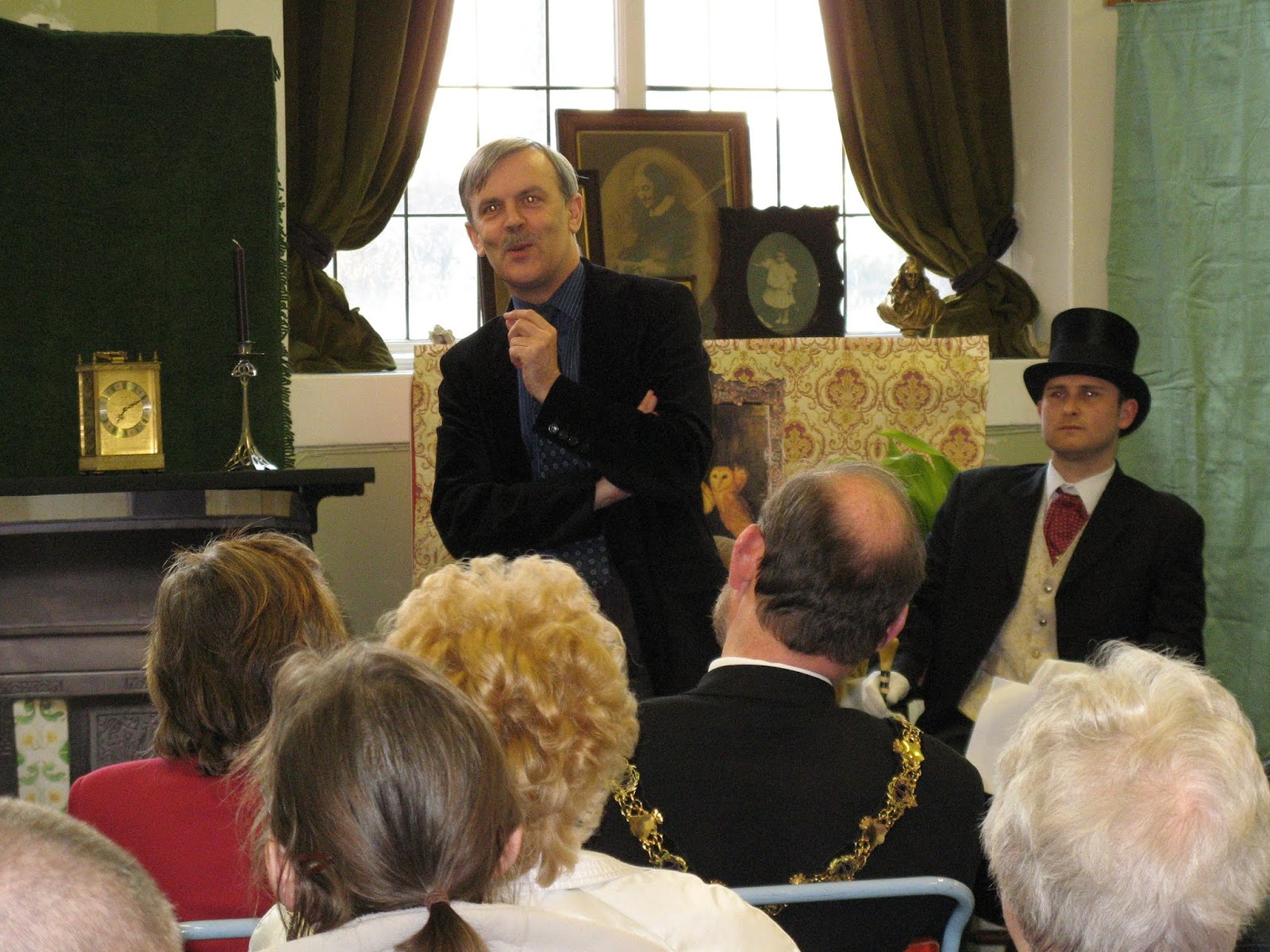


Venues that staged the Victorian mystery evening often asked me to write another script, and eventually I came up with a 1920s storyline, which has again been widely performed over the past few years. Then came the commission to write a festival-based mystery for a dinner audience, and so it has gone on. I've found the events have usually drawn sizeable audiences, often including people who aren't necessarily keen readers, but like the idea of solving a puzzle. Of course, these things are variable, just as novels are, and I've attended a few murder mystery events that weren't too gripping or impressive (usually because the organiser had bought some kind of pre-packaged script without researching the subject carefully) but happily, those occasions have been very much the exception rather than the rule. A well-done murder mystery event can be hugely entertaining and convivial. 


Monday, 1 April 2013

Jonathan Creek: The Clue of the Savant's Thumb: BBC TV review

Jonathan Creek returned tonight on BBC 1 with The Clue of the Savant's Thumb, a brand new episode written by David Renwick and starring Alan Davies as Creek and Sheridan Smith (whose acting career has been hitting the heights since we last saw her in this series) as his "Watson", Joey Ross. The supporting cast included Joanna Lumley, Nigel Planer and Rik Mayall, which indicates the focus of the show on "feelgood" television. And there's nothing wrong with the feelgood factor, especially after the winter we've had.

This story presented us with two mysteries. Fifty years ago, in a strict convent school, a young girl died in bizarre circumstances. Her death has haunted her old schoolfriend, played by Lumley, ever since. Now, Lumley is married to a terminally ill man (Nigel Planer) and is having an affair with her husband's GP. Her husband's blood-stained body is found by their adopted daughter. Lumley takes a photograph of the apparent crime scene. But by the time the emergency services arrive, the body has disappeared...

Meanwhile, Jonathan Creek has married and moved into the glitzy world of marketing along with his glamorous and wealthy wife. Joey tracks him down and persuades him to take an interest in the case, which is being investigated by Mayall, a brilliant detective in his own right, who is now confined to a wheelchair. There are plenty of clues, and even more red herrings, before first the old mystery is solved and then the puzzle of the disappearing corpse is explained, before a slightly cartoonish finale borrowed from a political conspiracy thriller.

David Renwick is a witty and clever writer, and his enthusiasm for the work of John Dickson Carr - which I share - is the key to what is most enjoyable about the Jonathan Creek storylines. Of course, you have to suspend your disbelief, but with Jonathan Creek, as with the Dickson Carr stories, the breezy writing means this is no hardship.

One of the great things about the success of Jonathan Creek is that it has shown that the classic elements of the traditional detective mystery can be adapted with great success for modern readers and audiences, if the writer is good enough, and shows respect for the form, rather than merely attempting pastiche (though I'd add that there have been a number of parodies and pastiches of Golden Age detective stories that I've really enjoyed.) This latest episode was entertaining, although I didn't think it was quite as effective as the last, The Judas Tree, but it may be that others will take a different view..

Impossible crime stories have long appealed to me, and I've written several over the years; short stories rather than novels, though. Just as Jonathan Creek tends to work better in a one hour episode than a ninety minute episode like this one, so do locked room tricks tend to be easier to pull off in short stories rather than novels. One of those stories, suitably adapted, forms the basis of my Victorian murder mystery event, "Who Killed George Hargrave?" This was performed a couple of weeks back at Holywell, in North Wales, by an excellent cast of library volunteers.

What interested me about this event (and another, at Knutsford a fortnight earlier) was that it was a sell-out, gaining much larger audiences than I find conventional talks or writers' panels tend to attract. In fact, I gave a talk about the locked room story as part of the event, and during the questions, again I was struck by the extent of people's enthusiasm for this type of story. As reaction to my Friday Forgotten Books posts shows, there is still a huge amount of interest in classic detective fiction - in fact, I'm certain there's more interest in it today than there was a few years ago. Jonathan Creek shows that this is not simply a matter of nostalgia. We still love a mystery, and there's plenty of room for the elaborate puzzle today, alongside all those relentlessly dark stories about autopsies and serial killers.

Monday, 4 July 2011

The life of a writer


The life of a writer has its ups and downs, but what life does not? Overall, it is an enormous privilege to be a published novelist, and there are many incidental pleasures to the lifestyle (which I've never been able to pursue full-time, but I'm sure that one day it will happen...)

Last week I mentioned my trip to the Isle of Man. Here are one or two photos from that splendid place, taken on my tour with Chris and Jo Ewan. The Chasms, splits in the cliff rocks, fascinated me, as did the seals basking on the Calf of Man. And I've also included the publicity shot from the Victorian mystery event. The actors, by the way, were excellent, despite their murderous intent. Very enjoyable performances.

After one visit to the Isle of Man, I was inspired to write a short story set in Peel called 'Sunset City', and trips like this do tend to give a writer fresh inspiration. As well as a lot of good times.

Paul Beech has kindly mentioned the talk I gave last Monday at the Lymm Festival. This was very different from the night in Douglas 48 hours earlier, but equally good fun from my perspective. The Festival has proved a great success for the past ten years, and I'm delighted to have been part of it this time around.

Sunday, 26 June 2011

The Isle of Man


Just back from a wonderful week-end in the Isle of Man. This is only a short post, as I have yet to prepare fully for a talk I'm giving tomorrow at the Lymm Festival, but I must just say how much I enjoyed my trip to the island.

Thanks to a recommendation from Chris Ewan, I was asked by Douglas Library to present my Victorian murder mystery event, and I must say that Jan Macartney, her colleagues Sue and Sharon from the library, and a great team of performers made it an evening to remember. The event was a sell-out, and a few people who turned up on the night had to be turned away as the Noble's Park Pavilion, where the event was held, was full to overflowing. I'll be honest, packed houses are rare in my career, so this was one to cherish!!

There were a few distinctive features to the evening. Usually, I give a talk at these events, but this time there was a Q and A session with Bob from Manx Radio, which seemed to go really well. And it was good to see Douglas Stewart and his family in the audience. Douglas, like Chris and me, combines a lawyer's life with that of a crime writer's.

Mind you, Chris is currently writing full time, and his is a name to watch as far as crime fans are concerned. Trust me, he will make it big in the future. It was a real treat to spend time with him and his wife Jo; very generous with their time, they took me around the island and proved to be perfect companions.

Saturday, 28 May 2011

Murder Mystery Events

Murder mystery events continue to gain in popularity. I really enjoy presenting my Victorian mystery, 'Who Killed George Hargrave?', and the event will have another outing at Douglas on the Isle of Man on 25 June. The idea of an event was suggested to me years ago by Ann Cleeves, who did a very good event called 'Body in the Library', and like Ann I've presented the show a good many times. The interactive nature of the event does generate a 'feelgood' factor in the audience, I think.

I was prompted to mention murder mystery events because I've been asked to mention a forthcoming event at the Natural History Museum, and although I don't normally advertise other events on this blog, (especially events featuring live maggots - eeek!) I'm happy to make an exception this time for what seems like an interesting occasion. Because museums, like libraries, deserve a lot of support in the current economic climate. I set out below an extract from their promo material.

'Join us for a unique, immersive event at the Natural History Museum and put your detective skills to the test as a scenes of crime officer. On Friday 24 June you will have the opportunity to meet three of the Museum’s very own forensic experts. Learn how they use their knowledge to assist the police and solve crimes. They’ll teach you the tricks of their trade so that you can comb the crime scene, collect the evidence and process the clues. Then you’ll take your evidence to trial where real barristers, police officers and a judge will demonstrate just how important forensic evidence is to a verdict.

The event includes:

· collecting insect evidence in the garden crime scene with scientists Martin Hall and Cameron Richards, and hundreds of live maggots

· fingerprint collection and identification workshop

· victim identification masterclass in the Attenborough Studio with Heather Bonney: learn how to identify sex, age and height by studying skeletal remains

· a mock court case in the Museum’s theatre

Arrive from 18.30 for a 19.00 start. Tickets cost £40 per person and must be booked in advance by calling 020 7942 5792 or 020 7942 5589.'

Monday, 7 March 2011

World Book Day and a review


On Saturday evening, I took part in the nationwide celebrations of World Book Day, giving a talk and hosting a performance of my Victorian murder mystery event at Timperley library in the borough of Trafford. And it was all very enjoyable.

There was a very good audience and I like to think that it was not just on account of the book giveaways that were part of the event this year! I have written before about the valuable part that libraries play in their local communities, and this was very evident on Saturday, as the library also hosted a talk and film show about the history of Trafford. The film was fascinating, and although it only dated back 80 years, it seemed to portray a totally different world.

I know there is a lot of debate about whether it is a good idea for vast numbers of books to be given away free. Most readers are surely bound to welcome this kind of initiative, but some booksellers worry about it, while some writers may fret that it keeps the spotlight was on the bestsellers who do not really need publicity as much as new and mid-list writers. The concerns strike me as reasonable, but on the whole it seems to me that any initiative that encourages readers, and fosters an interest in books has to be a good thing.

On Saturday also I was pleased to see the first advance review of the forthcoming US edition of Take My Breath Away. Kirkus said "Edwards spins a rattling good yarn, rich in incident and plot twists", and who am I to argue?

Wednesday, 23 December 2009

Events


I’ve enjoyed being involved in a wide range of events during the past twelve months, ranging from convention panels to a workshop for aspiring writers at Harrogate, the Crimefest Mastermind competition, bookshop and library talks, and various performances of ‘Who Killed George Hargrave?’

One of the pleasures of these events is the chance to meet readers (and potential readers – a much larger category!) and, of course, some of those who read and comment on this blog. I hope very much that 2010 will enable me to make the acquaintance of more of you.

My webmaster has now updated the Events page on my website to include details of next year’s events, so far as they have been scheduled. The first, on 30th January, is to take place at Ormskirk Library. It’s been arranged by Jenn Ashworth, herself an author and blogger of note. For the first time in several years, I’m teaming up with that fine writer Sophie Hannah. We last met in the autumn, when Sophie was inducted into the Detection Club, and I’m looking forward to working with her again.

Sunday, 5 July 2009

North by North East


I’m just back from a fascinating trip to the North East of England. All too brief, but restorative (at least, once I’d had an extensive lie-in this morning!) Among other things, there was the chance to meet up with Peter and Margaret Lewis, of Flambard Press, publishers of Dancing for the Hangman. We had coffee and scones together on Friday morning at the home of our mutual friends Ann and Tim Cleeves, in Whitley Bay. Great to see all of them again.

The previous evening, I’d staged the Victorian mystery event at Stockton-on-Tees. Claire Pratt and her colleagues really did me proud. I’ve never been to Stockton before, and I have to say that its traffic system and gyratory provided a mystery more challenging than anything Agatha Christie ever devised. But Claire talked me through it on the phone and I was delighted to meet her at last – we’ve been trying to organise the trip for a couple of years. The wait was well worth while as far as I was concerned.

The next day, a trip by Metro from Whitley Bay took me to the sparkling new city library in the centre of Newcastle, and another big audience for ‘Who Killed George Hargrave?’ Sheila Naughton told me that Val McDermid appeared at the library a fortnight ago, and Lee Child is due there shortly, but this was their first interactive mystery event. A fabulous place, and it would be good to think that other cities model their library plans on Newcastle’s stunning achievement.

Tuesday, 30 June 2009

George Dies Again


Friday evening saw me visiting Carlisle Library, to host another Victorian murder mystery evening when the question again was asked – 'Who Killed George Hargrave?' There was a large audience, which engaged admirably with the puzzle, and Paul Kimberley ultimately proved himself the best detective in Carlisle. The actors who played the suspects, from the Green Room company, were extremely good – the person who took the role of the culprit in particular put in a truly exceptional performance.

I’ve hosted more than twenty of these mystery events now, and typically, I find they attract much bigger audiences than conventional talks or panels with other writers. Why is this? I think it’s to do with the interactive element – people like the idea of being involved in solving a mystery. It’s not the prizes that matter to them, I’ve learned, as much as the sheer fun of taking part. One is reminded of those whodunits, very popular in the Golden Age, where writers such as Ellery Queen overtly set a ‘Challenge to the Reader’. But perhaps today more of us than in the past prefer to play the game in person rather than as readers.

One of the incidental pleasures of these events involves the people you meet. On Friday, a former client of mine showed up together with her partner – it was great to see her again. And the library staff were terrific – top marks for their period costume!

A special word of thanks to Helen Towers, the Reader Development Officer for Cumbria Libraries, who looked after me superbly. She has a large area to cover, and does a great deal of driving in her job, which must be hard work, but her enthusiasm is infectious – and her efficiency admirable.