Showing posts with label Edith Caroline Rivett. Show all posts
Monday, 23 September 2019
Researching Lunesdale and the Lake District
Friday was a beautiful day, and the weather was ideal for a trip with two research objectives in mind. First, I aimed to gather more material for a forthcoming introduction to a novel in the British Library Crime Classics series by Carol Rivett, better known as E.C.R. Lorac (although the book in question will be one of those she wrote under another name, Carol Carnac). I was lucky enough to talk to someone who actually knew Carol Rivett in the years up to the author's death in 1958. It was a fascinating conversation. What's more, I've acquired an original manuscript by the author for the Detection Club's archives, held at Gladstone's Library. Developing the archives is a very long-term project, but one which I believe is hugely worthwhile. It's so easy for writers and their work, even fine writers and great books, to disappear from the public consciousness. The aim of the archives is to preserve a wide range of items of crime fiction heritage, and to make them accessible to members of the public.
My kind and generous hosts also made me a present of two works of art from their Rivett inheritance, as well as showing me a number of fascinating items in their possession. Carol was a gifted artist, and above is an example of a Christmas card, depicting an interior scene from her home in Aughton, which she designed and sent in 1956.
We met in the small village of Gressingham in picturesque Lunesdale, close to Aughton, where Carol Rivett lived for the last fifteen or sixteen years of her life. The next leg of my journey took me to Ulverston. I've been researching the next Lake District Mystery for some time, and I wanted to absorb myself again in some of the countryside (just outside the national park in this case) which provides part of the background for the book.
Earlier this year, while taking part in a talk at Ulverston Library, I met a fellow crime writer, Zosia Wand, who lives in the town. Zosia is the author of Trust Me and The Accusation, and is also a successful writer for radio, coach of writers, and playwright. She's lived in Ulverston for some years, and kindly took me on a tour which encompassed both the Hoad Monument (a lighthouse-like tower on top of a hill) and Conishead Priory (above photo), now a charming Buddhist retreat, with woodland walks to the shore. The views of Morecambe Bay were absolutely magnificent.
I was so inspired by these sights that instead of setting off home straight away, I made the most of the sunshine by driving further along the coast, as far as Roa Island on the tip of the Furness peninsula, with views of Piel Island, which I visited four years ago - yes, I've been thinking about this new novel for four years! And whilst roaming, I came upon the ideal setting for the opening scenes. All in all, truly rewarding trip.
Monday, 22 January 2018
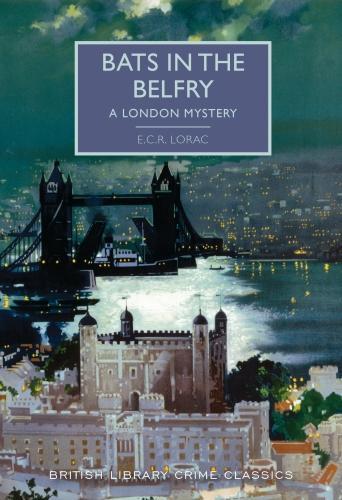
Bats in the Belfry

I'm excited about this year's programme for the Crime Classics series published by the British Library. The mix of titles that will appear this year is extremely varied. There should be something, I hope, for everyone who enjoys classic crime. My belief is that variety in a series such as this is essential, just as it is in an anthology. Yes, it means that not everyone will enjoy every story equally. But overall, that scarcely matters, because it also means that readers have the chance to sample writers and styles of writing that are unfamiliar to them, which has to be a good thing. And one of several exciting developments is that 2018 will see the reappearance in mass market paperback of two novels by E.C.R. Lorac.
I was first told about Lorac by my parents, when I was young. Both of them liked the books in particular because some of them were set in a part of the country, north west England, which they knew very well. My Dad was a real fan, although I'm not sure he ever cottoned on to the fact that the Lorac pen-name concealed the identity of a woman, Edith Caroline Rivett. But the books were out of print, something my Mum and Dad mourned. So when I started working, and haunting second hand bookshops, I snapped up every Lorac title that I could find, and presented it to my parents. (I did the same with quite a few other authors they liked; I'll say more about those books, some other time.) After their deaths, the books came back to me, and I've slowly been working my way through them, as well as adding some more titles to the collection.
One of the additions I made a couple of years ago was Bats in the Belfry, which is set in central London. I happened to be on holiday in, of all places, the Atacama Desert, when I checked a favourite dealer's site (as you do) and discovered that an inscribed copy was for sale. I nabbed it while still in Chile, on the assumption that I'd never get another chance, even though the book lacked a jacket. And when I read the book, I was delighted, not just by the inscription (to Lorac's mother) but by the story, which struck me as entertaining and atmospheric. Yes, I did guess whodunit, but I felt that the plot overall was pleasing enough for this not to be a problem.
Even before I bought that book, I'd been keen for the British Library to bring Lorac's books back into the public eye. But it proved very difficult to trace the rights holders. Finally, thanks to the sterling efforts of Rob Davies's department at the Library, the deed was done, and now Lorac is back in print. Bats in the Belfry was published last week, and another title, Fire in the Thatch, will come out before too long. I'm really pleased about this, and I hope that if you sample Lorac for yourself, you'll find her work enjoyable too.
Subscribe to:
Posts (Atom)